Amazon Basics Tilting TV Mount Review: Budget Win (8.3/10)
The bot slap-fights over trust are almost as loud as the hardware itself: one Reddit thread included a Fakespot summary that gave the Amazon review set a “D” grade with an “adjusted fakespot rating: 1.9,” even while the product page itself sits at 4.6 out of 5 stars. That tension—high star ratings, but doubts about review authenticity—frames how people talk about the Amazon Basics Heavy-Duty Tilting TV Wall Mount for 37" to 80" TVs. Verdict: a strong budget tilt mount for straightforward installs, with recurring gripes about instructions and edge-case setups. Score: 8.3/10 (based on aggregated review analysis score shown in provided data).
Quick Verdict
Conditional Yes — if you’re mounting into studs (or concrete/brick) and want a low-profile tilt mount with a “can’t beat the price” reputation. Conditional No — if you need forgiving placement for odd stud spacing, perfect documentation, or easy cable access behind the TV.
| What matters | Verdict | Evidence from users |
|---|---|---|
| Sturdiness | Strong | “solid and sturdy,” “rock solid,” “feels like it could hold a tank” (Amazon reviews) |
| Installation speed | Often fast | “less than 15 min,” “about 30 minutes,” “easiest wall mount” (Amazon + review analysis quotes) |
| Instructions quality | Recurring weak spot | “very poorly written,” “pictures are small,” “don’t even say how to put this thing together” (Amazon + review analysis quotes) |
| Stud vs drywall mounting | Studs favored | “drill into studs,” drywall anchors called “absolute worst” (Amazon reviews) |
| Tilt behavior | Mostly fine, some complaints | One Fakespot snippet: “tilt friction knobs… tv flops down” vs many “works as advertised” (Fakespot + Amazon reviews) |
| Cable/port access | Can be tight | “practically impossible to plug in cables” on close mounts (Amazon review) |
Claims vs Reality
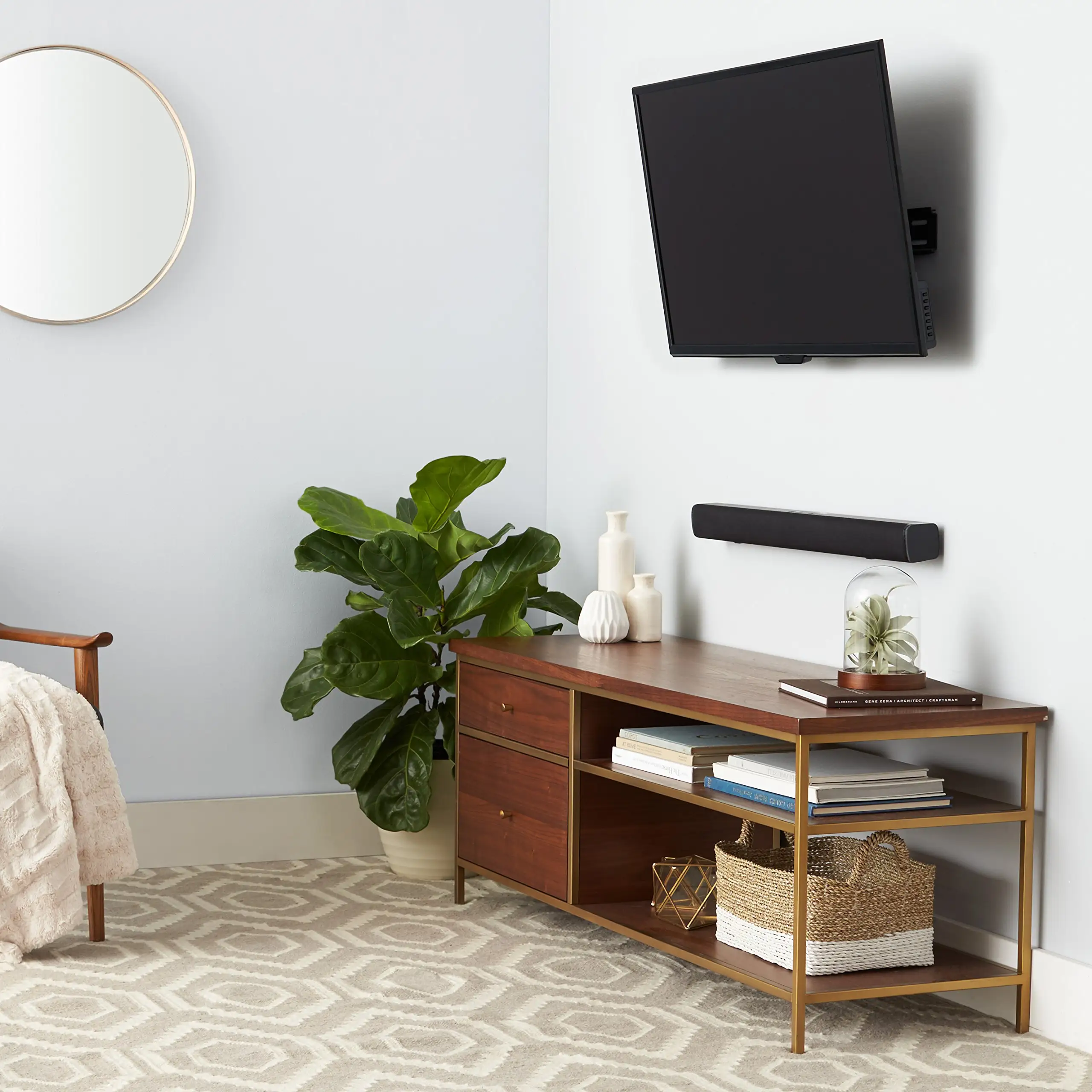
Marketing copy paints the Amazon Basics Heavy-Duty Tilting TV Wall Mount for 37" to 80" TVs as straightforward: a “flat panel tv wall mount” with “adjustable tilt,” “hardware and instructions for easy installation,” and a low-profile design that “extends 1.8 inch from the wall.” Digging deeper into user reports, the tilt mount concept generally holds up, but the “easy” part depends heavily on whether your wall and TV match the expected scenario.
Claim 1: “Easy to install… hardware and instructions included.”
Multiple buyers agree the install can be quick—especially for anyone comfortable finding studs and drilling. A verified buyer on Amazon wrote: “We used this to hang a LG TV, 43". It was on the wall… in about 30 minutes… directions were mostly pictures but it was relatively user friendly.” Another echoed the speed: “Install was so easy, it literally took less than 15 min.” Yet the same dataset shows a recurring narrative that the manual can be the hardest part. A verified buyer on Amazon complained: “The installation manual is very poorly written, including the illustrations… if I had to rely on the manual, I’d be out of luck.” Another put it more bluntly: “The instructions i got don’t even say how to put this thing together.”
Claim 2: “Durable construction / heavy-duty.”
Here, the feedback lines up closely with the positioning. A recurring pattern emerged in the way people describe the mount in physical metaphors—heavy, tank-like, immovable once anchored correctly. A verified buyer on Amazon said: “Quality built mount… drill into studs and this thing feels like it could hold a tank.” Another wrote: “It is a rock solid mount, and can handle quite a lot for this price.” That “for the price” qualifier is constant: users often compare it to $80–$300 local-store mounts and frame this as similar strength without the premium. One Amazon reviewer said: “Similar item at local stores were priced up to around $80… very strong.”
Claim 3: “Works on drywall (anchors included).”
This is where real-world confidence fractures. Some reviewers do mount through drywall, but many treat anchors as a last resort, not an intended path. A verified buyer on Amazon warned: “The drywall anchors are some of the absolute worst i have ever used. they pretty much just rip drywall apart… i certainly was not going to trust my 65" tv with this mount set up this way.” Another set the tone with a safety-first posture: “If you don’t install on studs… be my guest and use the plastic anchors,” while repeatedly urging: “Drill into studs.”
Cross-Platform Consensus
Universally Praised
The most consistent praise for the Amazon Basics Heavy-Duty Tilting TV Wall Mount for 37" to 80" TVs is simply that it holds—securely—when installed as intended. Across Amazon review excerpts and the aggregated “Review Analysis + Pros/Cons,” people repeatedly return to the same story: the mount disappears into the background once it’s up. A verified buyer on Amazon summarized the core appeal: “Works perfectly as advertised.” Another reinforced the emotional outcome (relief): “It securely holds my tv, giving me complete confidence that it’s safe and well-supported.” For homeowners mounting a living-room TV or a bedroom set, that confidence is the product.
A second theme is value as a motivator for people who otherwise feel priced out of “heavy-duty” mounting. One reviewer framed the market frustration: “I cannot understand why tv mounts are from 50-100 dollars still… this mount falls closer into what the market should be getting.” For remodelers or anyone mounting multiple TVs, that price-to-stability narrative shows up as repeat purchasing behavior: “Will probably buy this mount for other tvs,” and “Bought another… since it works so well.”
Installation speed—when conditions are normal—becomes its own mini brag. The review-analysis quotes include: “This was the easiest wall mount that I have ever put up.” A verified buyer on Amazon wrote: “I managed to do it all with just myself,” describing rehearsing the hang step first, then leveling once on the bracket. For DIY-leaning users, this isn’t just convenience; it’s control—less dependence on a contractor for a basic, low-profile tilt setup.
Bullets (after the narrative):
- Sturdiness stories dominate: “solid and sturdy,” “rock solid,” “could hold a tank.”
- Value is repeatedly contrasted with retail pricing: “priced up to around $80,” “can’t beat the price.”
- “Easy install” appears often, but usually paired with “if you can find a stud.”
Common Complaints
A recurring pattern emerged around documentation: even satisfied buyers warn that the instructions can sabotage first-time installers. One verified buyer on Amazon noted: “Pay attention to the instructions. The pictures are small and there are no written descriptions.” Another said the manual is worse than unhelpful: “The installation manual is very poorly written… if I had to rely on the manual, I’d be out of luck.” For renters or anyone anxious about drilling, unclear diagrams raise the perceived risk—especially when the object being mounted is a large, expensive TV.
Mounting constraints also show up as practical friction, especially in older homes or unusual wall layouts. One reviewer described a 1900-era home where studs weren’t “standard spacing,” and concluded the included drywall hardware wasn’t trustworthy for their situation. Even when the mount technically supports multiple installation types, the social consensus leans conservative: anchor into studs whenever possible, and treat drywall options as advanced/edge-case territory.
Cable access is another pain point tied to low-profile designs. The closer the TV sits to the wall, the harder it can be to plug in HDMI or power—especially if ports are rear-facing. A verified buyer on Amazon vented about non-motion mounts generally: “It’s practically impossible to ever change your HDMI… you’re going to be swearing up and down… trying to figure out where… parts are in a half inch of space.” While that quote is framed against older non-swivel setups, it highlights the same underlying tradeoff: low profile can mean cramped access.
Bullets (after the narrative):
- Instructions: “poorly written,” “pictures are small,” “leave much to the imagination.”
- Drywall anchors: described as weak by some (“rip drywall apart”).
- Tight clearance can complicate plugging in cables or swapping devices.
Divisive Features
Tilt control is one of the most split topics in the provided data. Many users say the mount behaves “as advertised,” but a subset report tilt slipping under load. A Fakespot snippet attributes a harsh complaint: “The tilt friction knobs are totally useless. No matter how hard I tightened them, the tv flops down.” Meanwhile, other Amazon reviewers describe stable positioning and easy adjustment. This divide suggests either unit variability, differences in TV weight distribution, or installation technique—especially if the TV is near the upper end of the mount’s real-world comfort zone.
Another divisive point is “studless” or drywall mounting. Some reviewers pursue it and even describe alternative fasteners, while others treat it as unsafe regardless of included hardware. One verified buyer on Amazon advised people mounting through hollow walls to consider different bolts and still emphasized: “Be sure to have at least one side… bolted into a stud.” In other words, the mount may be physically capable of multiple mounting modes, but community confidence isn’t evenly distributed across them.
Trust & Reliability
Digging deeper into the trust layer, the dataset contains a Reddit thread where a bot posted a Fakespot summary: “Fakespot reviews grade: D” and “adjusted fakespot rating: 1.9” for an Amazon Basics mount review set. That doesn’t claim the mount is bad; it signals skepticism about the review ecosystem, which matters for buyers leaning heavily on star averages. In parallel, Amazon’s own ratings shown here are strong (for example, “4.6 out of 5 stars” on the tilting low-profile listing excerpts), creating a credibility tug-of-war.
Long-term durability stories skew reassuring when people install into studs correctly. One verified buyer on Amazon shared an unusually long horizon: “I order this product 8 years ago… it’s held up for some years since. great product.” Another described repeat-checking for sag over time and reported: “It’s been a year and my 55 inch tv has not moved an inch!” For households that don’t constantly adjust their TV angle, those “set it and forget it” outcomes are the clearest reliability signal in the dataset.
Alternatives
Only a few competitors are directly named in the provided data, and they mostly appear as “the top seller” (unnamed) or as local-store comparisons rather than specific models. One Amazon reviewer contrasted this style of mount with a cheaper static option: “We had the ‘top seller’ one to save a few bucks but that doesn’t have motion. it’s awful… you can’t reach any of the hdmi or ports.” In that story, the alternative isn’t a brand; it’s the category of ultra-close, non-motion mounts that create port-access headaches.
The other “alternative” that shows up is simply paying more at big-box stores. Multiple reviewers reference seeing mounts for “$80” or even “$300+,” then choosing Amazon Basics anyway. A verified buyer on Amazon recalled being warned not to trust cheaper mounts, then reported satisfaction after over-buying capacity: “My tv is 50 lbs but i chose… a 100 lb capacity… the dual arms are built like a tank.” While that specific quote appears in the dual-arm listing excerpt, it reflects the same consumer calculus in this dataset: price skepticism dissolves when the mount feels heavy and secure after installation.
Price & Value
The value story is central to how people justify buying the Amazon Basics Heavy-Duty Tilting TV Wall Mount for 37" to 80" TVs. In the provided Amazon specs snapshot for the 37"–80" tilting model, the price shown is $29.57. Users repeatedly frame that as a market correction. One reviewer said: “For the price you can’t go wrong.” Another compared directly to local retail: “Similar item at local stores were priced up to around $80.”
Resale and secondary-market signals appear indirectly through eBay and auction listings included in the dataset (not reviews, but market price context). An auction listing shows the tilting mount model “PBH-994” sold for $7.00 against an “MSRP $21.99,” implying that open-box/liquidation channels can undercut Amazon pricing dramatically—if you’re willing to trade selection, warranty clarity, or convenience for cost. For bargain hunters mounting a guest-room TV, those channels can turn a “budget” mount into a near-impulse buy.
Community buying tips revolve around installation readiness more than coupon timing: get a stud finder, plan cable access before tightening everything down, and don’t assume the included drywall anchors are the safest choice for heavy screens. A verified buyer on Amazon summarized the mindset: “If you own a drill and can find a stud, this is super easy to install and worth the $20,” reflecting the broader theme: the mount is inexpensive, but the job still rewards preparation.
FAQ
Q: Does this mount really work well for big TVs like 70"–80"?
A: Yes—many users describe mounting large sets successfully, especially into studs. A verified buyer on Amazon noted: “Hung our new 70" tv on this mount,” and others said it “holds my 55"… perfectly and snugly against the wall.” Confidence rises when the wall attachment is solid and the TV stays within the weight limit.
Q: Are the included instructions actually helpful?
A: Often not. Multiple Amazon reviewers complain about the manual quality, including: “The installation manual is very poorly written” and “The pictures are small and there are no written descriptions.” Several people report the mount is still easy to install if you already understand stud mounting and bracket assembly.
Q: Can I mount it into drywall using the included anchors?
A: Some people try, but many recommend against it for heavier TVs. A verified buyer on Amazon warned the “drywall anchors are some of the absolute worst… rip drywall apart,” and others repeatedly stress “drill into studs.” If studs aren’t available, users discuss using stronger hollow-wall fasteners instead of the included ones.
Q: Will a low-profile tilt mount make HDMI and power cables hard to access?
A: It can. One Amazon reviewer described non-motion close mounts as making it “practically impossible to ever change your HDMI… in a half inch of space.” If you frequently swap devices or have stiff cables, the tight wall clearance is a known tradeoff with low-profile designs.
Q: Do users report tilt slipping over time?
A: Some do, especially in complaint snippets. A Fakespot excerpt claims: “The tilt friction knobs are totally useless… the tv flops down,” while many other Amazon reviewers say it “works perfectly as advertised.” The most consistent advice is proper stud installation and careful tightening, especially with heavier screens.
Final Verdict
Buy the Amazon Basics Heavy-Duty Tilting TV Wall Mount for 37" to 80" TVs if you’re a budget-focused homeowner mounting into studs (or concrete/brick) and want a simple low-profile tilt mount that people describe as “rock solid” and “can’t beat the price.” Avoid it if your install depends on drywall anchors, odd stud spacing, or if you need polished, beginner-proof instructions.
Pro tip from the community: plan for studs and cable access first—one reviewer’s safety mantra captured the tone: “Drill into studs. Do not argue—just do it.”