Godox V1 Pro Flash for Canon Review: Worth Upgrading?
A Canon Rumors commenter cut straight through the hype: “having reviewed the full specs list of the v1 pro versus the older v1, they are basically the same.” That tension—between “Pro” branding and what photographers actually feel changes—defines the story of the Godox V1 Pro Flash for Canon. Verdict: a compelling upgrade for specific workflows, but not a must-buy for every V1 owner. Score: 8.2/10
Quick Verdict
Conditional — Yes, if you shoot fast-paced events; No, if you already own a V1 and don’t need the new extras.
| What matters | What users said | Who it’s for |
|---|---|---|
| System value vs OEM | Canon Rumors users repeatedly frame Godox as “a lot more cost effective than the oem speedlights” | Budget-conscious pros, multi-light shooters |
| Battery life | A SonyAlpha Reddit thread praised that “The battery is amazing and a breeze to switch out mid-shoot.” | Weddings/events, long shoots |
| Light quality (round head) | Reddit user reports like “the v1 with the magnetic dome produces the best light i’ve seen from a speed light” | On-camera bounce users |
| Reliability in real jobs | One Redditor said they shot “about 3k photos… over two days… and only misfired once” (with Godox lights) | Working shooters needing endurance |
| Upgrade skepticism | Canon Rumors user: “price differential… does not seem worth it tbh.” | Existing V1 owners |
| Known quirks (ecosystem/software) | Canon Rumors user flagged “awkward way to update firmware” | Anyone expecting polished OEM software |
Claims vs Reality
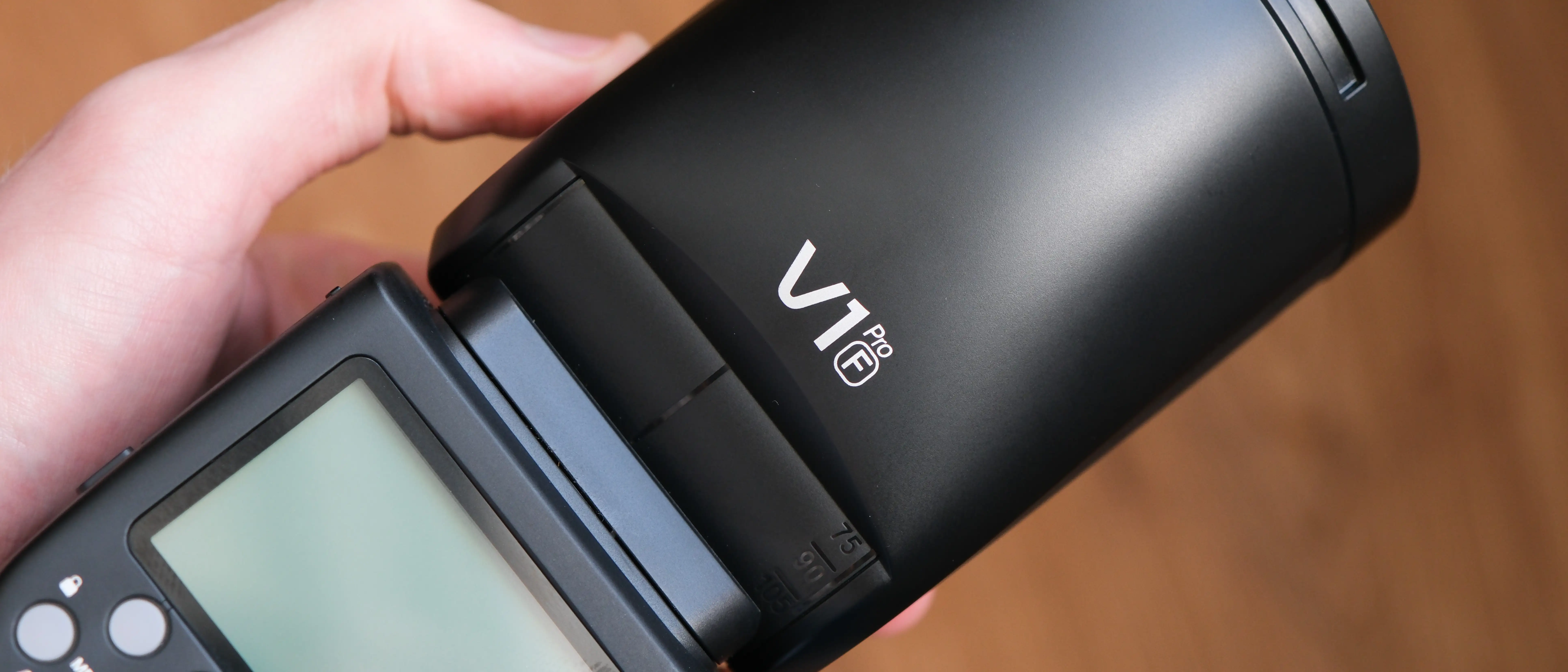
Godox’s marketing (and retailer copy) leans hard on the promise of endurance—“up to 100 continuous shots at full power”—and the V1 Pro’s identity as a “workhorse” that “forget[s] overheating limitations.” Digging deeper into community discussion, the more grounded interpretation is that the V1 Pro’s headline is less about raw power (still discussed as 76Ws) and more about sustaining performance during bursts. A Canon Rumors poster summarized the practical shift as: “a big difference from the v1 is they removed the 30 full power pop limit on this one, so you can shoot 100 full power pops sequentially according to the literature.”
But the same threads also temper that claim with a working-photographer mindset: performance depends on what you’re comparing against and whether you already solve the problem another way. A Canon Rumors user argued that “any pb960-capable godox flash… recycle instantly… at full power while connected to the external battery pack,” making the “Pro” promise less dramatic for shooters already invested in external power solutions. In other words: while the official story is “no thermal restraints,” real buyers weigh this against existing Godox workarounds (power packs, alternative models) and the kind of shooting they actually do.
The other big “new” claim is versatility: the detachable SU-1 fill light is positioned as a breakthrough for bounce + fill in one unit. The user commentary is split. Some see it as practical; others see it as marketing garnish. A Canon Rumors commenter called it “a bit gimmicky,” adding that “especially if used outdoors [it] will likely have zero effect.” That’s a clear reality check: the SU-1 may matter most indoors, in bounce-heavy event scenarios, and might be irrelevant in bright ambient conditions where small fill sources get swallowed.
Finally, modern convenience shows up as USB‑C charging and quicker recycle. The official listings emphasize charging flexibility; community feedback frames it as fixing a long-standing annoyance. One Canon Rumors user complained that older designs forced “taking the battery out and putting it in a pesky cradle,” describing it as “a gross engineering oversight,” and praised that “pro can now be charged directly using usb‑c.” For photographers who travel, shoot on location, or want fewer proprietary chargers in the bag, that “small” change reads like a real workflow improvement—even if it doesn’t change the look of the light.
Cross-Platform Consensus
Universally Praised
The strongest consensus isn’t that the V1 Pro is revolutionary—it’s that the Godox ecosystem (and the V1-style round head) earns real trust because it helps photographers do paid work without OEM pricing. On Canon Rumors, one commenter framed the whole value proposition bluntly: Godox is “a lot more cost effective than the oem speedlights.” In the Reddit wedding-and-event context, that affordability becomes strategy: more flashes, more backups, more off-camera options. A SonyAlpha Reddit contributor explained why the system shows up everywhere: built-in radio transceivers across models make “a multiple light off-camera flash set up affordable… and it’s all over radio not optical.”
Light quality is another repeated win, especially for on-camera users who lean on bounce and small modifiers. Reddit user commentary elevates the “round head + magnetic dome” combo as a signature look. In that SonyAlpha thread, a commenter said: “the v1 with the magnetic dome produces the best light i’ve seen from a speed light.” The implication for wedding photographers is straightforward: when you’re moving fast and can’t build a full modifier setup, predictable, flattering on-camera light matters. Another Canon Rumors user backed the power-and-practicality angle from real use: “i use the v1c with a dome diffuser (ak-r11) when using it as ‘on-camera’ flash and it works well. the 76 watt/sec power output is great.”
Battery performance—both endurance and convenience—shows up as the kind of praise that’s hard to fake because it’s rooted in long shoots. A Redditor summed up why V-series batteries keep converts: “The battery is amazing and a breeze to switch out mid-shoot.” Another working-style anecdote came from a user describing job-scale volume: “just shot about 3k photos for a job over two days… still have 1/3 to 2/3 battery left and only misfired once.” Even though that story references other Godox lights (AD600BM/AD200 Pro), it reinforces the broader pattern: people build confidence in the system through demanding workloads, then consider the on-camera speedlight as part of the same kit.
Summary points (after the stories):
- Strong value narrative vs OEM pricing (Canon Rumors, Reddit).
- Round head + magnetic modifiers praised for fast, flattering on-camera work (Reddit).
- Battery and endurance stories reinforce “event-ready” positioning (Reddit).
Common Complaints
A recurring pattern emerged: the biggest pushback isn’t “this flash is bad,” it’s “the upgrade pitch is thin.” Canon Rumors users repeatedly compare the V1 Pro to the older V1 and conclude the difference is marginal for many owners. One commenter wrote: “they are basically the same, same power output, same battery… same wireless specs, same zoom range… the price differential… does not seem worth it tbh.” For photographers who already own a V1-C and have a stable workflow, that critique lands as a practical warning: you may be paying for convenience features rather than better images.
There’s also friction around the less glamorous parts of ownership—firmware and software. On Canon Rumors, a long-time Godox user praised performance but pointed to a pain point: “the biggest flaw that i can see… [is] the awkward way to update firmware,” plus app connectivity issues with older models. That matters most to pros who can’t afford surprises before a job; even if the flash performs well, clunky updates can make the system feel less polished than OEM alternatives.
Some complaints are more about the broader Godox experience than the V1 Pro specifically: occasional reliability quirks and compatibility edge cases. In the SonyAlpha thread, one user warned: “godox has an issue with sync… had issues keeping up.” Another detailed a Sony-specific issue: off-camera TTL “will underexpose with apertures wider than f/4.” Those comments don’t directly indict the Canon version, but they shape how cautious buyers interpret “works seamlessly” language—especially those who shoot wide-open or rely heavily on TTL consistency.
Summary points (after the stories):
- Upgrade value questioned for current V1 owners (Canon Rumors).
- Firmware updating and software workflows criticized (Canon Rumors).
- Some users report sync/TTL edge issues in certain setups (Reddit).
Divisive Features
The detachable SU‑1 fill light is the most polarizing idea in the dataset. Godox positioning frames it as a breakthrough for bounce + fill, but users debate whether it solves a real problem or adds complexity. Canon Rumors captured the skeptic side clearly: the mini fill flash “looks a bit gimmicky,” and outdoors it may have “zero effect.” For shooters who already carry a bounce card, small modifier, or second light, the SU‑1 can feel like a solution looking for a problem.
On the other hand, the appeal is obvious for event photographers trying to control shadows while bouncing—without adding another stand or assistant. Even the Amazon/retailer descriptions repeatedly emphasize this “one unit, two roles” concept (bounce + fill), which aligns with the kind of quick-adjust shooting wedding photographers describe in Reddit threads. The divide, then, isn’t about whether fill is useful; it’s about whether this particular implementation is meaningful in your typical lighting conditions.
Trust & Reliability
Trust in the Godox ecosystem is built less on pristine marketing and more on stories of gear surviving real handling. One Canon Rumors commenter offered an unusually strong durability claim: “i love them since they have been bulletproof as i have dropped, submerged and manhandled them, while providing very consistent power and temperature.” That kind of testimony—especially when paired with another commenter emphasizing consistent “color accuracy and power output”—signals why many photographers accept some software awkwardness: the lights still show up and do the job.
At the same time, the data also contains caution flags that keep the reliability story from becoming a victory lap. A SonyAlpha Reddit participant mentioned a hardware break: “after a year the hot shoe had broke,” though they added it was cheaply repairable and “it worked pretty well now… already 3 years.” That’s a nuanced trust signal: failures happen, but some users feel the system is maintainable enough that it doesn’t become a deal-breaker.
(Trustpilot content provided here reads like product copy rather than verified user reviews, so there aren’t clear scam-pattern “user reports” to compile from that source.)
Alternatives
The alternatives discussion in user data isn’t theoretical—it’s often framed as “what I’d buy instead.” Canon Rumors commenters repeatedly compare the V1 Pro class to Canon’s EL‑1 and Profoto’s A10. One user praised EL‑1 performance: “the recycle speed is astonishing, it can basically shoot non stop,” then immediately grounded the tradeoff in price: “the el-1 costs… around 6x what the godox v1c costs.” For working shooters, that becomes a business decision: pay for peak recycle performance and an OEM ecosystem, or accept slightly less refinement for dramatically less money.
Within Godox itself, users propose different routes to solve the same problem. A Canon Rumors commenter recommended: “a tt685ii connected to a pb960 is the best solution; it’s way cheaper… recharge is instant even at full power.” Another suggested skipping speedlights entirely for power/ergonomics: using “an ad200 as a battery pack… three times as powerful than a v1… the rig in your hand is so much lighter.” These aren’t just spec comparisons—they’re workflow arguments from photographers optimizing for event endurance and comfort.
Price & Value
Price is where the V1 Pro becomes easiest to defend and easiest to criticize—depending on what you already own. The Amazon listing shows $329 for the Canon kit, while eBay listings show new units commonly in the mid‑$200s (for example, “$269.78” and “$279.00” listings appear in the market snapshot). That resale and discount landscape shapes the “should I upgrade?” conversation: a Canon Rumors commenter pointed out older V1 pricing, noting a sale around “$199,” and framed the question as whether “the additional $130 worth it—you decide.”
Digging deeper into user reports, “value” often means system expansion, not just one flash. Reddit photographers talk about building multi-light setups because affordability makes it possible. One user said they’ve been able to do “various professional jobs thanks to the affordability of godox,” and that sharing gear within a community (classmates/mentor) is easier when many people buy the same system. For buyers planning two flashes plus triggers, or a V1 Pro paired with AD strobes, Godox’s pricing isn’t just cheaper—it enables redundancy and scale.
Buying tips also emerge in small warnings. A Reddit commenter advised: “just make sure you get one with the metal hot shoe, not the plastic one.” Even though this refers to the V1 generally, it’s the kind of community note that influences how shoppers interpret listings and revisions—especially when buying used.
FAQ
Q: Is the Godox V1 Pro for Canon actually a big upgrade over the V1-C?
A: Conditional. A Canon Rumors user said the V1 Pro vs V1 are “basically the same” in core specs, but others highlight practical upgrades like USB‑C charging and the claim of “100 full power pops sequentially.” If you don’t need those workflow changes, the value case weakens.
Q: Does the round head really make a difference for portraits and weddings?
A: Many users think it does for on-camera work. In a Reddit thread, one person said “the v1 with the magnetic dome produces the best light i’ve seen from a speed light.” Another Canon Rumors user said their V1C with a dome diffuser “works well,” especially for event-style use.
Q: Is the detachable SU‑1 fill flash useful or just a gimmick?
A: Divisive. Canon Rumors includes a blunt take that the mini fill flash “looks a bit gimmicky,” especially outdoors where it may have “zero effect.” The concept still appeals to bounce-flash shooters who want quick fill without adding a second light, but real-world impact depends on venue and ambient light.
Q: How does it compare to Canon EL‑1 or Profoto A10?
A: Users mostly frame it as a value play. Canon Rumors commenters praise EL‑1 recycle performance—“basically shoot non stop”—but also stress the price gap, with EL‑1 costing “around 6x” a Godox V1-class flash in some regions. The decision often comes down to budget and whether OEM polish matters.
Q: Are Godox flashes reliable enough for paid work?
A: Many working photographers say yes, with caveats. One Canon Rumors commenter called their Godox gear “bulletproof” even after rough handling, and a Redditor reported only “misfired once” during a heavy two-day job. But others mention sync/compatibility issues in some setups, so testing your camera + trigger combo is still wise.
Final Verdict
Buy the Godox V1 Pro Flash for Canon if you shoot weddings, events, or fast-paced jobs where battery endurance, round-head modifiers, and the promise of longer full-power bursts matter more than having the most polished OEM ecosystem.
Avoid it if you already own a V1-C and your work rarely pushes recycle/overheat limits—because, as one Canon Rumors user put it, the two can look “basically the same” on paper and in output.
Pro tip from the community: if you’re shopping across listings, Reddit user advice is blunt—“make sure you get one with the metal hot shoe, not the plastic one.”