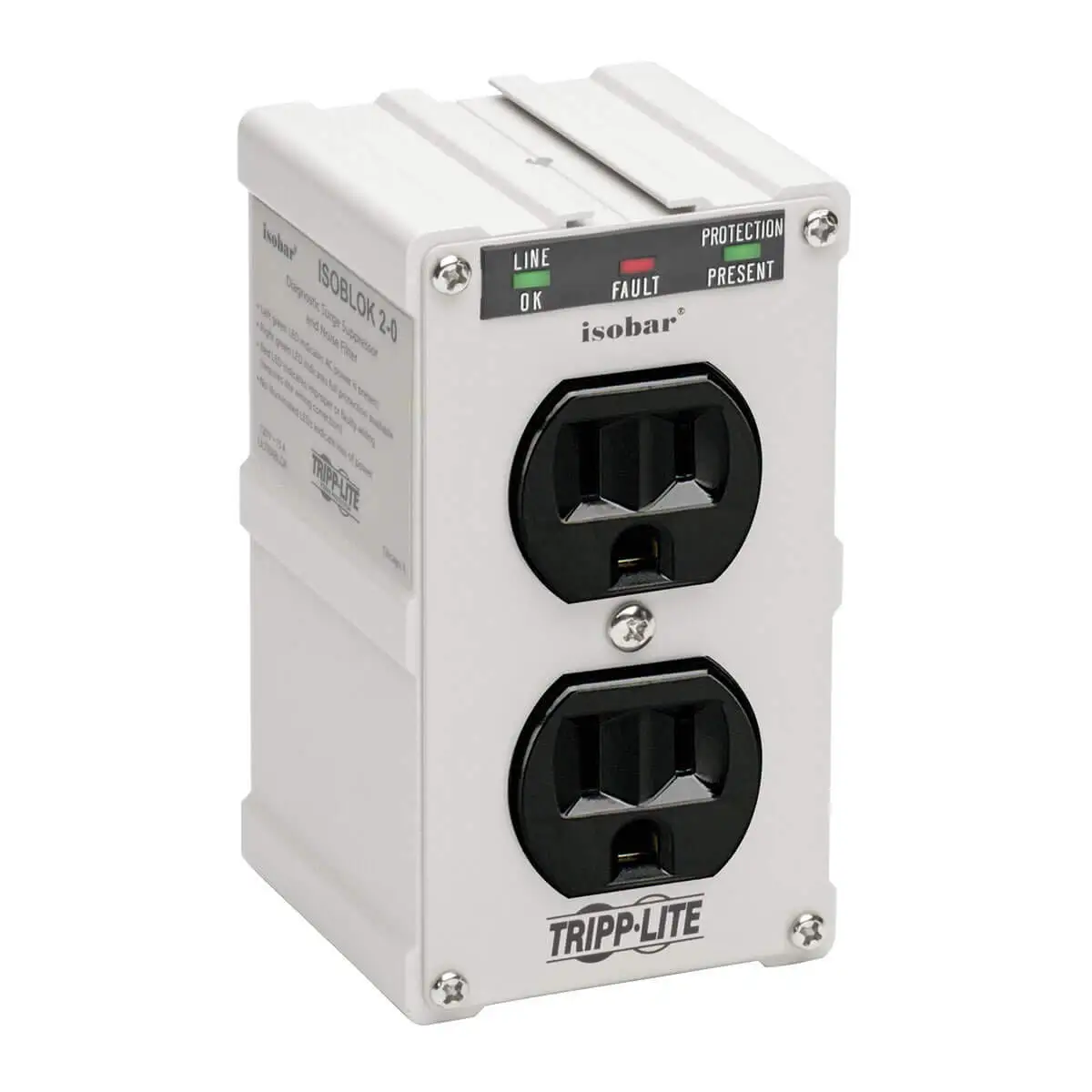
Tripp Lite Isobar ISOBLOK2-0 Review: Conditional 8.6/10
“Stay away from these crooks.” That single 1-star story sits awkwardly beside hundreds of glowing ratings for the Tripp Lite Isobar ISOBLOK2-0 Outlet Extender Surge Protector—and it frames the real conversation: people love the hardware, but not everyone trusts the warranty experience. Verdict: Conditional buy, 8.6/10.
Quick Verdict
For shoppers who want a compact, metal, direct plug-in surge protector with clear diagnostic lights, Tripp Lite Isobar ISOBLOK2-0 Outlet Extender Surge Protector gets strong approval across major retail review pages. But if your purchase hinges on “connected equipment” reimbursement, at least one Best Buy reviewer claims the guarantee “will not” be honored.
| What the feedback says | Evidence from user feedback | Who it matters to |
|---|---|---|
| Build feels “heavy duty” and “well constructed” | Staples reviewer noted: “these are heavy duty, high quality devices” | Garage, workshop, appliance owners |
| Diagnostic LEDs are genuinely useful | Staples reviewer Patricia said she “love[s] how it has a light… line ok, protection present, and fault” | Anyone troubleshooting wiring/ground |
| Helps with “line noise” in real setups | Staples reviewer William wrote: “filter out line noise… works like a charm” | Home theater + network gear users |
| Can be bulky / sticks out | Staples reviewer Ryan said it “sticks out from the wall a little more than one might like” | Tight outlets, behind furniture |
| Mounting screw can be annoying | Staples reviewer Production said the “mounting screw is a bit difficult to drive” | Permanent installs |
| Warranty/insurance trust concern | A Best Buy reviewer wrote: “they will not… find some excuse… Stay away” | Buyers expecting claim support |
Claims vs Reality
Marketing pushes this as “premium” Isobar protection in a “durable… metal housing” with “diagnostic LEDs” and a direct plug-in form factor (Amazon listing; Eaton spec page). Digging deeper into user reports, those claims mostly land—just not always in the way buyers expect.
First claim: premium construction and safety. On Staples, multiple reviewers fixate on the metal case as the reason they paid more. Staples user Marc said: “I paid for a quality product; that’s what I got!” and tied it directly to peace of mind: “I feel safe knowing it should never catch fire as some inferior products do.” Staples user Mark echoed the same theme bluntly: “no plastic for this surge protector… not cheap, but well constructed.” In practice, “premium” translates into perceived durability, especially in garages and around appliances.
Second claim: diagnostic LEDs for power, protection, and wiring/ground status. That’s not just a spec-sheet bullet for these buyers—it’s a daily reassurance. Staples user Patricia described the appeal as being able to tell “at a glance things are just fine,” calling out the separate indicators: “line ok, protection present, and fault.” Staples user Robert similarly praised “clear, clean leds… from across the room.” The “reality” here is that users interpret LEDs as a confidence tool, not merely a diagnostic feature.
Third claim: surge protection and connected-equipment coverage. Official pages highlight lifetime warranty and “$10,000 insurance” language (Amazon listing; Markertek overview; Beach Audio description). But one Best Buy reviewer directly disputes the real-world experience of making a claim: “Tripp-Lite states that they will cover damage… they will not… then find some excuse… stay away from these crooks.” While the product is marketed with insurance-style reassurance, at least one buyer’s story suggests the claims process may not match expectations.
Cross-Platform Consensus
A recurring pattern emerged across retailer reviews: people buy this for expensive, plug-in equipment that doesn’t need a long power strip—then judge it by build, fit, and whether it prevents nuisance problems like noise or surge anxiety. The strongest agreement shows up around ruggedness, clarity of status lights, and suitability for high-draw devices on a 15-amp circuit.
Universally Praised
Metal construction and “heavy duty” feel are constant refrains, especially from users protecting appliances or equipment in tougher environments. Staples reviewer Ryan framed it for garage use: “durable metal housing to help prevent ‘bumps and bangs’ and fluctuations in temperature and humidity.” Staples reviewer from 2017 (no username shown in the snippet) used it on “washer, microwave, and refrigerator,” calling them “heavy duty, high quality devices that look good and have a great warranty.”
Compact direct plug-in convenience is repeatedly praised by people with awkward outlet placement. Staples user Lawrence said “no extra power cords are required” for a difficult router location, emphasizing installation ease: “its compactness made installation easy.” Best Buy’s more positive reviewer called it a “compact surge protector that fits in close quarter,” adding that it “only uses one of the duplex sockets leaving the second socket available.”
Several stories highlight functional benefits beyond “it turns on,” particularly around interference and sensitive electronics. Staples user William bought it specifically to deal with treadmill-induced electrical noise on the same circuit as a server: “filter out line noise… works like a charm!… I can walk and my wife can watch a movie with no interference.” For home media and networking setups, that “line noise” win is the kind of outcome buyers can actually observe.
After those narratives, the praise clusters into a few repeatable themes:
- “Metal box” durability (Staples: Mark; Ryan; Marc)
- LEDs provide real confidence (Staples: Patricia; Robert)
- Works well with appliances and high-current devices (Staples: Patricia on treadmill amps; Ryan “no issues running high-current devices”)
Common Complaints
Bulk and clearance issues show up even among fans. The same 2017 Staples reviewer who said “I would buy this product again” also warned: “they are a little to thick to fit in some applications.” Staples user Ryan similarly noted it “sticks out from the wall a little more than one might like,” which matters most for tight furniture clearance or outlets that already have crowded adapters.
Mounting/securement is another friction point. Staples user Production liked the product overall but still called out the install detail: “the mounting screw is a bit difficult to drive into the isobar.” Best Buy’s positive review also implied you may need to use the wall-plate securing method because the unit’s size “makes it vulnerable to theft in public areas,” and said the method “works but could be better.”
The harshest complaint is not about electrical performance—it’s about trust in the guarantee when something goes wrong. A Best Buy reviewer described a failure scenario and alleged claim denial: “the product will fail and your equipment will be damaged… [they] find some excuse why their protective unit was not at fault.” This is a minority viewpoint in the provided data, but it’s the most severe because it targets the “insurance” promise that motivates many buyers.
Common complaint themes, grounded in the anecdotes above:
- Fit: “too thick” / “sticks out”
- Installation: mounting screw/securement could be better
- Trust: at least one allegation that coverage is not honored (Best Buy)
Divisive Features
The same “compact wall tap” design that wins praise can create the most debate. For some, it’s the perfect no-cord solution: Staples user Dennis called it “great product if you’re low on room!” and liked that it “fits in tighter spaces than the traditional strips.” For others, the compact block shape is exactly what creates clearance problems—“sticks out” and “too thick”—especially behind furniture or in crowded outlet areas.
There’s also a subtle split in how people evaluate surge protection itself. Staples user Michael openly questioned the consumer’s ability to verify it: “it’s hard to verify the performance of anything that claims to provide surge protection… without test equipment… blind faith.” That skepticism contrasts with users who feel vindicated by real events: Staples user Jeffrey said it “worked wonderful during the worst thunderstorm of the year so far.”
Trust & Reliability
A tension runs through the feedback: the product inspires confidence, but surge protection is inherently difficult to “prove” until something bad happens. Staples user Michael captured that uncertainty: “one must really take it on face value… a consumer must exercise blind faith.” That sets the stage for why warranty narratives matter so much to buyers.
On the trust side, the most damaging story in the provided data comes from Best Buy, where one reviewer accused the brand of dodging its promise: “they will not… pretend to honor their guarantee, but then find some excuse.” That complaint isn’t echoed elsewhere in the supplied review text, but it directly challenges the “$10,000” reassurance mentioned in product listings (Amazon; Markertek; Beach Audio).
For reliability in day-to-day use, the longer-lived anecdotes lean positive, especially in demanding contexts. Staples user Ryan reported “no issues running high-current devices” in garage locations, and Staples user Patricia described consistent use with a “mini treadmill” drawing “10-12 amp” on a 15-amp-rated unit: “working like a charm!” Staples user Glenn used it for an RV refrigerator in an outage-prone rural spot, saying it “will help protect my refrigerator.” These are not lab tests, but they are lived scenarios in which the device is trusted as a protective intermediary.
Alternatives
Only a few alternatives are explicitly mentioned in the provided data, and they’re mostly other Tripp Lite options rather than competitor brands.
Amazon includes a bundle listing that references the “Tripp Lite 3 outlet portable surge protector power strip… (SK3-0)” describing it as “compact” with “3 outlets” and “660 joules” (Amazon bundle text). For travelers or people who want more than two outlets in a similar direct plug-in style, that’s the clearest adjacent option in the dataset—though it’s positioned as lower joule protection than the ISOBLOK2-0’s 1410-joule rating (Amazon; Eaton page).
Within the broader Isobar family mentioned in the Fakespot excerpt (not a direct review platform, but still user-text presented there), one commenter referenced owning “other 4 plug isobar strips.” That hints at a path for buyers who like the “Isobar” idea but want more outlets and possibly a different physical layout.
Price & Value
Pricing in the supplied snapshots clusters around the high-$30s to low-$50s new, depending on retailer and timing. Amazon shows $37.90 (with a list price shown higher), while Best Buy displays $38.00 in its archived listing view. Other retailer pages list higher numbers: Staples shows $53.99, Markertek lists $44.82, and Beach Audio shows $52.72 (all as provided in the dataset).
Resale/secondary market data suggests these units do move used. An eBay listing shows a used ISOBLOK2-0 at $32.99 (single item, “used… cosmetic wear… fully operational”), indicating some retained value but not a massive premium over the lowest new prices shown.
Buying tips from community-style reviews skew practical: people justify the spend when protecting costly gear. Staples user Kenneth called it “common sense” and a “smart investment… to protect many hundreds of sensitive LED lighting equipment.” Staples user Marc framed the value proposition as paying for materials and peace of mind: “I paid for a quality product; that’s what I got!” Meanwhile, Staples user Michael’s skepticism suggests a different value lens: without measurable proof, some buyers are paying primarily for brand reputation and perceived build.
FAQ
Q: Does the ISOBLOK2-0 help with electrical noise, not just surges?
A: Yes, some buyers say it noticeably reduced line noise. Staples reviewer William bought it specifically to “filter out line noise” from a treadmill affecting a media server and said it “works like a charm,” letting them use both without “interference” (Staples).
Q: Will it work for higher-draw devices like treadmills or air conditioners?
A: Many users run it with high-current equipment. Staples user Patricia used it with a treadmill drawing “10-12 amp” on a “15 amp” unit and said it’s “working like a charm.” Staples user Marc used it for a “portable air conditioner” and praised its quality (Staples).
Q: Is it actually compact, or does it stick out from the wall?
A: Both can be true depending on your space. Some praise the “compact surge protector that fits in close quarter” (Best Buy). Others complain it “sticks out from the wall a little more than one might like” (Staples user Ryan) or is “too thick to fit” some spots (Staples review snippet).
Q: Are the indicator lights useful in real life?
A: Yes, multiple reviewers cite the LEDs as a key benefit. Staples user Patricia liked having lights for “line ok,” “protection present,” and “fault” so she can check “at a glance.” Staples user Robert praised “clear, clean leds” visible “from across the room” (Staples).
Q: Can you rely on the connected-equipment coverage promise?
A: Feedback is conflicted. Product pages highlight “$10,000” coverage language (Amazon; Markertek; Beach Audio), but one Best Buy reviewer alleged the company “will not” cover damage and “find some excuse” to deny fault. No other claim stories appear in the provided data (Best Buy).
Final Verdict
Buy if you’re protecting a couple of expensive devices in a tight spot—like an internet router in a “difficult location” (Staples user Lawrence), a garage dehumidifier/treadmill setup where “bumps and bangs” happen (Staples user Ryan), or a treadmill that creates circuit noise (Staples user William: “works like a charm!”).
Avoid if your outlet clearance is extremely tight or you need a flush profile; even fans admit it can be “too thick” or “sticks out.” Also avoid if your decision depends primarily on the reimbursement promise—because a Best Buy reviewer flatly warned: “they will not… honor their guarantee.”
Pro tip from community: use the mounting/secure method if you can. Staples user Robert said he used “the mounting bracket for added stability,” and Best Buy’s positive reviewer noted securing it to the wall plate can matter in public areas where it could be “vulnerable to theft.”