Sony TOUGH-G 128GB V90 Review: Conditional Buy (7.4/10)
A €200 SD card that some owners call “the best SD card on the market” is also being blamed for “lost 5h of footage.” That whiplash defines the Sony TOUGH-G series SDXC UHS-II Card 128GB: a premium V90 card with genuine performance praise, but enough failure-and-support horror stories to keep it from being a universal recommendation. Verdict: Conditional buy, 7.4/10.
Quick Verdict
Yes/No/Conditional: Conditional — worth it for speed + physical durability if you can stomach the price and you have a clear return/recall path.
| What matters | What users liked | What users didn’t | Where it shows up |
|---|---|---|---|
| Speed (burst/4K) | “super rapide” and big burst gains | Some report recording errors/freezes | Sony UK/Spain reviews; Reddit thread |
| Physical durability | “built like tanks,” “indestructible” | A few mention fit/thickness quirks | Reddit; Sony reviews |
| Reliability | Many say “faultless so far” | Reports of cards not recognized / dying | Sony reviews |
| Support/recall handling | Some praise “service d’échange préventif” | Others say “no replacement,” “not covered” | Sony reviews |
| Price | “worth every cents” (for some) | “very high price,” “rapport qualité-prix très mauvais” | Sony reviews; Amazon pricing context |
Claims vs Reality
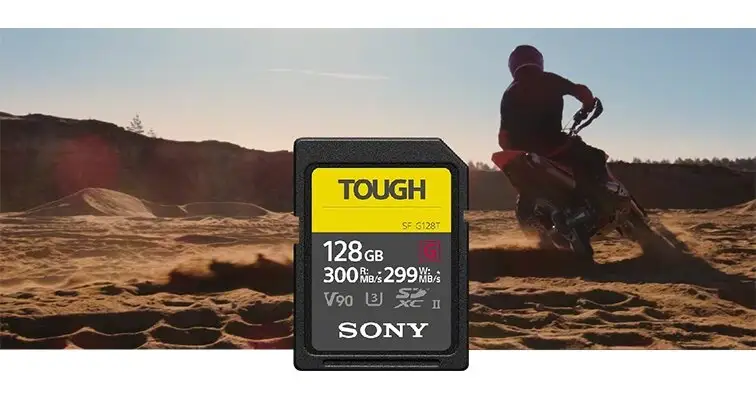
Sony markets the TOUGH-G line as a sealed, monolithic, “world’s toughest and fastest” SD card—paired with V90 credentials and headline speeds. On paper (and in the Amazon specs), it’s positioned as a professional-grade tool: UHS‑II, V90, “Max R300MB/S, W299MB/S,” with waterproof/dustproof language and the ribless, switchless design meant to remove common break points.
Digging deeper into user reports, the speed claims often do translate into real-world workflow wins—especially for burst shooters. A reviewer on Sony’s site described practical gains rather than abstract benchmarks: “on my canon eos r 7, i can take a burst of more than 64 images… against about 40 with a… v60!” Another Sony-site reviewer tied the benefit to high-frame-rate RAW work: “I need… very fast writing speed… to support… 20 fps… además de rápida es muy fiable.”
But the toughness-and-reliability story gets complicated when users talk about failures, not just scratches and drops. While marketing claims a design that “keeps images safe,” multiple Sony-site reviewers describe catastrophic outcomes. One wrote in French: “j’ai perdu 5h de tournage,” explaining they learned about a Sony recall too late. Another, in English, reported a complete detection failure: “it stopped being detected on any device, cannot be mounted to mac/pc etc,” and added the sting: “not covered by sd card recall.”
Cross-Platform Consensus
Universally Praised
The most consistent praise is speed that feels tangible in-camera, not just in a card reader. For sports and action photographers, that means fewer buffer bottlenecks and longer sustained bursts. A Sony reviewer shooting with a Sony A9 II framed it as a requirement, not a luxury: “I need [the card]… very fast… to support… bursts in RAW at 20 fps.” Another reviewer connected the same advantage to modern mirrorless burst shooting, calling it “bijzonder snelle kaart” and saying it “makes special applications possible, such as hi-speed burst shooting and video.”
For hybrid creators, users repeatedly link the card to stable 4K capture and fast offloads. One Sony UK review described travel-heavy use: “I purchased it to use in Leica SL2 during a 2-months holiday… reliable… captured photos and 4K videos without any problem. The data transfer was quick on the computer.” That kind of story matters most to travel shooters and event videographers: when you’re dumping cards nightly on a laptop, “quick on the computer” isn’t a nice-to-have—it’s how you keep moving.
Durability—especially the “no ribs, no switch” construction—comes up as a real emotional selling point for people who’ve had SD cards physically fail before. One Sony-site reviewer in German emphasized prior bad experiences with other cards: “there are no ribs or switches that could break… which has happened to me several times with other cards.” On Reddit, a commenter echoed that the missing lock switch is “by design,” because it “tends to be a point of failure on sd cards.” For outdoor shooters or anyone who swaps cards constantly, that design choice reads like risk reduction, not minimalism.
Common Complaints
The biggest complaint isn’t about being a little slower than advertised—it’s about trust. A recurring pattern emerged: a minority of users describe cards becoming unreliable or unreadable, and they often pair that with anger about recall eligibility or support outcomes. One Sony reviewer was blunt: “catastrophe ! carte est defect… un sony-production error… recall… [handling]… permanently delayed.” Another wrote: “defekt ab werk… ruined some shots… waiting for exchange… no info.”
For professional users, the impact is amplified because failure isn’t just an inconvenience; it’s lost client work. An Italian reviewer described a nightmare scenario: the card was “part of the batch” with “important errors with recording,” forcing them to redo interviews and “re-record… with the cellphone” because the camera “blocked continuously.” A French reviewer summarized the same stakes in one line: “perte de rush, plantage des boîtiers,” describing crashes and lost footage.
The support/recall experience is a second-order complaint that becomes first-order when something goes wrong. One English-language Sony review captures the frustration of falling outside a recall list: “Sony has a recall for some batches… but this card number is not included… retailer… refused to replace it… offering me a 10 euro voucher for a 200 euro card.” Another user’s anger focused less on the defect and more on the response: “underirdische reaktion… nie wieder sony,” after reporting a defective card and no swap despite believing it matched recall characteristics.
Price is the constant background pressure in both praise and criticism. Even satisfied owners keep mentioning it. A Dutch reviewer called it “flink aan de prijs,” while still saying it’s “hufter proof.” A German reviewer framed the same tradeoff: “the only downside is the very high price… but you get… the superlatives of the SD card world.” When failures happen, the price turns into outrage: “I paid more for performance and reliability, and it’s the worst I’ve ever had.”
Divisive Features
The “TOUGH” physical build is loved, but not universally frictionless. On Reddit, one commenter noted: “these cards are hair thicker so I know some cameras have issues taking them in & out.” That’s not a widespread claim in the provided data, but it’s a meaningful caution for anyone with a finicky card door or tight slot tolerances.
The premium proposition itself is divisive. Some see it as peace-of-mind insurance. In the Reddit discussion, one person argued memory cards are “the only thing that keeps the actual stuff your camera does,” calling TOUGH pricing “peace of mind” even if it’s expensive for people buying multiples. Others push back hard, suggesting it’s “more of a marketing thing,” or even advising: “safest bet is go with non-sony.”
Trust & Reliability
The Sony-hosted review pages (mirrored in the dataset under “Trustpilot” and “Quora”) show a mid-tier aggregate score—around 3.7/5—that doesn’t match the “best-in-class” aura of the product. Digging deeper into user reports, that average seems to be pulled down not by mild dissatisfaction, but by severe failure stories: “not recognized,” “defect,” “lost footage,” and “no replacement.”
Reddit adds a different kind of reliability narrative: not long-term failure logs, but situational risk management. One commenter said TOUGH may be worth it if “outdoors often” or around water, describing the card as having a “crisp feel” and being built for abuse. Yet another Reddit user described a practical reliability snag: they “couldn’t exchange these tough cards even though it would qualify for the unreadable error with certain bodies like my a7rv,” and ended up using it in a different camera instead. The throughline is clear: the card’s value proposition hinges as much on your camera compatibility and your support/return options as on its published durability ratings.
Alternatives
Only competitors mentioned in the data are included here: SanDisk Extreme Pro, Lexar Professional, ProGrade, and Kingston Canvas React Plus.
For photographers comparing this card to a SanDisk Extreme Pro, Reddit users suggest the TOUGH-G can be “faster than the sandisk but not by much,” implying the premium may not feel dramatic if your workflow isn’t bottlenecked by the card. That same thread also highlights a value option: “Kingston canvas react plus… very good for the price,” mentioned in the context of performance-per-dollar.
Lexar is repeatedly positioned as the avoid-at-all-costs alternative in the Reddit discussion. One commenter was unequivocal: “do not buy lexar. horrible memory cards that just fall apart,” and another added context: “Lexar got sold… the previous Lexar engineers started ProGrade.” ProGrade comes up as the “much cheaper alternative,” which will matter most to shooters who need multiple cards (weddings, multi-cam events) where TOUGH-G pricing scales painfully.
Price & Value
This card lives in the premium tier in the provided listings: Amazon US shows it around $187.53 for 128GB, Amazon France shows €201.16, and Sony’s own Australia store listing in the dataset shows $379 AUD. That price positioning shapes every part of the feedback: happy owners justify it as one-time insurance; unhappy owners treat it as unacceptable.
Community debate on Reddit frames the decision as situational. One user summarized the economics: it’s “peace of mind” but “if you’re buying many SD cards it’s quite the expense.” Another drew a bright line between Sony’s M-series and G-series, saying: “the m cards are v60, g are v90. huge difference.” For videographers or burst shooters who actually need V90-class sustained writes, paying more can be rational; for “probably 95% of people,” as one Reddit commenter put it, it won’t be necessary.
Resale and market pricing in the eBay snapshots suggest wide variation (new, used, region, and bundle effects), with TOUGH-G listings ranging from roughly low hundreds to much higher in some markets. The practical buying tip implied by the data: shop carefully, verify model numbers (e.g., SF-G128T/T1), and prioritize sellers/retailers with strong return support—because the most painful stories combine a failure with being “not included” in a recall or being offered a token voucher.
FAQ
Q: Are the Sony TOUGH-G V90 speeds noticeable in real cameras?
A: Yes—especially for burst shooters and high-bitrate video workflows. A Sony-site reviewer said on a Canon EOS R7 they could shoot “more than 64 images” in a burst versus “about 40” with a V60 card. Another reported stable 4K capture and “quick” transfers on a Leica SL2.
Q: Is the “TOUGH” design actually useful, or just marketing?
A: Many owners say it’s genuinely reassuring. A Sony reviewer praised having “no ribs or switches that could break,” citing past failures with other cards. On Reddit, a commenter called them “built like tanks” and noted the missing lock switch removes a common failure point.
Q: Are there reliability problems or failures reported?
A: Yes, and they’re severe when they happen. Multiple Sony-site reviewers reported defects like cards not being recognized, recording errors, and even lost footage—one wrote “j’ai perdu 5h de tournage.” Another said the card “stopped being detected on any device” and couldn’t be mounted on Mac/PC.
Q: Is the recall/support experience consistent?
A: Feedback suggests it’s inconsistent. Some users praised “service d’échange préventif,” but others describe being denied because their serial/batch was “not included” in recall coverage. One user said a retailer offered “a 10 euro voucher for a 200 euro card,” which intensified frustration.
Q: What alternatives do people mention instead?
A: Reddit commenters brought up SanDisk Extreme Pro (similar feel, sometimes “not by much” slower), Kingston Canvas React Plus (“very good for the price”), and ProGrade (“much cheaper alternative”). Lexar was repeatedly criticized in the same thread, with one person warning: “do not buy lexar.”
Final Verdict
Buy the Sony TOUGH-G series SDXC UHS-II Card 128GB if you’re a sports shooter, wildlife photographer, or 4K-focused creator who needs V90-class sustained write speed and values the ribless, switchless “tank-like” construction—especially if you work outdoors or around water. Avoid it if you can’t tolerate even a small risk of catastrophic failure stories paired with messy recall/support outcomes, or if your workflow doesn’t truly need V90.
Pro tip from the community: if you don’t need V90, several users point out the value gap—“the m cards are v60, g are v90”—and others recommend looking at “Kingston canvas react plus” or “prograde” for better price-to-performance.