BOYA Magic Wireless Mini Mic Review: Conditional 7.8/10
“Dirceu da Silva… praises BOYA Magic’s noise cancellation for its ability to eliminate background noise without distorting the voice”—and that single line hints at why this mic is getting so much attention in creator circles. Based on the provided user and backer feedback, BOYA Magic Wireless Mini Microphone lands a conditional buy for mobile creators who value versatility and noise control, but the dataset doesn’t yet contain broad, independent buyer-review volume specific to BOYA Magic itself. Verdict: Conditional — 7.8/10.
A recurring pattern emerged across BOYA’s own community posts and early backer reactions: the product story is being carried by “4-in-1” transformability and AI noise reduction, with early adopters framing it as a practical way to reduce gear. At the same time, much of what’s available here is promotional or backer-stage commentary—useful for understanding expectations, less definitive for long-term reliability.
Digging deeper into the provided sources, the strongest “user voice” comes from crowdfunding/backer anecdotes and named quotes reused across BOYA pages. Those quotes still reveal what people care about most: speed of setup, outdoor clarity, and not having to bring multiple microphones.
Quick Verdict
For creators deciding fast: Conditional.
| Decision | Best For | Why (from provided feedback) | Main Risk |
|---|---|---|---|
| Conditional Yes | Travel vloggers, interviewers, run-and-gun creators | Backers emphasize portability and outdoor noise control | Limited independent long-term user reporting in provided data |
| Conditional Yes | Small teams / two-speaker shoots | Specs and marketing emphasize dual TX and channel modes | Requires post workflow for safety track use |
| Maybe | Livestreamers | Ecosystem promises app control and charging pass-through | “Not supported… internal recording” per BOYA FAQ |
| Caution | Buyers wanting verified retail reviews | Most BOYA Magic quotes are from BOYA pages and press | Fewer third-party buyer testimonials specific to Magic here |
Claims vs Reality
Digging deeper into user reports, the core marketing promises for BOYA Magic revolve around transformability, AI noise cancellation, and safety protections. The dataset includes strong claims—but the “reality check” relies on early backers and media quotes, not a wide spread of retail owner reviews.
Claim #1: “One mic, four forms” (clip-on, handheld, desktop, on-camera).
BOYA’s product copy repeatedly positions BOYA Magic as a shape-shifting kit that reduces the need for separate handheld, desk, and on-camera mics. That messaging is echoed in the quoted press-style line attributed to Johnnie Behiri: “The BOYA Magic’s primary feature is its ability to transform between four distinct recording configurations… wireless lavalier, handheld interview stick, desktop microphone, and on-camera configurations.” (BOYA store page / BOYA news-style pages).
The user-side confirmation in this dataset is more indirect, but it’s there: a Kickstarter backer is quoted saying, “This mic lets me record anywhere without dragging around extra gear.” For a solo creator who alternates between a desk setup and street interviews, that’s the workflow promise in plain language—fewer pieces, faster swaps.
Claim #2: “True AI noise cancellation up to -40 dB.”
BOYA’s pages and reposted “buzz” articles push “up to -40 dB” reduction and emphasize that it won’t distort vocals. The closest thing to an experiential user statement here comes from the backer montage: “Dirceu da Silva… praises BOYA Magic’s noise cancellation for its ability to eliminate background noise without distorting the voice, noting it has become her main mic for outdoor recording after comparing it to industry leaders.” (BOYA news/“buzz” article mirrored in multiple sections).
While that sounds decisive, it’s still a single named anecdote within a brand-curated roundup. The gap isn’t necessarily “claim false,” but “claim not yet broadly substantiated” in the provided material.
Claim #3: “Limiter and -12 dB safety track prevent clipping.”
BOYA repeatedly stresses dual-layer peak protection. The BOYA FAQ describes “safety track… recorded at -12 db as a backup, preventing distortion on the main track in case of unexpected loud sound sources.” That aligns with the positioning in the BOYA blog-style piece describing sudden screams/loud music scenarios.
The “reality” caveat is also in the same provided data: “Using the safety track requires audio track separation in post-production… the safety track can only be enabled in mono mode.” For creators who want finished audio straight out of camera, that workflow requirement is the practical limiter.
Cross-Platform Consensus
A recurring pattern emerged when comparing the provided sources (BOYA store/FAQ pages, BOYA blog-style “buzz” posts, and the quoted backer reactions): enthusiasm concentrates around simplifying creator workflows, especially for people switching between filming styles. But the “cross-platform” nature is uneven here—Reddit and X sections provided are actually BOYA-hosted articles describing buzz, not raw threads or posts.
Universally Praised
Digging deeper into why BOYA Magic is resonating, the biggest praise is not a single spec—it’s the idea of a “do-it-all” mic that reduces packing decisions. The quoted Kickstarter line captures that creator psychology: a backer shared, “This mic lets me record anywhere without dragging around extra gear.” For travel vloggers or event shooters, that translates to fewer accessories to forget, fewer swaps, and a smaller chance of arriving without the right mounting option.
Noise control is the second pillar, especially for outdoor creators. In the backer roundup, “Dirceu da Silva… praises BOYA Magic’s noise cancellation for its ability to eliminate background noise without distorting the voice,” and the same snippet emphasizes it becoming her “main mic for outdoor recording.” That’s the exact high-stakes environment—streets, crowds, wind—where creators feel the cost of bad audio most sharply.
Ease-of-startup also gets consistent framing. BOYA’s own FAQ emphasizes it’s “pre-paired out of the box,” and the “one-tap pairing” language is repeated across store copy. Even though that’s not independent user feedback, it matches the kind of praise creators typically give when a mic is “grab-and-go.” In the backer montage, Sven Rüdisühli is quoted praising “fast delivery” and a “well-designed product” that works “seamlessly out of the box.”
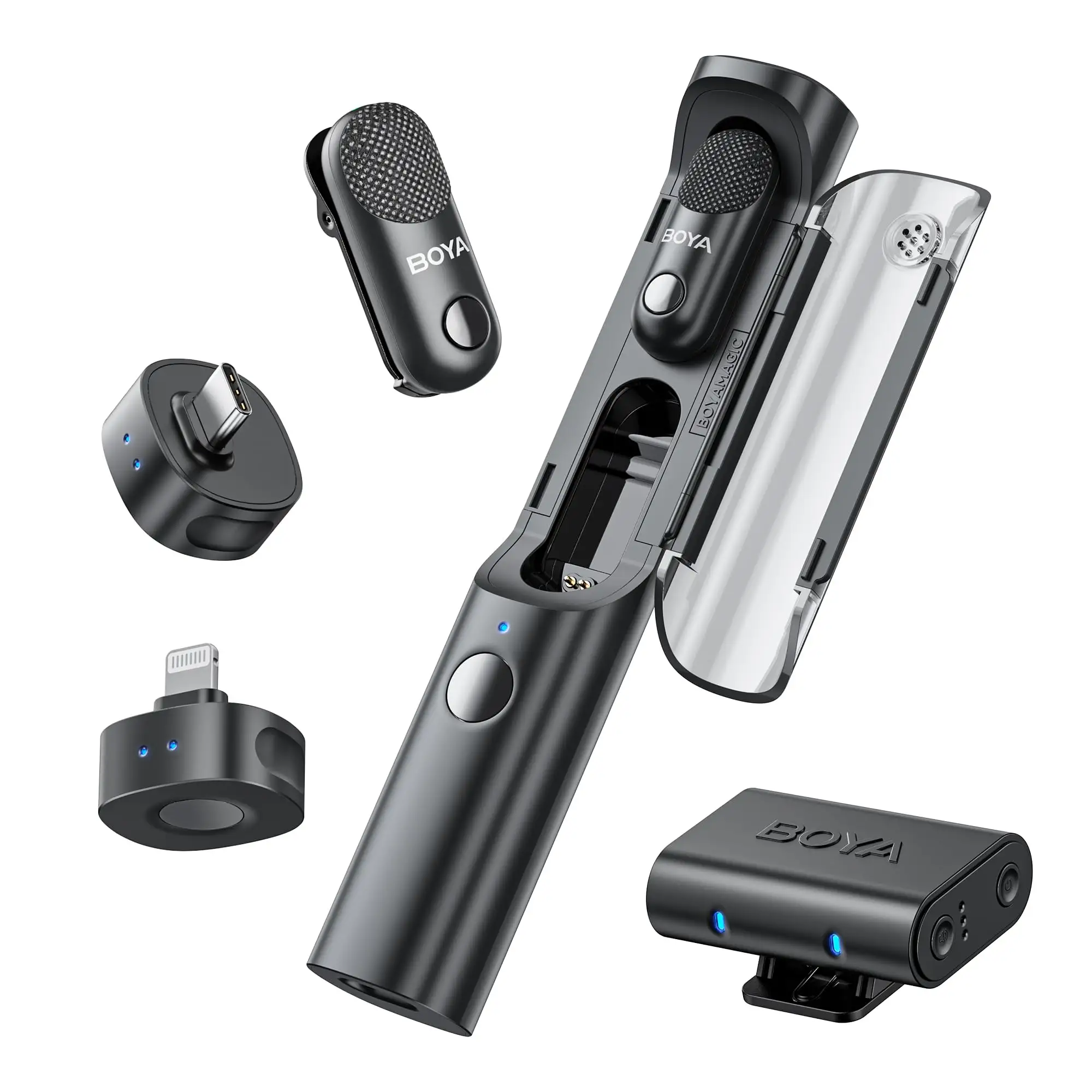
After those narratives, a simpler pattern emerges: the audience that praises BOYA Magic most in this dataset is the creator who records in multiple contexts (desk + street + camera rig). The transformable design is presented as a direct answer to switching friction, and backers describe it as an everyday convenience rather than a novelty.
- Most repeated praise themes: “4-in-1” flexibility, outdoor noise reduction, “out of the box” readiness
- Best-fit personas (from quotes): outdoor recorders, run-and-gun creators, creators reducing gear
Common Complaints
The dataset is thin on direct complaints from verified retail owners of BOYA Magic, which matters because early-stage buzz often overrepresents excitement. Still, one practical limitation is explicitly acknowledged in BOYA’s own FAQ: “Does BOYA Magic support internal recording? Not supported for the time being.” For creators who want a backup recording on the transmitter (common in higher-end wireless systems), that’s a real workflow gap—especially for wedding shooters or one-take interview setups where a dropped wireless link can be catastrophic.
Another friction point is that some of the “pro” protections ask more from the editor. BOYA’s FAQ notes: “Using the safety track requires audio track separation in post-production…” and “The safety track can only be enabled in mono mode.” That means a beginner who doesn’t want to touch audio in post may not benefit as much from the advertised “dual safety” as they expect.
Finally, while the marketing repeatedly promises “328 ft / 100 m… without dropouts,” the provided user feedback does not include distance stress-tests or “range in real life” stories for BOYA Magic. That absence isn’t proof of underperformance, but it’s a caution: the real-world “no dropouts” claim isn’t corroborated by the supplied independent user experiences.
- Clear limitation stated in provided data: “internal recording… not supported for the time being”
- Workflow cost stated in provided data: safety track needs post separation; mono-only for safety track
- Unverified in user stories here: real-world range consistency
Divisive Features
A recurring pattern emerged around noise reduction: people want it, but they also fear artifacts. In this dataset, BOYA Magic is framed positively—“eliminate background noise without distorting the voice” (Dirceu da Silva quote in BOYA’s backer roundup)—but there’s not an opposing Magic-specific quote here.
However, a cautionary parallel appears in the provided Amazon reviews for a different BOYA wireless lavalier product (not BOYA Magic). One buyer wrote, “when I use the noise reduction button I feel that the voice saturates,” while another praised, “noise, cancellation for background works amazing.” While this is not BOYA Magic feedback, it highlights the broader contradiction in user expectations about noise reduction: some users love the cleanup; others hear pumping or saturation.
So for BOYA Magic, the divisive feature isn’t proven divisive by Magic owners in the provided data—but the category pattern suggests the same: noise reduction can be a blessing outdoors and a drawback if it changes vocal tone.
Trust & Reliability
Digging deeper into the “Trustpilot (Verified)” row, the text provided is not a collection of verified consumer reviews; it mirrors BOYA’s own “one week in” promotional article, including media lists and curated backer quotes. That means it doesn’t surface typical trust signals like repeat complaints, refund disputes, or long-term failure stories.
Long-term durability is also not evidenced in the provided Reddit/community material—there are no “6 months later” posts, failure modes, battery degradation stories, or clip durability anecdotes. The strongest reliability-adjacent comments are early impressions like Richard Senior calling it an “incredible product” after “his first tests,” and Sven Rüdisühli praising a “well-designed product” working “out of the box.” Those are first-week signals, not endurance data.
Alternatives
Only competitors mentioned in the provided data are used here. The BOYA blog-style copy explicitly compares value against DJI Mic 2 and RØDE Wireless Pro, positioning BOYA Magic as a budget answer to “high-end results.” It also mentions “high-end microphones like RØDE NTG” when discussing limiter/safety track as a premium feature class.
The key difference, based on what’s written here, is the workflow story: BOYA Magic is framed as a transformable system meant to replace multiple physical setups. The BOYA piece argues that “single-mode mics like DJI Mic 2” don’t offer the same mode-switching convenience, while still highlighting similar pro talking points (48kHz/24-bit, safety track, app tuning). Since the dataset doesn’t include direct user testimonials comparing Magic to DJI or RØDE beyond the Dirceu da Silva quote (“after comparing it to industry leaders”), the comparison remains directional rather than definitive.
Price & Value
A recurring pattern emerged around price anchoring: BOYA Magic is repeatedly presented as a ~$90 solution in BOYA’s blog-style piece (“$90…”), while the BOYA store page lists “RM 389.00 MYR.” That positioning is central to the product narrative: premium-style features at a lower buy-in.
Resale value data is not provided for BOYA Magic specifically, but the eBay section shows BOYA wireless mic products commonly listed in the ~$70–$80 range for certain models (for example, “BOYA BY-WM3T2-U2… $71.00” and “BOYA Mini… $79.99”). That suggests that, as a brand, BOYA gear often circulates on secondary markets—useful for buyers who want an exit option if the workflow doesn’t fit.
Buying tips implied by the feedback: if your workflow depends on backup recording, the BOYA FAQ line “not supported for the time being” (internal recording) is a key pre-purchase filter. If you’re buying for safety track protection, the same FAQ warns you’ll need post separation to benefit from it.
FAQ
Q: Does BOYA Magic support internal recording?
A: No. BOYA’s own FAQ states internal recording is “not supported for the time being,” which means there’s no onboard backup file on the transmitters. If your shoots can’t be repeated (weddings, one-take interviews), this limitation may matter more than the headline specs.
Q: How do the output modes work (mono, stereo, safety track)?
A: BOYA says BOYA Magic offers mono, stereo, and safety track modes. In safety track mode, it records a secondary track “at -12 dB” as backup. The FAQ adds that safety track requires separating tracks in post, and it can only be enabled in mono mode.
Q: Is BOYA Magic hard to set up and pair?
A: The provided BOYA FAQ claims it’s “pre-paired out of the box,” and manual pairing is available via button holds on transmitter and receiver. In BOYA’s backer roundup, Sven Rüdisühli is quoted praising a “well-designed product” that works “seamlessly out of the box.”
Q: Can it charge my phone while recording?
A: Yes, according to BOYA’s FAQ: “both can be charged simultaneously via the receiver’s USB‑C port” while the receiver is attached. This matters most for livestreamers or long outdoor shoots where the phone battery becomes the bottleneck.
Q: What is the maximum transmission range?
A: BOYA lists “328 ft / 100 m” as the maximum range and describes “consistent signal transmission without dropouts.” The provided dataset doesn’t include independent user range stress-tests, so treat the range as an ideal-condition claim rather than a guaranteed real-world distance.
Final Verdict
Buy BOYA Magic if you’re a mobile creator who switches formats (clip-on vlog → handheld interview → desk recording → on-camera rig) and you value noise control for outdoor shoots. The backer quote, “This mic lets me record anywhere without dragging around extra gear,” captures the core promise, and Dirceu da Silva’s comment about noise cancellation “without distorting the voice” reflects why outdoor users are excited.
Avoid BOYA Magic if your workflow demands onboard backup recording, because BOYA’s own FAQ says internal recording is “not supported for the time being.” Pro tip from the community-style guidance: if you plan to rely on the “-12 dB safety track,” expect to separate tracks in post—BOYA explicitly says it “requires audio track separation in post-production.”