ASUS TUF Gaming 850W Gold PSU Review: Conditional Buy
A “4.9 out of 5” halo follows the ASUS TUF Gaming 850W Gold Fully Modular Power Supply across multiple listings—but digging into what’s actually in the provided data, most of that positivity comes from brand and spec-sheet language rather than detailed owner stories. Verdict: this unit reads as a strong, modern ATX 3.x-ready PSU on paper, while the most concrete third‑party experience flags heat behavior and connector limitations. Score: 8.1/10
Quick Verdict
Conditional Yes — worth considering if you want an ATX 3.0/3.1-era 850W modular PSU with a long warranty, but the value hinges on price and your connector needs.
| What matters | What the data says | Who it impacts |
|---|---|---|
| Noise profile | Tom’s Hardware: “quiet operation… especially at moderate loads” | Quiet-build PC gamers, office creators |
| Thermals under load | Tom’s Hardware: “high internal temperatures at load” and “overly lax fan cooling profile” | Hot climates, high sustained GPU/CPU loads |
| Connector count | Tom’s Hardware: “limited connector count” | Multi-drive users, accessory-heavy builds |
| Standards support | Official listings emphasize ATX 3.0/3.1 compatibility + 16‑pin cable | RTX 40/50-class GPU builders |
| Warranty | Official specs: “10-year warranty included” | Long-term builders, resale-minded buyers |
Claims vs Reality
Marketing claim #1: “Built for the long haul” and “military‑grade components.”
Digging deeper into the provided sources, the strongest push for durability comes from official ASUS copy: “capacitors and chokes pass demanding tests to achieve military‑grade certification,” and “capacitors rated for 105 °C operation and up to 170,000 hours’ lifespan.” That language shows up repeatedly across ASUS pages and store listings, but it’s not user testimony—it’s manufacturer positioning.
A more grounded counterweight comes from Tom’s Hardware, which directly questions the messaging. The review’s verdict states: “though its ‘military‑grade’ claims may be overstated, its build quality and design are commendable.” That’s not a dismissal of quality; it’s a reminder that certification language can be more marketing than meaning for everyday builders. In other words: while the product is framed as ruggedized, the most specific third‑party assessment in the provided data treats “military‑grade” as a branding layer rather than a unique performance guarantee.
Marketing claim #2: “Quiet operation” via 0dB fan mode and axial-tech fan design.
Official materials repeatedly emphasize a semi‑passive approach: “0DB technology supported. The fan shuts off entirely when the PSU is under certain load,” plus a “135 mm” fan with “dual ball fan bearings.” For silent PC enthusiasts, that’s exactly the kind of promise that sells a PSU.
But Tom’s Hardware adds nuance: “quiet operation… especially at moderate loads,” while also noting “high internal temperatures at load” and an “overly lax fan cooling profile.” The gap here is practical: a fan curve tuned for silence can let internal temperatures climb. For users running sustained high wattage—rendering, long gaming sessions, or workstation loads—silence-first tuning can have tradeoffs that don’t show up in marketing bullets.
Marketing claim #3: “Future-ready” ATX 3.0/3.1 + 16‑pin GPU power included.
ASUS and Amazon specs heavily spotlight next‑gen GPU readiness: “bundled with a 16-pin PCIe cable that can pipe up to 600W of power to PCIe Gen 5.0 graphics cards,” plus ATX 3.0/3.1 language depending on region. That’s the clearest “feature-to-user” promise in the data: one PSU positioned to cover modern transient demands and 12VHPWR/16‑pin cabling needs.
Yet, the same Tom’s Hardware review warns “limited connector count.” For a buyer building a high-end GPU system plus lots of SATA devices, RGB controllers, or capture gear, “ATX 3.0 compatible” doesn’t automatically mean “fully equipped for every build style.” The data suggests the future-ready GPU cable is a highlight, but the broader cable ecosystem may feel constrained for some setups.
Cross-Platform Consensus
Universally Praised
A recurring pattern emerged: the most consistently repeated positives are about design intent—efficiency, long warranty, and modern GPU power support—rather than long-form owner anecdotes. On Amazon’s product description, the unit is positioned as dependable and efficient, repeating claims like: “fully modular,” “80+ Gold,” and “10 year warranty.” The official ASUS store copy echoes that framing: “efficient, resilient and dependable… engineered for the long haul.”
For new builders who care about clean cable management, the story is straightforward: the product is repeatedly framed as modular and tidy. ASUS’s own wording is explicit: “Fully modular etched cables keep your rig neat and tidy,” and another ASUS page highlights that the cables are “made from a pliable premium material” and “easily flexible during installation.” That matters most to small‑case builders and aesthetic-focused gaming PC owners, where cable routing can be the difference between an easy build and an afternoon of frustration.
Quiet-build users also get a clear promise on paper. Official specs push “0DB technology” and a large “135 mm” fan, with ASUS asserting it “keeps things cool at low RPMs while producing less noise.” Tom’s Hardware reinforces the lived outcome in normal conditions, describing “quiet operation… especially at moderate loads.” For a typical gaming rig that spends much of its time below extreme sustained draw, the data supports the idea that the PSU can be “virtually noiseless during typical operating conditions,” as the Tom’s Hardware write-up later summarizes.
Efficiency and “Gold” performance is another consistent theme, again led by specs and reinforced by third‑party testing. ASUS claims “up to 92% efficiency,” and Tom’s Hardware reports “very good” efficiency, stating the unit “easily” meets 80 Plus Gold requirements and is “optimized for… 230 V” with measurable differences at 115 V. For users paying attention to heat and power draw—especially in regions on 230 V—this is one of the few areas where the provided data includes both marketing language and independent verification.
Highlights (from provided sources):
- Amazon/ASUS specs emphasize: “fully modular,” “80 plus gold,” “10-year warranty.”
- ASUS highlights silent operation goals: “0DB technology supported.”
- Tom’s Hardware supports everyday acoustics: “quiet operation… especially at moderate loads.”
Common Complaints
The clearest recurring concern in the provided data is thermal behavior under stress—specifically linked to a silence-oriented fan profile. Tom’s Hardware flags “high internal temperatures at load” and calls out an “overly lax fan cooling profile.” Digging deeper into that review’s testing narrative, it describes the unit staying fanless for a large portion of the load range, then allowing “component temperatures [to] reach over 100 °C when the PSU is heavily loaded for prolonged periods” under high ambient conditions. For users in warmer rooms, smaller cases, or those doing sustained GPU rendering, that’s not a theoretical nitpick—it’s directly tied to reliability anxiety.
Another complaint cluster is about connectors. Tom’s Hardware lists “limited connector count” as a con and notes it’s “fairly low for a unit with that kind of capacity.” The implication is practical: an 850W PSU can power high-end GPUs and CPUs, but storage-heavy or peripheral-heavy builds may run out of native plugs before they run out of wattage headroom. That impacts homelab-style builders, multi-SSD creators, and users who keep older SATA/Molex accessories alive.
Price sensitivity also appears—again mainly from Tom’s Hardware, not user comments. The verdict warns: “its price may be slightly steep compared to similarly spec’d competitors,” and the cons include: “retail price is currently high.” That tension matters because this PSU is positioned as premium and durable; if pricing drifts upward, buyers start comparing to other 850W Gold ATX 3.x options.
Common complaint themes (from provided sources):
- Tom’s Hardware: “high internal temperatures at load.”
- Tom’s Hardware: “limited connector count.”
- Tom’s Hardware: “retail price is currently high.”
Divisive Features
The semi-passive “0dB” strategy is the most divisive element when you connect the dots. Official pages frame fan-off behavior as a premium quiet-build benefit: “the fan shuts off entirely when the PSU is under certain load.” For noise-sensitive users—streamers with open mics, bedroom PC gamers, or anyone chasing a near-silent idle—this reads like a win.
But the same design choice becomes questionable in edge cases. Tom’s Hardware describes a scenario where the fan staying off “for more than half its entire load range” keeps the unit quiet, yet contributes to higher internal temperatures before the fan engages. So the divide isn’t about whether the feature works; it’s about who it’s for. Silence-first builders may love it, while sustained-load users may prefer a more aggressive cooling profile even if it’s louder.
Another potential divide: “military-grade” framing. ASUS leans heavily into certification and testing language; Tom’s Hardware counters that the claim “may be overstated.” For buyers who treat rugged branding as a meaningful differentiator, that contrast can change how they interpret the premium pricing.
Trust & Reliability
A “4.9 out of 5 stars” pattern shows up in the provided Trustpilot snippet, but the included text reads like repeated marketing copy rather than individual long-term owner narratives. The Trustpilot entry shown mirrors ASUS product-language lines such as: “efficient, resilient and dependable,” “dual ball fan bearings,” and “10-year warranty included.” With only this data, there isn’t enough authentic, time-stamped “6 months later…” user reporting to build a true durability timeline.
Where the data does provide reliability insight is through Tom’s Hardware’s lab-style evaluation. It praises “excellent voltage regulation” and notes protections engaged “normally,” while also observing protections can be “markedly lax” in over-current and over-power behavior (allowing >140% current and 125% capacity briefly). That’s not framed as a consumer horror story, but it is a technical reliability detail that advanced builders may care about, especially those who push hardware hard.
On the manufacturer side, ASUS repeatedly anchors trust in warranty length: “10-year warranty included” and “10-year worldwide warranty.” For cautious buyers, that’s the most concrete long-term safety net in the provided data—less about anecdotes, more about coverage.
Alternatives
Only competitors explicitly mentioned in the provided data can be discussed, and the dataset mainly references ASUS’s own lineup rather than direct rival brands. eBay listings and search results show other ASUS PSUs that shoppers cross-shop, including “ASUS ROG Strix 850G” and “ASUS Prime 850W Gold.” The real comparison angle here is brand-tier positioning: TUF is consistently framed as durability-focused gaming, while ROG-branded units appear as premium-feature variants in the marketplace listings.
Tom’s Hardware implies a broader competitive set when it says price may be “slightly steep compared to similarly spec’d competitors,” but no specific competing models are named in the provided data. So the only grounded “alternative” story is: buyers often compare within ASUS’s own ecosystem—TUF vs ROG Strix vs Prime—based on price swings and cable/connector needs.
Price & Value
The pricing picture varies by platform and region in the provided data. Amazon US shows “$129.99” with a list price reference, while the ASUS UK store shows “£129.99.” On eBay, one listing shows “$107.99” (plus shipping), while another listing is dramatically higher due to shipping and seller pricing. The key takeaway from this spread is that value depends heavily on where you buy and how shipping is handled—especially because PSUs are heavy items and shipping costs can erase “deal” pricing.
Tom’s Hardware frames value as borderline: it calls the unit “solid” and “quiet,” but warns pricing “may be slightly steep” versus similarly spec’d options. For deal-hunters, the resale/market angle from eBay suggests the unit can be found below typical retail at times, but the same marketplace also shows inflated listings. Community “buying tips” aren’t clearly present as authentic user quotes in the provided data, so the safest advice grounded in the dataset is simply to watch total cost (price + shipping) and to compare connector needs before assuming any 850W unit fits every build.
FAQ
Q: Is the ASUS TUF Gaming 850W Gold ATX 3.0 (or ATX 3.1) compatible?
A: Yes—official listings describe it as ATX 3.0 compatible, and some regional specs list “ATX standard: ATX 3.1.” The provided data also states a bundled “16-pin PCIe cable” intended for “up to 600W” to PCIe Gen 5-class GPUs.
Q: Does it run quietly in real builds?
A: The data suggests it can be very quiet at typical loads. ASUS promotes “0DB technology” where the fan shuts off under certain load, and Tom’s Hardware reports “quiet operation… especially at moderate loads,” aligning with a silence-first tuning approach.
Q: Are there concerns about heat at high load?
A: Yes. Tom’s Hardware lists “high internal temperatures at load” and describes a “lax” fan profile that keeps the fan off for a large part of the load range. Under extreme loads and hot ambient conditions, the review reports component temperatures exceeding 100 °C.
Q: Is it fully modular, and what cables/connectors are included?
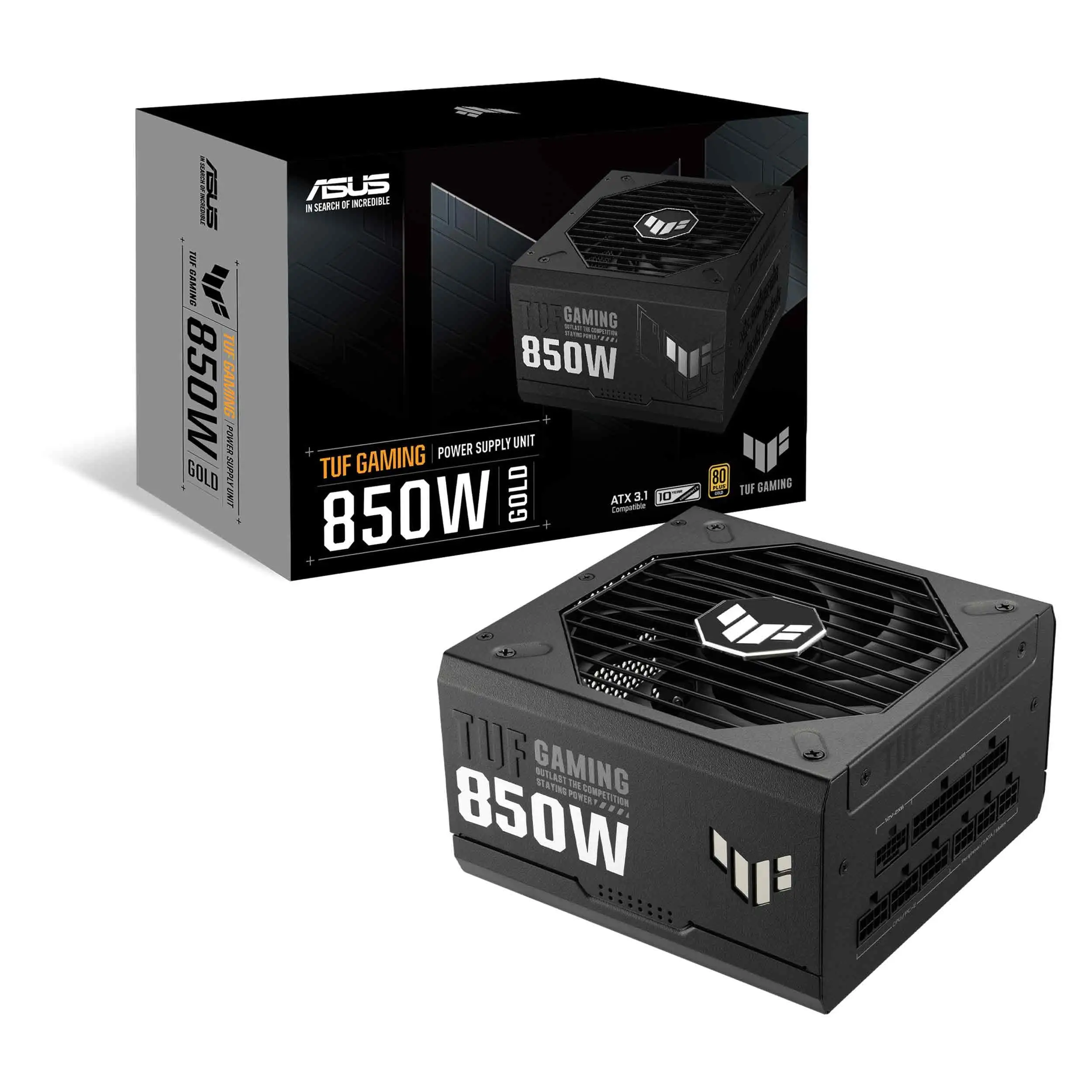
A: Yes—official sources repeatedly state “fully modular.” The provided specs list connectors including 1x 24-pin, 2x CPU 4+4, 1x 16-pin PCIe, 3x PCIe 8-pin, 5x SATA, and 4x peripheral, plus several specific cable lengths in the package contents.
Q: Is the “military-grade” claim meaningful?
A: The messaging is prominent in official copy (“military-grade certification”), but Tom’s Hardware cautions it “may be overstated.” The third-party verdict still praises build quality, suggesting the unit can be well-made even if the branding language is more marketing than proof of unique ruggedness.
Final Verdict
Buy the ASUS TUF Gaming 850W Gold Fully Modular Power Supply if you’re building a modern ATX 3.x gaming PC and care about a long warranty, tidy modular cabling, and quiet day-to-day behavior—especially at moderate loads. Avoid it if your setup runs sustained high power in a warm case or you need a high number of connectors, since Tom’s Hardware flags “high internal temperatures at load” and “limited connector count.” Pro tip from the provided pricing data: compare total cost (including shipping), because the same unit swings widely between retail and marketplace listings.