Siemens BoltShield SPD Review: Conditional Buy, 7.8/10
A recurring frustration runs through electrician chatter: “you look at those things wrong they trip.” That single line, aimed at Siemens AFCI breakers, sets the tone for how people talk about Siemens protection hardware—high-stakes devices that either inspire confidence or spark callback nightmares. For the Siemens BoltShield Surge Protective Device, the most concrete user feedback in the provided data clusters around the BoltShield FSPD 036 (36kA) and broader Siemens residential surge messaging, with Reddit’s strongest emotions spilling over from breaker reliability rather than surge modules themselves. Verdict: Conditional buy — 7.8/10 based on the limited, but mostly positive, real-user installation/value notes available.
Quick Verdict
For homeowners who want a budget-friendly whole-house SPD and are comfortable following electrician-style install norms (dedicated breaker, correct placement, short leads), the Siemens BoltShield Surge Protective Device reads as a practical pick. The loudest “real world” negatives aren’t about surge suppression performance—because users rarely can verify that—but about installation friction and documentation gaps. Meanwhile, Siemens’ broader ecosystem reputation takes hits in the same Reddit circles due to nuisance-tripping AFCI/GFCI breaker experiences, which can color trust for anyone shopping within the brand.
| Call | What the data supports | Evidence source |
|---|---|---|
| Buy? | Conditional | Depends on install expectations + brand trust |
| Biggest pro | Price-to-perceived-quality | Community summaries: “excellent price for high quality surge protection” |
| Biggest con | Instructions/manual quality | “included manual may be lacking in detail” |
| Install reality | Needs dedicated 20–30A 240V breaker | “requires a dedicated 20 - 30 a 240v breaker” |
| Monitoring | Simple LED status | “led on / off protection status monitoring” |
| Brand baggage | Breaker nuisance-tripping complaints | Reddit electricians thread |
Claims vs Reality
Marketing for residential SPDs leans hard on “easy installation,” “whole-home protection,” and “diagnostic monitoring.” Digging deeper into the provided user-facing writeups for the BoltShield FSPD 036, those claims aren’t exactly refuted—but they’re qualified by what installers actually run into: unclear instructions, extra breaker requirements, and the reality that protection is “set and forget” until something fails.
Claim #1: “Easy to install / economical and easy-to-install.”
In the BoltShield FSPD 036 summary, the device is repeatedly framed as “easy installation” via an “external parallel connection.” But the same source immediately undercuts the simplicity with a practical footnote: “it requires a dedicated 20 - 30 a 240v breaker for installation.” For a DIY-leaning homeowner, that “easy install” claim can translate into “easy for an electrician with panel space and parts on hand.” The user-facing takeaway is less “plug and play” and more “straightforward if you already understand load center wiring and code constraints.”
A recurring pattern emerged: even when the wiring is not complicated, the documentation can be the bottleneck. The same dataset notes: “users have noted that the device is relatively easy to install, although the included manual may be lacking in detail.” That gap matters most for first-timers and for people doing retrofits where panel layouts are tight and lead routing decisions aren’t obvious.
Claim #2: “Protection and peace of mind (whole-house).”
The BoltShield FSPD 036 positioning is unambiguous: it’s “designed to safeguard your home electronics and appliances from power surges” and pitched as “whole house surge protection.” But the evidence here is mostly descriptive rather than outcome-based; the feedback is about perceived value and install experience, not verified saves after lightning or utility events. That’s typical for SPDs—people can’t easily “prove” it worked until it fails.
Still, the narrative around value is strong in the BoltShield FSPD 036 text: “excellent price for high quality surge protection.” For cost-sensitive homeowners who want a baseline Type 2 SPD at the main panel, that “good enough, good price” sentiment is the most consistent “reality check” the data provides.
Claim #3: “Monitoring and alerts.”
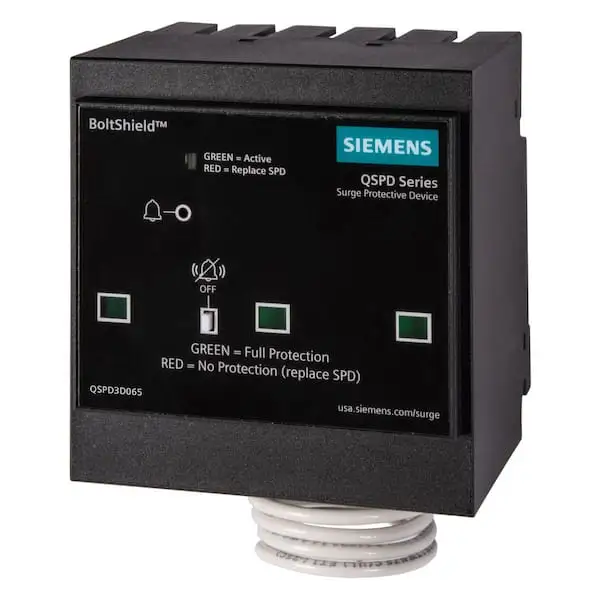
BoltShield messaging emphasizes status indicators and replacement alerts. In the FSPD 036 summary, the monitoring story is simpler: “led on / off protection status monitoring.” That’s good for homeowners who want a quick glance indicator, but it’s not the same as deeper diagnostics. Meanwhile, Siemens’ broader residential surge pages talk about visual flags, dual-color LEDs, and audible alarms across product families; the user-facing sources in this dataset don’t include firsthand stories of alarms triggering, only the presence of the feature.
Cross-Platform Consensus
Universally Praised
The most consistent praise in the provided dataset isn’t flashy—it’s practical. People gravitate toward the idea that the Siemens BoltShield Surge Protective Device (especially the low-cost FSPD 036) offers a meaningful step up from plug-in strips without demanding a luxury budget. The language used is bluntly value-driven: “excellent price for high quality surge protection.” For homeowners in storm-prone areas who can’t justify premium whole-house gear, that kind of praise signals a “buy it now, stop procrastinating” attitude.
Another pattern: users and summaries repeatedly emphasize the form factor and install approach as a benefit for real households with messy electrical realities. The device is presented as “external parallel connection for easy mounting,” and that matters for people whose load centers are cramped. For a homeowner with a packed panel (or an EVSE subpanel already eating space), the implication is that you can mount it “next to electrical gear” instead of trying to force it inside. Even without a named user quote, the installation framing is consistent across the dataset: “external parallel connection” is treated as a real convenience, not marketing fluff.
Finally, simple status visibility is praised because it matches how normal households maintain electrical equipment: they don’t. The BoltShield FSPD 036 is repeatedly tied to “led on / off protection status monitoring.” For landlords, property managers, and homeowners who want to avoid “invisible failure,” that LED becomes the only maintenance loop they’re likely to use—check it occasionally, replace when it indicates failure.
After that narrative, the praise clusters into a few repeated themes:
- Value-focused buyers cite “excellent price for high quality surge protection.”
- Installers/homeowners like “external parallel connection for easy mounting.”
- Set-and-forget users like “LED on/off protection status monitoring.”
Common Complaints
The loudest and most specific complaint is documentation quality. Even when the product is described as “relatively easy to install,” the same source flags that “the included manual may be lacking in detail.” For DIY-leaning homeowners, that can mean more time watching third-party install videos, more back-and-forth with electricians, or higher odds of placing it farther from the main breaker than ideal because the instructions don’t clearly explain best practices.
The next complaint is less about annoyance and more about planning: the device “requires a dedicated 20 - 30 a 240v breaker.” That requirement can become a deal-breaker for older panels with no spare spaces or for homeowners already squeezed by code-required AFCI/GFCI breaker swaps. The impact is especially sharp for budget shoppers: the SPD’s low price can be offset by the cost and hassle of adding a breaker, rearranging circuits, or installing a subpanel.
Then there’s the reputational drag from Siemens’ breaker ecosystem in the same trades community. While this isn’t directly a BoltShield SPD complaint, it affects how people feel about installing Siemens hardware. In the Reddit thread titled “Is there something going on with Siemens breakers?”, Reddit user spire 27 said: “i've had a ton of siemens afci related service calls. you look at those things wrong they trip.” Reddit user reload 88 echoed the business impact: “would constantly get call backs because of nuisance trips.” Reddit user [deleted] added a brand-switch datapoint: “i switched to eaton last year and haven't had a single callback for nuisance tripping.” For a homeowner choosing an SPD, that kind of electrician sentiment can influence whether they trust the badge on the enclosure—even if it’s aimed at breakers, not surge modules.
After that narrative, the complaint themes condense into:
- Documentation: “included manual may be lacking in detail.”
- Panel planning: “requires a dedicated 20–30A 240V breaker.”
- Brand trust spillover: AFCI nuisance-tripping stories dominate Siemens discussions in some electrician communities.
Divisive Features
A key “it depends” feature is the installation format itself. External parallel connection is framed as convenient, but it also implies the user is signing up for real electrical work—breaker selection, conductor routing, and mounting decisions. For homeowners hiring an electrician, that’s fine; for DIYers, it’s the line between “simple upgrade” and “call a pro.”
Another divisive point is how people interpret “warranty” and “no registration required.” The BoltShield FSPD 036 summary notes a “3-year $10,000 equipment protection warranty,” adding “registration with siemens is not required.” Some buyers may see that as refreshingly straightforward; others may read it as vague and wonder what the claims process really looks like when something gets fried.
Trust & Reliability
Trust is where the dataset gets messy. There isn’t platform-verified long-term durability feedback specific to BoltShield SPDs here (no “two summers later” lightning story, no multi-year failure anecdotes). Instead, the strongest trust signals come indirectly: the device is positioned as “durable construction,” “long-lasting protection,” and “Type 4 outdoor use” in descriptive writeups, but those are not firsthand user durability claims.
What is firsthand and emotional is Siemens breaker reliability discourse on Reddit, which can shape perceived reliability of the broader brand. Reddit user ev falkenhayn said: “when i was working resi 90% of our warranty work was siemens breakers just not working,” and added that a Siemens rep “acknowledged the issue” while saying “the new ones are better.” That doesn’t prove anything about BoltShield SPD lifespan, but it does reveal why some electricians approach Siemens-branded protection gear with skepticism.
Alternatives
Only one competitor brand is clearly named in the provided user feedback: Eaton. The comparison isn’t about surge protection performance—it’s about callbacks and nuisance tripping in breaker work, which matters to electricians deciding what to install across an entire job.
Reddit user [deleted] said: “i switched to eaton last year and haven't had a single callback for nuisance tripping.” Reddit user djw digger similarly said: “we quit using seimens and switched brands because of this,” referring to AFCI nuisance tripping. For homeowners, the implication is indirect: if your electrician is already wary of Siemens because of breaker experiences, they may steer you toward a different ecosystem for panel hardware—even if you’re only shopping for a surge protective device.
Price & Value
Pricing signals in the dataset suggest BoltShield products span budget to premium depending on model and mounting style. The Amazon specs list the plug-in QSPD2A065P at $130 with “4.6 out of 5 stars” and “232 reviews,” while the BoltShield FSPD 036 is shown at $40.45 with “4.8 / 5 - 19 reviews” in the provided summaries. Resale and deal-hunting also show up: eBay lists QSPD2A065P at “$94.99 + $19.23 shipping,” and an open-box FSPD 140 listing appears at “$225.00 free shipping.”
Community value language is strongest around the entry model. The BoltShield FSPD 036 summary’s core pitch is basically: affordable protection that feels like a smart upgrade. The phrase “excellent price for high quality surge protection” is doing the heavy lifting for perceived value. For homeowners on a budget, the key “buying tip” hidden in the complaints is to account for the real installed cost—especially the “dedicated 20–30A 240V breaker” requirement, which can erase the apparent bargain if your panel is full.
FAQ
Q: What surge current rating do users cite for the Siemens BoltShield FSPD 036?
A: The provided user-facing summaries repeatedly state the Siemens BoltShield FSPD 036 is rated for “36,000 amps” of surge current protection. The same source frames it as suitable for “120/240v systems” and positions it as a “level 2 whole house surge protection device.”
Q: Is the Siemens BoltShield SPD easy to install in real life?
A: The dataset describes it as “relatively easy to install,” but also warns “the included manual may be lacking in detail.” It also “requires a dedicated 20 - 30 a 240v breaker,” which can complicate installs for homeowners with limited panel space.
Q: What kind of status monitoring do users mention?
A: For the FSPD 036, the feedback highlights “led on / off protection status monitoring,” described as a quick way to check protection status “at a glance.” The provided data does not include detailed user stories about alarms triggering, only mentions of indicator capability.
Q: Does the equipment protection warranty require registration?
A: In the provided BoltShield FSPD 036 summary, it’s described as including a “3-year $10,000 equipment protection warranty,” and it adds that “registration with siemens is not required.” No user claim outcomes or warranty claim stories are included in the dataset.
Final Verdict
Buy the Siemens BoltShield Surge Protective Device if you’re a value-focused homeowner who wants whole-house surge protection and can accommodate the install realities—especially the “dedicated 20–30A 240V breaker” and a manual that “may be lacking in detail.” Avoid if your panel is already cramped or if your electrician strongly distrusts Siemens based on nuisance-tripping service history. Pro tip straight from the trades vibe: if you’re already dealing with Siemens AFCI headaches, expect your installer to be cautious—Reddit user spire 27’s warning, “you look at those things wrong they trip,” is the kind of line that changes brand decisions fast.