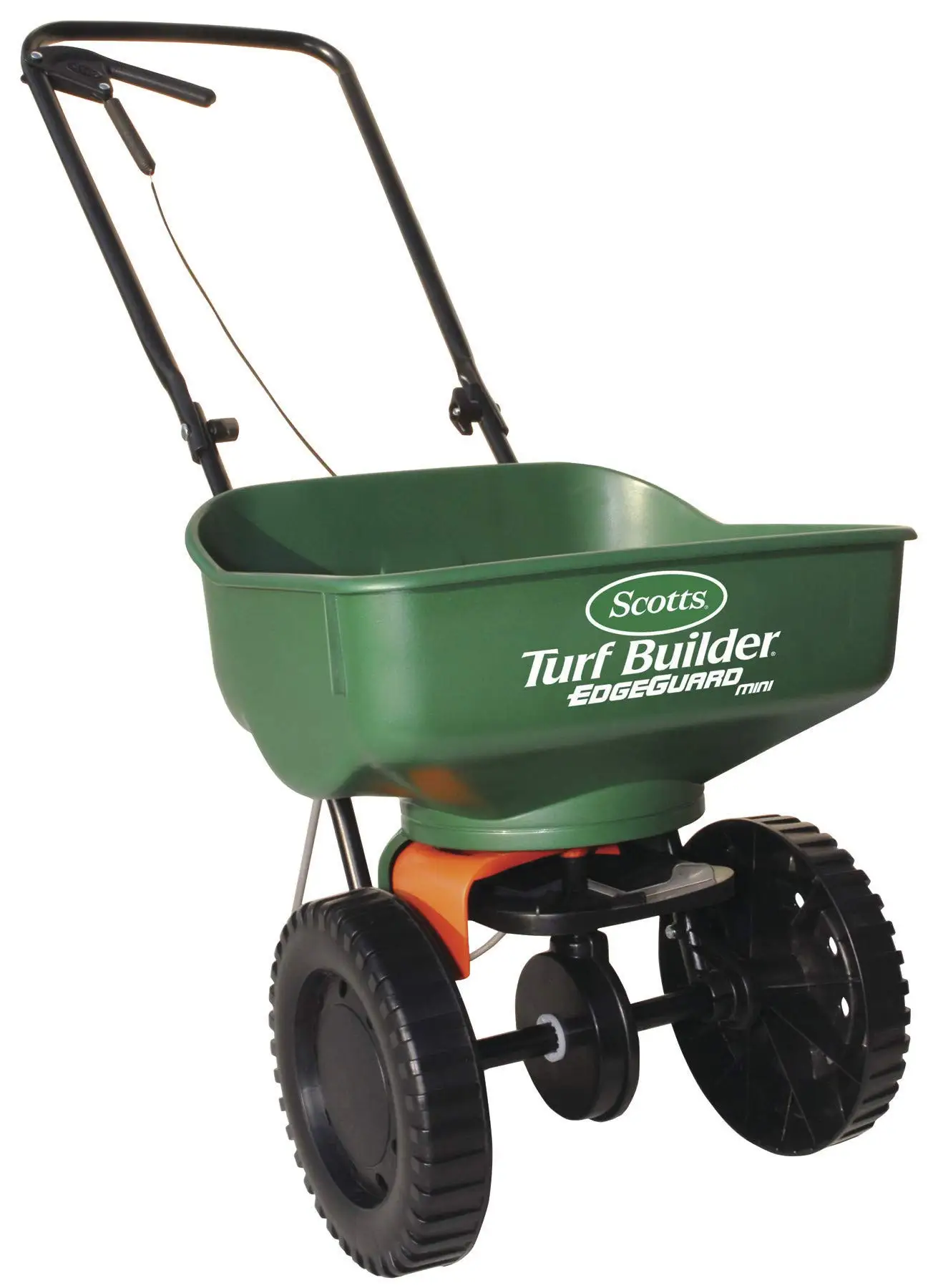
Scotts EdgeGuard Mini Spreader Review: Mixed User Verdict
The Scotts Turf Builder EdgeGuard Mini Broadcast Spreader emerges from user feedback with a mixed verdict: 6.2/10. While marketed as a compact, precise, and ready-to-use lawn spreader, real-world experiences reveal both strong points—like ease of storage, straightforward assembly, and suitability for small yards—and recurring design flaws that lead to uneven coverage and mechanical issues. For casual homeowners with small lawns, it can be a convenient, budget-friendly tool. For larger properties or those seeking long-term durability, multiple users caution against relying on it.
Quick Verdict: Conditional
| Pros | Cons |
|---|---|
| Easy to assemble and store | Uneven spreading, heavy center trail |
| Lightweight and compact | Fertilizer collects in hollow wheels, causing stripes |
| Precise EdgeGuard feature when working | Flimsy plastic parts prone to breakage |
| Affordable price point | Calibration settings often inaccurate |
| Good for small yards and tight spaces | Handle height uncomfortable for taller users |
| Compatible with seed, fertilizer, salt | EdgeGuard mechanism prone to failure |
| Works well with Scotts products | Wheels slip or jam, especially on wet grass |
Claims vs Reality
The brand claims that EdgeGuard technology “keeps lawn product off landscaping, driveways, and sidewalks.” While some users confirm this, such as a Trustpilot reviewer who noted, “I like the guard on one side of the unit. It prevents product from being thrown onto unwanted areas,” others report leakage. A Home Depot reviewer explained, “The edgeguard works pretty good, except it does shoot some of the seeds in that area where they are not supposed to go when edgeguard is on.”
Marketing also emphasizes “precision rate settings for more accurate coverage.” In practice, calibration inconsistencies are a common frustration. A Trustpilot user admitted, “The spreader calibration is hopelessly incorrect… fertilizer poured out at more than twice the correct rate.” Similarly, another buyer found that even at the recommended setting, “I still had half of a 15,000 sq ft bag of fertilizer left after covering my lot,” suggesting under-application.
Finally, the product is promoted as “ready to use—no assembly required.” While assembly is indeed minimal, with many praising the fold-down handle and quick setup, mechanical reliability is less robust than advertised. Reddit user feedback warns, “Gears will not last through a single season… Edge guard has broken on all 4 units I’ve owned.”
Cross-Platform Consensus
Universally Praised
Ease of use and portability are consistent benefits. A verified Amazon buyer highlighted its convenience: “It arrived fully assembled in perfect condition and ready to use… saved fertilizing my sidewalks and driveway.” The compact size suits homeowners with smaller plots or gardens, as one Home Depot reviewer put it: “Perfect spreader for small yards… easy to set dial… easy to push around the yard.” Users also appreciate the price point compared to larger, more industrial spreaders, with one Trustpilot reviewer noting, “Most spreaders are too expensive. This unit is not.”
EdgeGuard, when functioning properly, is valued for precision in tight spaces. A Trustpilot story shares, “It prevents product from being thrown onto my neighbor’s driveway, my driveway, and the street,” which is particularly important for urban or suburban properties.
Common Complaints
Uneven spreading is the most reported flaw. The issue of a heavy center trail causing lawn stripes appears across Reddit, Home Depot, and Trustpilot. As one frustrated user stated, “Drops a significantly heavier trail in the center… leaves me with darker, thicker stripes in my yard marking the path.” Hollow wheel design compounds the problem by trapping and dumping fertilizer, leading to burnt patches; “Due to the open tire design I now have dead lines in my yard,” reported a Home Depot customer.
Durability concerns are widespread. Plastic components—especially the gears and wheels—are prone to breaking under minimal stress. A blunt Trustpilot critique reads: “Happy Meal toys are more robust… the wheels bowed and the frame separated after one push.” Mechanical jams from fertilizer clumping or moisture exposure are also common, with several users describing the need to constantly stop and clear blockages.
Divisive Features
Calibration accuracy divides opinion. Some find the rate settings work fine when using Scotts-branded products and following bag instructions. Others, like one Trustpilot reviewer, find them “not anywhere close to being correct,” requiring guesswork and adjustments.
EdgeGuard reliability also splits the crowd. While some praise its effectiveness, others report it failing entirely within months, as in: “Less than 3 months of use… the edgeguard is not working. It does not move even when placed in the ‘on’ position.”
Trust & Reliability
Trustpilot patterns show notable dissatisfaction with build quality and engineering oversight. One reviewer accused Scotts of cutting corners: “This is a somewhat cheaply made product… one of the bolts was missing… the handle is way too short.” Long-term durability is questionable, with Reddit user reports of gear failures within the first season and repeated warranty replacements.
Even loyal Scotts customers express disappointment, citing a decline in quality compared to older models. One Trustpilot story recalls a previous unit lasting six years, contrasted with the newer model’s flimsy parts: “You can definitely feel the flex/bending when going over uneven ground.” Trust is further eroded when customer support fails to resolve missing parts or mechanical issues promptly.
Alternatives
Alternatives emerge mainly in user suggestions rather than explicit comparisons. Several reviewers mention moving to larger, more robust broadcast spreaders for medium-to-large lawns. Others recommend older Scotts models like the Speedy Green, which one Home Depot buyer claimed lasted 25 years before breaking. For those seeking precision without mechanical issues, handheld spreaders are sometimes preferred for small plots, despite requiring more passes.
Price & Value
Current market prices hover around $55.99 new on Amazon and eBay, with auction resale dipping to $13.50 for used units. The affordability makes it attractive for occasional use, but frequent users may find the recurring replacement costs outweigh the initial savings. Community buying tips include purchasing during seasonal sales, sticking to Scotts granular products to minimize clumping, and modifying wheel covers to prevent striping.
FAQ
Q: Is the EdgeGuard feature effective?
A: When functioning, yes—it helps prevent spread onto unwanted areas. However, multiple users report mechanical failure within months, reducing its reliability.
Q: Does it work with products other than Scotts?
A: Yes, but calibration may be off. Several users noted the need to adjust settings manually when using non-Scotts fertilizers or seed.
Q: How big of a lawn can it handle?
A: Officially 5,000 sq. ft., but ideal for small to medium yards. Larger properties will require multiple refills and more passes.
Q: Can it be used for salt or ice melt?
A: Yes, but performance in icy conditions is mixed—plastic wheels may slip, and the trap door can stick.
Q: Is assembly required?
A: Minimal—most units arrive pre-assembled. Users only need to attach wheels and unfold the handle.
Final Verdict: Buy if you have a small yard, use Scotts granular products, and value easy storage. Avoid if you need consistent, even spread patterns over large areas or demand long-term durability. Pro tip from community: Add homemade wheel covers to prevent fertilizer from collecting in the hollow wheels and causing stripes.