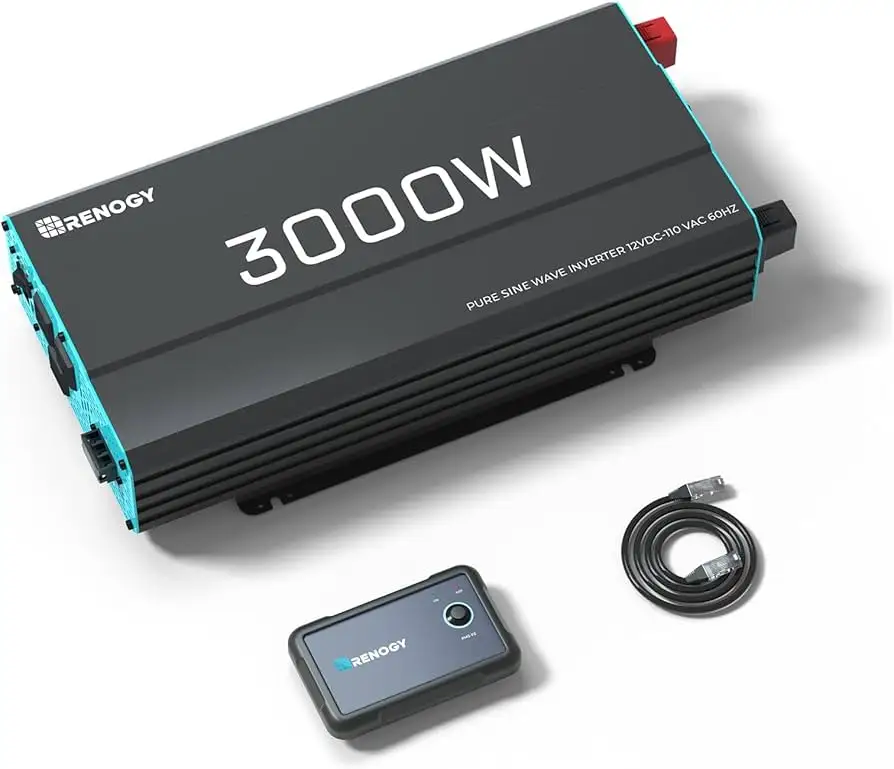
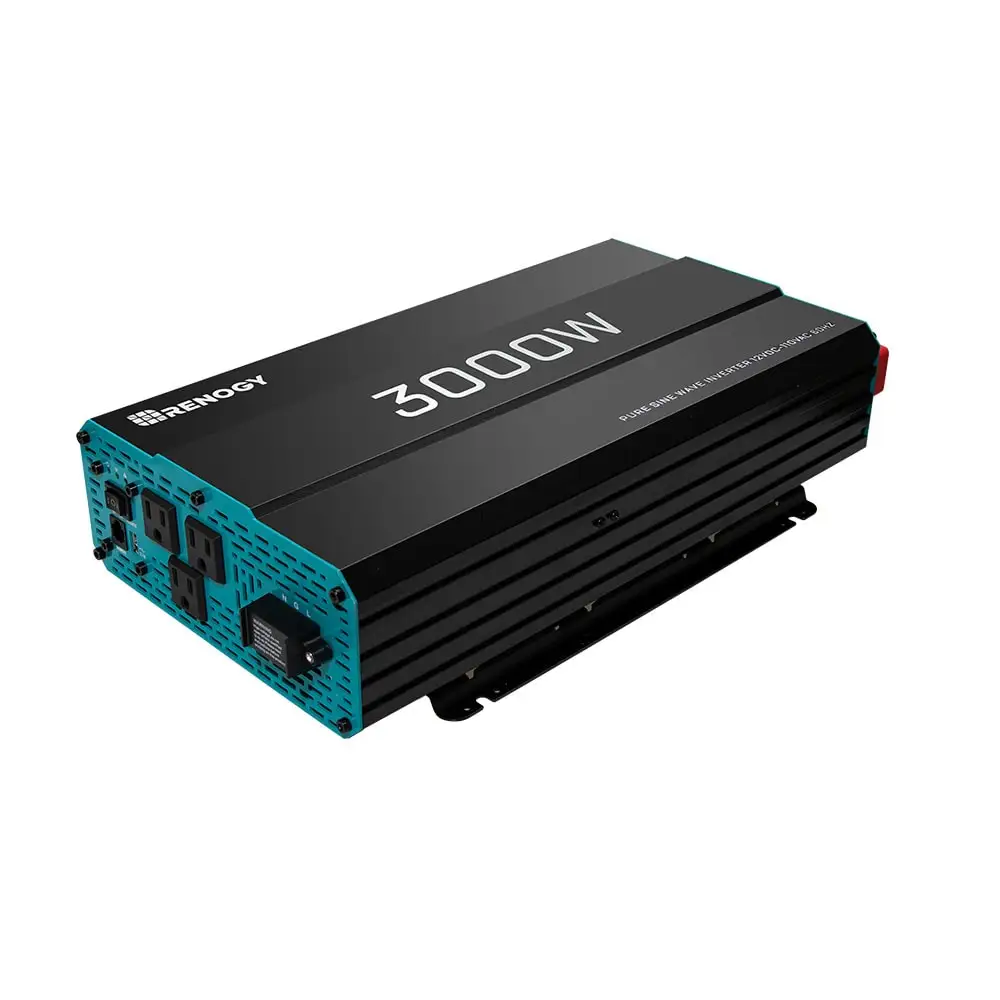
Renogy Inverter P2 3000W Review: Conditional Buy (7.7/10)
“Would be a good product, but the fact that there is no reset switch for the ground fault is a terrible flaw.” That single complaint shows up so sharply in owner stories that it shapes the whole buying decision around one question: will the built-in GFCI fit your wiring reality? Renogy Inverter P2 3000W Pure Sine Wave Inverter 12V to 120V with Wired Remote earns a conditional verdict: powerful and often impressively quiet, but with real edge cases that can turn into major headaches. Score: 7.7/10.
Quick Verdict
Conditional: Yes for RV/off-grid users who want clean power and remote on/off; No for certain marine installs where GFCI/grounding interactions become a recurring pain point.
| What owners agree on | Evidence from user feedback | Who it matters to |
|---|---|---|
| Quiet operation is a standout | A Home Depot reviewer said: “i also love that i never even hear it run.” | Van/RV sleepers; anyone mounting near living areas |
| Runs real loads (microwave, hair dryer, AC) when configured right | A Home Depot reviewer noted using the hardwire to run a “1400 watt microwave… hair dryer and curler.” | Full-time RVers, off-grid cabins |
| Remote control is genuinely useful | A Home Depot reviewer said: “love the on-off remote with trouble lights.” | Installs where the inverter is tucked away |
| GFCI behavior can be a dealbreaker | A Home Depot reviewer warned: “huge problem because the gfci kicks out at 5 milliamp.” | Boat owners, sensitive grounding setups |
| Build/QA concerns appear in a minority of reports | A Home Depot reviewer said “screws are falling out of it all the time.” | Buyers prioritizing ruggedness |
Claims vs Reality
Renogy’s official positioning leans hard on “pure sine wave,” “quiet,” and “safe” protections like GFCI. Digging deeper into user reports, a recurring pattern emerged: many owners feel those claims are accurate in normal RV/cabin use, but the same safety features can create friction in specific installations.
The “quiet, high-quality AC power” line is echoed directly in owner language. One Home Depot reviewer described a continuous boat setup and concluded, “i also love that i never even hear it run,” even while running a refrigerator 24/7. Another Home Depot reviewer framed the inverter’s performance as relief after past failures: “it fired right up ! it has performed perfectly ever since.”
Where marketing says “GFCI for enhanced safety,” multiple Home Depot reviews show that this protection can become the story. One user reported: “the gfci kicks out at 5 milliamp… i actually had to open the inverter to bypass the gfci to make it work on my boat.” Another called it “almost unbelievable” that “there is no reset switch for the ground fault,” adding, “i waited months and it finally reset itself somehow.”
Finally, the “easy to use” positioning is partly supported—but with caveats around wiring and documentation. A Home Depot reviewer praised immediate productivity: “installing and using the same day… used my chop saw and hand saw… i was impressed it really worked.” Yet another asked for clearer electrical guidance: “the spec’s should include how many amps it draws… [and] the correct wire size… and the correct amperage fuse.”
Cross-Platform Consensus
Universally Praised
A recurring pattern emerged across owner stories: when this inverter is installed with realistic expectations (not running every high-draw device at once) and sensible wiring, people describe it as “residential-like” power in mobile or off-grid contexts. One Home Depot reviewer said it “works just as well as residential,” then got specific: using the hardwired connection for a “1400 watt microwave… the wife’s hair dryer and curler,” and concluding, “i am very pleased with the overall function… full-time traveling for 8 months.” For RV and van-lifers, that kind of everyday appliance compatibility is the whole point of paying for pure sine wave.
Quiet operation also comes through as more than a spec-sheet claim—it’s a quality-of-life theme. A Home Depot reviewer running a boat install emphasized, “i also love that i never even hear it run,” and another described it as “works flawlessly, doesn’t even get warm.” For people mounting an inverter under a bed, under a seat, or in a camper cabinet, the difference between constant fan noise and near-silent operation changes how livable the setup feels.
Owners also repeatedly value the wired remote as a practical feature, not a gimmick. One Home Depot reviewer tied it directly to daily convenience: “love the on-off remote with trouble lights.” That matters for installs where the inverter is out of reach—under a seat, behind panels, or in a battery compartment—because it changes the inverter from “something you avoid touching” into “something you actually use.”
When performance is good, it’s often described with a sense of surprise. One Home Depot reviewer contrasted it against other products: “i have had such a bad experience with other inverters… it fired right up !… pleasantly surprised.” Another simply treated it as repeat-buy validation: “second one of these 3000 watt units building a second off grid system.”
After those stories, the praised themes can be summarized:
- Quiet/low-fuss operation in real installs (“never even hear it run”)
- Handles common RV/off-grid appliances (microwave, hair tools, refrigerators)
- Remote on/off adds real daily convenience (“love the on-off remote”)
Common Complaints
Digging deeper into user reports, the most serious complaints cluster around GFCI behavior and what happens after a trip. This isn’t a small nit—multiple Home Depot reviewers describe it as a design-level problem. One wrote: “huge problem because the gfci kicks out at 5 milliamp… had to… bypass the gfci.” Another reported that once it trips, “good luck,” because “there is no reset switch for the ground fault,” and the unit only recovered unpredictably: “i waited months and it finally reset itself somehow.” For marine users or anyone with complex grounding/isolators, these experiences suggest the safety feature can create repeated downtime.
The wiring experience is another friction point, especially for users expecting straightforward AC hardwire connections. One Home Depot reviewer complained the “three screws connections… are too close together to allow bent 10/2 wires” and too small for the connectors they wanted to use. The same reviewer described an unhelpful support interaction: “they asked me to provide a video… i’m still waiting for them to send me a video.” Notably, another Home Depot reviewer later posted an “ac connection update,” explaining a workaround: “used a yellow 10/12 gauge ring terminal… clipped the sides until it fit… now i have a secure and safe connection.” That combination—complaint followed by DIY fix—signals that some installations may require improvisation.
There are also durability/QA worries in a minority of stories, but they’re serious when they appear. One Home Depot reviewer said, “screws are falling out of it all the time,” and highlighted the risk: “if a nut… come loose… you now have a risk of shorting something out.” Another reported a short lifespan: “inverter lasted 1 month.” And in a harsh marine environment, corrosion came up: a Home Depot reviewer described an earlier unit placed where “condensing salty moisture” existed and said it “lasted only a year… a lot of corrosion inside.”
After those stories, the complaint themes can be summarized:
- GFCI trips and lack of a clear reset path (“no reset switch”)
- AC hardwire connection tightness/connector fit frustrations
- Occasional QA/durability flags (loose screws, early failure, corrosion in salty moisture)
Divisive Features
The same GFCI protection that is marketed as a safety win becomes divisive in user narratives. For some, it’s part of a stable, long-running setup; for others, it’s the central reason the inverter nearly fails the job. One Home Depot reviewer running a boat refrigerator 24/7 said they had “all sorts of trouble with the ground fault tripping,” but found a system-level workaround by removing a galvanic isolator, adding, “this fix is not a problem” for their use case. In contrast, another boat owner’s response was more extreme: they “had to open the inverter to bypass the gfci.”
Load handling is also divisive—but in a predictable “physics meets expectations” way. A Home Depot reviewer who loved the power still warned about not doing everything at once: “it will power everything in my travel trailer, not at once, a/c by itself but not with the microwave.” That experience doesn’t necessarily contradict the 3000W rating; it shows how real-world starting surges and outlet/hardwire choices shape outcomes.
Trust & Reliability
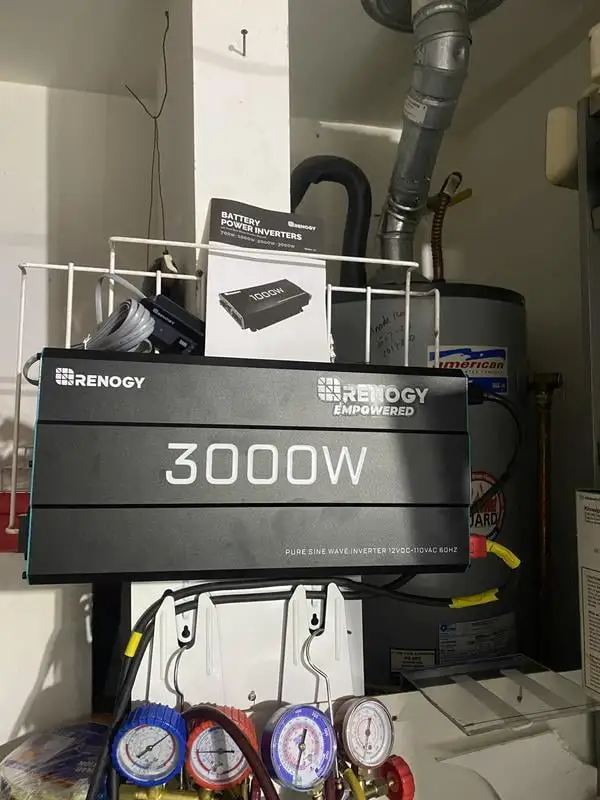
Long-run stories are encouraging in normal conditions but cautionary in harsh ones. One Home Depot reviewer reported continuous operation: “so far it has run continuously now for 4 months without a problem,” using it to keep a “120 volt standard refrigerator… 24/7.” That kind of daily duty cycle is exactly what many off-grid users want validated by another person’s experience.
At the same time, durability looks sensitive to environment and installation. The same reviewer contrasted their prior unit placed in “condensing salty moisture,” which “lasted only a year” and had “a lot of corrosion inside.” Another reviewer reported a rapid failure—“inverter lasted 1 month”—without additional context, which makes it hard to attribute cause, but it does add uncertainty for buyers who need maximum uptime.
Support quality also shows up as a trust factor. One wiring-complaint reviewer described back-and-forth with Renogy: “they asked me to provide a video… i’m still waiting for them to send me a video of how their design team connected the wires.” Meanwhile, another reviewer had a smoother service story when buying the wrong item: “renogy assisted me with the return and promptly shipped this one.”
Alternatives
Only one true alternative product category is explicitly presented in the provided data: Renogy’s own inverter charger models (sold in the UK listing), which combine DC-to-AC conversion with battery charging from shore power. The inverter-only P2 is repeatedly framed by owners as the “heart” of off-grid power, but it will not charge your batteries.
If you’re the user who expects a single box to both run AC loads and handle shore-power charging, the official Renogy FAQ language is blunt: “the inverter… can only convert dc power to ac power,” and Renogy directs buyers toward an inverter charger line instead. That distinction matters for RVers who bounce between campgrounds and boondocking, because it determines whether you need additional charging hardware.
Price & Value
Pricing in the provided listings ranges widely by market and condition: refurbished/open-box pricing was shown at $299.99 (sold out), while other official listings show $359.99–$399.99 for the inverter. Value, in user language, tends to be framed as “it replaced multiple bad experiences” rather than as a bargain.
Several Home Depot reviewers describe the inverter as enabling lifestyle upgrades—“creature comforts… rv living full time,” or “more time boondocking.” Those buyers treat it like infrastructure, not a gadget. One reviewer summed that sentiment as “one of my best purchases,” specifically because it unlocked longer off-grid stays.
Resale value trends aren’t directly described in user quotes, but marketplace data (eBay search results) suggests active buying/selling across Renogy inverters and related gear. For shoppers trying to maximize value, refurbished/open-box deals are present in the data, paired with shorter warranties (the refurbished listing mentions a “6-month warranty” and “no refunds or exchanges… without quality issues”), which is a practical tradeoff.
FAQ
Q: Can it run an RV air conditioner and a microwave at the same time?
A: Usually not, based on owner experiences. A Home Depot reviewer said it could power “a/c by itself but not with the microwave.” Another user reported it could run a “16,000 btu a/c unit if other loads are not really being used,” sometimes with a soft start.
Q: Does it charge the batteries like an inverter charger?
A: No. Renogy’s own FAQ states the 12V DC to AC inverter “can only convert dc power to ac power,” and “can i use this inverter to charge my batteries? no.” If you need charging from shore power, the inverter charger category is the relevant alternative.
Q: Is the wired remote actually useful?
A: Yes, in real installs where the inverter is mounted out of reach. A Home Depot reviewer said they “love the on-off remote with trouble lights.” Another common scenario described is mounting the inverter under seats or inside compartments, where a remote saves constant access.
Q: What’s the biggest real-world problem owners run into?
A: Ground-fault (GFCI) trips and reset behavior, especially in boats. A Home Depot reviewer said the “gfci kicks out at 5 milliamp,” and another wrote there is “no reset switch for the ground fault,” describing a months-long wait before it “finally reset itself.”
Q: Is it quiet under load?
A: Many owners say yes. One Home Depot reviewer concluded, “i also love that i never even hear it run,” even during continuous use for a refrigerator. Another described it as “works flawlessly, doesn’t even get warm,” though noise and heat will still depend on load and ventilation.
Final Verdict
Buy Renogy Inverter P2 3000W Pure Sine Wave Inverter 12V to 120V with Wired Remote if you’re an RVer, van-lifer, or off-grid cabin user who wants clean power for microwaves, hair tools, and refrigerators, and you value remote on/off for a tucked-away installation. A Home Depot reviewer’s “works just as well as residential” story captures the upside when the system is sized and wired well.
Avoid it if your setup is marine/grounding-complex and you can’t tolerate GFCI-related downtime; multiple boat owners describe “ground fault tripping” and one called the lack of reset “a terrible flaw.” Pro tip from the community: where AC hardwire connections felt cramped, one Home Depot reviewer shared a workaround—“used a… ring terminal… clipped the sides until it fit”—suggesting some installs may require hands-on adaptation.