Panasonic FV-30VQ3 Review: Powerful, Conditionally Worth It
“Not a whisper quite fan!” is the kind of line that keeps showing up right next to people calling it “stupid quiet,” and that contradiction is the story. Panasonic WhisperCeiling Bathroom Exhaust Fan, FV-30VQ3 with Installation Kit earns a conditional verdict, largely because performance praise is loud—and so are the installation complaints. Score: 8.2/10.
Quick Verdict
Conditional: Yes—if you can run (or already have) a 6" duct and you’re ready for a bigger housing and more involved mounting. No—if you’re doing a tight retrofit with a standard 4" duct and want truly “whisper” sound for recording spaces.
| Decision Factor | What Users Liked | What Users Didn’t Like | Sources |
|---|---|---|---|
| Air movement (CFM) | “this sucker moves some air!!!” | “probably overkill for most bathrooms” | Amazon reviews |
| Noise | “so quiet, you can hardly even hear it” | “far from whisper quiet” (measured dB claims) | Amazon reviews |
| Retrofit install | “doable… easier with 2 people” | “nightmare to install” / “not recommended… existing construction” | Amazon reviews |
| Ducting | Works best with 6" | “Reducing… to 4” … will likely be noisier” | Amazon reviews |
| Controls | Z-Wave speed control success | DC models harder; AC ok with right switch | |
| Listing accuracy | Some buyers happy | “description is confusing and incorrect” / “states it has hangers: it does not” | Amazon reviews |
Claims vs Reality
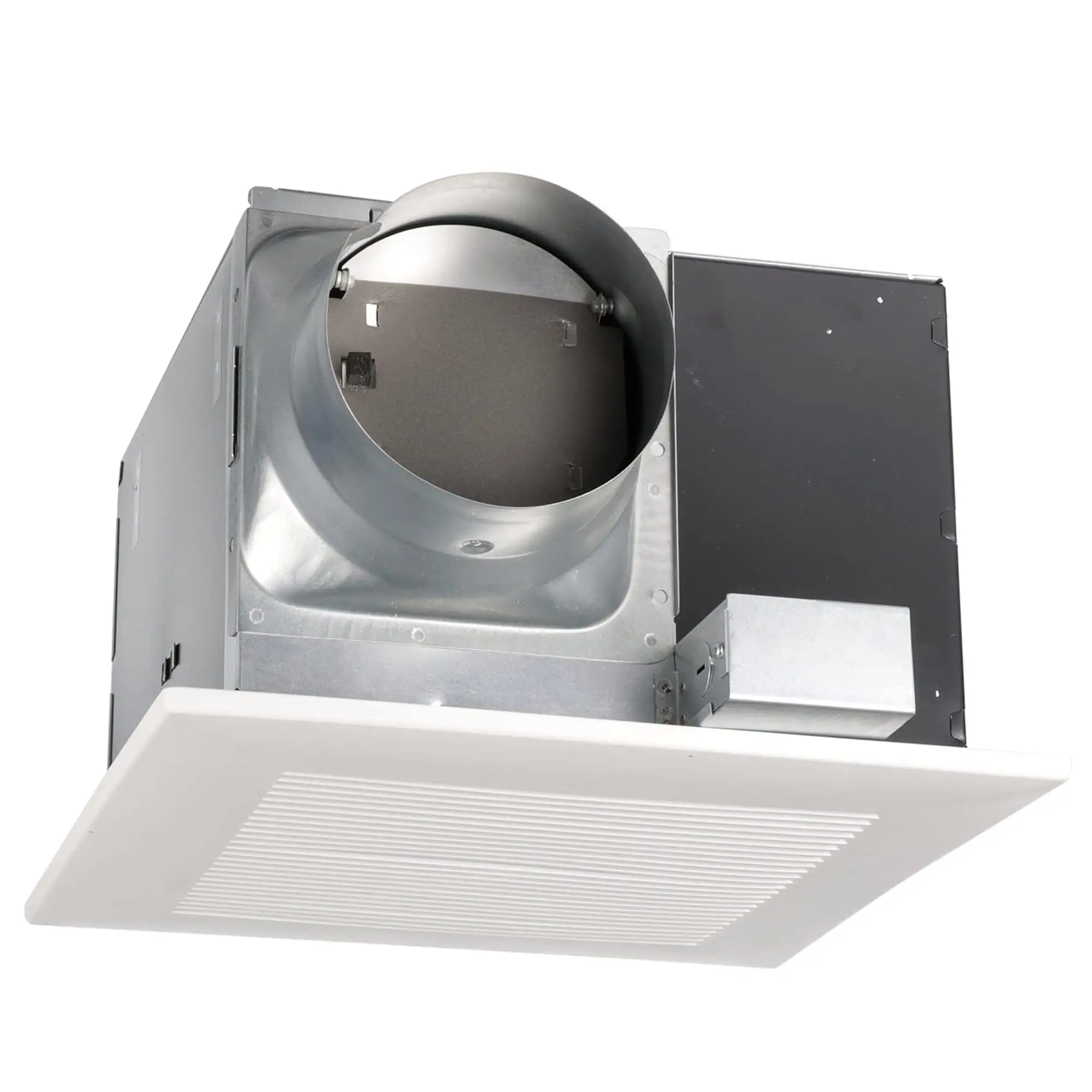
Panasonic markets the FV-30VQ3 as “powerful yet quiet,” and that’s exactly the tension in real-world feedback. The official spec lists noise at “2.0 sones” for “290 @ 0.1" SP” on Panasonic’s site. While officially rated at 2.0 sones, multiple users describe audible “whooshing” and even “metallic rattle,” especially when ducted poorly or reduced down. A verified buyer on Amazon noted: “at full speed, you can hear the fan and some light rattling noise,” suspecting it came from “pushing a high volume of air through the reducer into the 4-inch duct.” Another verified buyer went further: “it’s far from whisper quiet,” claiming they measured “73.5 decibels” at full speed. (Amazon reviews; Panasonic specs page)
Installation is another marketing gap. Some listings imply easy mounting hardware, but multiple reviewers insist the 290 CFM version lacks what they expected. A verified buyer on Amazon wrote: “please note, the 290 cfm version does not include an adjustable mounting bracket… you will need to construct a mounting bracket (frame) out of 2x4’s.” Another verified buyer summarized the listing mismatch bluntly: “the description states it has hangers: it does not.” Meanwhile, at least one retailer page claims “adjustable mounting brackets… included,” which clashes with repeated buyer experiences. (Amazon reviews; Build.com listing)
Finally, the “bathroom fan” label doesn’t stop people from using it elsewhere, and the stories reveal why. Users trying to solve stubborn smoke, cooking odors, or basement air issues describe the FV-30VQ3 as a workaround when a traditional range hood or weak exhaust wasn’t doing the job. A verified buyer on Amazon explained they used it to ventilate a kitchen where the range hood “only circulates air through a charcoal filter,” saying even at lower settings it “does an excellent job of removing steam and smoke.” That same user acknowledges they’re going off-label: “panasonic says in the manual that this model is not meant for use in kitchen but i use it anyway.” (Amazon reviews)
Cross-Platform Consensus
Universally Praised
“Moves a ton of air” is the closest thing to a universal refrain, and it matters most for homeowners fighting persistent humidity or stale air in larger spaces. A recurring pattern emerged: people replacing 50 CFM-era fans or dealing with big bathrooms talk about the FV-30VQ3 like a reset button. A verified buyer on Amazon replacing a “previous owner’s fan which was only 50 cfm” said: “the power on this fan was outstanding.” Another verified buyer who battled shower steam in a “160 sq ft” bathroom described the outcome after the painful install: “no more steamy bathroom… and no more hot bedroom after showers.” (Amazon reviews)
Quiet—at least for many buyers—shows up as praise when the ducting is handled well. Digging deeper into user reports, the “quiet” claims often include conditions: attic access, straight duct runs, and avoiding reducers at the fan outlet. A verified buyer on Amazon wrote: “the fan is so quiet, you can hardly even hear it… if you have attic access… this will be no problem.” Another verified buyer tied noise directly to setup mistakes: “all the reviews that mentioned the fan being noisy involved placing an exhaust duct reducer (6" to 4") right at the fan discharge outlet. so don’t do this.” (Amazon reviews)
There’s also an undercurrent of respect for build quality and brand consistency among repeat Panasonic buyers. One verified buyer on Amazon framed it as a second purchase driven by prior satisfaction: “the quality of that fan is so good/quiet that there was no question in my mind what brand to buy.” On Reddit, a user describing non-bathroom use called it “stupid quiet and really sucks (i couldn’t resist),” using it for a DIY fume/airflow setup. (Amazon reviews; Reddit via redditfavorites.com)
After the narrative, the praise tends to crystallize into a few repeatable wins:
- Airflow that solves real humidity/odor problems in larger rooms (Amazon)
- “Quiet” performance when paired with proper 6" ducting and fewer restrictions (Amazon)
- Strong perceived quality and repeat-buy behavior (Amazon)
- Flexibility to run on different controls/smart fan controllers for some setups (Reddit)
Common Complaints
Installation is the most consistent pain point, and it hits hardest for retrofit homeowners without attic access or without room to open up drywall. Multiple reviewers describe this as a “new construction” style unit that can be forced into remodels—but not gracefully. A verified buyer on Amazon said: “this ended up being a nightmare to install… poorly made for ‘old jobs’ (renovation).” Another verified buyer warned: “reading the instructions, you find out this is not recommended for installation in existing construction… that would have been nice to know up front.” (Amazon reviews)
The missing-mounting-hardware issue comes up repeatedly as a source of frustration because it turns an expected fan swap into carpentry. One verified buyer on Amazon emphasized: “the 290 cfm version does not include an adjustable mounting bracket… you will need to construct a mounting bracket (frame) out of 2x4’s.” Another echoed the listing confusion: “description is confusing and incorrect… the description states it has hangers: it does not.” (Amazon reviews)
Duct size becomes the second trapdoor. The FV-30VQ3 is designed around a 6" duct (official specs confirm 6"). Users trying to keep an existing 4" duct often end up wrestling with reducers, noise, and perceived performance loss. A verified buyer on Amazon summed it up: “most ‘normal’ home exhaust fans have 4" exhausts and if you really want the max cfm, you will need to change to 6".” Another detailed the consequences: reducing to 4" right at the fan made it “so noisy” and output disappointing, but moving the reducer farther down the line made a “huge difference.” (Amazon reviews; Panasonic specs)
After the narrative, the complaints cluster into practical warnings:
- Retrofit installs can be “hands down the hardest” for DIY remodelers (Amazon)
- Listings can be misleading about included hangers/brackets (Amazon)
- 6" ducting is not optional if you want quieter, closer-to-rated performance (Amazon)
- Physical layout annoyances (junction box placement, odd outlet sizing) complicate bracing and duct fitment (Amazon)
Divisive Features
Noise is the most polarizing trait because people are talking about different realities: full-speed airflow through constrained ducting versus an open 6" run, or a bathroom context versus a recording context. A verified buyer on Amazon framed the disappointment numerically and situationally: they bought it for a “video studio,” but “we cannot” use it during filming because “fan noise is picked up very readily.” In contrast, another verified buyer using a multi-speed wall switch claimed: “at the two lowest speeds, you can not hear the unit,” and even the third-highest was “barely” audible. (Amazon reviews)
“Overkill” is also divisive, depending on room size and goals. One Amazon reviewer advised: “good fan but probably overkill. get the 150 or 190 cfm,” describing the FV-30VQ3 as “almost certainly overkill for most bathrooms.” Meanwhile, the people buying it for stubborn steam, basements, or odor-heavy spaces seem to choose it precisely because it’s oversized. On Reddit, one user embraced that mindset: “it is total overkill… but i’m a go big or go home person.” (Amazon reviews; Reddit)
Trust & Reliability
On “trust” signals, the clearest pattern is not scam behavior but expectation mismatch: the product arriving without the hangers/brackets implied by some listings. A verified buyer on Amazon flagged it early: “amazon’s offering provides the option of selecting a 190 cfm version… i believe the product description is for the 190 cfm version,” and then warned the 290 version “does not include an adjustable mounting bracket.” Another verified buyer echoed: “description is confusing and incorrect.” These aren’t counterfeit claims—but they are friction points that can make buyers feel misled. (Amazon reviews)
Long-term durability is referenced more as brand reputation than “6 months later” updates in the provided Reddit snippets. Still, the use-cases hint at confidence: a Reddit user describes controlling the FV-30VQ3 with a Z-Wave fan controller across multiple speeds, implying ongoing use in a “computer room.” On Amazon, one buyer using it in a kitchen acknowledged the risk of grease over time: “even if it will die in 3-5 years from oil clogging up… i’ll just replace it.” That’s not a failure report—but it shows how some owners mentally price in heavy-duty use. (Reddit via redditfavorites.com; Amazon reviews)
Alternatives
Only a few competitors/models are explicitly mentioned in the provided data, and the most useful comparison comes from an Amazon reviewer who owned multiple Panasonic units. For typical bathrooms, that reviewer steers people away from the FV-30VQ3’s size and install burden: “panasonic fv-15vq5 (150 cfm)… my favorite,” praising that it has a “gentle sound” and “easy installation with the included telescoping mounting brackets.” They describe the FV-08VQ5 (80 CFM) as “so quiet that you can hardly tell it’s on,” but also admit it’s “not loud enough to create privacy,” underscoring how “quiet” can be a feature or a downside depending on expectations. (Amazon reviews)
The same reviewer positions the FV-20VQ3 (190 CFM) as a middle ground: “moderate whooshing sound” but “difficult installation because it doesn’t include mounting hardware,” which mirrors the FV-30VQ3’s biggest complaint while lowering “overkill” risk. In other words, users who want Panasonic airflow without committing to 6" duct upgrades often appear happier stepping down in CFM—at least in that reviewer’s experience. (Amazon reviews)
Price & Value
Across listings and resale signals in the provided data, pricing floats widely depending on retailer and condition. A Factory Outlet listing shows “$235.99” for the FV-30VQ3; Build.com shows “$271.99”; and an eBay listing shows “$254.89 + $42.98 shipping.” On the lower end, a PicClick snapshot shows an “open box” unit sold at “$179.95.” (FactoryOutletStore; Build.com; eBay; PicClick)
Value perception, in user language, tends to hinge on avoiding a full kitchen hood install or solving a persistent ventilation problem. A verified buyer on Amazon compared it to installing “a real kitchen vent” as “over kill” due to “at least $1,700” total cost and “deafening noise,” preferring this fan even if it might not be intended for kitchens. Another buyer emphasized cost in a different way: once it’s in, they plan on “buying more to replace existing fans,” but only “where i have the attic access” to support the 6" duct upgrade. (Amazon reviews)
Community buying tips are more about preventing hidden costs than chasing the cheapest unit:
- Budget for 6" ducting (and possibly roof/soffit/wall changes) to avoid “noisy” reducer setups (Amazon)
- If reducing to 4", users report better results when the reducer is not “right at the output of the fan” (Amazon)
- Expect carpentry or blocking work if the fan lacks mounting brackets in your package/version (Amazon)
FAQ
Q: Does the FV-30VQ3 really come with mounting brackets/hangers?
A: Some buyers say no. A verified buyer on Amazon warned: “the 290 cfm version does not include an adjustable mounting bracket,” and another wrote: “the description states it has hangers: it does not.” Expect to build a 2x4 frame for joist installs. (Amazon reviews)
Q: Is it actually “whisper quiet”?
A: It depends on setup and expectations. One verified Amazon buyer said: “the fan is so quiet, you can hardly even hear it,” while another said: “it’s far from whisper quiet,” citing their own decibel readings. Several users tie extra noise to reducing 6" down to 4" near the fan. (Amazon reviews; Panasonic specs)
Q: Can I connect it to a 4-inch duct?
A: People do, but many report tradeoffs. A verified buyer on Amazon used a reducer and noted “light rattling noise,” blaming airflow through the reducer. Another buyer said placing a reducer at the fan made it “so noisy,” but moving it farther away made a “huge difference.” The fan is designed for 6" ducting. (Amazon reviews; Panasonic specs)
Q: Is it a good choice for existing construction (retrofit)?
A: Many owners say it’s possible, but not pleasant. A verified buyer called it “not recommended… existing construction,” while another said it was “hands down the hardest” retrofit install they’d done. Others say it’s manageable with attic access and willingness to patch drywall. (Amazon reviews)
Q: Can I control fan speed with smart controls?
A: Some users have. Reddit user (username not provided in the data excerpt) said they controlled a “panasonic fv-30vq3” with a “GE Enbrighten… Z-Wave Plus smart fan control,” getting “off, low, medium and full speed.” This suggests AC-motor control compatibility with the right controller. (Reddit via redditfavorites.com)
Final Verdict
Buy if you’re ventilating a larger bathroom, basement, or stubborn humidity problem—and you can commit to a proper 6" duct run and a more involved install. A verified buyer on Amazon celebrated the end result: “this sucker moves some air!!! no more steamy bathroom.”
Avoid if you want a quick swap into an existing 4" duct with minimal drywall work, or if “whisper quiet” means “usable during filming.” A verified buyer on Amazon said they bought it for a video studio “which we cannot” use because the noise is picked up.
Pro tip from the community: a verified buyer on Amazon said the noisy setups often come from reducing “6" to 4" right at the fan discharge outlet,” advising: “so don’t do this,” and another buyer reported a “huge difference” when they moved the reducer farther down the duct run.