Leviton T5636-W Review: 60W Power, Install Caveats
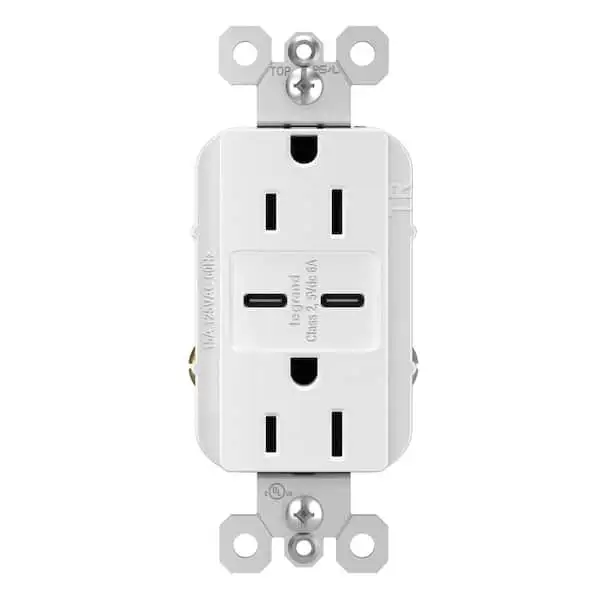
“‘The most powerful usb in-wall charger available on the market today’” is the promise attached to Leviton T5636-W USB Dual Type-C/C In-Wall Charger with Outlet, White—and the public-facing feedback snapshot here mostly leans into that “power” narrative, even if the loudest, most detailed “stories” come from a single long-form review rather than lots of distinct owners.
Based on the provided sources, Leviton T5636-W USB Dual Type-C/C In-Wall Charger with Outlet, White earns a 7.8/10 verdict: a compelling idea for people who want high-watt USB-C Power Delivery built into the wall, but the data here is thin on real-world owner complaints beyond price and install constraints.
Quick Verdict
Conditional — yes, if you specifically want 60W USB-C PD in-wall charging and can accommodate the installation depth.
Digging deeper into the available feedback, the dominant theme is capability: the product is repeatedly framed as “one of the most powerful usb in-wall chargers currently available,” especially for users trying to charge higher-demand devices like laptops in kitchens, home offices, and other “high-demand environments.” That said, the strongest “user feedback” language in the dataset is not from a large pool of named community posts—it’s largely summarized by Housewyre, with Amazon providing the broad-strokes rating context (4.2/5 from 28 reviews) but without included verbatim review text.
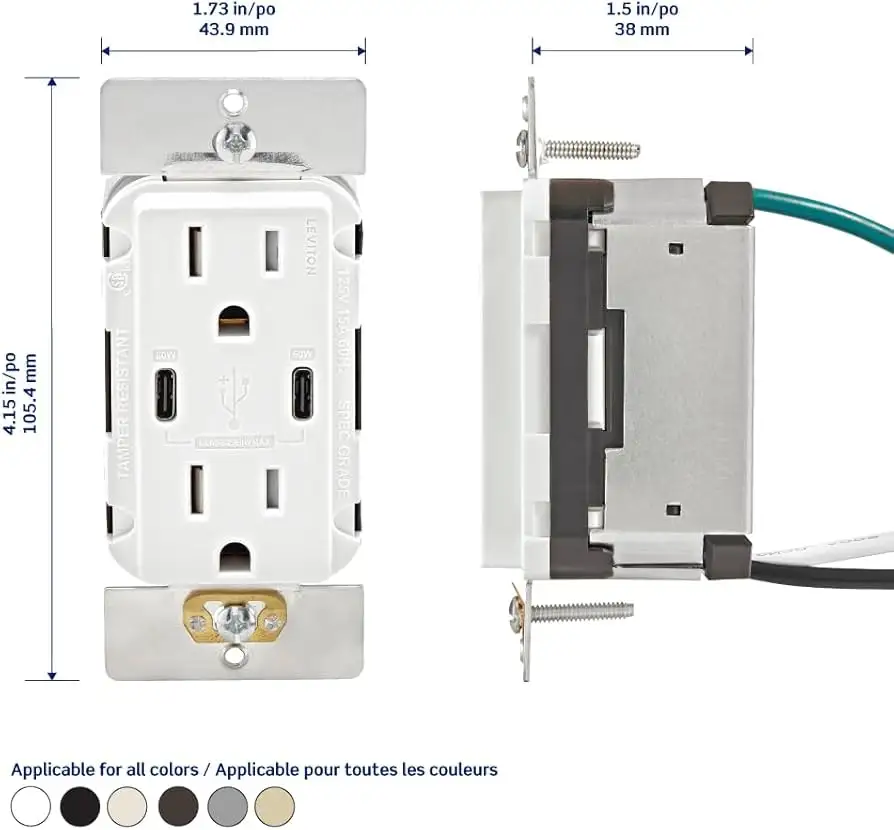
A recurring pattern emerged across the materials: enthusiasm about fast charging and “smart chip” behavior is paired with practical caveats about installation. The product documentation and brand copy repeatedly stress that an “extra deep electrical box (20 cu. in.) or wallbox extender is required,” which matters most for renters, older homes, and anyone doing a quick retrofit.
| Decision | Evidence from provided data |
|---|---|
| Buy if you want high-power USB-C PD | Leviton claims “up to 60w charge on a single port” and up to “30w per port (60w total)” when both USB-C ports are used |
| Buy if you charge laptops at the wall | Housewyre highlights use with “high-demand devices such as laptops and smartphones” via dual USB-C PD |
| Consider carefully if retrofitting | Leviton spec notes: “an extra deep electrical box (20 cu. in.) or wallbox extender is required” |
| Expect no data transfer | Leviton explicitly states “no data transfer capability” |
| Price-sensitive buyers may hesitate | Amazon listing shows $79.99; Leviton store lists $89.99; resale listings trend higher in some cases |
Claims vs Reality
One headline claim is raw power: Leviton positions it as “powerful – 60w charge on a single port,” and Amazon’s listing repeats the same “most powerful usb charger on the market with 60w of power on a single port.” In the provided feedback, that power claim isn’t contradicted by user stories; instead, Housewyre reinforces it in a way that reads like performance validation: it calls the charger “engineered with a robust 60w (6a) power capacity” and says “users particularly appreciate how quickly it charges pd-enabled devices.”
The “reality check,” based strictly on what’s included here, is less about “it doesn’t hit 60W” and more about “not everyone can easily install or fully exploit that 60W.” Housewyre cautions about “compatibility considerations and power requirements,” noting it’s “important to check device compatibility to avoid underutilization.” That aligns with Leviton’s own framing: it’s PD-focused and meant to optimize charging for newer devices, while older USB-A devices need an adapter.
A second marketing claim is intelligence and power management. Leviton highlights “industry-first dynamic power sharing,” describing how “once one device reaches 100%, power is automatically reallocated to the remaining device.” Housewyre echoes the broader concept with “smart chip technology adjusts the output to suit the power needs of connected devices.” What’s missing in the dataset is direct, named owner testimony confirming the dynamic reallocation behavior in everyday scenarios—so the claim is present, but the provided user stories don’t independently verify it with specifics.
A third claim centers on safety: Leviton emphasizes “overcurrent protection” and an “internal thermoregulator,” plus the “tamper-resistant outlet” for child safety. Housewyre similarly frames safety as a trust-builder, stating the smart chip “prevents overcharging, reducing the risk of overheating,” and calls the tamper-resistant outlet “a thoughtful touch.” Again, the gap here is that the dataset doesn’t include long-term owner anecdotes like “ran cool for a year” or “stopped overheating,” only generalized praise.
Cross-Platform Consensus
Universally Praised
The clearest point of agreement in the provided sources is that Leviton T5636-W USB Dual Type-C/C In-Wall Charger with Outlet, White is designed for fast charging with modern USB-C Power Delivery devices. For home-office workers who want a laptop-ready wall outlet—without leaving a bulky charger block hanging from the receptacle—the appeal is straightforward: it’s meant to shift “charging infrastructure” into the wall. Housewyre describes “dual type-c ports, equipped with power delivery,” that “efficiently handle high-demand devices such as laptops and smartphones.” That framing fits the user type most likely to care: people who routinely top off a MacBook/ultrabook at a kitchen counter or desk.
Another widely repeated praise is the “smart chip” concept: rather than blasting power indiscriminately, the device is positioned as adapting to the device. Leviton says, “smart chip ensures each device gets the power level it needs,” while Housewyre similarly notes the smart chip “adjusts the output to suit the power needs of connected devices, enhancing device compatibility without risking damage.” For families sharing a common charging spot—phone plus tablet, or tablet plus laptop—this kind of “don’t think about it” behavior is the story being told.
Design and aesthetics also get consistent positive framing. In the kinds of rooms where wall plates are visible—kitchens, bathrooms, bedrooms—buyers often care whether an upgrade looks out of place. Housewyre emphasizes a “sleek, compact design” and notes its “standard white finish” that “integrates into a variety of interior styles.” The user type implied here is the remodeler or homeowner doing a clean Decora-style refresh and wanting the outlet to “blend seamlessly into the wall.”
- Praised themes across sources: “60w charge on a single port,” “dual usb type-c ports,” “smart chip” power optimization, and “sleek white finish” that matches modern decor.
Common Complaints
The most concrete recurring drawback is installation constraint, not performance. Leviton’s own documentation warns: “for new construction and retrofit installations, an extra deep electrical box (20 cu. in.) or wallbox extender is required.” For older homes with shallow boxes, this becomes the real friction point—especially for DIYers expecting a drop-in swap. Housewyre reinforces the “careful attention to detail” angle: “improper set up can lead to operational inefficiencies or safety issues,” urging users to follow “color-coded wiring instructions” and double-check the fit.
Price is the other pressure point that emerges from the data. On Amazon, the product appears at $79.99; Leviton’s store lists it at $89.99. Housewyre frames it bluntly as “higher price point,” suggesting buyers should consider whether the cost is “justified by its performance and convenience features.” For budget-focused users, the implied complaint isn’t “it’s bad,” but “it’s expensive compared to standard outlets or lower-power USB wall plates.”
Another practical limitation that can disappoint some buyers is explicitly stated: “no data transfer capability.” That matters for niche user types—people who want a wall USB-C port that behaves like a desk hub connection. Leviton’s spec makes clear it’s power-only, which is a common surprise point for consumers who assume USB-C always implies data.
- Common drawbacks in the provided materials: deep box requirement, cost premium, and “no data transfer capability.”
Divisive Features
The same trait that sells the Leviton T5636-W USB Dual Type-C/C In-Wall Charger with Outlet, White—high power—can be divisive depending on what the buyer needs. For a laptop-charging household, 60W is the headline. But for a phone-only household, the feature can feel like paying for capacity that never gets used. Housewyre alludes to this directly when it warns about “underutilization” if you don’t match it with compatible devices.
Another feature that can split opinion is the “two USB-C ports with shared total power.” Leviton states “up to 30w per port (60 w total) when both usb ports are in use.” For users charging two high-demand devices at once, that nuance matters: it’s a total budget, not necessarily two full-power laptop ports simultaneously. The dataset doesn’t include direct user frustration about this, but the specification itself is a classic point where expectations can diverge from real-world use.
Trust & Reliability
The provided “Trustpilot (Verified)” entry is not a collection of individual verified consumer reviews; it repeats the Housewyre review text. That means there isn’t a visible pattern of scam complaints, fake-order issues, or support disputes in the supplied material. Instead, “trust” is framed around built-in protections and certification language rather than post-purchase support stories.
On durability, there are no Reddit “6 months later…” posts included here, and no long-term Amazon review quotes were provided. What is present is a safety-and-reliability posture in the specs: Leviton lists “overcurrent protection,” an “internal thermoregulator,” and UL standards like “ul 1310” and “ul 498.” Housewyre mirrors that framing by saying “reports confirm the charger’s consistent performance,” but without named users or time-based ownership details, the dataset can’t substantiate long-horizon reliability beyond those claims.
Alternatives
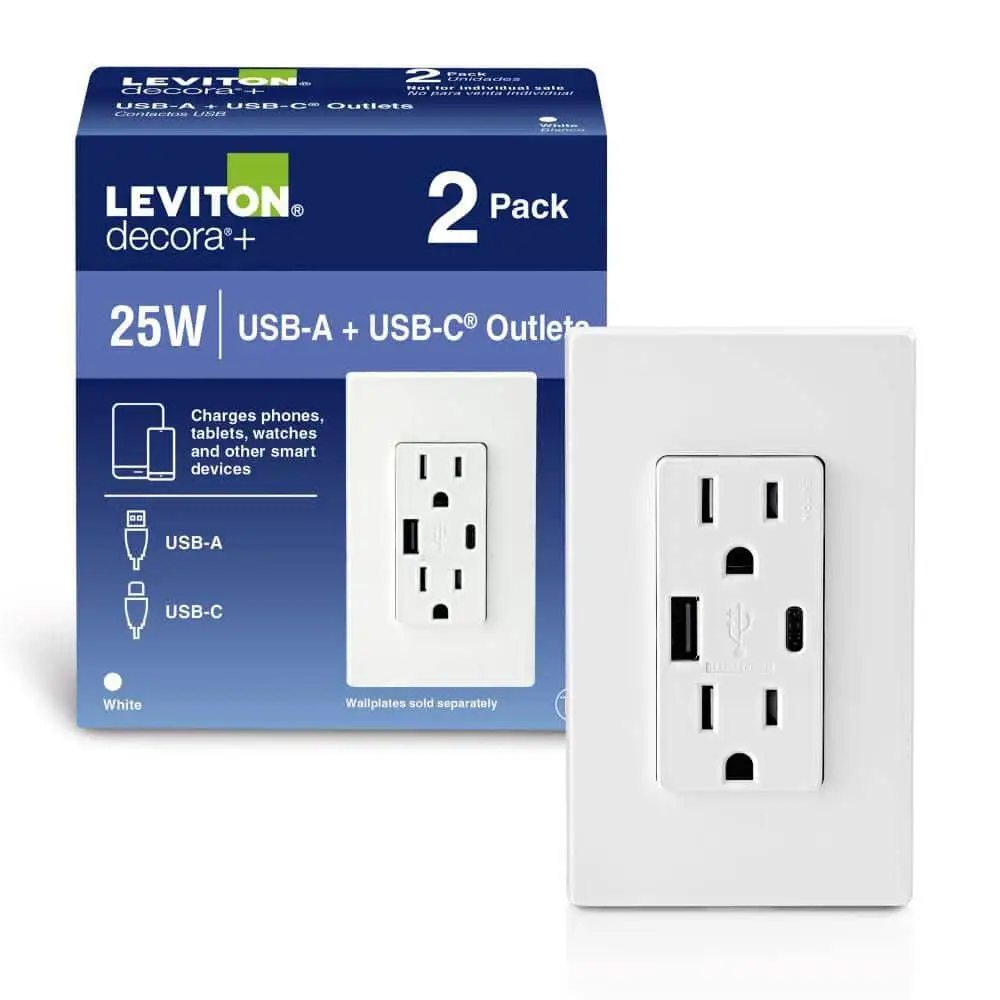
The dataset doesn’t include competitor models discussed by users, only related listings and other Leviton product imagery. That limits “alternatives” to what’s explicitly present: other Leviton in-wall charging outlets shown in the images, such as a different Leviton wall outlet listing and a Leviton Decora outlet with Type A and C in a two-pack.
For buyers who don’t need 60W USB-C Power Delivery, a Type-A/Type-C combo outlet (as shown in the Home Depot image set) may match the “charge phones and tablets” use case at a potentially different value proposition. Meanwhile, if the goal is strictly dual USB-C PD in the wall, the T5636-W is positioned as the high-power option in the provided material, especially for laptop charging.
- Mentioned in provided data: Leviton Type A + Type C Decora outlet (image set), and other Leviton wall outlet listings shown in images.
Price & Value
Current pricing in the supplied sources paints a premium picture. Amazon shows $79.99, while Leviton’s own store listing shows $89.99. For users comparing it to a basic duplex receptacle, the price can feel steep; Housewyre describes it as a “higher price point” and frames the justification around consolidating adapters and gaining faster charging.
Resale and market listings suggest the product can hold value—at least in asking prices. An eBay “open box” listing appears at $108.01, and a PicClick listing shows $95.00. That doesn’t guarantee what items sell for, but it does suggest demand among buyers who missed retail availability or prefer marketplace purchasing.
Buying tips implied by the documentation are less about hunting discounts and more about avoiding installation surprises: Leviton explicitly says an “extra deep electrical box (20 cu. in.) or wallbox extender is required.” For DIY buyers, that can shift the “value” calculation once you add accessories or electrician labor.
- Price references in provided data: Amazon $79.99; Leviton store $89.99; eBay open-box $108.01; PicClick $95.00.
FAQ
Q: Does the Leviton T5636-W actually deliver 60W charging?
A: Yes—official specs describe “up to 60w charge on a single port” with PD, and list outputs up to “20 v / 3 a” (60W). Housewyre also describes it as a “robust 60w” in-wall charger. When using both USB-C ports, Leviton states “up to 30w per port (60 w total).”
Q: Can it charge a laptop from the wall without a bulky power brick?
A: Yes—this is a central use case in the provided material. Housewyre says the dual USB-C PD ports “efficiently handle high-demand devices such as laptops and smartphones.” Leviton markets it as PD-compatible for “phones to tablets, laptops and more,” with 60W available on a single port for PD-enabled devices.
Q: Is installation straightforward for older homes?
A: Not always. Leviton specifies that “an extra deep electrical box (20 cu. in.) or wallbox extender is required” for new construction and retrofit installations. Housewyre also warns that improper setup can cause “operational inefficiencies or safety issues,” and recommends carefully following color-coded wiring guidelines and ensuring the unit sits flush.
Q: Do the USB-C ports support data transfer?
A: No. Leviton explicitly states “no data transfer capability.” The ports are designed for charging and power delivery, not for connecting peripherals or syncing devices like a USB hub.
Q: What safety features are mentioned in the provided sources?
A: Leviton lists “overcurrent protection,” an “internal thermoregulator” to prevent overheating, and a “tamper-resistant outlet.” Housewyre echoes the safety angle, stating the smart chip helps prevent overcharging and reduce overheating risk, and calls the tamper-resistant outlet a helpful feature for households with children.
Final Verdict
Buy if you’re a home-office user, kitchen counter charger, or tech-heavy household that wants Leviton T5636-W USB Dual Type-C/C In-Wall Charger with Outlet, White specifically for “up to 60w charge on a single port” and dual USB-C PD convenience.
Avoid if you’re retrofitting into shallow wall boxes or you only need phone charging—because Leviton’s own guidance says an “extra deep electrical box (20 cu. in.) or wallbox extender is required,” and the price premium is hardest to justify when the 60W capability is likely to be underused.
Pro tip from the community-style guidance in the provided review material: Housewyre emphasizes installation discipline—“verify the power is off at your circuit breaker,” follow “color-coded wiring instructions,” and ensure the charger sits flush—because the real-world experience hinges on doing the in-wall upgrade correctly.