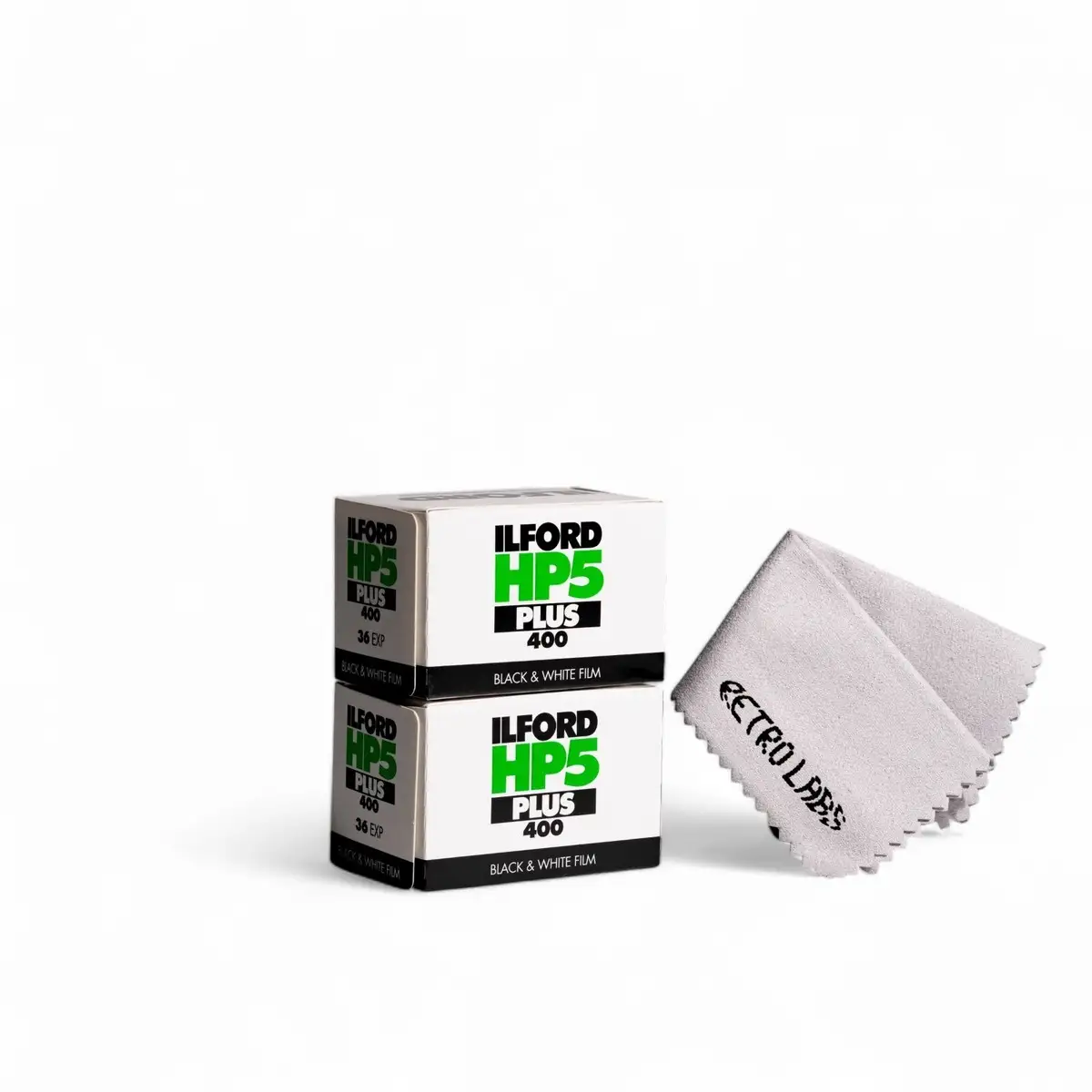
Ilford HP5 Plus 35mm 2-Pack Review: Versatile, Gritty
A recurring pattern emerged: people keep calling Ilford HP5 Plus Black and White Film 35mm 2-Pack “forgiving” and “versatile,” yet some shooters describe the look as “grainy” and even “dirtier, softer,” especially when their process (lab scans, pushing, contrast expectations) doesn’t match what the film naturally gives. Verdict: a dependable ISO 400 staple with huge latitude—if you like a classic, slightly gritty character. Score: 8.6/10
Quick Verdict
Conditional — Yes if you want a flexible, pushable B&W negative film with classic grain; No if you want ultra-clean, high-contrast negatives without doing much in development/scanning/post.
| What you’re deciding | Evidence from sources | Who it’s best for | What can go wrong |
|---|---|---|---|
| Versatility/latitude | “wide exposure latitude” (Amazon specs); “most versatile bw film out there” (The Darkroom) | Beginners, travel/street shooters | Can feel “soft” or “low contrast” |
| Pushing performance | Officially “rated up to EI 3200” (Amazon/Ilford specs); users: “pushed to 1600 it can handle almost anything” (ShootAnalog) | Low-light, faster shutter needs | More grain/contrast; some dislike the look |
| Grain/texture | “grain is very fine… detail in the shadows and highlights” (The Darkroom) vs “grainy with a dirtier, softer look” (Phil Armstrong) | Those who want texture | Those who want clean tonality may be disappointed |
| Lab scanning dependence | Reddit debate on lab scans; “having a lab do the process and scanning… terrible idea” (Reddit thread) | DIY developers/scanners | Lab scan choices can flatten or misrepresent the negative |
Claims vs Reality
Claim 1: “ISO 400… great results in varied lighting conditions” (Amazon specs).
Digging deeper into user reports, this claim largely holds—but with a caveat: “great results” often depends on how the negative is developed and scanned. In a practical coaching tone, a commenter in the Reddit thread emphasized flexibility: “The wonder of black and white film (especially a versatile stock like hp5) lies in its ability to give you a large amount of flexibility and latitude in creating the final product.” That same thread steers attention away from expecting magic in-camera and toward finishing: “The strengths of black and white film are shown in the printing and editing stage.”
For newer shooters, that latitude becomes a safety net. A verified reviewer on The Darkroom used a vivid metaphor for learning: “This film stock is that laid back driving instructor… ‘don’t worry mate, she’ll be ‘right’… while you commit all sorts of horrible atrocities.” In other words: the film can tolerate exposure and technique mistakes better than fussier stocks.
Claim 2: “Formulated to respond well to push-processing… up to EI 3200” (Amazon/Ilford specs).
While officially rated as pushable “up to EI 3200,” multiple sources describe pushing as central to the HP5 experience—often for speed, not just style. On ShootAnalog, the author framed it as a go-anywhere tool: “Bright light, low light, pushed to 1600 it can handle almost anything and still have useable images from the negatives.” A Reddit commenter echoed the tradeoff clearly: “hp5 can be pushed easilly one or two stops… this increase contrast and grain at the same time.”
But the “works at high EI” story is also where expectations can diverge. One The Darkroom reviewer praised pushing but warned about use-case: “I much prefer this film over tri-x if pushing in bright situations but i wouldn’t recommend it when working in low light.” That’s not a contradiction so much as a reminder: push-processing can be aesthetically and technically successful, yet still not match every shooter’s preferred tonality in dim conditions.
Claim 3: “Fine grain, medium contrast… outstanding sharpness” (Amazon specs).
While marketing calls it “fine grain” and “medium contrast,” some photographers strongly experience it as grain-forward and softer. Phil Armstrong’s critique is blunt: “It’s grainy with a dirtier, softer look and mid-range contrast.” Meanwhile, others see that same character as the point. ShootAnalog celebrated the texture: “I really like the grain in these images, it’s that old school look that a lot of people try to recreate with filters in lightroom.”
The gap often appears to be less about whether grain exists and more about whether the shooter wants that “old school look,” and whether scanning/post keeps the tonal separation they expect from “medium contrast” film.
Cross-Platform Consensus
Universally Praised
The strongest consensus is that Ilford HP5 Plus Black and White Film 35mm 2-Pack behaves like a dependable workhorse film—particularly for people who need an everyday ISO 400 option that doesn’t fall apart when conditions change. A verified reviewer on The Darkroom put it plainly: “This film is incredibly reliable and shoots well in most situations.” For travel shooters or anyone who doesn’t want to pack multiple emulsions, that reliability matters more than chasing a perfect lab-condition look.
A recurring pattern emerged around latitude and “saveability.” One The Darkroom buyer wrote: “This film is saveable when over or under exposed… retains so much detail in the shadows and highlights.” That’s a practical win for beginners learning metering, street photographers reacting quickly, and anyone shooting mixed light where highlights might blow or shadows might block up.
Pushing is the other major point of agreement—and it’s discussed as a tool for real shooting problems (faster shutter speeds, less light), not just an aesthetic trick. A Reddit user shared a personal workflow: “My go to for hp 5 + is rating it 800 and pushing a stop in development, mainly to use faster shutter speeds.” That same user connected the choice to practical control: “using xtol 1+1 keeps the grain in check and the latitude is so flexible in post.” Meanwhile, The Darkroom’s long-time shooter backed up the broader claim: “pushing it 1 or 2 stops? no problem but personally i prefer the look when pushing it to 800.”
Finally, many users treat HP5 as a learning film—something you can shoot a lot and refine over time. Another The Darkroom reviewer described buying in bulk to understand one stock deeply: “hp5 is an incredibly flexible, forgiving film… it handles highlights well… relatively low contrast.” That’s less a product pitch than a user strategy: pick a forgiving film and learn how exposure, development, and scanning shape the outcome.
Summary bullets (after the stories):
- Reliability across situations: “incredibly reliable” (The Darkroom)
- Wide latitude: “saveable when over or under exposed” (The Darkroom)
- Push-friendly: “rating it 800 and pushing” (Reddit); “pushed to 1600” (ShootAnalog)
Common Complaints
Digging deeper into critical takes, the most repeated issue isn’t catastrophic failure—it’s aesthetic mismatch. For photographers expecting crispness and “clean” tonality, HP5 can read as too grainy or too soft. Phil Armstrong captures that disappointment: “It’s grainy with a dirtier, softer look and mid-range contrast.” For portrait shooters chasing ultra-smooth skin tones or landscape shooters wanting fine-detail crispness, this “softer” rendering can feel like a downside rather than character.
Another friction point shows up in workflow dependence—especially when the shooter relies on a lab for processing and scanning. In the Reddit thread, the original poster described using lab scanning systems: “the lab i go to has a noritsu and also a fujifilm scanner… i’ve been getting my stuff scanned on the noritsu.” That discussion triggered a sharp rebuttal from another commenter: “having a lab do the process and scanning. terrible idea with conventional b&w film.” Whether or not everyone agrees with that extreme stance, the underlying complaint is clear: the lab scan can define the “look” as much as the film does, and users can feel stuck with results that don’t match expectations.
Even when people like HP5, some frame it as low-contrast by default—meaning you may need to add contrast in post or via filters/development choices. A Reddit commenter noted: “hp 5 + is naturally medium-ish contrast wise… contrast is something easy to add in post.” One The Darkroom reviewer similarly said: “contrast is not that great, but allows for the addition in digital post.”
Summary bullets (after the stories):
- Grain/softness concerns: “dirtier, softer look” (Phil Armstrong)
- Lab scan/process variability: “terrible idea” vs lab users (Reddit thread)
- Contrast may need shaping: “contrast… easy to add in post” (Reddit)
Divisive Features
The same traits that make HP5 beloved also split opinion. Grain is the clearest example. ShootAnalog praised it as a signature: “that old school look,” while Phil Armstrong called it “grainy” and “softer,” and still admitted the pull of the occasional standout: “23 of the 24 frames could be a dull mess, but if that remaining photo is a hit, the roll was worth it.” That love/hate dynamic suggests HP5 can be inspiring when it aligns with subject matter and processing, and frustrating when it doesn’t.
Pushing is similarly divisive: it’s celebrated as a way to shoot faster and in lower light, but it’s inseparable from tradeoffs. A Reddit commenter summarized the cost: pushing “increase contrast and grain.” For some street/documentary shooters, that “raw” look is the goal; for others, it’s exactly what they’re trying to avoid.
Trust & Reliability
A recurring pattern emerged across platforms: complaints center on preference and workflow, not reliability failures. On The Darkroom, the tone is long-term confidence—“i’ve been shooting hp 5 + for over 15 years and it has never disappointed me!”—which functions as a durability story in practice: not that the product physically lasts, but that its behavior is consistent roll after roll for repeat shooters.
The most trust-related friction in the dataset is process control rather than scams. In the Reddit discussion, one user attacked the lab-scan approach as inherently risky: “having a lab do the process and scanning. terrible idea with conventional b&w film.” That’s an extreme claim, but it highlights a trust dynamic: some users don’t trust lab workflows to represent HP5’s negatives faithfully, especially if scanner profiles and contrast curves vary.
Alternatives
Only competitors mentioned in the provided data are included, and the comparison here is rooted in user language and use-cases.
Kodak Tri‑X is the constant foil. A ShootAnalog-style framing calls it a “debate,” and The Darkroom reviewer described the practical difference as contrast character: “the latter has more contrast by default.” For photographers who want punchier negatives without much post shaping, the Tri‑X mention suggests it’s often chosen for that contrast signature—whereas HP5 is favored when latitude and flexibility matter more.
Ilford FP4 Plus and Pan F appear as cleaner, slower alternatives in Phil Armstrong’s preference list: “nor do i prefer it over ilford’s fp4 plus or pan f.” The implication is straightforward: if the user dislikes HP5’s grain/softness, these slower films may align better with a sharper, finer-grain goal (at the cost of speed).
Ilford XP2 shows up as a pragmatic suggestion in the Reddit thread: “shoot xp 2.” Since this was offered in the context of frustration with lab processing/scanning, it reads like a workflow alternative for people leaning on labs and wanting smoother results from a standardized process.
Price & Value
On pricing, the data points show a fairly accessible entry cost alongside active market demand. Amazon specs list HP5 Plus 35mm “from… $9.49,” and an Amazon listing for a 3-pack is “$28.98” with “4.6 out of 5 stars” based on “44 reviews.” On eBay, a “2x Ilford HP5 Plus 35mm… 24 exp” listing sits around “$20.61,” with the seller showing “99.8% positive feedback” and “1682 sold,” which signals consistent turnover.
For value-focused shooters, The Darkroom reviews repeatedly frame HP5 as an “everyday” or “go-to” stock: “affordable… great foundation for b&w shooting in most situations.” Another reviewer framed the value proposition through substitution: “in most situations i’d choose to shoot hp5 pushed two stops instead of a dedicated low-light film like delta 3200.” That’s less about sticker price and more about buying fewer specialized films by relying on HP5’s flexibility.
Buying tips also emerge indirectly: lab scanning choices can shape perceived value. The Reddit poster planned to ask the lab “which scanner they recommend most for black and white,” underscoring that for many buyers, “value” includes the scan output they actually receive—not just the negative’s theoretical quality.
FAQ
Q: Can Ilford HP5 Plus really be pushed to ISO 3200?
A: Yes—official material says it “can be rated up to EI 3200.” Users also discuss pushing as common practice; a Reddit commenter said HP5 “can be pushed easilly one or two stops,” with the tradeoff that it “increase contrast and grain.”
Q: Is HP5 Plus good for beginners?
A: Yes, especially if you want a forgiving film. A verified reviewer on The Darkroom described it as a “safety net” while learning and called it “laid back.” Official specs also emphasize “wide exposure latitude,” which helps when exposure isn’t perfect.
Q: Does a CPL (polarizer) work on black-and-white film like HP5?
A: Yes. In the Reddit thread, a commenter replied: “The polarizer should work just fine,” and another added: “cpl filters work both in color and black and white… makes some of the sky darker and cut reflexions.”
Q: What look should I expect—fine grain or gritty grain?
A: Both descriptions appear. Officially it’s “fine grain” and “medium contrast,” and one The Darkroom reviewer said “grain is very fine.” But Phil Armstrong described it as “grainy with a dirtier, softer look,” and ShootAnalog praised the “old school look” grain can create.
Q: Is lab processing/scanning okay for HP5?
A: It depends on who you ask. The Reddit poster uses a lab with Noritsu/Fujifilm scanners, but another Reddit commenter argued: “having a lab do the process and scanning… terrible idea.” The practical takeaway is that scan choices can heavily influence your results.
Final Verdict
Buy if you’re a street/travel/documentary shooter who values latitude and wants a film you can rate at box speed or “rating it 800 and pushing a stop” for faster shutter speeds (Reddit). Avoid if you consistently dislike “grainy with a dirtier, softer look” rendering (Phil Armstrong) or want high contrast without shaping development/scans. Pro tip from the community: lean into contrast control—“hp 5 + is naturally medium-ish contrast wise… contrast is something easy to add in post” (Reddit).