Fujifilm QuickSnap Flash 400 Review: Conditional Buy 7.6/10
A single switch turned into the loudest “why doesn’t every disposable do this?” moment in the feedback around the Fujifilm QuickSnap Flash 400 One-Time-Use Camera—but the same reports also warn that the camera’s “fun and easy” promise can collapse into “blurry or underexposed” frames when light gets tricky. Verdict: Conditional buy — 7.6/10.
Quick Verdict
The Fujifilm QuickSnap Flash 400 One-Time-Use Camera is a conditional “yes” for people who want a simple, pocketable disposable that can handle daylight and basic indoor snapshots—especially if you actually use the flash and respect the fixed-focus distance. It gets the strongest praise for ease of use and a practical flash design, but users and reviewers repeatedly flag low-light failures (without flash), occasional blur, and color shifts (notably magenta skin tones).
Digging deeper into user reports, the camera’s biggest win is not “sharp pictures” in every scenario—it’s predictability when you treat it like what it is: ISO 400 film, fixed focus, plastic lens, and a limited flash range. The feedback consistently steers new buyers toward a simple playbook: daylight without flash; indoors or shadows with flash; keep subjects at a sensible distance.
For casual party shooters, wedding guest books, and travelers who want a nostalgic 35mm film look without settings, the QuickSnap Flash 400 shows up as one of the easier disposables to operate. For anyone expecting modern low-light forgiveness or consistent skin tones across mixed lighting, the same feedback suggests disappointment is common.
| Verdict | Evidence-based takeaway |
|---|---|
| Buy? | Conditional: best in daylight + flash indoors |
| Biggest pro | Flash usability (“keep the flash on”) |
| Biggest con | Low-light blur/underexposure risk |
| Best for | Simple travel/party snapshots, landscapes |
| Watch-outs | Fixed focus distance, color shifts (magenta) |
Claims vs Reality
Marketing claim #1: “Produces very sharp pictures… great for taking pictures indoors or outdoors.”
The official product copy leans hard on sharpness and broad usability, describing the camera as “fun and easy to use – great for taking pictures indoors or outdoors” and stating it “produces very sharp pictures” (Amazon listing/manufacturer text; Fujifilm developing page). But multiple feedback sources narrow that promise: it’s sharp enough within the constraints—especially outdoors—yet noticeably fragile in low light or if the camera isn’t held steady.
A consumer-style summary on ShopSavvy captures the gap bluntly, warning that “some folks have found that their photos can turn out a bit blurry or underexposed, particularly in low-light situations or if the camera isn’t held steady.” That same source pushes a workaround rather than denying the issue: “make sure you always use the built-in flash for indoor shots or when it’s a bit darker.”
Marketing claim #2: “10' flash range” and “continuous flash… recharges for your next picture.”
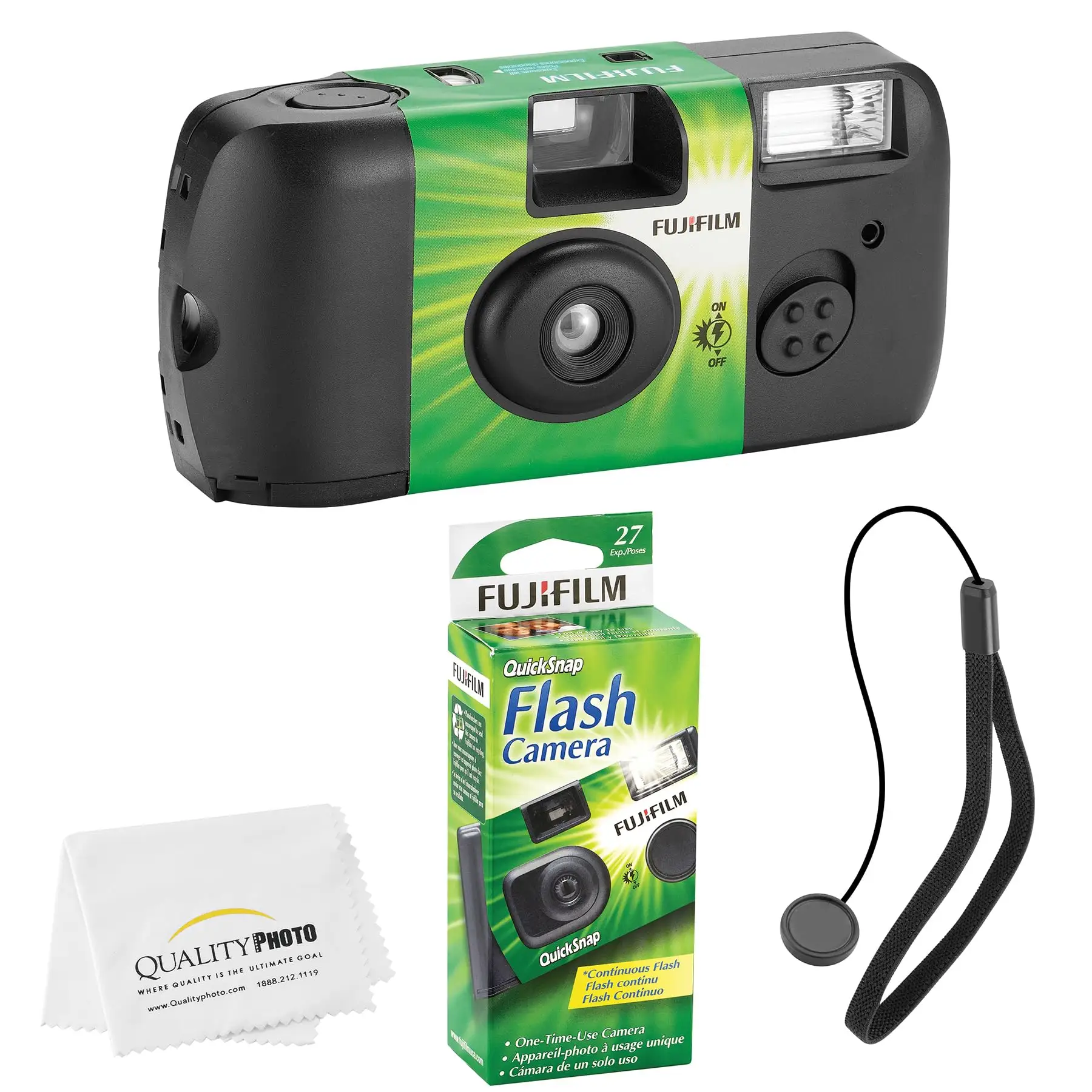
On paper, the flash sounds like a cure-all: Amazon and Fujifilm materials describe a “10 ft flash range” and highlight a “continuous flash switch” meant to make multiple shots easier. Digging deeper, the user-facing guidance focuses less on the number and more on the behavior: the flash design is repeatedly praised because it reduces friction compared to disposables that require charging every single time.
A reviewer on The Darkroom emphasizes exactly that practical difference: “it has a practical flash switch that allows you to keep the flash on,” contrasting it with other disposables where “you need to press the button to charge the flash for every shot.” In other words, the “continuous flash” claim aligns with user experience—but it doesn’t eliminate the underlying limitations of ISO 400 film and fixed focus.
Marketing claim #3: “Excellent skin-tone reproduction… vibrant, natural color reproduction.”
Fujifilm’s promotional language (via iShootFujifilm product page text provided in the dataset) highlights “vibrant, natural color reproduction” and “excellent skin-tone reproduction.” Yet third-party review commentary complicates that: The Darkroom’s review says the colors “often goes magenta for skin tones and whites.” That conflict is important because it shows where “natural” can become situational—especially under mixed lighting or with flash.
While promotional materials present skin tones as a strength, the review feedback suggests buyers should expect occasional color casts, and that the camera may be more dependable for landscapes than for flattering indoor portraits.
Cross-Platform Consensus
Universally Praised
The simplest compliment kept resurfacing: this disposable is unusually easy to operate, and that ease translates into more “keepers” for casual shooters who don’t want to fuss with settings. The Darkroom review sets the tone: “of all 8 of the disposable cameras we reviewed, the quicksnap is the easiest to use.” For partygoers and travel groups passing a camera around, that matters—no one has to explain menus or modes, just advance the film and shoot.
A recurring pattern emerged around the flash interface specifically. Many disposables make flash a chore; here, the switch is treated like a usability feature, not a spec line. The Darkroom reviewer calls out that “practical flash switch that allows you to keep the flash on,” and describes how “all the other cameras we reviewed you need to press the button to charge the flash for every shot.” For event snapshots—birthday dinners, indoor gatherings, night streets—this reduces missed moments caused by forgetting to charge a flash.
The praise also extends to how the camera fits certain “film look” expectations: fine enough grain for ISO 400 and pleasant colors in good light. ShopSavvy’s consumer summary notes it “works well in outdoor settings with good natural light” and “tends to capture vibrant colors nicely in these conditions.” That’s the user persona sweet spot: travelers or hikers shooting midday scenes, beach trips, or bright street photos where a fixed-focus 32mm lens can deliver pleasing results without effort.
Finally, the data repeatedly reinforces the “27 exposures” expectation and the basic simplicity of the format. The Darkroom describes it as “like all single use cameras with a simple plastic lens, manual film advance, and 27 exposures.” For buyers choosing it for weddings, trips, or a weekend festival, that predictable shot count becomes part of planning—one camera, one roll, one set of memories.
After those narratives, the most-cited “wins” can be summarized like this:
- Easier flash operation than many disposables (“keep the flash on”)
- Strongest results in daylight and bright outdoor settings
- Straightforward, beginner-friendly shooting process (advance → frame → shoot)
- Predictable 27-exposure format for trips and events
Common Complaints
The most consistent complaint is not that the camera is “bad,” but that it punishes the exact situations many people buy disposables for: dim rooms, night scenes, and quick candid motion. ShopSavvy’s summary is explicit: “photos can turn out a bit blurry or underexposed, particularly in low-light situations or if the camera isn’t held steady.” That’s a warning label for party and bar shooters—if the camera moves or the subject is too far, the results can disappoint.
Another common thread is that the flash is not optional in many real-world use cases. The Darkroom reviewer frames this as physics and film speed rather than user error: “having a good flash is important for this camera because has finer grain 400 iso film which means need the flash for the lower lit scene, unlike the 800 iso cameras.” For indoor family gatherings or cloudy-day street shots, that translates into a constant decision: flash on, subject within range, and hold steady.
Color behavior—especially on people—shows up as a meaningful downside for portrait-heavy users. While promotional claims stress “excellent skin-tone reproduction,” The Darkroom review says, “it often goes magenta for skin tones and whites.” For wedding guests and party photographers, that means faces and clothing can shift unexpectedly, even when exposure is acceptable.
There’s also a subtle mismatch between official flash range wording and user guidance. While the manufacturer materials mention “10 ft” and effective ranges like “1m–3m,” The Darkroom describes the flash as “good from about 3′ to 12′ (1 m to 4 m).” The practical implication is the same: close-to-mid distance works; beyond that, don’t expect miracles. For group photos across a room, that’s where complaints about darkness and softness tend to originate.
After the narratives, the most common “pain points” look like this:
- Low-light blur and underexposure without disciplined flash use
- Flash range limitations for distant subjects/groups
- Occasional magenta color cast on skin tones/whites
- Fixed-focus constraints that punish too-close subjects
Divisive Features
A divisive feature is the very thing some buyers love: ISO 400 film paired with a built-in flash. For landscape shooters and daylight travelers, ISO 400 can be a plus—less grain, calmer colors in bright sun. The Darkroom review even recommends it in that lane: “if you’re looking for a cheap daylight camera that excels for landscapes this camera would be a great choice.”
But for nightlife and indoor-heavy users, the same ISO 400 choice becomes a liability unless the flash is used constantly and subjects stay within range. The Darkroom contrasts it directly with 800-speed disposables, saying the 400-speed film “means need the flash for the lower lit scene, unlike the 800 iso cameras.” In effect, the camera divides buyers into two camps: those who live in daylight and those who want low-light forgiveness.
Even the “simplicity” splits people. The ShopSavvy summary positions it as “a straightforward way to capture memories without the fuss of digital settings,” but also cautions it “isn’t going to provide the image clarity and control you get with digital cameras,” and that “automatic focus can sometimes lead to blurriness.” For nostalgia seekers, that’s acceptable; for buyers expecting point-and-shoot consistency in every condition, it’s a deal-breaker.
Trust & Reliability
A recurring credibility signal in the dataset is that the most detailed critique comes from a comparative reviewer voice rather than isolated one-off comments. The Darkroom review provides step-by-step usage guidance and repeatedly compares the QuickSnap against “all 8” disposables they reviewed, which strengthens the interpretability of complaints like color casts and low-light dependency.
That same review also suggests a reliability expectation: the camera is “the smallest,” “easiest to use,” and built around a simple mechanical process—advance film, frame, press shutter—meaning fewer “feature failures” to worry about, but also fewer ways to recover from user errors. When photos fail, the feedback typically points back to light levels, distance, and steadiness rather than unpredictable electronics.
However, the dataset provided does not include Reddit “6 months later” durability stories or scam-complaint patterns beyond a single Trustpilot-style entry that reads like a review article. Given that limitation, the most responsible reliability takeaway from the sources here is practical: the camera is consistently described as straightforward, but results reliability depends heavily on following the flash/distance guidance.
Alternatives
The only clear competitor mentioned in the provided feedback is the family of 800 ISO disposable cameras and Fujifilm’s own waterproof line. The Darkroom review explicitly contrasts this model with “the 800 iso cameras,” arguing that the 400-speed film “means need the flash for the lower lit scene, unlike the 800 iso cameras.” For indoor-first users—bars, receptions, night streets—the alternative implication is direct: an 800 ISO disposable is more forgiving when flash use is inconsistent.
Fujifilm’s waterproof disposable also appears as an alternative for wet environments. The Darkroom review notes, “fuji also has the best selling waterproof disposable camera,” and advises that if you expect wet conditions, “consider the fujifilm quicksnap waterproof camera,” while also cautioning “the quality isn’t as good as the fujifilm quicksnap.” That frames a classic tradeoff: durability and water resistance versus image quality expectations.
Price & Value
The Amazon listing in the dataset shows a strong rating signal—“4.7 out of 5 stars” across “2,097 reviews”—and a listed price of $37.99 for a 2-pack (Amazon.com page excerpt). That kind of rating suggests broad buyer satisfaction, but the narrative feedback indicates satisfaction is often conditional on using it correctly (flash, distance, daylight).
Resale and market pricing from eBay looks scattered, implying that age/expiration and bundle size dominate value. Listings range from roughly $11–$15 for single units in some entries to higher prices for multi-packs, with shipping sometimes exceeding the item price in the examples shown. Several listings highlight expiration dates, including lots with older expirations (e.g., “exp 2008”), reinforcing ShopSavvy’s advice to “keep an eye on the film’s expiration date.”
Community-style buying tips embedded in the feedback are practical rather than bargain-focused: ShopSavvy recommends using flash indoors and watching film expiration; The Darkroom emphasizes flash discipline and distance. Translating that into value guidance: paying more for a “fresh” camera with a clear expiration date may be worth it if you’re using it for an event you can’t redo.
FAQ
Q: How many exposures does the Fujifilm QuickSnap Flash 400 have?
A: It’s consistently described as a 27-exposure disposable. ShopSavvy states “the fujifilm quicksnap flash 400 offers 27 exposures,” and Fujifilm’s specification text lists “135 - 27 exp.” The 2-pack version is typically presented as 54 total exposures (27 each).
Q: Do you need to use the flash indoors?
A: For most indoor or darker scenes, feedback strongly suggests yes. ShopSavvy advises to “always use the built-in flash for indoor shots,” and The Darkroom says “having a good flash is important for this camera” because the ISO 400 film “means need the flash for the lower lit scene.”
Q: Why do some photos come out blurry or underexposed?
A: Multiple sources tie failures to low light and movement. ShopSavvy notes photos can be “blurry or underexposed, particularly in low-light situations or if the camera isn’t held steady.” With fixed focus and limited flash range, distance and steadiness become critical.
Q: Are the colors good—especially skin tones?
A: The feedback is conflicted. Promotional text claims “excellent skin-tone reproduction,” but The Darkroom reports the camera “often goes magenta for skin tones and whites.” In bright daylight, ShopSavvy says it “tends to capture vibrant colors nicely,” suggesting lighting plays a major role.
Q: What distance works best with the flash?
A: The manufacturer specs describe an effective flash range around 1–3 meters, while The Darkroom describes it as “about 3′ to 12′ (1 m to 4 m).” Practically, the recurring guidance is to keep subjects relatively close for indoor flash shots to avoid dark frames.
Final Verdict
Buy the Fujifilm QuickSnap Flash 400 One-Time-Use Camera if you’re a daylight traveler, a casual event shooter who will actually keep the flash on indoors, or someone who wants a simple 35mm disposable for landscapes and straightforward snapshots. Avoid it if your main use case is dim venues, long-distance group photos across a room, or if consistent skin tones are the priority.
Pro tip drawn straight from the feedback playbook: follow The Darkroom’s “best used in open daylight with no flash or in low light with flash,” and pair it with ShopSavvy’s warning that results can go “blurry or underexposed” if you skip the flash or don’t hold steady.