ESR Shift Case (M4) Review: Conditional Buy (7.6/10)
A kitchen scale reading—“~1336 g” for iPad plus case—captures the shock factor around ESR for iPad Pro 11 Inch Case (M4) 2024, Rotating Case with Removable Magnetic Cover, Shift Series, Black. That single number (shared in a community thread) became a proxy for what many buyers argue over: a stand system that feels unusually stable, but also unusually hefty.
Verdict: Conditional buy — 7.6/10. The case earns real praise for its multi-angle versatility, lap stability, and detachable two-piece design, but repeated complaints about weight, thickness, sharp edges, and a front cover that won’t stay shut keep it from being an easy recommendation.
Quick Verdict
Yes/No/Conditional: Conditional — great if you prioritize stand stability and modes over minimal weight and slimness.
| What matters | What users say | Best for | Risk for |
|---|---|---|---|
| Stand stability & angles | “the flap uses magnets that fit inside and don't budge unless you force it” (MacRumors) | Desk + lap use, watching, reading | People who tap/write while elevated |
| Detachable design | “love that its a 2 piece so i dont have to carry the cover all the time” (Amazon) | Home users, handheld gaming | Anyone needing front-cover closure security |
| Fit & cutouts | “all holes and cutouts are aligned perfectly” (MacRumors) | People picky about alignment | A minority reporting edge/charging issues |
| Weight/thickness | “this case is heavy!” (Amazon) | Users who mostly set it down | Commuters, backpack carry |
| Cover closure | “the cover will fling open” (MacRumors) | Users who don’t flip it upside down | Tossing in bags, frequent carrying |
Claims vs Reality
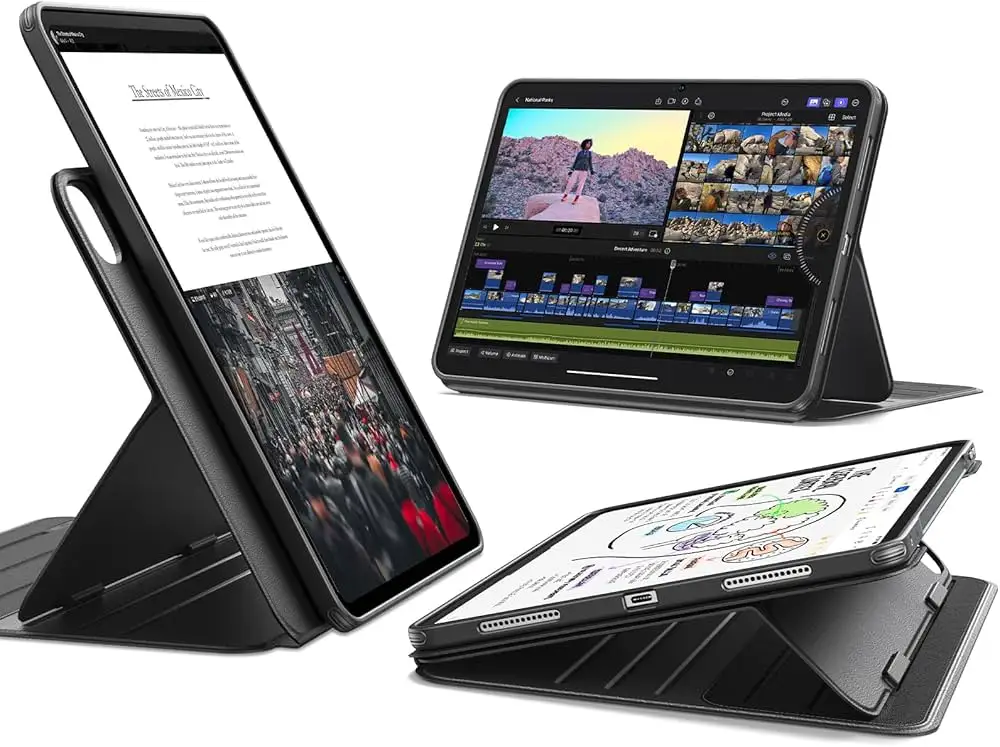
ESR’s marketing centers on a case that’s “ultra-stable,” offers a “raised screen view,” and gives “up to 9 different angles.” Digging deeper into user reports, the stability claim holds up best—especially for lap use—while the everyday carry story is where the friction starts.
Claim: “Ultra-stable stand… even when using… on your lap.”
MacRumors forum feedback repeatedly backs the lap-stability pitch. A MacRumors user chiba mac said: “tested the case in bed and unsurprisingly it worked perfectly,” and contrasted it with Apple’s folio, adding it “still isn't sturdy enough to inspire confidence on my lap.” Another MacRumors participant described a practical workflow win: “the thing feels very sturdy on the lap… and type away,” suggesting the stand can handle real typing setups, not just passive viewing.
Claim: “Raised screen view… more comfortable position.”
The raised mode reads like a gimmick in marketing, but some users treat it as a daily habit. MacRumors user chiba mac framed it bluntly: “it's totally not… gimmicky… and actually really useful,” describing less neck strain: “my head doesn't have to be propped up with my neck bent as much.” Another community voice echoed the adoption effect—“i actually use the higher position all the time”—which suggests the feature can become central for desk viewing with a keyboard.
Claim: “Powerful versatility… 9 angles… detach instantly.”
Versatility is widely acknowledged, but it’s also part of why the case becomes polarizing. On Amazon, a verified buyer wrote: “multi-angle and ways to use the case (landscape… portrait… angled enough for writing),” and praised “magnets galore and they’re all really strong.” Yet MacRumors user it troll pushed back on the closed-state behavior: “the weak magnets mean the front cover also slides around when closed,” and worried about grit and scratches. The flexibility is real; the cost is bulk and sometimes imperfect closure security.
Cross-Platform Consensus
Universally Praised
A recurring pattern emerged across forum discussions and Amazon reviews: people who wanted a “do-it-all” stand case kept circling back to stability and mode variety as the core win. MacRumors user chiba mac called the folio engineering “fricken great,” describing the groove system as something that “don't budge unless you force it.” For bed viewers and lap users, that detail matters: it’s the difference between a stand that collapses under touch and one that stays planted during long sessions.
For desk-based users, the raised screen view is more than comfort talk—it changes how the iPad fits into a setup. chiba mac described detaching and re-seating the case higher—“your ipad pro 's case lifts”—then emphasized it remains stable enough to use in bed. Another MacRumors poster reinforced the desk use case: “very nice when working with a bluetooth keyboard at a table,” essentially treating the case like a portable mini-stand they don’t have to remember to pack.
Fit and alignment also show up as a consistent positive for detail-oriented buyers. chiba mac wrote: “very snug fit” and “all holes and cutouts are aligned perfectly.” Amazon feedback mirrors that: a verified buyer called it “perfectly fitted,” and another said installation was “really just snapping the tablet into the case.” For people who hate wobbly corners or misaligned ports, this is one of the strongest cross-platform signals.
- Stand grooves and magnets feel secure in use: “don’t budge unless you force it” (MacRumors)
- Raised viewing mode becomes a daily desk feature for some: “actually really useful” (MacRumors)
- Fit/cutouts praised repeatedly: “aligned perfectly” (MacRumors), “perfectly fitted” (Amazon)
Common Complaints
The biggest complaint is not subtle: weight and thickness. MacRumors commenters repeatedly describe it as “very heavy,” with one user comparing carry burden: “taking the esr with my ipad would be like carrying two , maybe two and half , ipads.” Another went further: “the case alone weighed more than the ipad,” and compared it to the Magic Keyboard weight class. On Amazon, a verified buyer echoed the same shock: “this case is heavy!” and quantified the experience by comparison—“the case alone weighs in at 15 oz,” noting it “easily doubles the thickness” and “all gains… on how thin… and how light… is lost.”
Cover security is the next recurring pain point—especially for users who carry the iPad around or flip it over in transit. chiba mac complained that while a sleep/wake magnet exists, “this magnet does not keep the flap closed… the cover will fling open.” MacRumors user it troll agreed and added: “the front cover also slides around when closed,” describing the unsettling tactile experience: “you can feel the cover moving in your hand.” Amazon reviews reflect similar frustration: a verified buyer wished “the cover… had a stronger magnet i can feel it moving.”
Sharp edges appear as a smaller but persistent comfort issue. chiba mac said: “the sides of the folio can feel a bit sharp while handling,” and another MacRumors user called them “sharp edges… uncomfortable.” This tends to hit handheld users hardest—people who pick up the iPad often, read for long periods, or carry it without a bag.
- Weight/thickness dominates negative feedback: “this case is heavy!” (Amazon), “very heavy” (MacRumors)
- Front cover closure feels unreliable for some: “cover will fling open” (MacRumors)
- Comfort gripe: “sides… feel a bit sharp” (MacRumors)
Divisive Features
The detachable two-piece concept splits users by lifestyle. For home-first users, it’s a workaround to the weight problem. An Amazon verified buyer wrote: “love that its a 2 piece so i dont have to carry the cover all the time,” describing how removing the outer portion makes it “much lighter and thinner to hold.” MacRumors user char gr made the same argument: “having the option to detach the case eliminate’s that problem right away.”
But for commuters or anyone who wants a single, always-secure carry state, detaching can create new compromises. One MacRumors comment warned that if you carry it detached, “you have an exposed screen that can only be laid flat.” The same thread includes concern about the cover shifting when closed and picking up grit, which matters most to people throwing an iPad into a backpack or moving between meetings.
The raised, elevated “high position” mode also divides users by interaction style. Some love it for viewing comfort; others find it less ideal for touch-heavy use. MacRumors user it troll acknowledged it “won't fall over” but said it becomes “quite wobbly when touched , so not so good for interactive use.” That’s a classic split: watchers and typers may love it; sketchers and heavy tappers may not.
Trust & Reliability
Support interactions show up as a trust signal in user narratives. One Amazon reviewer described being contacted after posting feedback, quoting ESR’s stated goal: “goal is to make sure every customer has a happy shopping experience,” and said ESR offered “a refund or replacement without asking me to change the review.” In the MacRumors thread, a user reported ESR “sent me a rebound hybrid 360 to improve my experience,” and emphasized the replacement’s “magnetic clasp ensures that the front cover remains securely closed,” directly addressing their core complaint with the Shift-style design.
Long-term durability isn’t deeply documented in the provided community data as “six months later” stories, but there are early warnings and expectations. An Amazon reviewer framed ESR as good value but not forever materials: “visible signs of wear-and-tear after 2-3 years,” and predicted possible glue issues: “i wouldn't be shocked if… material start to become unglued after a while.” On the other hand, another Amazon buyer contrasted a prior ESR case that survived serious drops—“fallen twice from a 7 foot tall shelf”—and credited it with keeping an older iPad “as good as new,” which sets a credibility baseline for ESR’s protective approach.
Alternatives
Only a few competitors are explicitly discussed in the data, and they help define who should skip this case. Zugu comes up as the “comfort and carry” benchmark in MacRumors conversations. One user called Zugu “the best of the best,” praising how it’s “very comfortable , convenient , and relatively light,” and contrasting that with the ESR feeling “very heavy with sharp edges.” Another described why Zugu stays lighter: “zugu cases do not feature detachable elements which contributes to how light they are,” implying the ESR’s modularity and magnets are a deliberate weight trade.
Apple’s folio is referenced less as a direct alternative and more as a stability foil. chiba mac said Apple’s folio “still isn't sturdy enough to inspire confidence on my lap,” positioning ESR as the choice for lap stability even if it’s bulkier.
Within ESR’s own lineup, the Rebound Hybrid 360 becomes the fallback for people who like ESR’s general design language but can’t tolerate the Shift’s closure/hand-feel issues. A MacRumors user who received it from support said it “weighs less than the shift and feels much nicer in hand,” while still offering “a similar number of landscape and portrait viewing angles,” and crucially: “front cover remains securely closed.”
Price & Value
On Amazon, the Shift Series listing shows a Prime member price of “$35.99” (with “10 percent savings”), versus a “$39.99” regular price, with the product positioned as a rotating, multi-angle, removable-cover case. ESR’s own store pricing in the provided data places a Shift Magnetic Case around “$52.99,” suggesting Amazon discounts can materially change the value story depending on timing.
Resale value isn’t directly documented in the market data excerpts, but the community “buying tips” revolve around timing and use style rather than flipping. The strongest tip is implied in repeated comments: if you mainly use the iPad at home, weight becomes a tolerable trade. As one MacRumors user put it, “around the house , the weight isn't bugging me,” and another explained that on lap or in bed, the heft “isn't hurting anything.” For commuters, the same weight becomes the dealbreaker—“feel in a backpack”—making sale pricing less persuasive.
- Best value window appears when Amazon dips near
~$35.99rather than~$52.99MSRP-like pricing - For home use, users describe the weight as a trade for lap stability: “it’s a trade off” (MacRumors)
- For travel/carry, multiple users frame it as “like carrying two… ipads” (MacRumors)
FAQ
Q: Does the stand actually feel stable on your lap or in bed?
A: Yes—multiple users describe it as notably stable for lap and bed use. MacRumors user chiba mac said: “tested the case in bed and unsurprisingly it worked perfectly,” and another poster wrote: “the thing feels very sturdy on the lap,” even while typing with a keyboard placed in front.
Q: Is the case heavy enough to cancel out the iPad Pro’s thin/light design?
A: For many buyers, yes. A verified buyer on Amazon wrote: “this case is heavy!” and said their iPad plus case reached “1 lb 14 oz,” adding that “all gains… on how thin… and how light… is lost.” MacRumors users repeatedly call it “very heavy.”
Q: Does the front cover stay closed securely when you carry it?
A: Not consistently, based on user reports. MacRumors user chiba mac said: “this magnet does not keep the flap closed… the cover will fling open.” Another MacRumors user it troll added: “the front cover also slides around when closed,” and an Amazon reviewer similarly wished for “a stronger magnet” because they could “feel it moving.”
Q: Is the detachable design actually useful, or just a gimmick?
A: It’s useful for people switching between “stand mode” and handheld use. A verified buyer on Amazon said: “love that its a 2 piece so i dont have to carry the cover all the time,” and MacRumors user chiba mac described leaving the folio as a “home base,” keeping protection from the inner case while reducing carry bulk.
Q: Are there comfort issues like sharp edges?
A: Some users report discomfort from the folio edges. MacRumors user chiba mac said: “the sides of the folio can feel a bit sharp while handling,” and another user described “sharp edges… uncomfortable.” Others didn’t notice it, suggesting it may vary by sensitivity or handling style.
Final Verdict
Buy if you’re a lap-and-desk user who wants a highly adjustable portrait/landscape stand and will actually use the raised viewing mode—especially if you like the idea of a detachable “home base” folio. MacRumors user chiba mac summed up the upside as “the star of the show” among early M4 case options, praising grooves that “don't budge unless you force it.”
Avoid if you commute with your iPad daily, hate bulky builds, or need a front cover that stays firmly shut in hand or in a bag. The clearest warning comes from MacRumors: “the cover will fling open,” paired with repeated complaints that it’s “very heavy” and can feel sharp.
Pro tip from the community: treat the folio as a stationary dock and carry the inner case when you can—mirroring the “home base” idea—and watch Amazon pricing, where the same product can swing from around ~$52.99 to a discounted ~$35.99.