DEWALT DXFRS800 Walkie Talkies Review: Conditional 8.3/10
“‘The sound is crystal clear and there are no issues with interference or glitches.’” That line captures the core appeal of the DEWALT DXFRS800 Heavy Duty Walkie Talkies (6 Pack with Charger)—but it also hints at the bigger story: clarity and toughness tend to impress, while real-world range and carry security spark the fiercest debates. Verdict: Conditional buy — 8.3/10.
Quick Verdict
Yes/No/Conditional: Conditional — strong for job sites and businesses that value durability and simple comms, less ideal if you need long-distance performance through walls or a secure belt carry.
| What shoppers care about | What feedback suggests | Evidence (platform) |
|---|---|---|
| Voice clarity | Consistently praised | BestViewsReviews: “sound is crystal clear…”; “very little static” (OutdoorEmpire) |
| Range in real use | Often good outdoors; unreliable through buildings/obstacles | BestViewsReviews range quotes; OutdoorEmpire: “0.5 miles to 2 miles” |
| Battery life | Frequently described as “all day” and beyond | BestViewsReviews battery stories; DEWALT claims “up to 18hrs” |
| Durability/waterproofing | Toughness reinforced by user anecdotes; sinks in water | OutdoorEmpire: “throwing it into a lake… continued to work”; “sinks like a rock” |
| Ease of use | Simple controls, quick setup | BestViewsReviews ease-of-use quote; OutdoorEmpire “minimal buttons” |
| Holster/belt clip | Repeated weak point in narrative reviews | OutdoorEmpire: “worst I have encountered… fell off” |
Claims vs Reality
DEWALT and major listings position the DEWALT DXFRS800 Heavy Duty Walkie Talkies (6 Pack with Charger) as “long range,” “waterproof,” and job-site tough. Digging deeper into user reports, the “tough” part is the least controversial, while “long range” becomes highly situational depending on walls, corridors, and terrain.
The headline range marketing is where expectations collide with physics. Amazon’s specs cite a “talking range maximum 25 miles,” and DEWALT’s product copy emphasizes “300,000 sq. ft (or 25 floors).” Meanwhile, a recurring pattern emerged in user-style testing summaries: clear comms across a few blocks is believable, but multi-wall or mechanical-room scenarios can collapse fast. One BestViewsReviews excerpt reads: “the range of our cb two-way radios is limited to 200 yards and marginally functional at about 1/2 a mile in real-world tests,” while another says, “the advertised distance may be achievable only in ideal conditions, such as from a hot air balloon several miles up.”
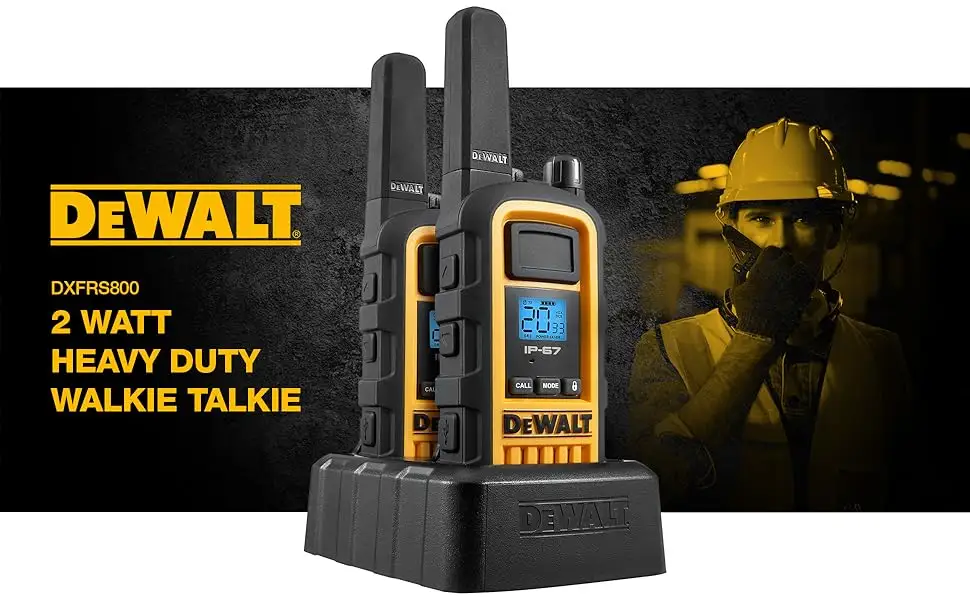
Waterproofing is also a story of “yes, but…” On paper, it’s IP67 (Amazon and DEWALT both state this). OutdoorEmpire’s reviewer leaned into that claim with a blunt real-world experiment. The author wrote: “I tested this by throwing it into a lake several times, and it continued to work just fine.” Yet the same narrative flags a practical contradiction for boaters and paddlers: “the walkie-talkie sinks like a rock.” So while officially rated for immersion, multiple reports emphasize you may not get a second chance if it goes overboard.
A third gap shows up around all-day usability versus carry security. The radios are pitched as job-ready and convenient for teams, and many comments reinforce ease and runtime. BestViewsReviews includes: “I particularly like the volume control knob with a small white line that allows me to set the volume level easily,” and multiple battery-life anecdotes like “the battery gauge still read 3 out of 4 bars.” But OutdoorEmpire calls the holster/clip “a fatal flaw,” writing: “The first time I used this two-way radio, it fell off as I was getting out of my truck.”
Cross-Platform Consensus
Universally Praised
The clearest consensus around the DEWALT DXFRS800 Heavy Duty Walkie Talkies (6 Pack with Charger) is that when a message gets through, it tends to sound good. That matters most for noisy environments—construction crews, hotel staff, and families using the set as a household intercom—where garbled audio is the real productivity killer. A BestViewsReviews excerpt describes exactly that use case: “The two-way radios work beautifully as an intercom for us to communicate with our 13 year old. The sound is crystal clear and there are no issues with interference or glitches.” For a family, that “intercom” framing is the difference between a novelty gadget and something that replaces yelling across a house.
Battery life is another repeated win, especially for shift work where charging routines need to be simple and predictable. BestViewsReviews highlights a cold-weather anecdote: “After being turned on for 5-8 hours each day and exposed to temperatures in the 30s each night for 4 days, I was impressed to see that the battery gauge still read 3 out of 4 bars.” For crews working outdoors or in partially heated spaces, that story is less about lab runtimes and more about not losing comms mid-task.
Ease of operation keeps coming up as a “no training needed” theme. That matters for teams with turnover—restaurants, grocery, retail—where a complicated radio becomes a management problem. OutdoorEmpire’s reviewer said: “I was easily able to set up and use the dewalt walkie talkie without having to dig into the owner’s manual,” and BestViewsReviews points to tactile design: “I particularly like the volume control knob… [to] set the volume level easily.” The implication is that the controls are discoverable under stress, not just in a quiet living room.
Durability and water resistance show up as confidence builders rather than marketing fluff. OutdoorEmpire describes the device as “tough and waterproof down to 1 meter,” and goes further with field handling: “it withstood all accidental drops.” For job sites, that translates into fewer dead radios and less babysitting. Even the bright color becomes a practical upside in the same narrative: “it’s bright yellow or i wouldn’t be able to find it on the bottom of the lake.”
After those patterns, the key “praised” takeaways look like this:
- Clear audio for intercom-style use and team comms (BestViewsReviews; OutdoorEmpire)
- Battery stories that match long shifts and multi-day casual use (BestViewsReviews)
- Simple controls that work for mixed-experience teams (BestViewsReviews; OutdoorEmpire)
- Ruggedness that survives drops and wet conditions (OutdoorEmpire)
Common Complaints
Range is the most frequently contested part of the experience, and the frustration tends to spike in the exact environments DEWALT targets: buildings with walls, corridors, and mechanical rooms. BestViewsReviews includes a scenario that reads like a facilities team’s worst day: “The radios only work in the main corridors and when they are 300 ft away behind multiple walls and in mechanical rooms, the radio is all static and unusable.” For hotels, grocery backrooms, or multi-room restaurants, that complaint is less about “miles” and more about whether a manager can reach staff behind concrete and equipment.
Multiple user-style reports try to reframe expectations around terrain and obstacles, but that doesn’t erase the disappointment when marketing sets a high ceiling. One BestViewsReviews excerpt explains: “one watt provides roughly one mile of range, with a maximum of two miles,” and another claims: “I have seen up to 1/2 mile range… approximately 3/4 mile.” OutdoorEmpire’s field test lands in the same neighborhood: “reliable communication distance varied between 0.5 miles to 2 miles, depending on the terrain and level of tree cover.” While officially marketed with “25 miles” style language on listings, multiple users report performance that looks far closer to sub-mile to a couple miles in normal terrain.
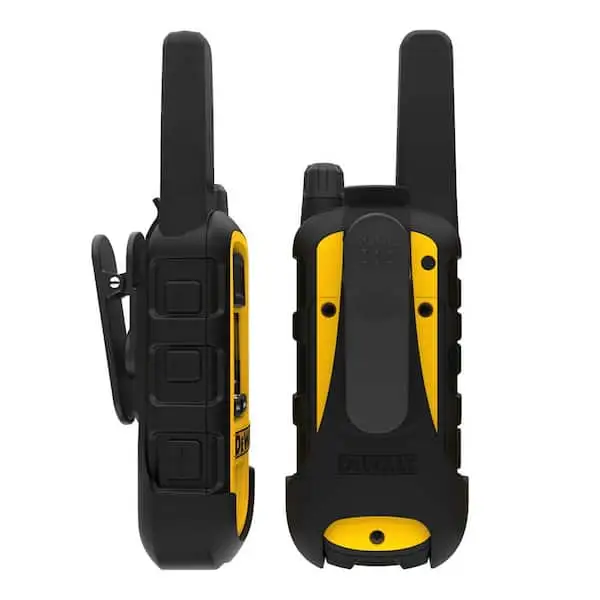
Carry hardware—specifically the holster/belt clip—emerges as a repeat offender in narrative feedback. OutdoorEmpire doesn’t soften it: “It’s a great radio with a fatal flaw… its biggest weakness lies in the holster and belt clip,” and later: “it fell off as i was getting out of my truck.” For tradespeople on ladders or anyone moving fast, that’s not a minor annoyance; it’s a lost-radio risk. The same source adds there’s “no way to tether the radio to yourself,” amplifying the consequence of a weak clip.
VOX is another place where expectations can clash with real communication needs. OutdoorEmpire frames VOX as the main “extra feature,” but notes: “it wouldn’t activate until i was halfway through my first word. cut-off words made it hard to understand.” For teams using headsets or hands-free modes, that kind of clipped audio can defeat the point of voice activation.
Common complaint themes, in plain terms:
- Range drops sharply through multiple walls/industrial rooms (BestViewsReviews)
- Real-world distance often lands around fractions of a mile to ~2 miles (BestViewsReviews; OutdoorEmpire)
- Holster/clip design leads to drops and potential loss (OutdoorEmpire)
- VOX can clip the beginning of speech (OutdoorEmpire)
Divisive Features
The “long range” positioning is divisive because experiences vary from “surprisingly good” to “basically unusable,” sometimes within the same overall sentiment. BestViewsReviews shows both sides: “I tested the range… walking four blocks with no difference in clarity,” while another report says it’s “limited to 200 yards” and becomes “all static” behind walls. This isn’t just disagreement—it’s a reminder that job-site radio satisfaction depends heavily on layout, obstacles, and whether users are mostly outdoors or buried behind equipment.
Even the control layout can split people. OutdoorEmpire calls the push-to-talk placement “a minor issue,” but still flags it: “the placement of the push-to-talk button on the front of the radio, rather than on the side as is traditional.” Meanwhile, Fakespot excerpts echo that reaction: “I have never seen a button in that place and it’s a little odd.” For some teams, that’s a learning curve; for others, it’s a non-issue once muscle memory adjusts.
Trust & Reliability
A recurring trust wrinkle comes not from the radio itself but from the review ecosystem around it. Fakespot’s page alleges review volatility, stating: “our engine has detected that the listing / variation has anomalous review count history,” and claims Amazon “altered, modified or removed reviews… approximate total reviews altered up to 1678.” That doesn’t prove the product is bad, but it does suggest buyers should weigh narrative reviews and detailed use-case reports more heavily than a single star average.
Reliability concerns also show up in at least one sharp negative anecdote captured in the same Fakespot pull: “at least half of them are already inoperable due to bad speakers.” That kind of failure story matters most to business buyers ordering multi-packs—exactly the audience for the 6-pack—because even a small defect rate becomes operational downtime.
On the durability side, longer-term storytelling is limited in the provided community excerpts, but OutdoorEmpire’s narrative leans hard into rugged survival: after multiple water dunks, it “continued to work just fine,” and it “withstood all accidental drops.” That’s not a “six months later” forum thread, but it is a concrete durability story that aligns with IP67 messaging—paired with the repeated warning that it sinks.
Alternatives
Only a few direct competitors are explicitly named in the data, but they highlight what different buyers prioritize. OutdoorEmpire suggests the Motorola Talkabout T600 H2O for water use specifically, arguing it “boasts the same ip rating… is more affordable, floats, offers additional features, and has a more reliable clip.” For kayakers or lake users, “floats” is the practical feature that changes the stakes of waterproofing.
For shoppers chasing more power or stronger clarity comparisons, OutdoorEmpire points to Rocky Talkie and also mentions BC Link as slightly better on clarity: “the rocky talkie and bc link perform just a bit better in this aspect.” The same review positions a “5 watt radio” variant as the step up if you need more than license-free FRS performance.
Price & Value
Value looks different depending on whether you’re buying new for a team or piecing together a set. Amazon positions this as a premium multi-pack with “6 walkie talkies and a gang charger,” and the star rating shown is 4.5/5 based on 2,582 reviews. On the resale side, eBay listings show brand-new single/pair units often clustering around roughly $80–$100 for “new” items (multiple examples: $80.96, $89.49, $93.99), while used pairs can appear around $64.99/ea in one listing. That pricing spread suggests there’s active secondary demand, which can soften the risk for buyers who might resell if the radios don’t fit their building layout.
Community-style buying tips embedded in the excerpts lean toward realism about range. BestViewsReviews includes the blunt reminder that “range… depends on factors like terrain, weather, and obstacles,” and even jokes that advertised distance might require “ideal conditions… from a hot air balloon.” For value, the practical advice is to treat these as strong short-to-mid range job-site radios with great durability, not miracle long-distance communicators through concrete.
Buying-value takeaways based on the provided data:
- New purchases buy you the rugged/IP67 story and multi-unit convenience (Amazon specs; DEWALT copy)
- Used/refurb market pricing suggests reasonable resale liquidity (eBay listings)
- The “worth it” hinges on your environment: outdoors/campus-like spaces vs. deep indoor mechanical areas (BestViewsReviews; OutdoorEmpire)
FAQ
Q: How far do the DEWALT DXFRS800 radios actually work in real life?
A: Real-world reports vary widely. OutdoorEmpire’s reviewer said “reliable communication distance varied between 0.5 miles to 2 miles,” while BestViewsReviews excerpts include everything from “walking four blocks with no difference in clarity” to “limited to 200 yards” and “all static… behind multiple walls.”
Q: Are they truly waterproof?
A: They’re marketed as IP67 (Amazon and DEWALT). OutdoorEmpire’s reviewer wrote: “I tested this by throwing it into a lake several times, and it continued to work just fine.” But the same source warns: “the walkie-talkie sinks like a rock,” so waterproof doesn’t mean recoverable.
Q: Is battery life good enough for a full work shift?
A: Many user stories suggest yes. BestViewsReviews includes: “I am satisfied with the long battery life and easy overnight charging,” and another reports multi-day use with the gauge still showing “3 out of 4 bars.” DEWALT’s claim is “up to 18hrs,” typically assuming mostly standby.
Q: What’s the biggest design complaint?
A: Carry security. OutdoorEmpire calls the holster/clip “the worst I have encountered,” saying it “fell off… getting out of my truck,” and adds there’s “no way to tether the radio to yourself.” That matters most for tradespeople climbing, moving fast, or working over water.
Q: Does VOX work well for hands-free use?
A: It depends on expectations. OutdoorEmpire says VOX sensitivity is adjustable, but reports a key issue: “it wouldn’t activate until i was halfway through my first word,” leading to “cut-off words.” For quick commands in noisy settings, that delay can be frustrating.
Final Verdict
Buy if you run a crew in retail/hospitality/job-site settings and need tough, simple radios with strong clarity and battery stories—especially if most communication is in open areas or light obstructions. Avoid if your priority is reliable comms “behind multiple walls” or in mechanical rooms, where one report says it becomes “all static and unusable,” or if losing a radio would be costly given the holster/clip complaints.
Pro tip from the community mindset: treat “25 miles” as a best-case marketing ceiling; plan around your building layout and obstacles, because, as one BestViewsReviews excerpt puts it, advertised distance may only happen in “ideal conditions… from a hot air balloon.”