GIGABYTE AORUS FO32U2 Review: OLED Gaming Beast Verdict
With a blistering 240Hz refresh rate at full 4K UHD resolution, the GIGABYTE AORUS FO32U2 has been hailed by enthusiasts as “the monitor I chose for a reason” by a PCPartPicker reviewer. Across platforms, it earns an average 4.3–4.8/5, with most users praising its image quality and competitive gaming edge. Final verdict: 8.7/10.
Quick Verdict
Recommendation: Conditional — Ideal for competitive gamers who demand OLED clarity, but may be overkill or overpriced for casual users.
| Pros | Cons |
|---|---|
| Stunning QD-OLED panel with infinite contrast | SDR and HDR brightness limited compared to mini-LED monitors |
| 4K at true 240Hz with near-instant (0.03ms) response times | Large stand footprint can eat desk space |
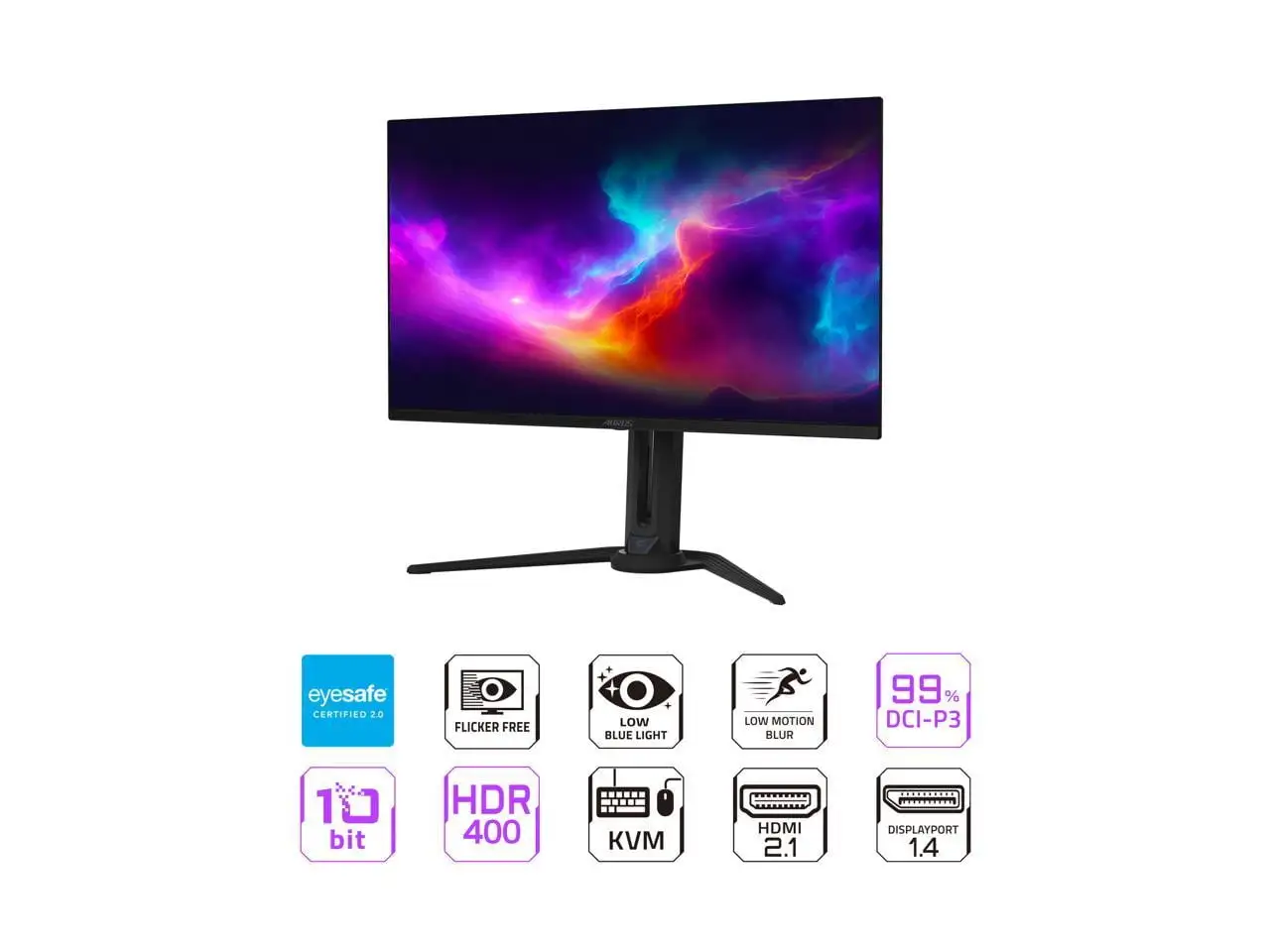
| Wide color gamut (99% DCI-P3, 100% sRGB) | USB-C power delivery limited to 18W on FO32U2 (65W on FO32U2P) |
| Built-in KVM switch, strong connectivity | Raised black levels in bright rooms |
| AI-based OLED burn-in protection | Premium price tag against similar-panel competitors |
| 3-year warranty including burn-in | Glossy/semi-gloss coating prone to micro-scratches |
| Ergonomic stand with height, tilt, pivot, swivel | Design considered plain by some users |
Claims vs Reality
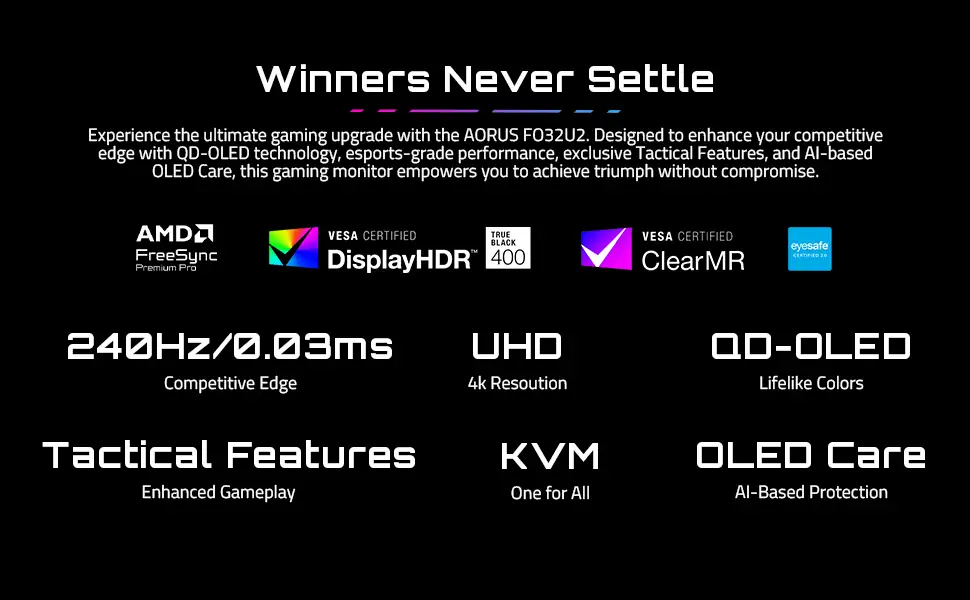
Marketing calls the FO32U2 a “winner’s monitor” with esports-grade speed and unmatched clarity thanks to Samsung’s QD-OLED. On paper: 4K 240Hz, 0.03ms GTG, infinite contrast, and advanced OLED care.
Digging deeper into user reports, the “240Hz 4K” claim holds, but only if your GPU can drive it. A PCPartPicker gamer noted hitting “80fps on Ghost of Tsushima… to near 180 for Forza Horizon 5,” emphasizing that future GPUs will unlock its full potential.
The “HDR excellence” pitch meets mixed reality. PCWorld measured HDR peak at 437 nits on small highlights, typical for OLED, but “falls behind mini-LED in large bright scenes,” making snowy landscapes less striking. This matches the PCPartPicker review saying HDR isn’t “as eye-popping as actual OLED TVs.”
On burn-in fears, Gigabyte’s AI “OLED Care” routines earn praise for being unobtrusive. The same PCPartPicker user highlighted, “It doesn’t nag me for pixel refreshes like the Alienware did… I only run it every 5-6 hours.”
Cross-Platform Consensus
Universally Praised
The most consistent praise centers on visual fidelity. AlaTest’s aggregated reviews tout “excellent image with immersive contrast,” while Destructoid lauds the “pristine 31.5-inch 4K OLED” with factory calibration and deep blacks. For story-driven gamers, the vibrancy is transformative — PCPartPicker reports Horizon Forbidden West looking “absolutely stunning, with incredible detail and depth.”
Competitive players benefit from the motion handling: 240Hz at true 4K plus OLED’s instant pixel transitions yield “buttery-smooth gameplay… motion blur virtually non-existent,” according to PCPartPicker. PCWorld’s testing backs this up, showing motion clarity competitive with 360Hz LCDs.
Connectivity is another win. Two HDMI 2.1 ports, DisplayPort 1.4, and USB-C with DP Alt Mode make it versatile for consoles, PCs, and laptops. The built-in KVM lets you “control multiple devices with one keyboard and mouse,” streamlining multi-system setups — especially valued by streamers and multitaskers.
Common Complaints
Brightness limitations top the list of negatives. PCWorld recorded only 234 nits SDR, common for OLED but restrictive in bright rooms. Raised black levels in well-lit environments frustrate some; PCPartPicker admits it’s “definitely noticeable and can impact perceived contrast.”
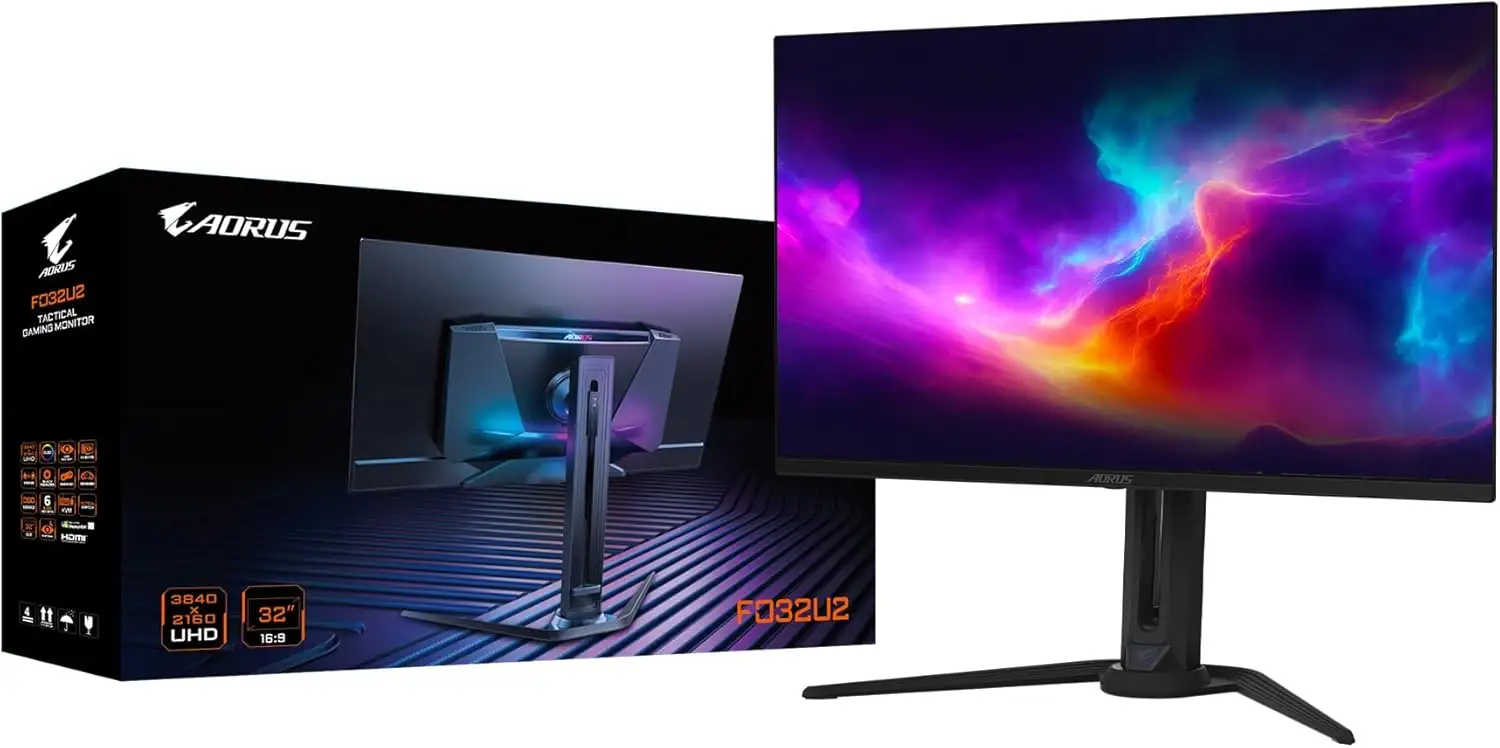
Design choices draw critique. The wide stand is “larger than it needs to be,” per PCWorld, consuming desk space without flat legs for peripherals underneath. A plain aesthetic relative to Alienware or ASUS rivals leaves the RGB to carry the styling load.
USB-C implementation divides owners — the FO32U2 delivers just 18W, enough for data and light power, but short for charging laptops. The FO32U2P’s 65W solves this, as noted in eBay listings, but at a higher price.
Divisive Features
Gigabyte’s OLED care is appreciated for being customizable and “running in the background with minimal interference,” yet OLED skeptics still worry about long-term burn-in despite the 3-year warranty covering it. Built-in speakers earn faint praise as “usable” by PCWorld, but many still prefer headsets or external audio.
Trust & Reliability
Trustpilot sentiment echoes reliability, with no large-scale defect reports and the warranty giving “peace of mind” for burn-in coverage. Long-term Reddit use cases (six months and counting) report “no noticeable pixel shifting” and burn-in prevention features running unobtrusively.
Durability seems solid — heft and material quality were praised, with “exceptionally little flex” in PCWorld’s handling. However, the semi-gloss finish is delicate; multiple users warn it “can get micro-scratches if you’re not careful.”
Alternatives
Direct rivals named in user data include the Alienware AW3225QF and ASUS ROG Swift PG32UCDM. Alienware brings sharper design and default firmware yielding steadier luminance. ASUS offers official G-Sync certification and USB-C with 90W PD. MSI’s MPG 321URX is $350 cheaper with similar specs.
PCWorld notes performance parity across these QD-OLED panels, making choice hinge on price, secondary features, and aesthetics rather than image quality.
Price & Value
eBay and Idealo.fr list new FO32U2 units around €1,398–€1,962, while FO32U2P models hit $1,999 AUD. Refurbished options dip to ~$1,599. Reviewers call it “very expensive” but in line with rival flagship OLEDs.
Resale value appears stable thanks to the 3-year burn-in warranty, but waiting for seasonal sales (Destructoid cited a $240 rebate period) can ease the sting. Buyers are advised to match their GPU capability to avoid paying for unused 240Hz potential.
FAQ
Q: Does the FO32U2 support full 4K 240Hz on consoles?
A: Yes, with HDMI 2.1 it can deliver native 4K at high refresh rates on latest-gen consoles, though many console titles cap below 240Hz.
Q: How effective is Gigabyte’s OLED care?
A: User feedback suggests it reduces burn-in risk without interrupting gameplay — routines run in the background and pixel refresh is only prompted when needed.
Q: Is HDR bright enough for daylight rooms?
A: In dim or controlled lighting, HDR highlights pop; in bright rooms, peak brightness (437 nits on highlights) is modest compared to mini-LED.
Q: Are the built-in speakers good?
A: They’re adequate for casual listening, with decent clarity, but most gamers still prefer dedicated audio gear.
Q: What’s the main difference between FO32U2 and FO32U2P?
A: The P variant adds higher USB-C power delivery (65W vs 18W), potentially useful for powering laptops, and DisplayPort 2.1 support.
Final Verdict
Buy if you’re a competitive or cinematic gamer with a GPU that can push high frame rates at 4K, and you value OLED’s contrast and color above peak brightness. Avoid if your room is bright, desk space is tight, or you need high USB-C charging power without paying for the FO32U2P.
Pro tip from community: Wait for promotional discounts — several users report snapping it up during rebate events, making its high-end performance far more palatable.