Shure BLX24/PG58 Review: Great Value, Band Matters (8.6/10)
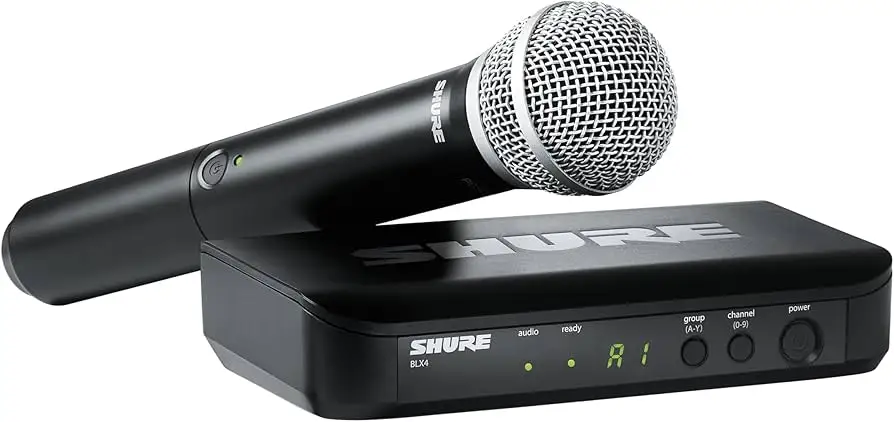
“4.6 out of 5 stars” across “1,007 reviews” is a loud opening signal—but the most telling detail is simpler: Shure BLX24/PG58 Wireless Microphone System with PG58 Handheld Mic is positioned as an “ideal entry-level wireless microphone system for small venues,” not a no-compromise touring rig. Verdict: a strong, mainstream pick for vocals and speech with a lot of institutional trust behind it—8.6/10.
Quick Verdict
Yes—conditionally. If you choose the correct frequency band for your area and you’re operating in typical church/club/event-room conditions, the value proposition is clear. If you’re in a congested RF environment or buying blindly without checking band compatibility, the same system can become a troubleshooting project instead of a plug-and-play win.
| What stands out | What users should watch | Who it matters to |
|---|---|---|
| High overall satisfaction (Amazon 4.6/5 from 1,007 reviews) | Band selection must match your location | Churches, schools, small venues |
| Long stated runtime (“up to 14 hours”) | Interference risk depends on environment | Event MCs, presenters |
| Long stated range (“up to 300 ft”) | “Line of sight” assumptions | Performers who roam |
| Simple setup (“one-touch scan and selection”) | Channel coordination for multi-mic setups | Houses of worship, venues |
Claims vs Reality
Shure and major retailers repeat a tight set of promises: simple setup, strong audio, long range, and long battery life. Digging deeper into the provided material, most of what appears “user-like” is actually platform copy (Shure regional pages and retailer descriptions), so the most responsible approach is to treat those as marketing claims rather than firsthand reports.
Claim 1: “Quick & easy set up… one-touch scan and selection.”
The system is repeatedly framed as frictionless: Amazon describes it as “quick & easy set up… up and running in record time,” while Shure USA highlights “one-touch scan and selection.” A retailer listing reinforces the same theme, calling out “one-touch quickscan frequency selection quickly locates the best frequency.”
The caveat shows up right alongside the promise: Amazon explicitly warns, “Before purchasing, please ensure that the wireless frequency band you select works in your area.” In real-world terms, that means setup may be easy after you’ve made the correct band choice. The “simple setup” story is strongest for buyers who already understand local RF constraints or are copying a known-good configuration in a stable venue.
Claim 2: “Extend the stage… range of up to 300 feet.”
Amazon calls out a “300 ft range,” and Shure pages repeat “up to 300 feet (100 m).” Musician’s Friend also frames this as a “line of sight: 300'” spec. While that’s consistent across sources, the language “up to” and “line of sight” signals best-case conditions rather than a guarantee in crowded rooms.
A second built-in qualifier appears in Shure’s own copy: “Note: region and environment dependent.” In other words, the marketing headline is consistent, but the fine print is where the practical reality lives—especially for users in RF-noisy spaces.
Claim 3: “Battery life… up to 14 hours.”
Amazon, Shure USA, Shure Singapore, and Shure regional pages all repeat “up to 14 hours” on “a single pair of AA batteries.” The alignment across official and retail sources suggests this is a core design target.
Even here, the phrasing “up to” matters. For vocalists running rehearsals, services, and events, “14 hours” reads like “a full weekend without battery anxiety,” but performance depends on battery type (Amazon notes “battery type: alkaline”) and usage patterns. The safest real-world interpretation is that long runtime is a major selling point, but not something to assume without keeping spare AAs in the kit.
Cross-Platform Consensus
Universally Praised
The loudest consensus in the provided data isn’t a single review quote—it’s how consistently multiple platforms describe the Shure BLX24/PG58 Wireless Microphone System with PG58 Handheld Mic as the “accessible” or “entry-level” path to recognizable Shure sound. Amazon’s description frames it as “wireless freedom, made simple,” and Shure Singapore calls it “the most accessible wireless Shure vocal microphone.”
For church tech volunteers and school AV staff, that positioning matters: it suggests a system designed to be deployed by non-specialists. The story being sold is reduced operational friction: Amazon emphasizes “simple set up and an intuitive interface,” while Shure USA repeats “simple set up” and highlights “one-touch scan and selection.” Musician’s Friend reinforces the same expectation with “an intuitive interface… simplifies set up and monitoring during use.”
For singers and presenters, “professional-quality sound” is the emotional core of the pitch. Amazon states “superior audio… professional Shure sound,” and Shure regional pages echo “professional-quality sound… for legendary audio performance right out of the box.” Musician’s Friend adds the capsule-specific angle: “the PG58 mic capsule captures vocals or speech with a balanced tone.”
Finally, for event use where mobility matters, the narrative centers on range and stability. Amazon promises you can “take the show into the crowd,” and Shure USA repeats “reliable signal… range of up to 300 feet.” Musician’s Friend’s technical framing—“microprocessor-controlled internal antenna diversity”—supports the claim that the system is engineered to maintain signal integrity in typical small-venue use.
- Repeated strengths across sources: “simple set up,” “one-touch scan,” “professional Shure sound,” “up to 300 ft,” “up to 14 hours.”
- Best-fit users implied by the messaging: churches, karaoke hosts, vocalists, presenters, small venues.
Common Complaints
A recurring pattern emerged in the fine print: the biggest “complaint-shaped” issue is RF and regulatory reality—not the microphone itself. Amazon includes a prominent “consumer alert” that “most users do not need a license,” but operation is “subject to certain restrictions” and the system has “no protection from interference received from any other device.” That’s not a user rant, but it is a warning that maps directly to a common wireless pain point: interference is often external and unavoidable.
The second likely friction point is buying the wrong frequency band. Amazon explicitly instructs buyers to verify band compatibility via Shure’s frequency finder (“before purchasing, please ensure that the wireless frequency band you select works in your area”). That suggests a real-world scenario where a buyer expects “plug it in and go,” but instead learns that band selection is a precondition for success.
Inventory availability can also be a practical frustration. Amazon’s listing states, “currently unavailable,” which can push buyers toward alternate bands, used markets, or resellers—choices that increase the odds of band mismatch or uncertain provenance.
- Main risk themes reflected in platform warnings: interference exposure, band-selection mistakes, and availability constraints.
Divisive Features
The same “entry-level” framing that makes Shure BLX24/PG58 Wireless Microphone System with PG58 Handheld Mic approachable can also be polarizing for advanced users. The system is presented as “single-channel receiver” and “tabletop” style—perfect for quick deployment, less ideal for users who want rack integration or complex channel coordination across many systems.
Musicician’s Friend describes it as “budget-friendly” yet “road-tested components,” a combination that can split buyers into two camps: those who want maximum value per dollar for recurring gigs, and those who interpret “entry-level” as a ceiling. The data doesn’t include firsthand disputes, but the positioning itself implies the divide: convenience-first versus infrastructure-first workflows.
Trust & Reliability
Trust concerns in the provided dataset show up most clearly through official cautions and resale-market context rather than direct community posts. Amazon’s “consumer alert” sets a serious baseline: the system “has no protection from interference received from any other device,” and the FCC may change rules. That messaging isn’t casual—it suggests that even legitimate, mainstream wireless systems can be blamed for problems they can’t control.
Reliability, meanwhile, is repeatedly asserted through brand reputation language: Amazon calls out “trusted quality… engineered by Shure with the durability that set the world standard,” while Musician’s Friend reinforces “durable ABS polymer construction and a steel grille.” Those are durability claims, not user diaries—but they do map to why institutions (churches, schools, event rental closets) repeatedly gravitate toward this tier: predictable operation and a long-established brand support network.
Alternatives
Only a few “alternatives” appear in the provided material, and they’re mostly variants rather than competing brands. Shure’s own pages list multiple frequency band options (H9, H10, H11, J11 in the USA listing) and regional SKUs (for example, Shure India’s H8E/J10/K3E/M17 options). The most meaningful “alternative” decision is therefore: picking the correct band and region configuration.
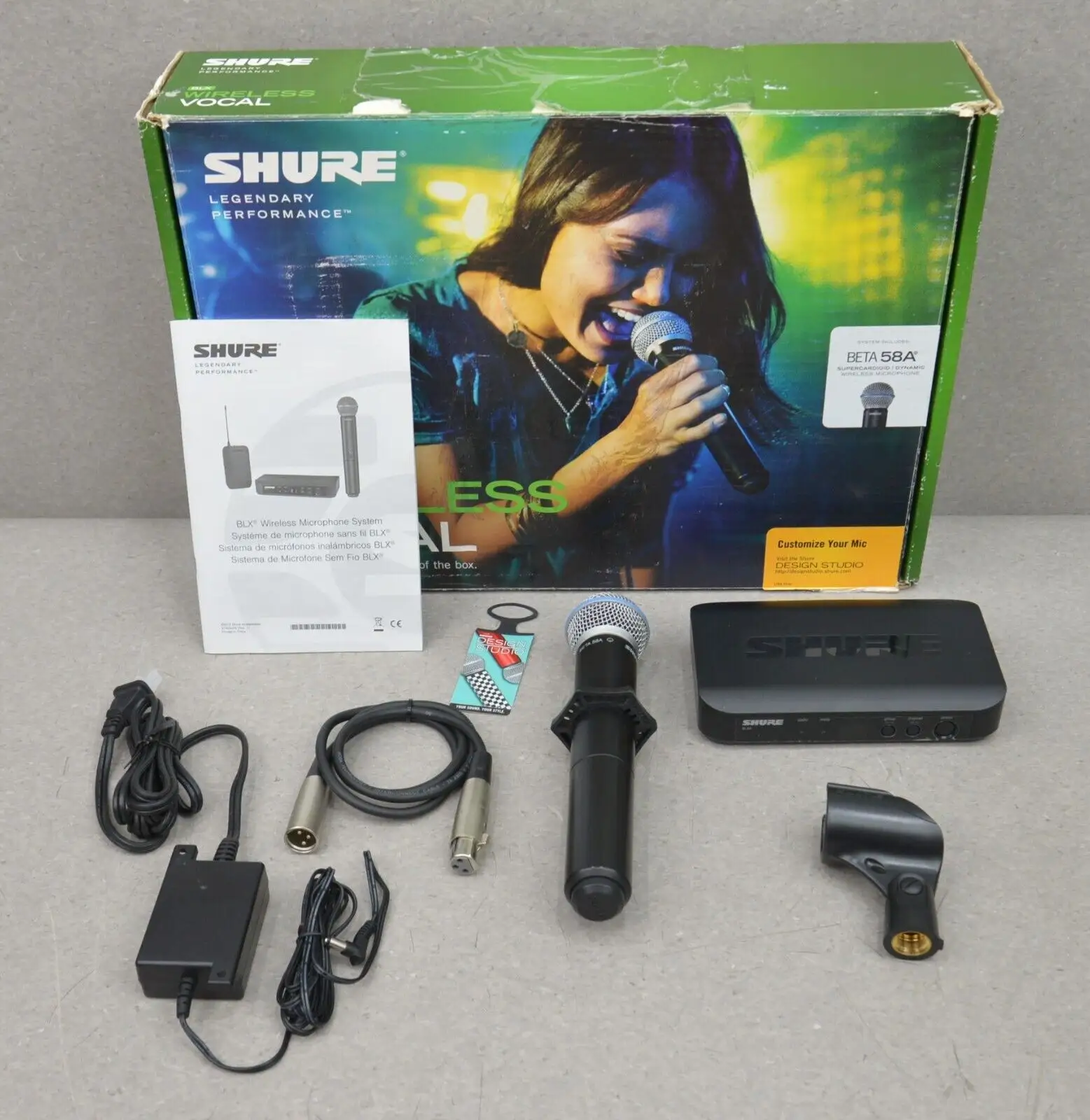
For buyers comparing listings, Musician’s Friend also surfaces an “Open Box” version of the same system, which functions as a price-based alternative. That can appeal to budget-conscious performers, but it carries practical risk: cosmetic damage or missing accessories can become a hidden cost if you’re trying to deploy the system immediately for a service, show, or conference.
Price & Value
The value story depends heavily on where you buy. Shure Singapore lists the Shure BLX24/PG58 Wireless Microphone System with PG58 Handheld Mic around “S$489.00” (sale) and “S$499.00,” while Musician’s Friend lists a new unit at “$329.00.” The spread suggests regional pricing, included accessories, and market conditions matter more than a single “official” number.
Resale and secondary markets show two different realities. eBay lists a “new” unit at “$299.00 or best offer” from a high-feedback seller, but also shows an out-of-stock “for parts or not working” listing at “$165.00” plus shipping. That contrast highlights the buyer’s dilemma: wireless systems can be bargains used, but only if condition, band, and completeness are verified.
Buying tips implied by the data are straightforward: confirm the frequency band, prioritize complete kits (“what’s in the box” lists receiver, power supply, batteries, clip), and treat suspiciously cheap listings—especially “as is” hardware—as potential repair projects rather than turnkey stage gear.
FAQ
Q: What is the Shure BLX24/PG58 system best suited for?
A: It’s positioned as an “entry-level wireless microphone system for small venues,” commonly marketed for “church, karaoke, vocals,” and presenters. The included PG58 handheld mic is described as tuned for vocal applications, making it a typical fit for speech and singing in rooms where quick setup matters.
Q: How long does the battery last on the BLX transmitter?
A: Official listings repeatedly state “up to 14 hours” from “a single pair of AA batteries.” That suggests all-day events are possible without mid-show battery swaps, but “up to” implies runtime varies by battery type and usage. Keeping spare AAs remains a practical safety step.
Q: What range can you expect from the BLX24/PG58?
A: Multiple sources cite “up to 300 feet (100 m),” and one retailer frames it as “line of sight: 300'.” That points to strong best-case mobility, but real performance is “region and environment dependent,” and there’s no protection from interference caused by other devices in the area.
Q: Do you need a license to use this wireless microphone system?
A: Amazon’s consumer alert states “most users do not need a license,” but operation is subject to restrictions and must not cause harmful interference. It also notes there’s “no protection from interference received from any other device,” and regulatory rules may change depending on FCC decisions.
Q: How do you choose the correct frequency band (H10, J11, etc.)?
A: Amazon explicitly recommends verifying that the “wireless frequency band you select works in your area” using Shure’s frequency finder. Since performance and legality depend on region and environment, band choice should be treated as a prerequisite—especially if you’re buying used or importing a region-specific SKU.
Final Verdict
Buy the Shure BLX24/PG58 Wireless Microphone System with PG58 Handheld Mic if you’re a church AV team, karaoke host, or event presenter who wants a widely trusted, “simple set up” wireless handheld with headline specs of “up to 14 hours” and “up to 300 ft.” Avoid it if you can’t confirm the correct frequency band for your area or if you’re working in highly congested RF conditions where interference risk is the main battle. Pro tip from the data: treat “before purchasing… ensure the wireless frequency band… works in your area” as the real first step, not an afterthought.