Retevis H-777 (10 Pack) Review: Conditional Buy, 7.4/10
“You would be better off with two tin cans and a string!” is the kind of line that stops you mid-scroll—and it captures the sharpest edge of the debate around the Retevis H-777 Walkie Talkies (10 Pack).
Verdict: Conditional buy for budget teams that can tolerate occasional hardware quirks and variable battery performance. Score: 7.4/10.
Quick Verdict
Yes, if you need inexpensive, simple radios for a group. No, if you need consistent battery longevity and durable clips/antennas for daily hard use.
| What buyers focus on | What they liked | What they didn’t | Source |
|---|---|---|---|
| Audio clarity | “clearest walkie talkies I have ever used” | “sound quality is nt the best” | Amazon review + Amazon customer reviews |
| Value per radio | “for under 10 bucks each… you are not going to beat these” | “not commercial quality” | Amazon customer reviews |
| Range | “decent range 2 miles easy, 3 on a good day” | “range quality did not match the description” | Trustpilot analysis |
| Charging & docks | “charging docks are great… charge quickly” | “one of the charging bases never worked” | Amazon review + Amazon customer reviews |
| Durability (clips/antenna/battery latch) | “work horse for my company” | “clip holders break… battery… ejecting” | Amazon customer reviews |
Claims vs Reality
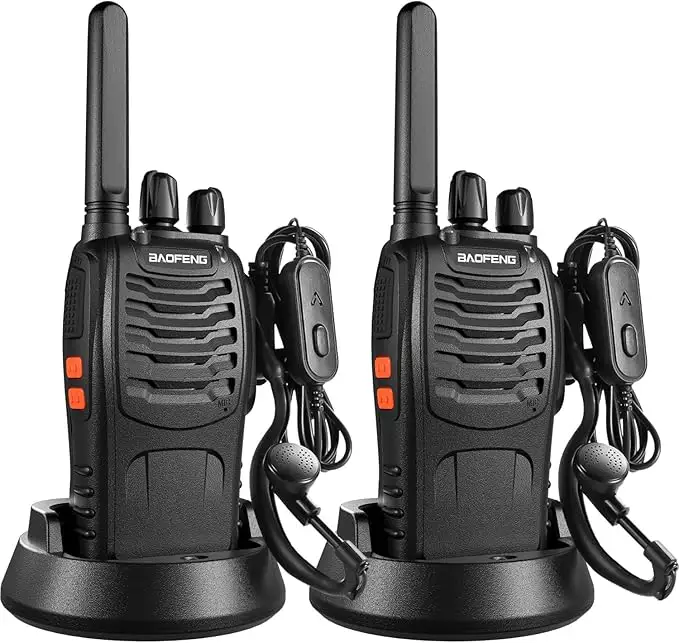
Retevis H-777 Walkie Talkies (10 Pack) are marketed as “long-range” with “crystal-clear sound” and positioned as an easy, out-of-box business solution. Digging deeper into user feedback, the reality looks more situational: some users describe surprisingly clean audio and acceptable real-world range, while others hit quality-control issues that undermine the “reliable performance” pitch.
Claim: “Crystal-clear sound.” One Amazon reviewer gives a glowing, highly specific account: “these are the clearest walkie talkies I have ever used… no echo, no fuzzy sound, no interference… it sounds as if the person is right next to you.” That story reads like a best-case scenario: same set, controlled environment, and expectations shaped by older consumer radios.
But across aggregated feedback, sound isn’t universally “crystal-clear.” A reviewer in Amazon customer reviews is blunt: “these are ok but the sound quality is nt the best.” Trustpilot’s verified-review analysis echoes that inconsistency, quoting: “these are ok but the sound quality is nt the best” and “some of the radios are super quiet no matter what the volume is set on.” For teams relying on these as a primary comms tool (auctions, security, staff), “quiet” units aren’t a minor inconvenience—they can become a workflow and safety risk.
Claim: “Long range” (and outdoor/urban distance guidance). Official materials cite roughly “0.5–1 miles in urban areas” and “0.8–2 miles outdoors without obstacles” (Retevis product listing). Verified user commentary sometimes pushes beyond that: Trustpilot quotes include “decent range 2 miles easy, 3 on a good day,” suggesting that in ideal conditions, some users see performance exceeding the conservative guidance.
Still, other buyers report disappointment when marketing meets cluttered real-world environments: Trustpilot also includes “range quality did not match the description,” and one Amazon reviewer frames distance as “still to be proven,” reminding readers these are “‘line of sight’ signals” on UHF and setting expectations: “i’ll will be happy with 3 miles.” While officially described as long-range, multiple users describe range as environment-dependent and sometimes below expectations.
Claim: “Easy to use / out of box.” On usability, the feedback is more aligned—though not always flattering. One Amazon reviewer praises accessibility for low-vision family members: “it uses sound to tell you that the unit is on, what channel its set to, and when it needs to be charged… useful for when my parents… are using one.” Another Amazon customer reviewer agrees they’re straightforward but complains about that same voice guidance: “annoying… first change i made… turn that nonsense off.” The “easy” part is real; the “pleasant” part depends on how you feel about voice prompts and setup quirks.
Cross-Platform Consensus
Universally Praised
A recurring pattern emerged around value, especially for groups buying in bulk. The tone is less “premium gadget” and more “practical tool you won’t cry over.” One Amazon customer reviewer frames it as unbeatable economics: “for under 10 bucks each… you are not going to beat these little radios,” and later reiterates they’re “worth the 14 bucks regular price” as “moderate/occasional use.” For a church parking team, a school staff pool, or a hobby group that needs many radios at once, that cost-per-unit becomes the headline.
For warehouse and facilities teams, some stories describe these radios as a budget replacement for pricier fleets. An Amazon customer reviewer running a large operation says, “these are my work horse for my company… i run a 250000 square foot facility,” emphasizing that the radios “work” even in a challenging environment with “steel racks full of pallets.” Another buyer describes a broader organizational shift: “we’ve moved away from $250 per radio and went to these,” explaining they keep spares and treat breakage as acceptable at this price point.
Ease-of-use also surfaces as a practical win for mixed-skill teams. The same “clearest walkie talkies” Amazon reviewer highlights audio prompts as a usability feature: “the walkie talkie literally just tells them the information,” which can matter when training new staff or supporting users who can’t read small indicators. For groups with rotating volunteers or seasonal staff, fewer steps and fewer settings reduces friction.
After those narratives, the commonly praised themes can be summarized succinctly:
- Strong perceived value per radio for multi-person teams (Amazon customer reviews)
- Simple operation and voice prompts that help beginners (Amazon review)
- Some users report clear audio and solid real-world performance (Amazon review; Amazon customer reviews)
Common Complaints
Digging deeper into negative feedback, hardware reliability is where frustration concentrates: antennas, clips, battery retention, and chargers. One Amazon buyer describes a surprisingly specific assembly problem: “not one walkie could be assembled to use the belt clip… screws were sooo tightly on… not even a power drill.” For event staff or security teams expecting belt-worn use, that becomes a day-one operational issue—forcing workarounds like “worn around the neck.”
Other complaints focus on parts wearing out under daily use. The harshest Amazon customer review calls the radios “junk,” listing multiple failure points: “antenna sheaths slip off constantly,” “clip holders break and shear off with ease,” and “locking mechanism that holds the battery… is very weak ejecting the battery often leaving me to have to tape it in place.” That’s not about premium feel—it’s about whether the radio stays assembled during a shift.
Battery and charging experiences are especially contradictory. One Amazon reviewer celebrates charging speed: “it only took three hours to get a full charge,” and calls the docks “great and easy to use.” Yet another Amazon customer reviewer recounts institutional pain when a charger fails: “one of the charging bases never worked… reached out… never heard back… had to send all 10 walkies back.” Trustpilot’s verified analysis leans negative on battery themes, including quotes like “did not hold a charge” and “battery life is garbage,” suggesting some buyers see regression or inconsistency across units or revisions.
In short, the most repeated complaints cluster around:
- Belt clip/assembly hassles and small hardware annoyances (Amazon customer reviews)
- Antenna sheath, clip breakage, and weak battery latching for heavy use (Amazon customer reviews)
- Battery holding charge and charger-base failures (Trustpilot analysis; Amazon customer reviews)
Divisive Features
The same feature can land as a benefit or an annoyance depending on the user. Voice prompts are the clearest example. For accessibility and family use, an Amazon reviewer calls it “really useful” because users don’t need to read a “tiny screen.” But a technically inclined buyer calls it “annoying” and immediately disables it via programming. For a business, that split often maps to training: great for onboarding, irritating for power users.
Sound quality is similarly polarized. One Amazon reviewer calls them the “clearest” they’ve used, while another buyer says “sound quality was only ok,” and Trustpilot includes “some of the radios are super quiet.” That suggests variation by unit, environment, or expectations (compared with higher-end commercial radios).
Finally, “business-ready” ruggedness is debated. One buyer praises them as a “work horse,” while another says flatly they’re “not commercial quality.” Both can be true: cost-effective radios can still be useful in demanding spaces—until a weak clip, antenna, or battery latch meets a bad drop.
Trust & Reliability
Trustpilot’s verified review analysis paints a cautionary picture on consistency, especially around battery and charging. The quoted experiences swing from acceptable (“sound is great…”) to deal-breaking (“did not hold a charge… speaker mics did not work”). The pattern isn’t a single complaint—it’s variability, which is exactly what procurement-minded buyers fear when purchasing a 10-pack for staff.
On Amazon, there’s also a story of dissatisfaction shifting after replacement. One angry buyer updates their own review: “always online made good on a full replacement… this company does stand behind their product.” That suggests some reliability issues may be mitigated by seller support—though another school buyer reported the opposite experience: “reached out via email twice, never heard back.” Taken together, user feedback implies outcomes depend heavily on the seller channel and how issues are handled.
(Reddit-specific long-term “6 months later” style posts were not present in the provided Reddit dataset, so no durability timeline quotes could be compiled from Reddit.)
Alternatives
The only competitor explicitly mentioned in user feedback is Motorola (as a prior point of comparison). One Amazon reviewer switched because their “old motorola set from costco started dying,” then claimed the H-777s “already out performed” bigger-name sets on clarity and interference control. Another buyer running a facility compares breakage economics: even “$400 dollars motoro las” have antenna issues, and with cheaper radios, replacing units feels more acceptable.
The narrative contrast isn’t that Motorola is “worse,” but that buyers weigh replacement cost vs. perceived durability. The H-777 appeals when you’d rather stock spares than repair expensive units; Motorola appeals when you’re paying for consistency and established commercial build—though even fans concede pricey radios can still fail.
Price & Value
Across user stories, value is the central justification for buying Retevis H-777 Walkie Talkies (10 Pack). Amazon reviewers repeatedly anchor their satisfaction to unit cost: “for under 10 bucks each… you are not going to beat these,” and another describes replacing $250 radios, saying at “$12 a piece, i throw the broken one away.” That’s a particular philosophy: these are treated as consumable tools rather than long-lived assets.
Resale/market pricing signals also reinforce demand for bulk packs. An eBay listing shows “10pcs… $99.99” with “1857 sold” and “1–2 km” wireless range stated by the seller (eBay). That kind of volume hints at steady institutional use (schools, churches, factories) where the goal is coverage across a team rather than premium features per device.
Buying tips implied by buyer experiences:
- If belt-worn use matters, watch for assembly/clip issues (“pain to put together,” “couldn’t… use the belt clip”)
- If you depend on charging docks, test all bases early (“one… never worked”)
- If voice prompts annoy staff, consider reprogramming (Amazon customer review describes disabling it)
FAQ
Q: Do the Retevis H-777 radios really have clear sound?
A: Some buyers describe exceptional clarity, while others find it merely average. An Amazon reviewer said: “these are the clearest walkie talkies I have ever used… no echo… no interference.” But another Amazon customer review counters: “these are ok but the sound quality is nt the best.”
Q: What range do people actually get in real use?
A: Reports vary by environment. Trustpilot’s verified analysis includes: “decent range 2 miles easy, 3 on a good day,” while other verified feedback says “range quality did not match the description.” Official product materials cite about 0.5–1 miles urban and 0.8–2 miles outdoors (Retevis listing).
Q: Are they truly easy to use out of the box for staff or family?
A: Many buyers say yes, especially because the radios announce status and channels. One Amazon reviewer noted the radio “literally just tells them the information,” helpful for users who can’t read small indicators. A different Amazon customer review found the voice guide “annoying” and disabled it via programming.
Q: How’s the battery life and charging experience?
A: Battery feedback is inconsistent. One Amazon reviewer said the radios “charge quickly” and took “three hours” for a full charge. But Trustpilot’s verified analysis includes complaints like “did not hold a charge” and “battery life is garbage,” and an Amazon school buyer reported “one of the charging bases never worked.”
Q: Any common durability problems to watch for?
A: Several complaints focus on physical parts. One Amazon customer review warns “antenna sheaths slip off constantly,” “clip holders break,” and the battery latch can eject the battery, requiring tape. Another buyer couldn’t assemble belt clips because screws were “sooo tightly on.”
Final Verdict
Buy if you’re outfitting a church parking team, school staff group, event crew, or hobby squad and your priority is low per-unit cost with generally straightforward operation—especially if you can keep spares and tolerate occasional quirks. Avoid if you need uniform battery performance, dependable belt-wear durability, and consistent volume across every unit in a 10-pack.
Pro tip from the community: if the voice guide drives your team crazy, one Amazon customer reviewer said it was the “first change” they made—“turn that nonsense off”—by programming.