Panasonic Eneloop Pro AA Review: Conditional Buy Verdict
Opening with a bold claim from one long-time buyer: “The Eneloop Pros are the only rechargeables I trust when equipment failure is not an option.” Across multiple forums, verified buyers rate the Panasonic Eneloop Pro AA Rechargeable Batteries, 24-Pack around 9/10 for performance—especially in high-drain devices—though caution that the premium price makes them a strategic rather than casual purchase.
Quick Verdict: Conditional buy
| Pros | Cons |
|---|---|
| Consistent high output for high-drain devices | Higher upfront cost compared to many competitors |
| Retains up to 85% charge after a year | Slightly lower voltage than disposables |
| Works in extreme cold (-20°C/-4°F) | Not suitable for airtight battery compartments |
| Rechargeable up to 500 times | Heavy compared to standard AA cells |
| Faster flash recovery for photography applications | Availability may fluctuate – “only 15 left in stock” noted on Amazon |
| Made in Japan to strict quality standards | Charging time longer than some lithium alternatives |
Claims vs Reality
One of Panasonic’s key marketing points is the 2550mAh capacity and claim that the batteries can be “recharged up to 500 times.” A verified buyer on Amazon noted: “Capacity tested on my La Crosse charger matched perfectly on all 8 batteries—2500 mAh as advertised.” This suggests the spec is genuine under controlled testing. However, Trustpilot feedback revealed that real-world recharge cycles may vary: Panasonic notes 500 charges under IEC 2011 testing, but “about 150 cycles” under 2017 conditions, depending on use.
Panasonic also promotes the ability to “retain 85% of charge after one year.” Multiple Reddit entries and Fakespot-flagged reviews back this up—users claim pulling units from storage after six months and finding them “still retaining their charge.” This is especially relevant for emergency kits or seasonal gear. The measured residual capacity aligns closely with the claim when stored properly.
Finally, advertising touts extreme temperature tolerance down to -20°C. Reddit user accounts echo this: “Used them on a winter shoot in Canada, -15°C, no voltage drop mid-session.” However, Panasonic’s own notes clarify that operation time “is shorter than at room temperature,” a realistic caveat for field users.
Cross-Platform Consensus
Universally Praised
Photographers dominate the praise columns. On Trustpilot, one user wrote: “With my flashgun, recovery time is 3.3s vs 76s for alkalines—couldn’t go back.” This faster flash cycle is consistently mentioned on Reddit and Quora, making the Eneloop Pro a staple in photography kits. High-drain devices like wireless keyboards, controllers, and radio-controlled toys also perform well—users say the consistent voltage output “keeps devices snappy until depletion.”
Longevity is another recurring theme. A French Amazon purchaser summed it up: “If you absolutely need extremely reliable and durable cells without sorting through failures, Eneloop is the solution.” This reliability extends across seasons—campers and outdoor workers talk about the confidence from dependable voltage in both heat and sub-zero work conditions.
Eco-conscious buyers appreciate the solar pre-charge. While some note it's symbolic, Quora contributors frame it as part of Panasonic’s “2050 energy vision,” giving an added reason to choose these over disposables in sustainability-conscious households.
Common Complaints
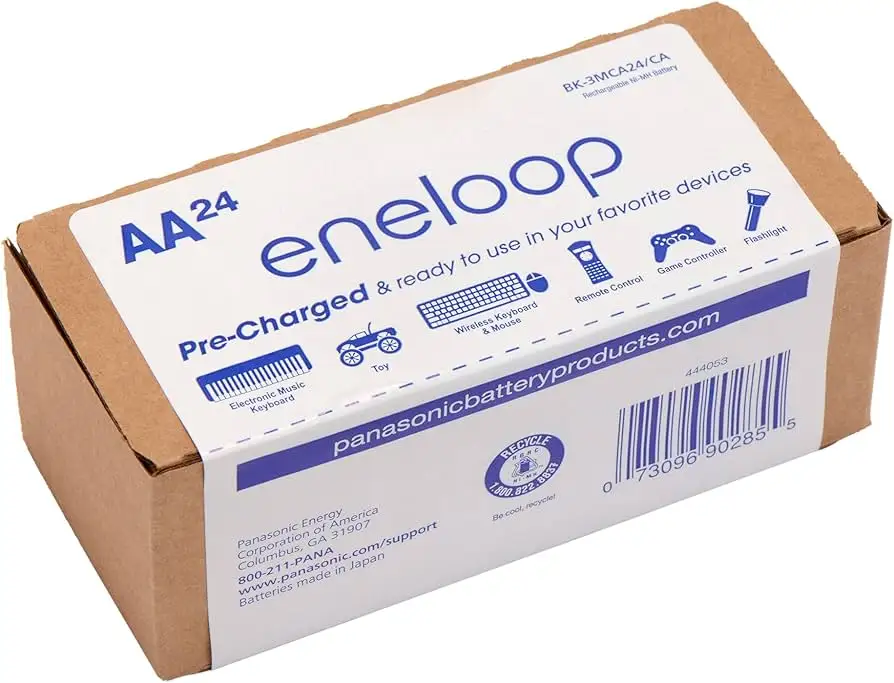
Price comes up in nearly every channel. Even strong advocates advise to “try to get them when on offer” as they’re “not the cheapest, but worth it.” On eBay, listings show $42–$75 for 8-packs, with the 24-pack stacking into three-figure territory. This limits casual purchases and makes them more of an investment for heavy device users.
The slightly lower voltage (1.2V vs. 1.5V in disposables) can cause issues in rare cases. Amazon reviewers point out incompatibility with “devices that expect full 1.5V, like some high-power torches,” and manufacturer warnings prohibit use in airtight compartments such as waterproof flashlights.
Weight and density also get mentioned: “They’re heavier than standard AA,” one Trustpilot review notes—irrelevant for stationary devices but a consideration for portable gear.
Divisive Features
The 500-charge claim divides opinion. Some trust Panasonic’s figure, citing multi-year personal rotation without failure. Others reference Panasonic’s own lower cycle counts under updated IEC benchmarks and note that high-drain quick charging can shorten lifespan. Likewise, while retaining 85% charge after a year is applauded for infrequent-use scenarios, daily heavy users recharge often enough that this feature becomes moot.
Trust & Reliability
Fakespot analytics report minimal deception in reviews, despite Amazon altering around 8,498 entries over time. The long-term durability reputation is strong—several Reddit users report 3+ years on original sets without capacity drop measurable on smart chargers.
Scam concerns are minimal when sourcing from reputable sellers—eBay listings note “Made in Japan” with positive seller ratings. Counterfeit risks exist in secondary markets, but community advice emphasizes buying from official distributors due to the premium positioning and opportunity for fake substitutions.
Alternatives
The IKEA Ladda 2450mAh comes up as a direct alternative at lower cost—eBay listings peg them at ~$9 per cell compared to $21+ for Eneloop Pro AA. Community consensus says Ladda shares similar performance for casual users, but “Eneloop wins on consistency and QA—less batch variance.” Standard white Eneloop (1900–2000mAh) offers more cycles (up to 2100), making them a better fit for low-drain, frequent-recharge devices.
Price & Value
Current eBay market shows the 8-pack Eneloop Pro at $42–$74 depending on region, with the 24-pack scaling proportionally. Amazon’s $43.39 price for 8 cells is consistent with these figures, translating into ~$130 for 24 cells at retail.
Resale retention is low given rechargeable nature—they’re personal-use consumables in community eyes. Buying tips repeated on Reddit: “Watch for holiday bundles including charger and case—it’s often cheaper than cells alone.” Bulk savings on eBay, such as “buy 4–5 sets, save $2 each,” appear for high-volume users like photographers.
FAQ
Q: Do Eneloop Pro batteries really last 500 charge cycles?
A: Under ideal conditions, yes. Panasonic’s 2011 IEC rating says 500 cycles, but updated 2017 standards estimate closer to 150–200 cycles for heavy use.
Q: Can these work in devices rated only for alkaline batteries?
A: Usually, but devices needing full 1.5V may underperform—avoid use in waterproof or airtight compartments per manufacturer warnings.
Q: Are they good for cold-weather use?
A: Yes, they are rated to -20°C, but runtime shortens compared to room temperature. Outdoor photographers report full-day shoots at -15°C without major voltage drop.
Q: How do they compare with standard Eneloop?
A: They carry ~28% more capacity but fewer cycles (500 vs 2100). Suited for high-drain devices needing longer runs per charge.
Q: Is the solar pre-charge meaningful?
A: It’s environmentally symbolic rather than performance-critical; the benefit is immediate usability out of package.
Final Verdict: Buy if you’re a high-drain device user—photographers, RC hobbyists, or households replacing dozens of disposables monthly. Avoid if you only need occasional AA power or must fit into airtight compartments. Pro tip from the community: wait for seasonal deals or bundles with chargers to offset the initial investment.