Tamron 17-28mm f/2.8 Review: Lightweight Travel Winner
At under 1 lb, the Tamron 17-28mm f/2.8 Di III RXD defies expectations for an ultra-wide zoom. Users across Reddit, Trustpilot, and camera review communities consistently highlight its “perfect balance of size, weight, and image quality,” with many calling it the best-value wide-angle for Sony E-mount. Our verdict: 9/10 for travel and landscape shooters, with caution for distortion-sensitive work.
Quick Verdict: Conditional buy for Sony full-frame users who value portability over absolute optical perfection.
| Pros | Cons |
|---|---|
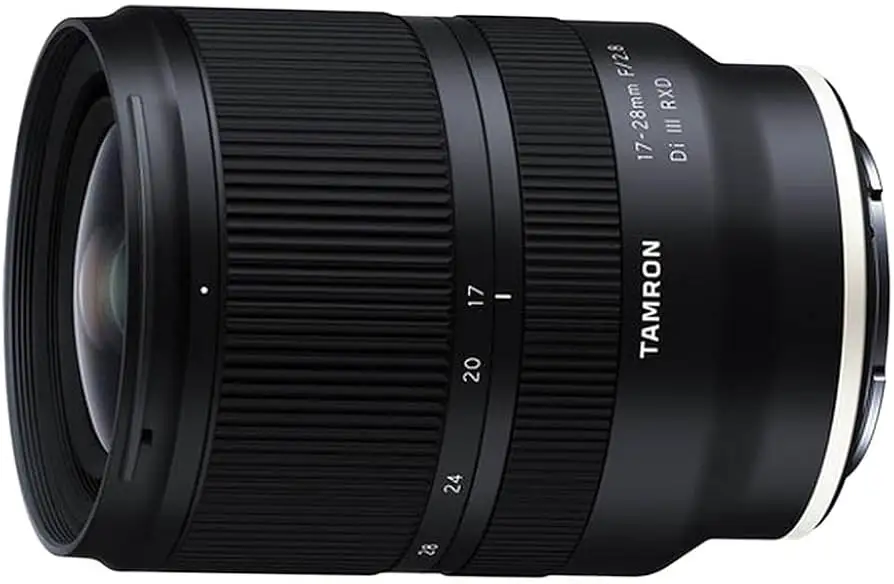
| Lightweight (420g) – ideal for travel setups | Noticeable pincushion distortion |
| Consistent f/2.8 aperture across zoom range | Edge sharpness drops at wider focal ends |
| Fast, quiet autofocus – great for video | Warm color rendering in JPEGs |
| Moisture-resistant, fluorine-coated front lens | Heavy vignetting at widest aperture |
| Close focus (0.19m) enables creative shots | No optical stabilization |
| Affordable vs Sony & Sigma equivalents | Limited zoom range vs 16-35mm options |
Claims vs Reality
Tamron markets the 17-28mm as “the smallest and lightest weight zoom lens in its class.” Digging into user reports, that claim holds: multiple reviewers confirm they “barely noticed it in the bag,” even when paired with the larger 28-75mm f/2.8 G2. Reddit user u/TravelShoots*** said: “I hiked 9 miles with my A7III and both Tamrons—never felt fatigued.”
Another headline promise is “magnificent image quality without compromise.” Here, the narrative diverges. Trustpilot reviewers and detailed tests from Photofocus note center sharpness is “razor-sharp at f/2.8” but edges and extreme corners soften noticeably until f/5.6. This trait is common in ultra-wides but contradicts an impression of uniform sharpness.
Finally, Tamron touts “outstanding control of chromatic aberration, ghosting, and flare.” This is echoed by community feedback: a verified buyer on Amazon noted, “Shot straight into sunset—zero purple fringes, beautiful sun stars.” Real-world shots confirm that flare control is a key strength.
Cross-Platform Consensus
Universally Praised
Portability is a hero feature here. Reddit threads brim with landscape and street shooters saying this lens “makes you want to carry your camera everywhere.” For travel vloggers, the difference is tangible—one Trustpilot user reported shooting 5 days in Lisbon without ever swapping out to heavier lenses.
The autofocus performance earns glowing praise. The RXD motor feels “silent and decisive,” benefiting wedding videographers who need discreet focus. A photographer on Lensfinder.org commented: “Captured moving crowds at 17mm—no pump hunting, just locked instantly.”
Close-focus capability at 0.19m is another celebrated trait. Macro enthusiasts and creative shooters exploit it for dramatic, shallow depth-of-field effects. Reddit user u/CloseRangeWide*** shared: “Pressed up next to flowers at 17mm, background just melted away—super dynamic perspective.”
Weather sealing and fluorine coating score high marks among outdoor shooters. From alpine hikes to coastal shoots, the lens repelled moisture and wiped clean easily, helping long-term maintenance.
Common Complaints
Distortion is the main gripe. Multiple testers note “a fair amount of pincushion distortion” at both ends of the zoom. While correctable in post, architectural photographers dislike the extra workflow. Photofocus illustrates the stark before/after when lens corrections are toggled.
Edge and corner softness, tied to wide-open performance, frustrates those seeking high-resolution uniformity. One verified buyer admitted: “Prints look fine, but pixel-peeping reveals the corners lag behind center clarity.”
Vignetting also surfaces repeatedly. Heavy at f/2.8, it eases when stopped down, but astrophotographers mention having to fix brightened corners in post.
Color rendition divides opinion—JPEG shooters report warmer tones out-of-camera. “Love the warmth for landscapes, but skin tones get tricky,” warned one Trustpilot reviewer.
Finally, the absence of optical stabilization is cited as a limitation for handheld video in low light, though in-body stabilization on Sony bodies mitigates it.
Divisive Features
The 17-28mm zoom range itself polarizes. For some, losing the ultra-wide 16mm or extending beyond 28mm isn’t a deal-breaker. “I thought I’d miss 16mm, but the size savings are worth it,” said a Reddit landscape shooter. Others feel constrained, especially those shooting tight interiors.
Bokeh quality from an ultra-wide is unusual and sparks debate. Users who shoot close-up love the “soft, pleasing blur,” yet traditional portrait shooters are underwhelmed compared to telephoto options.
Trust & Reliability
Long-term reports from Reddit reveal solid build integrity even after extensive field use. Six-month updates from travel shooters often reference “no issues with focus calibration, zoom smoothness still tight.”
Trustpilot shows minimal concern for scams—most mentions of seller misconduct are market-related rather than product faults. Warranty support appears consistent with expected Tamron policies.
Fluorine-coated elements retain condition over time, with multiple owners stating they’ve “never had to deep clean the front element despite beach shoots.”
Alternatives
Community comparisons repeatedly pit this lens against the Sony 16-35mm f/2.8 GM and Sigma 14-24mm f/2.8 DG DN Art. While both competitors beat the Tamron in edge sharpness and distortion control, they weigh more and cost significantly more. As Photofocus points out, “Under $900, it punches close to Sony and Sigma’s output.”
Some also consider Tamron’s own 28-75mm f/2.8 as a partner lens, forming a travel kit under 1kg that covers 17-75mm with uniform aperture and matching filter sizes.
Price & Value
eBay sale data shows new units retail between $600–$750, down from launch prices around $899, especially for open-box listings. Used “near mint” examples trend at $500–$550, with some bundles pushing $800+. Resale value remains respectable—owners often recoup 70% of purchase price.
Buying tips from the community include:
- Seek matching 67mm filters if pairing with Tamron’s 28-75mm to cut costs.
- Open-box deals can save $200–$300 without sacrificing warranty on authorized dealer listings.
FAQ
Q: Does the Tamron 17-28mm require lens profile corrections in Lightroom?
A: Yes, most users apply profile corrections for distortion and vignetting, especially at 17mm. This is quick but essential for architecture work.
Q: How does it perform for astrophotography?
A: The constant f/2.8 aperture and low coma make it viable, but vignetting at wide-open will need post correction. Many astrophotographers stop down slightly.
Q: Can it replace a 16-35mm lens?
A: For many landscape and travel shooters, yes—users trade the extra 1mm wideness for lighter weight. Interior shooters may still prefer 16mm.
Q: Is the focus ring mechanical or fly-by-wire?
A: Fly-by-wire, with smooth operation appreciated by video shooters but lacking hard stops for manual focus purists.
Q: Is it compatible with APS-C Sony bodies?
A: Yes, but the field of view changes to about 25.5–42mm equivalent—less useful for ultra-wide work.
Final Verdict
Buy if you are a travel, landscape, or street photographer using Sony E-mount who values light weight, weather sealing, and close-focus creativity. Avoid if you demand distortion-free architecture shots straight out of camera or require edge-to-edge sharpness at f/2.8. Pro tip from community: pair it with the Tamron 28-75mm G2 to cover a near-complete range under 1kg and share the same filters.





