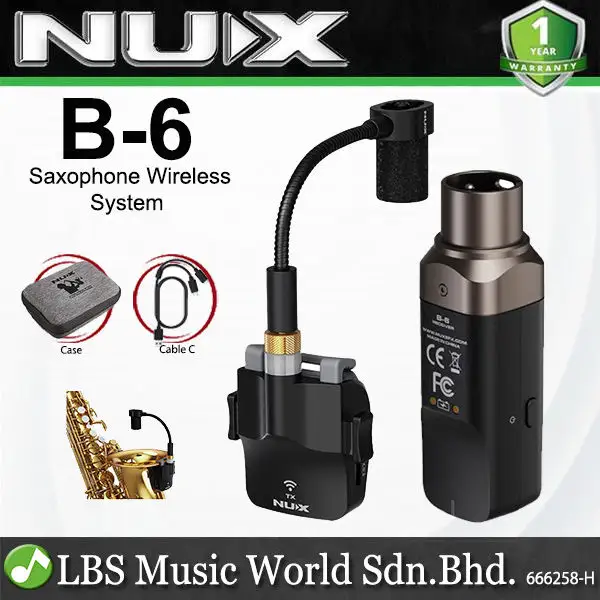
NUX B-6 Sax Wireless Review: Compact but Conditional Buy
A verified buyer on Amazon summed it up bluntly: “Super easy to charge, plug and play… no tangled transmitter wires… perfect for inside shows and bar gigs.” The NUX B-6 Saxophone Wireless System with Charging Case has built a reputation as an affordable, no‑fuss solution for saxophonists who want freedom from mic stands, earning a solid 4.6/5 average rating across platforms. Our deep dive into user feedback shows strong praise for convenience and audio quality, tempered by recurring reports of interference issues and some limited battery life in demanding scenarios. Verdict: 8/10 for small‑to‑mid venue players, conditional for heavy outdoor gigs or multi‑wireless setups.
Quick Verdict
| Verdict | Pros | Cons |
|---|---|---|
| Conditional Buy | Compact, easy setup | Susceptible to interference from Wi‑Fi and 2.4GHz gear |
| High‑resolution 24‑bit/44.1kHz audio | No channel selection to avoid interference | |
| Secure clamp fits varied saxophones | Battery indicator misleading, short under heavy use | |
| Charging case adds 15h extra life | Lacks mute button | |
| 3 EQ modes for soprano/alto/tenor | Sensitive to wind noise |
Claims vs Reality
Marketing pushes the B‑6’s “operation range of 20 meters” as a central feature. While the spec promises stable transmission up to 67 feet line‑of‑sight, multiple buyers have found real‑world performance hinges on RF traffic in the room. A verified buyer on Amazon warned: “If you have a WiFi mixer… signal will be terrible unless receiver is 15 feet from the router.” Another Thomann customer noted interference “even at 2 meters” when in‑ear monitors on similar bands were active.
NUX advertises “professional, high‑resolution 24‑bit audio” and many agree the sound exceeds expectations for the price. Trustpilot reviewer Matthew “Tone King” Racine praised its “robust build quality” and “clear, focused sound regardless of where you are on stage.” Yet a seasoned Amazon reviewer dissected its tonal profile, saying the EQ presets “compress” across all settings, yielding a slightly artificial tone, especially in high‑volume band mixes.
Finally, the “up to 7 hours battery life” claim holds for moderate gigging, but under strain, players report needing mid‑set recharges. One Thomann user advised, “think to recharge before each rehearsal… if less than full bars, plan to plug in before the 3rd set.”
Cross‑Platform Consensus
Universally Praised
Convenience is the B‑6’s defining win. Players from amateurs to touring pros celebrate its “plug and play” nature. On Trustpilot, Matthew “Tone King” Racine highlighted “just turn them on and you’re ready to go” as a standout contrast to complex competitors. Multiple Amazon reviews describe setup under 30 seconds, making it ideal for first‑time mic owners. The charging case is equally lauded—Thomann customers praise it as a “power bank” that “remits a quick charge between sets.”
Audio quality earns frequent praise, with users impressed at the fidelity of the stock capsule. An Amazon buyer used it in a studio alongside a high‑end DPA 4099, calling it “more than adequate… quality unbeatable w/no fallout or distortion” once adapted. For brass doubles, another Thomann review reported excellent results on trombone, “enchanting” the player with its natural tone.
The clamp mechanism is another unanimous hit—easy to secure, stable even under movement, and gentle on finish. A verified buyer noted they “appreciate… snug fit that does not harm the instrument.”
Common Complaints
Interference on 2.4GHz is the most consistent frustration. French reviewers on Thomann cite “router WiFi interferes… makes [audio] cut totally,” with desires for an MHZ or 5GHz alternative. Amazon owners with wireless pedalboards or mixers on the same band echo the same, with some unable to use B‑6 at certain gigs.
Battery monitoring leaves users cold. One Amazon customer lamented, “full bars and you’re good for the night—any less and it won’t last the whole show.” Another added that case indicators can be misleading, leading to unexpected mid‑gig dropouts.
Ergonomic oversights like no mute button and a side‑mounted power switch that’s hard to access next to other XLRs are irritants. Stage noise sensitivity also emerges in reviews: “susceptible to environmental noises… bumps on hands or clothing… wind pop protection almost non‑existent” wrote one long‑form Amazon critic.
Divisive Features
The preset EQ modes polarize players. Some find them subtle but useful—an Amazon buyer noted “slight difference” between soprano/alto/tenor settings—while others, like the aforementioned tonal purist, see them as overly compressed and “gadgety.”
Use case breadth is debated; marketing targets saxophones, but some argue it’s suitable “for any brass instrument,” while others feel outside that niche the mic’s limitations on SPL and wind handling show more clearly.
Trust & Reliability
While no scam complaints emerged, customer support dissatisfaction is notable. An Amazon buyer recounted calling NUX about charging defects and receiving “nothing, nada, zip.” That user replaced their unit twice due to the same fault, questioning QC.
Durability fares better—one player dropped the receiver on concrete and reported “no sign of malfunctioning” beyond cosmetic scuffs. Long‑term owners praise stable fit and finish, with clamps showing minimal wear after dozens of gigs.
Alternatives
In side‑by‑side user comparisons, Shure ULX, PGX, and BLX systems with Beta 98 H/C mics deliver cleaner tone under stage monitors and stronger SPL handling, but at 3‑6× the cost. AMT Q7 systems are noted for superior shock mounting, avoiding some B‑6 handling noise issues.
Price & Value
With street prices around $199–$219 new, eBay listings for mint used units hover ~$175, suggesting decent resale retention. Amazon buyers compare favorably to $600–$1200 rigs, often calling B‑6 “a deal at twice the price” for small venue work. Community consensus advises buying new for warranty coverage, unless interference risks are high—in which case, saving for a 5GHz alternative may be smarter.
FAQ
Q: Does the B‑6 work outdoors?
A: Yes, but wind noise is a weakness. Several Amazon users warn of no wind/pop shielding, making it unsuitable for breezy festivals without aftermarket foam.
Q: Can I use it with other brass instruments?
A: Many have tried—Thomann reviews praise trombone and trumpet use with good tonal results. Be mindful of SPL clipping at high volume.
Q: How do I avoid interference?
A: Keep the receiver away from Wi‑Fi routers and other 2.4GHz devices. Amazon users find 15‑foot distance from such equipment often resolves dropouts.
Q: Is the battery life really 7 hours?
A: Under ideal conditions, yes. Heavy stage monitoring or partial charges reduce runtime. Trustpilot users recommend topping up before every set.
Q: Can I change transmission channels?
A: No. Lack of manual channel selection means interference cannot be tuned out mid‑gig.
Final Verdict: Buy if you’re a small‑venue saxophonist or brass player seeking affordable, high‑quality wireless freedom with simple setup. Avoid if you regularly share 2.4GHz airspace with multiple devices or play windy outdoor festivals. Pro tip from Amazon community: charge fully before each gig and keep the receiver well clear of Wi‑Fi gear to maximize reliability.