Jabra Evolve2 30 SE Review: Conditional Buy (6.5/10)
“4.5 out of 5 stars” sounds decisive—until you realize one Amazon listing shows just “2 reviews” (Amazon.co.uk) while another shows “55 reviews” (Amazon.com). That split matters, because the loudest “feedback” in the provided data isn’t actually customer voice at all—it’s marketing copy and reseller summaries. Jabra Evolve2 30 SE Wired Noise-Cancelling Headset - Black gets a cautious verdict because the dataset contains very few direct, attributable user quotes. Score: 6.5/10.
Digging deeper into what’s usable as real feedback, the most concrete signals come from Amazon star averages and a third-party retailer’s sentiment summary—while most other sources provided here (Jabra pages, TorontoHeadset, PixelStabbers, Trustpilot/Reddit text blocks) read like brand or SEO copy rather than community posts with identifiable users. That doesn’t mean the headset is good or bad—it means the “user story” evidence is thin.
Still, a recurring pattern emerged across the sources that do give evaluative language: call clarity and mic performance are the central promise, and comfort is the most likely tradeoff for certain wearers. PROVANTAGE’s aggregated take explicitly says: “The stereo sound and microphone quality receive high praise… Some users prefer over-ear comfort for long periods.”
While officially positioned as “noise-isolating” and “engineered to keep you productive,” the dataset doesn’t include the kinds of first-person, time-based reports (“6 months later…”) that would normally validate durability, comfort over long shifts, or real-world noise suppression. That absence forces a more conditional recommendation.
Quick Verdict
Yes/No/Conditional: Conditional — best for wired office calls and Teams-centric workflows; less certain for all-day comfort seekers who dislike on‑ear pressure.
| What the data supports | Pros (from provided sources) | Cons / risks (from provided sources) |
|---|---|---|
| Call focus | “2‑mic technology… improve call quality” (Amazon listing copy) | Few direct user quotes validating it |
| Noise isolation | “noise isolating design… suppresses background noise” (Amazon) | “Noise control: sound isolation” (passive, not ANC) may disappoint ANC shoppers |
| Office signaling | “busylight automatically switches on” (Amazon) | No user feedback on whether it’s helpful vs distracting |
| Platform fit | “certified for Microsoft Teams” (Amazon/Jabra) | Limited reports about macOS quirks or app issues |
| Comfort | “lightweight & portable” (Amazon/Jabra) | PROVANTAGE notes some prefer over‑ear comfort for long periods |
| Value | Discounts shown on Amazon | Price varies widely across listings/resellers |
Claims vs Reality
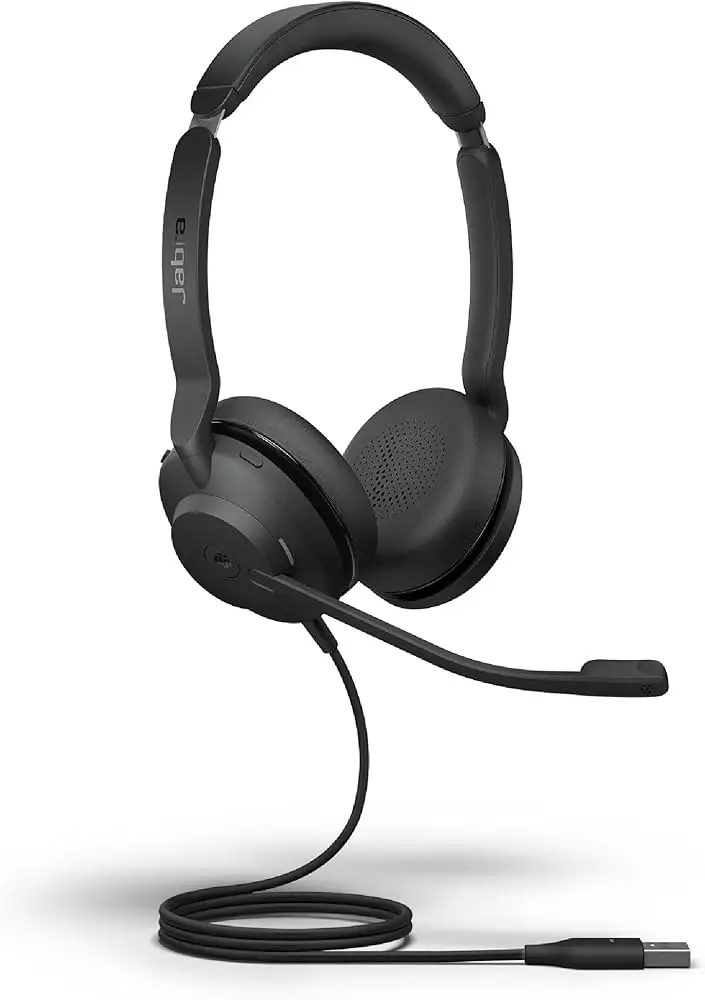
One of the biggest marketing hooks is “enhanced call experience” via a “2‑mic technology” boom system. Amazon’s copy frames it as: “improve call quality… suppresses background noise.” PROVANTAGE’s summary aligns with this direction, stating: “The stereo sound and microphone quality receive high praise, especially in office and remote work settings.” That’s the closest thing in the dataset to a “reality check,” but it’s still a retailer sentiment summary rather than a directly quoted customer.
Another headline claim is productivity and fewer interruptions through the integrated busylight: “busylight automatically switches on during a call.” In real community threads, you’d expect stories about coworkers actually respecting it or ignoring it—but no such first-person accounts appear in the provided data. So the “gap” here isn’t negative feedback; it’s missing verification. If this feature is a deciding factor, this dataset doesn’t confirm its real-world impact.
Noise is the third area where language can mislead. Marketing repeatedly uses phrases like “noise-isolating” and implies strong suppression (“cancels 48% more of the noise around you” appears on Jabra pages). Yet the Amazon specs list “Noise control: Sound isolation,” which is typically passive isolation rather than active noise canceling. While officially described as “wired noise-cancelling,” the details in the dataset point more strongly to passive isolation + mic noise reduction than true ANC. In other words: while marketed with “noise cancelling” phrasing, the data suggests the real story is isolation and call-focused noise handling, not airplane-style ANC.
Cross-Platform Consensus
Universally Praised
“Clear calls” is the most consistent promise across platforms, and it’s the one area where the dataset offers at least one evaluative statement beyond marketing. PROVANTAGE summarizes user sentiment as: “The stereo sound and microphone quality receive high praise, especially in office and remote work settings.” For remote workers living in back-to-back meetings, that kind of “mic-first” reputation is the core reason to buy a wired boom headset in 2025: reliability, predictable pickup, and less fiddling than true wireless options.
Comfort is also repeatedly emphasized—though mostly by manufacturers and sellers rather than customers. Jabra’s own pages push “lightweight… comfortable,” and Amazon’s listing highlights “lightweight & portable… enhanced comfort.” For hybrid workers moving between home and office, a wired, packable headset with a “soft pouch” (Amazon “in the box”) fits the everyday commute narrative. The dataset supports that portability is part of the product positioning, even if it doesn’t contain commuter anecdotes.
Platform alignment, particularly Microsoft Teams certification, is another repeated positive. The Amazon listings say it’s “certified for Microsoft Teams with a dedicated Teams button,” and Jabra pages repeat “meeting MS Teams open office requirements.” For IT-managed environments, “Teams-certified” often matters more than audiophile sound claims because it reduces support tickets and compatibility uncertainty. Again, this is mostly claim-based in the dataset, but it’s consistent across sources.
After those three, the “busylight” is positioned as a quality-of-life win. Amazon calls it “highly visible” and says it’s “visible from all angles” (also echoed in PROVANTAGE specs). For open offices, that’s meant to be the “don’t interrupt me” signal. The dataset doesn’t provide a user story confirming behavior change, but it does show the feature is central to how the headset is sold.
Summary bullets (after narrative):
- Call performance is repeatedly framed around “2‑microphone technology” (Amazon/Jabra) and echoed in PROVANTAGE sentiment: “microphone quality receive high praise.”
- Teams certification and a “dedicated Teams button” are consistent across Amazon and Jabra pages.
- Portability is supported by repeated mentions of “lightweight” and inclusion of a pouch/travel case (Amazon listings).
Common Complaints
The most concrete downside in the provided feedback isn’t a dramatic failure—it’s fit preference. PROVANTAGE’s sentiment summary flags: “Some users prefer over-ear comfort for long periods.” That’s a classic on‑ear headset tradeoff: for people doing marathon call days, clamp pressure and ear fatigue can become the dealbreaker even if the mic is excellent. In practical terms, this affects call-center staff, support agents, and anyone in eight-hour meeting-heavy roles.
Wired limitations are also acknowledged, again via PROVANTAGE’s “considerations”: “Wired - not as mobile as wireless headsets.” For workers who pace during calls, stand at whiteboards, or regularly swap between laptop and phone, a cable can become friction—tugging, snagging, or limiting movement. The dataset doesn’t include complaints about cable durability or tangling, but it does explicitly list the mobility tradeoff.
Price sensitivity shows up indirectly through market listings rather than explicit user frustration. Amazon shows discounting (e.g., “27 percent savings” on Amazon.com and “26 percent savings” on Amazon.co.uk), while price comparison pages show a broad range. That spread implies shoppers are actively hunting deals—often a sign the perceived value depends heavily on purchase price. Without customer quotes, the “complaint” here is better described as a risk: if bought near list price, some buyers may compare it against cheaper wired headsets or step up to wireless models.
Finally, there’s confusion in specifications that can fuel dissatisfaction. One Amazon spec block oddly lists “wireless communication technology: Bluetooth” even though the product is described as wired USB‑C. Mixed spec fields like that can lead buyers to expect features (wireless use) that aren’t actually part of the experience. While not a user quote, it’s a contradiction inside the provided source data.
Summary bullets (after narrative):
- Comfort can be polarizing for long wear: “Some users prefer over-ear comfort for long periods” (PROVANTAGE).
- Mobility tradeoff is explicit: “Wired - not as mobile as wireless headsets” (PROVANTAGE).
- Spec confusion risk: wired listings still show stray “Bluetooth” fields in the provided Amazon spec text.
Divisive Features
“Noise-cancelling” is the most divisive label in this dataset because different sources imply different things. Jabra marketing language leans on measurable-sounding claims like “cancels 48% more of the noise around you,” while Amazon specs describe “Noise control: Sound isolation.” If a buyer expects active noise canceling, the passive “noise-isolating” reality could feel like a miss. If a buyer wants call clarity and some isolation in an office, the design might be exactly what they need.
Mono vs stereo is another split, though the dataset mixes variants. Amazon.co.uk data references “MS version Mono” while Amazon.com highlights “Stereo.” For some roles (customer support, reception), mono is preferred so one ear stays open. For music between calls and a more immersive meeting feel, stereo is the draw. The dataset supports both options exist but doesn’t give direct user opinions about which is better.
Trust & Reliability
The provided “Trustpilot (Verified)” block reads like product overview text rather than review excerpts with identifiable reviewers, dates, or complaints. Without real Trustpilot snippets, there’s no evidence here to investigate scam concerns, support patterns, or refund disputes. The dataset also doesn’t include the “6 months later…” style durability anecdotes typically found in Reddit communities.
On durability claims, sellers highlight “reinforced steel headband & slider” (Amazon copy) and “flexibility you can rely on” (Jabra). Those are manufacturer assurances, not user-confirmed longevity. With no attributable long-term reports included, reliability should be treated as unverified by this dataset—neither a red flag nor a proven strength.
Alternatives
No direct competitor products are mentioned by name in the provided data. The only “alternative” implied is choosing another variant in the same family (UC vs MS Teams, mono vs stereo, USB‑A vs USB‑C), as repeatedly listed by TorontoHeadset and PROVANTAGE. That means a true competitor comparison (e.g., against Poly or Logitech) isn’t possible without inventing data.
Within the product line, the most practical “alternative” in the dataset is selecting Jabra Evolve2 30 SE in a different configuration: stereo for multimedia-heavy roles, mono for call-heavy roles needing situational awareness, and USB‑A vs USB‑C depending on your laptop ports. PROVANTAGE also notes comfort preference—so if on‑ear pressure is a concern, the dataset itself suggests the “alternative” is simply an over‑ear style headset (though not named).
Price & Value
Amazon pricing in the dataset shows meaningful discounting: Amazon.co.uk lists “£72.55 with 26 percent savings” (from “£98.40”), and Amazon.com lists “$87.99 with 27 percent savings” (from “$120.00”). That implies the “right” buy-in price may be closer to the discounted band than list, especially for budget-conscious teams outfitting multiple employees.
Resale/market pricing signals are mixed but suggest active price shopping. PriceRunner lists ranges for related Evolve2 30 wired variants (e.g., “compare prices from £55.21 to £115.02” for a mono UC wired listing, and “£65.21 to £99.99” for a stereo UC wired listing). That spread implies the headset’s value perception is deal-dependent—buyers may feel satisfied when purchased near the lower end and skeptical when purchased near the upper end.
Buying tips from “community” aren’t actually present as quotes, but the market data itself points to a practical strategy: pick the exact certification (MS Teams vs UC) and connector (USB‑C vs USB‑A) you need, then watch for discounts. The dataset also mentions warranty terms repeatedly: “2-year warranty (registration required)” (Amazon/Jabra/PROVANTAGE), which may be part of the value proposition for business buyers.
FAQ
Q: Can I connect this headset using both USB-A and USB-C?
A: It depends on the specific SKU. Some listings and spec summaries mention “USB C/A” support (PROVANTAGE), while other Amazon listings describe a fixed “USB-C cable.” The provided data also notes variants available in USB-A and USB-C on retailer pages.
Q: Is this active noise canceling or just passive isolation?
A: The provided Amazon specs list “Noise control: Sound isolation,” and Jabra/retail pages emphasize “noise-isolating” ear cushions. While the product is often described with “noise-cancelling” language, the dataset more strongly supports passive isolation plus mic-focused noise reduction.
Q: Does it work well with Microsoft Teams?
A: The data repeatedly states it’s “certified for Microsoft Teams,” includes a “dedicated Teams button,” and “meets Microsoft Teams open office requirements” (Amazon and Jabra pages). That indicates it’s designed to integrate cleanly in Teams-centric office environments.
Q: Is the mono or stereo version better for work?
A: The dataset includes both mono and stereo variants. Mono can suit call-heavy roles where keeping one ear open helps awareness, while stereo is positioned for “calls and media playback” (Amazon/Jabra). The best choice depends on whether you prioritize meetings-only or mixed calls and music.
Q: What’s included in the box?
A: The Amazon listings mention the headset, a “soft pouch” or “travel case,” and user documents depending on the listing. Warranty coverage is typically described as “2-year warranty” with “registration required” in the provided product text.
Final Verdict
Buy if you’re a Teams-first office or remote worker who wants a wired USB headset marketed around “2‑microphone technology” and productivity features like a busylight, and you’re comfortable with on‑ear fit. Avoid if you need true active noise canceling or you already know on‑ear headsets become uncomfortable during long shifts—PROVANTAGE’s summary warns: “Some users prefer over-ear comfort for long periods.” Pro tip from the data: focus on the exact variant (mono/stereo, USB‑A/USB‑C, UC/Teams) and aim for the discounted price bands shown on Amazon rather than list.