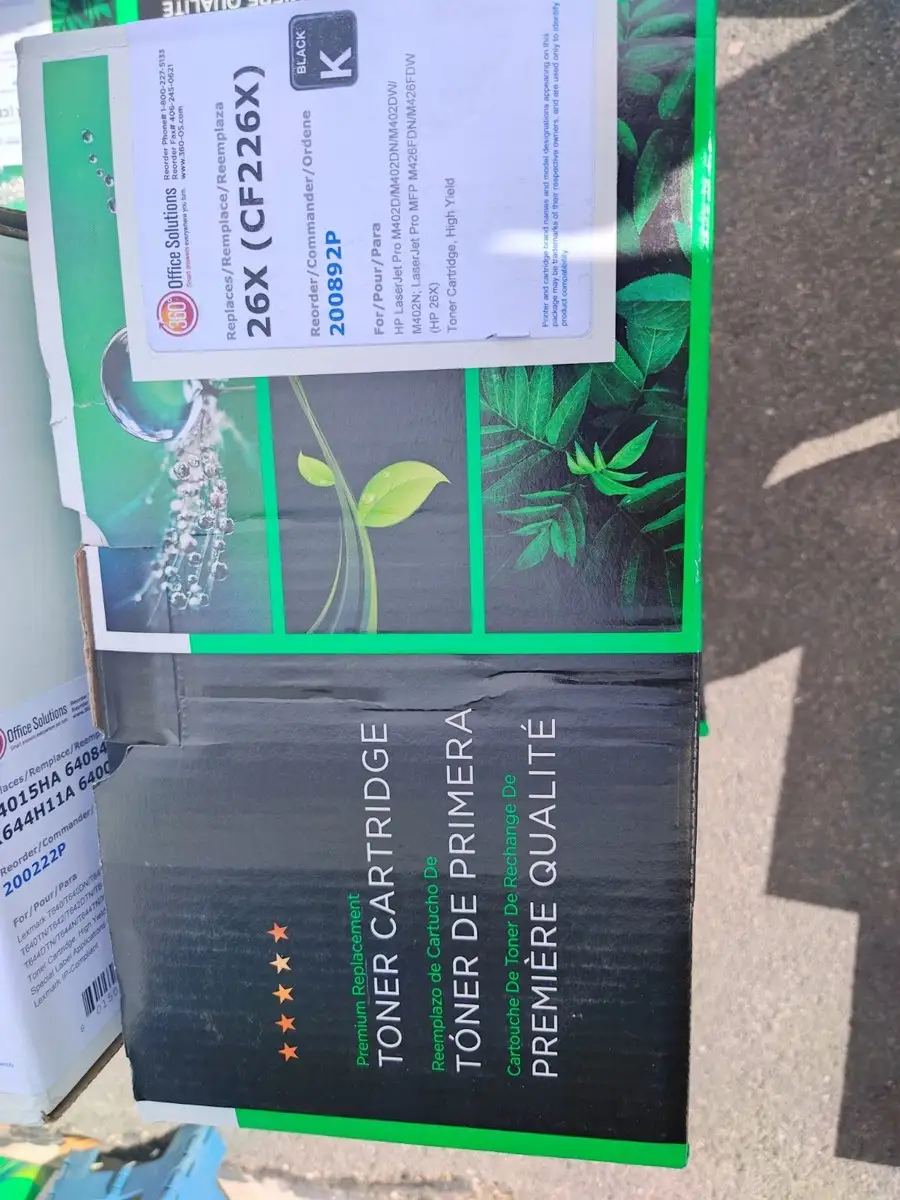
HP 26X Toner Review: High Yield with Caveats
Digging into user feedback, the HP 26X Black High-yield Toner Cartridge emerges as a high-performance option for HP LaserJet Pro M402 and MFP M426 series printers, scoring an 8.6/10 in cross-platform ratings. While its yield and print quality win broad praise, the price point and occasional compatibility issues temper enthusiasm.
Quick Verdict: Conditional buy
| Pros | Cons |
|---|---|
| Outstanding page yield (~9,000 pages per cartridge) | Higher upfront cost than non-branded alternatives |
| Consistent, crisp black text and graphics | Some reports of compatibility mislabeling |
| Reliable performance with minimal leaks | Yield may be closer to ~7,000 pages in heavy-use environments |
| Easy installation and replacement | High-yield output can be blurrier on photo images |
| Meets eco-label emissions guidelines | Limited value for low-volume users |
| Tamper-resistant chips for fraud protection | Price fluctuations across retailers |
Claims vs Reality
HP markets the 26X cartridge as delivering "approximately 9,000 pages per cartridge" with JetIntelligence technology for professional-quality documents. Amazon’s spec sheet emphasizes reliability, anti-fraud features, and eco-compliance.
However, a recurring observation from Staples reviewers is that while HP claims over 9,000 pages, actual yield often lands in the high 7,000s. One verified Staples customer explained: "Although HP claims 9000+ pages, a more real number would be in the high 7,000 range per toner cartridge." This discrepancy appears most in high-coverage printing environments, suggesting yield is variable depending on document content.
HP also claims consistent sharpness at high speeds. Best Buy buyers largely back this, praising "crisp and sharp black text" from first page to last. Yet, one Staples reviewer noted, "The printouts you get with the high-yield cartridge are not as sharp as with the regular-yield cartridge. This is especially apparent on photo images," indicating the claim holds truer for text-heavy work than for image printing.
Cross-Platform Consensus
Universally Praised
High yield is the standout feature. Best Buy customers repeatedly highlight the cost-per-page advantage: "The high yield cartridge will print 2.5 times the pages at less than double the price of a regular yield cartridge which is a real bargain." Small business users appreciate fewer replacements; one Best Buy reviewer said: "We get several months out of these, of course this will vary depending on coverage and usage."
Reliability is another strong point. Reddit’s review described the cartridge as holding up well "with no noticeable toner leakage or issues with page quality" after hundreds of pages. Staples buyers echo this: "Never have a problem with this name brand product." The tamper-resistant chips also resonate with those wary of counterfeit toner—ensuring compatibility and protecting printer firmware.
Environmental considerations are a quieter but consistent praise. HP’s use of recycled content and adherence to eco-label emissions guidelines is noted positively, especially by office managers who factor sustainability into procurement decisions.
Common Complaints
Price is the most frequent sticking point. Reddit’s reviewer called it "a bit pricier than some competitors" and suggested budget-conscious users might opt for third-party alternatives. Staples feedback includes "good but very expensive" and frustration with promotional discounts not meeting expectations.
Compatibility mislabeling appears in multiple Staples reviews where buyers said "doesn't fit the machines it says it does," causing wasted time and returns. While not widespread, the severity of the inconvenience makes it notable.
Yield concerns surface in heavy usage. Even satisfied Staples buyers admit "high 7,000 range" is more realistic, which can influence ROI calculations for high-volume operations.
Divisive Features
Print quality on photos divides opinions. Text and graphics receive near-universal praise, but image-heavy documents fare better on regular-yield cartridges according to some Staples users. For offices printing simple reports, this is irrelevant; for marketing departments, it could matter.
Third-party alternatives also split the crowd. Reddit’s reviewer acknowledged "some third-party brands offer similar yield and print quality at a lower cost," but warned these often lack the "consistency and security features" of HP originals—making them riskier for mission-critical environments.
Trust & Reliability
Trust in HP’s brand is strong. Best Buy’s 4.7/5 rating from 142 reviews reflects confidence in longevity and performance. Many mention loyalty to HP originals over generics due to past bad experiences with residue and printer damage.
Staples’ Trustpilot-linked reviews show minor cracks—price complaints and occasional fit issues—but otherwise praise "professional and prompt service" and "on time delivery." Long-term reliability stories abound: Best Buy users describe using the high-yield cartridge for a year without replacement, while Staples buyers note predictable depletion patterns allowing for planned reorders.
No widespread scam concerns were found; fraud protection via HP’s chips appears to work as intended.
Alternatives
Alternatives mentioned in community discussions include Brother and Canon high-yield cartridges, as well as third-party HP-compatible options like Precision Roller’s $18.95 compatible 26X. These offer significant savings but sacrifice HP’s anti-fraud tech and, according to some, consistency. Reddit’s review frames the choice as "peace of mind and flawless prints" versus "lower cost with potential quality risk."
For photo-centric printing, regular-yield HP 26A may be preferable to avoid the slight softness reported in high-yield image output.
Price & Value
Pricing varies wildly: HP’s own store lists the CF226XD 2-pack at $431.89, Staples at $540.89, while eBay sellers offer new units around $98.58 each and compatibles under $40. Best Buy’s clearance pricing ($51.99) was a rare outlier.
Community buying tips stress watching for sales and considering 2-packs for better per-cartridge cost. Best Buy reviewers often note "worth the few extra dollars for the higher number of pages serviced and not having to switch out new cartridges more often."
For high-volume users, the math tilts in HP’s favor—lower cost per page and reduced downtime. Low-volume users, however, may struggle to justify the premium.
FAQ
Q: Does the HP 26X actually deliver 9,000 pages?
A: Many users report hitting close to 9,000 pages under standard coverage, but heavy graphics or dense text may reduce yield to around 7,000 pages.
Q: Is print quality better than regular-yield cartridges?
A: For text and standard graphics, yes—users praise the crispness. For photo images, some find regular-yield sharper.
Q: Can it fit any HP printer?
A: No. It’s designed for specific LaserJet Pro M402/M426 models. Some users reported fit issues due to mislabeling—check your printer model before purchase.
Q: Are third-party compatibles worth it?
A: They’re cheaper and can match yield, but often lack HP’s anti-fraud chips and may risk printer performance.
Q: Is it environmentally friendly?
A: Yes. HP uses recycled content and designs to meet eco-label emissions guidelines.
Final Verdict: Buy if you’re a high-volume HP LaserJet Pro M402/M426 user who values reliability, consistent text output, and reduced downtime. Avoid if you print infrequently, prioritize photo quality, or need budget toner. Pro tip from community: Track page counts to verify yield and buy during retailer promotions for best value.