Furman AC-215A Review: Quieting Hum, But Limited
A guitarist summed it up with near disbelief: “picked up this furman and wow… the amp is 95% quieter.” That kind of dramatic “noise fix” story shows up repeatedly around the Furman AC-215A Power Conditioner—but it’s also paired with confusion about what a “line conditioner” even is. Verdict: a compact, two-outlet unit that wins fans when the problem is dirty power and hum, but can frustrate anyone expecting lots of outlets or a magic cure for every electrical issue. Score: 8.6/10.
Quick Verdict
For many setups, Furman AC-215A Power Conditioner is a conditional “yes”: yes if you need compact, discreet power filtering + surge/overvoltage protection for a small rig; conditional if you need more outlets or expect it to solve issues that aren’t power-related.
| Call | Evidence from users | Who it suits best |
|---|---|---|
| Conditional Yes | Sweetwater users repeatedly describe noise reduction (“dead quiet,” “95% quieter”). | Guitarists, small studios, A/V installs |
| Pro: Noise reduction | Sweetwater: “completely isolated my amp from the 60 cycle hum.” | Players fighting hum in bad venues/homes |
| Pro: Compact + portable | Sweetwater highlights “bring protection over to your guitar amp,” and users call it “portable.” | Fly rigs, behind-TV mounting |
| Pro: “Feels safer” protection | Sweetwater: “never felt safer or less noisy!” | People worried about unstable power |
| Con: Only two outlets | Sweetwater: “i only wish the had a 4 outlet device.” | Anyone powering multiple devices |
| Con: Some uncertainty on protection | EFLC reviewer: “i have no idea if it will work… everything survived.” | Buyers wanting visible proof/metrics |
Claims vs Reality
Claim 1: “Eliminates AC line noise” (marketing emphasis on filtering).
Digging deeper into user reports, the loudest real-world “proof” is in guitar and audio setups where hum and crackle are the enemy. A Sweetwater reviewer (Chris P. from League City, Texas) described chasing a noisy amp through multiple failed attempts—“i tried my hum x and it did nothing… nothing was working”—before saying, “picked up this furman and wow… the amp is 95% quieter.” For that user, the “line noise” claim wasn’t abstract; it translated into a huge reduction in audible hiss/hum.
Another Sweetwater buyer (Mark S. from Clinton, SC) framed it as a hard win in a tough electrical environment: “it has completely isolated my amp from the 60 cycle hum in an ungrounded house circuit.” And a third (M. G. from Orlando, Florida) attributed silence to the unit after trying multiple workarounds: “noise gate pedals… hum x plug… the adapter with no ground pin, nothing worked… my rig is dead quiet now.” For gigging musicians and home studios, those stories line up with the filtering promise—when the underlying issue is actually power noise.
Claim 2: “Surge and spike protection without sacrificing itself” (SMP non-sacrificial concept).
Users don’t typically “see” surge protection working, and some say exactly that. One reviewer on EFLC.ca openly admitted the limits of reviewability: “it’s tough to review power products because you don’t really know if they are doing what they promise until and if they don’t.” Still, that same reviewer explained why they sought this style of protection—contrasting MOV-based strips that “are weakened over time” versus SMP-style designs that “safely absorbs non-catastrophic surges indefinitely”—and concluded: “i’m happy with mine, which is now protecting my home office set up consisting of multiple pcs and monitors.”
On Reddit, one commenter described durability under repeated punishment: Reddit user (username not provided in the data) said: “they have taken some pretty horrific abuse over the years, but so far the only sacrificial element on it to fail on me has been the replaceable fuse.” That’s not lab validation, but it is a lived “this thing keeps coming back” narrative that supports the non-sacrificial positioning.
Claim 3: “Ideal for tight spaces” (compact chassis + discreet mounting).
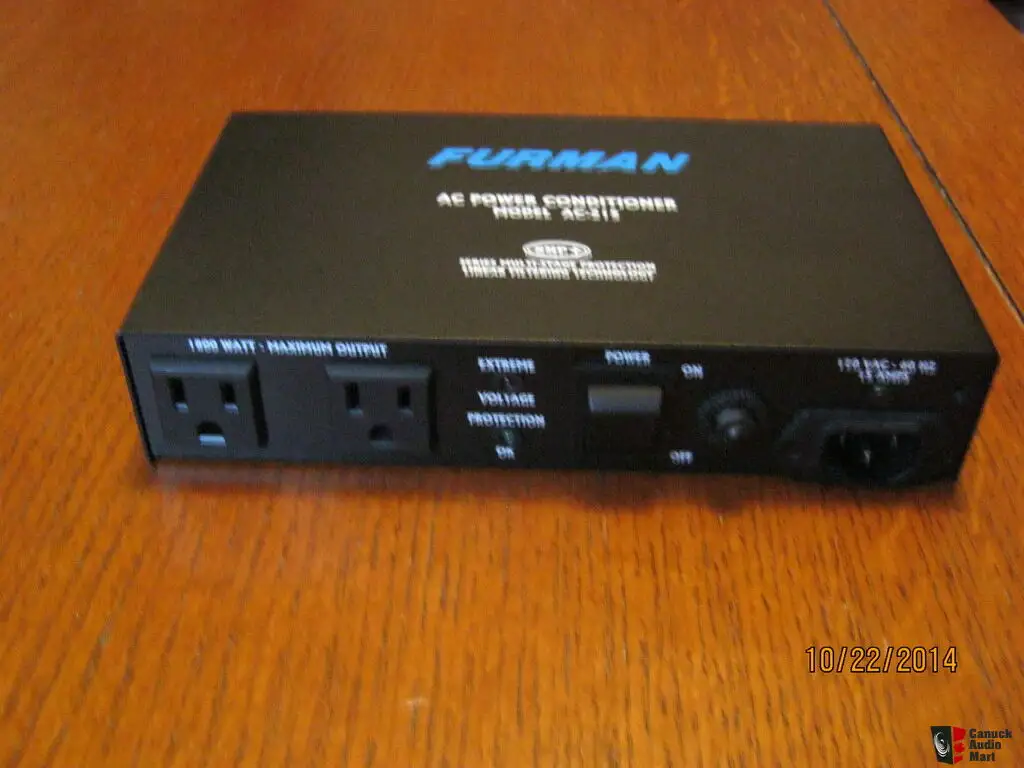
Here, reality appears more straightforward: users talk about portability and placement as part of why they bought it. Sweetwater’s framing—“need to bring protection over to your guitar amp?”—matches how customers describe it in practice. Sweetwater reviewer Scott from Florida called out the form factor and quality as a package deal: “you get all the furman quality in a compact package,” even while wishing for more outlets.
On the flip side, the compactness is inseparable from the two-outlet design. People who expect a rack-style strip experience this not as a benefit but as a constraint—especially in multi-device studios or living-room A/V stacks.
Cross-Platform Consensus
Universally Praised
The most consistent praise across platforms is that Furman AC-215A Power Conditioner is a “noise problem solver” for musicians—especially those fighting hum, fluorescent-light buzz, or crackle when turning gear on/off. A recurring pattern emerged: users who tried multiple fixes (cable swaps, moving amps, noise gates, Hum X devices) often describe the Furman as the first thing that made a big difference. Sweetwater reviewer Chris P. said: “i have a carr bloke that was just so noisy… i tried my hum x and it did nothing… picked up this furman and wow… the amp is 95% quieter.” For guitarists with tube amps or sensitive rigs, that’s a practical quality-of-life change: less time troubleshooting, more time playing.
Several stories also highlight the “quieting” effect in difficult electrical situations that aren’t easily fixed at the source. Sweetwater reviewer Mark S. described an extreme case: “completely isolated my amp from the 60 cycle hum in an ungrounded house circuit.” Another Sweetwater reviewer (M. G., Orlando, Florida) tied the improvement to a noisy venue environment: “there is a lot of flourecent lights and i think wiring troubles… my rig is dead quiet now.” For gigging bassists and guitarists, these are exactly the environments where a compact conditioner becomes part of the survival kit.
A second theme is psychological comfort—users repeatedly say it makes them feel safer or more protected, even when they can’t “prove” the protection is working. Sweetwater reviewer Matthew M. put it bluntly: “i absolutely love these, never felt safer or less noisy!” On EFLC, a buyer described it as a preventative purchase after real losses: “our country power supply… has fried two routers and damaged some music devices… we had a recent power outage. everything survived.” That kind of story resonates most with home office users, A/V owners, and musicians who’ve already paid the price for unstable power.
Finally, portability and fit show up as practical wins. Sweetwater reviewer Jonathan (Los Angeles) described it as “just enough outlets” and suggested it “should be part of any guitarist fly rig.” For touring players or anyone who needs discreet placement behind equipment, that “small box, big impact” appeal comes through more than once.
- Quieting/hum reduction is the standout theme (Sweetwater, Reddit, EFLC).
- “Feels safer” protection is frequently cited, even when benefits are not measurable day-to-day (Sweetwater, EFLC).
- Compactness/portability is repeatedly tied to real setups like amps, small studios, and discreet installs (Sweetwater).
Common Complaints
The most repeated complaint isn’t about performance—it’s about capacity. Two outlets is “just enough” for some and a dealbreaker for others. Sweetwater reviewer Scott from Florida captured the frustration: “i only wish the had a 4 outlet device.” For a home studio with interfaces, monitors, computers, and chargers, two outlets forces add-ons, which can defeat the simplicity of a single “clean power” point.
There’s also a knowledge gap: some users remain confused about what a “line conditioner” is versus a surge protector or voltage regulator. On Reddit, one commenter reacted with confusion: Reddit user (username not provided in the data) said: “line conditioner huh? like… a surge protector… i dont understand.” Another Reddit thread participant admitted uncertainty even while using multiple layers of power gear: Reddit user (username not provided in the data) said: “here’s the furman. honestly not sure what this does… they probably do basic surge protection at best.” For buyers who want a straightforward “this fixes X” product, the category itself creates frustration.
A third complaint is the inherent invisibility of protection. EFLC’s long-form reviewer said it plainly: “it’s tough to review power products because you don’t really know if they are doing what they promise until and if they don’t.” That uncertainty can affect value perception—especially at higher price points—because you may only notice it when something goes wrong (or doesn’t go wrong).
- Outlet count is the practical limiter for multi-device setups (Sweetwater).
- “Line conditioner” terminology confuses shoppers expecting a simple surge strip (Reddit).
- Protection benefits are hard to validate in daily use (EFLC).
Divisive Features
The “does it really do anything?” debate is where Furman AC-215A Power Conditioner splits audiences. Some users describe dramatic, immediate improvements in hum and crackle, implying obvious filtering benefits. Sweetwater reviewer Patrick B. wrote: “lower noise, no more crackling when i turn my amp off and i even hear a bit more clarity from my guitar.” Meanwhile, other Reddit voices are skeptical about the broader promise of “conditioning,” with one user saying they’re “more confuse than i was when i started,” and another describing it as potentially “basic surge protection at best.”
It’s also divisive depending on the rig. For a guitarist fly rig, two outlets can be perfect. For a studio or entertainment center, it can feel restrictive. Jonathan (Los Angeles) praised “just enough outlets,” while Scott (Florida) wished for “a 4 outlet device.” The same physical design becomes a benefit or a drawback depending on whether the buyer values minimalism or expansion.
Trust & Reliability
Concerns about trust show up less as “scam” accusations and more as uncertainty about whether the protection is real until you need it. On EFLC, one buyer described buying it after serious electrical damage in their environment—“fried two routers and damaged some music devices”—but admitted: “i have no idea if it will work.” Their only evidence is survival through an outage: “everything survived.” That’s the recurring reliability dilemma with power products: users crave confidence, but most outcomes are counterfactual.
For long-term durability stories, Reddit provides the closest thing to “years later” reassurance. Reddit user (username not provided in the data) said: “they have taken some pretty horrific abuse over the years, but so far the only sacrificial element on it to fail on me has been the replaceable fuse.” That’s not a controlled test, but it’s a narrative of repeated real-world stress where the unit appears to keep functioning, which matters to touring musicians and anyone in unstable power environments.
Alternatives
The alternatives mentioned in the user data aren’t direct head-to-head substitutes as much as “layered” power strategies in studios. One Reddit user described using multiple devices: “first is the tripp lite, second is the monster, third is the furman.” They linked a Tripp Lite unit “for voltage regulation” and described it adjusting “up and down several volts,” while describing the Monster as doing “rf and basic rejection.”
In that framing, Furman AC-215A Power Conditioner is treated as one component in a chain rather than the entire solution—useful context for buyers deciding between “conditioning,” “surge protection,” and “voltage regulation.” If your issue is voltage swings, the Reddit narrative implies some people look to voltage regulation products first, then add conditioning/surge layers after.
Price & Value
Price perception is volatile in the data, and that volatility becomes part of the buying story. A Reddit commenter warned about spikes: Reddit user (username not provided in the data) said: “right now on amazon they are approaching $300—though i’ve found them for about $180 at authorized furman dealers before.” That suggests value depends heavily on timing and seller.
eBay listings reinforce the idea that resale and secondary-market pricing swings widely, from low auction outcomes to higher “brand new” listings. Meanwhile, Amazon’s listing shows a “4.5 out of 5 stars” rating with “399 reviews,” signaling broad satisfaction at least on that platform—but the user narratives provided from other sources focus more on noise relief than on value math.
For buying tips, the community emphasis is implicit: shop carefully and compare across authorized dealers and secondary markets, because the same unit can look like a bargain or overpriced depending on where you encounter it.
FAQ
Q: Does it actually reduce hum and noise for guitar amps?
A: Many Sweetwater reviewers describe big reductions in hum and buzz, especially in difficult electrical environments. A Sweetwater buyer said: “picked up this furman and wow… the amp is 95% quieter,” while another wrote it “completely isolated my amp from the 60 cycle hum.”
Q: Is it just a surge protector, or a real “line conditioner”?
A: Reddit discussions show confusion about the term. One Reddit user said: “line conditioner… like… a surge protector… i dont understand,” while another admitted: “honestly not sure what this does.” Other users point to noise reduction stories as the practical difference.
Q: Is two outlets enough for a home studio or PC setup?
A: It depends on your gear count. Some users praise “just enough outlets,” but others want more capacity. A Sweetwater reviewer wrote: “i only wish the had a 4 outlet device,” suggesting multi-device studios may need additional distribution.
Q: Can you tell if its surge protection is working?
A: Users often say it’s hard to judge until something goes wrong. An EFLC reviewer explained: “it’s tough to review power products because you don’t really know if they are doing what they promise until and if they don’t,” though they still felt satisfied using it to protect PCs and monitors.
Q: Is it worth it at higher prices?
A: Value depends on the deal. A Reddit user noted: “right now on amazon they are approaching $300,” but also said they found it “about $180 at authorized furman dealers before.” Buyers who primarily want noise reduction may feel it’s worth more than those who just want extra outlets.
Final Verdict
Buy Furman AC-215A Power Conditioner if you’re a guitarist, bassist, or small-studio owner battling hum, crackle, or “dirty power” in real rooms and venues—because multiple Sweetwater users describe results like “amp is 95% quieter” and “my rig is dead quiet now.” Avoid it if your main need is powering many devices; the two outlets are a recurring sticking point (“i only wish the had a 4 outlet device”). Pro tip from the community: watch pricing swings—one Reddit user claimed it’s been “about $180 at authorized furman dealers” even when “approaching $300” elsewhere.