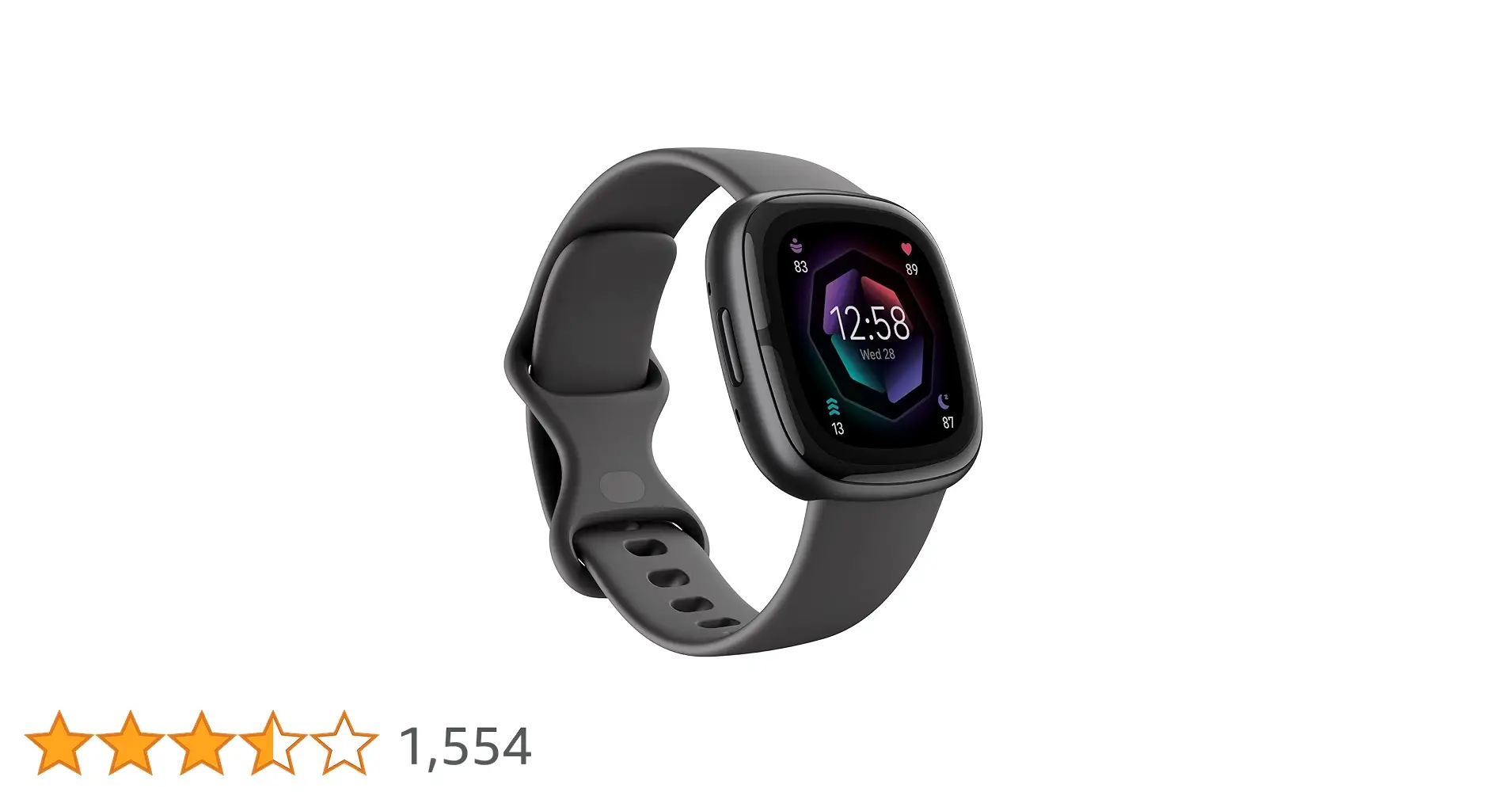
Fitbit Sense 2 Review: Comfort Wins, Accuracy Lags
The surprising takeaway from months of cross-platform discussion is that the Fitbit Sense 2 Smartwatch (Shadow Grey/Graphite) earns a conditional 6.5/10 — praised for its comfort, stress and sleep tracking, and battery life, but repeatedly criticized for inaccurate heart rate data, missing smart features, and reliance on a paid subscription for deeper insights.
Quick Verdict: Conditional Buy
| Pros | Cons |
|---|---|
| Comfortable, lightweight design | No third-party app support |
| Strong stress tracking tools (CEDA sensor) | Heart rate accuracy issues during workouts |
| Sleep tracking highly rated | GPS connectivity inconsistent for some users |
| Battery life up to 6 days | Requires Fitbit Premium for full analytics |
| Built-in GPS and waterproof to 50m | Missing Google Assistant, limited smart features |
| Responsive touchscreen and physical button | Notifications unreliable for some users |
| Good integration with Google Wallet & Maps (coming) | Price considered high for feature set |
Claims vs Reality
Fitbit’s marketing leans heavily on “advanced stress management” via its continuous electrodermal activity (CEDA) sensor. While PCMag and several Reddit users agreed that the Sense 2 “does a better job of helping me be more mindful about stress than any other wearable I’ve tried,” others found it less practical. A Fitbit Community member bluntly stated: “EDA and CEDA are rather useless. Sounds good on paper but not in action.”
Another bold claim is “6+ days battery life.” Verified buyers on Amazon and Reddit confirm this is largely accurate — one Reddit user reported: “Battery life: 5 days without GPS, 2 days with occasional GPS,” which still beats most Wear OS or Apple Watch devices. However, enabling features like always-on display or continuous GPS shortens that lifespan considerably.
Fitbit also promotes “accurate health tracking” with ECG, SpO₂, and skin temperature monitoring. In reality, heart rate accuracy during exercise is a frequent complaint. One Fitbit Community post noted: “It doesn't register actual heart rate during a workout which renders it worthless,” especially in high-intensity or weight training contexts.
Cross-Platform Consensus
Universally Praised
Across Reddit, Fitbit Community, and PCMag, the slim, lightweight design and comfort are standout positives. PCMag’s reviewer found it “lightweight and comfortable… even when I wear it to bed for sleep tracking,” while French site Univers de Montres echoed that it’s “légère et agréable à porter au quotidien.” This matters for all-day wearers and sleep trackers who dislike bulky devices.
Sleep tracking earns consistent praise. Reddit user u/Mix123 noted, “Sleep tracking is quite good. I like the EDA scans and stress scores. Readiness score with premium is pretty good.” The watch’s ability to detect naps — absent in some competitors — was highlighted by another Reddit poster as a unique perk.
Battery life is a major win. For travelers, fitness enthusiasts, and shift workers, not needing daily charging is a relief. PCMag saw five days of use per charge, exceeding Fitbit’s own estimate in testing.
Common Complaints
Heart rate accuracy is the most damaging flaw for fitness-focused buyers. A Fitbit Community member compared data to a chest strap and found: “It’s not even close… raw data doesn’t lie.” This undermines other metrics like calorie burn and Active Zone Minutes.
GPS performance is divisive. Some cyclists report flawless tracking, while others see “long straight lines because GPS got lost,” leading to undercounted distances. This inconsistency frustrates outdoor athletes who rely on precise mapping.
Feature removals from the original Sense angered loyal users. Gone are third-party apps, Google Assistant, music controls, and certain lifestyle apps like Spotify or Strava. One Reddit user lamented: “No third-party apps… it’s not like the Sense 2 cannot support them.”
Notifications are unreliable for some. A user with button malfunctions described being bombarded by payment prompts “several dozen times per day,” while others said alerts arrive too late to act on calls or messages.
Divisive Features
Stress management tools split opinion. For mindfulness enthusiasts, the real-time body response alerts and mood logging feel valuable. For others, the inability to distinguish positive excitement from harmful stress is annoying — “telling me to breathe and relax if I indicate I’m happy or excited… like those are bad emotions.”
Fitbit Premium is another point of contention. Some appreciate the curated workouts and 90-day trend graphs; others resent paying $80/year to “access my own data.”
Trust & Reliability
Long-term users report mixed durability. One Reddit poster kept theirs for six months, tolerating bugs only because of a steep $80 discount. Another Fitbit Community member with a decade of Fitbit experience called switching from Versa 2 to Sense 2 “a mistake,” citing constant sync failures since a recent app update.
Trust issues also arise from feature promises that don’t materialize. Google Wallet support has been “broken since January” according to multiple community posts, with ongoing but unresolved investigations by support.
Alternatives
The Fitbit Versa 4 is repeatedly suggested by community members as a cheaper, nearly identical option minus the advanced sensors. PCMag notes it “tracks the same key metrics” except for ECG, EDA, and skin temperature.
Outside Fitbit, Garmin’s Venu 2 Plus earns praise for heart rate accuracy and richer sports metrics, albeit at a higher price. Apple Watch is lauded for accuracy but criticized for short battery life. Samsung Galaxy Watch 5 offers robust smart features and better HR tracking, though its battery is shorter than the Sense 2.
Price & Value
Pricing is a sticking point. Many refuse to pay MSRP (~$299), with several Reddit users claiming it’s “not worth $200.” The standout deal was an $80 Amazon pricing glitch, which one buyer said made the flaws tolerable. eBay resale prices range from $124 used to $186 new, suggesting depreciation is steep.
Community buying tips include setting CamelCamelCamel alerts for future discounts and considering older models or competitors if accuracy is a priority.
FAQ
Q: Is the Fitbit Sense 2 good for fitness tracking?
A: Only if you prioritize basic metrics and stress/sleep features over workout heart rate accuracy. Many users find HR data unreliable during high-intensity exercise.
Q: Does it support Google Assistant?
A: No. It uses Alexa and will add Google Wallet and Maps, but Assistant is not included, which frustrates Google ecosystem fans.
Q: Can I install third-party apps?
A: No. Fitbit has removed app store access for Sense 2, limiting customization to Fitbit-developed faces and tiles.
Q: How accurate is the GPS?
A: Varies by user and activity. Some report flawless tracking, others see major dropouts, especially in cycling.
Q: Is Fitbit Premium required?
A: Core tracking works without it, but detailed analytics, readiness scores, and guided programs need a paid subscription.
Final Verdict
Buy if you’re a wellness-focused user who values comfort, long battery life, and detailed sleep/stress tracking, and can live with imperfect workout data. Avoid if you need accurate heart rate for training or want rich smartwatch features. Pro tip from the community: wait for sub-$150 pricing — anything higher risks overpaying for a limited feature set.