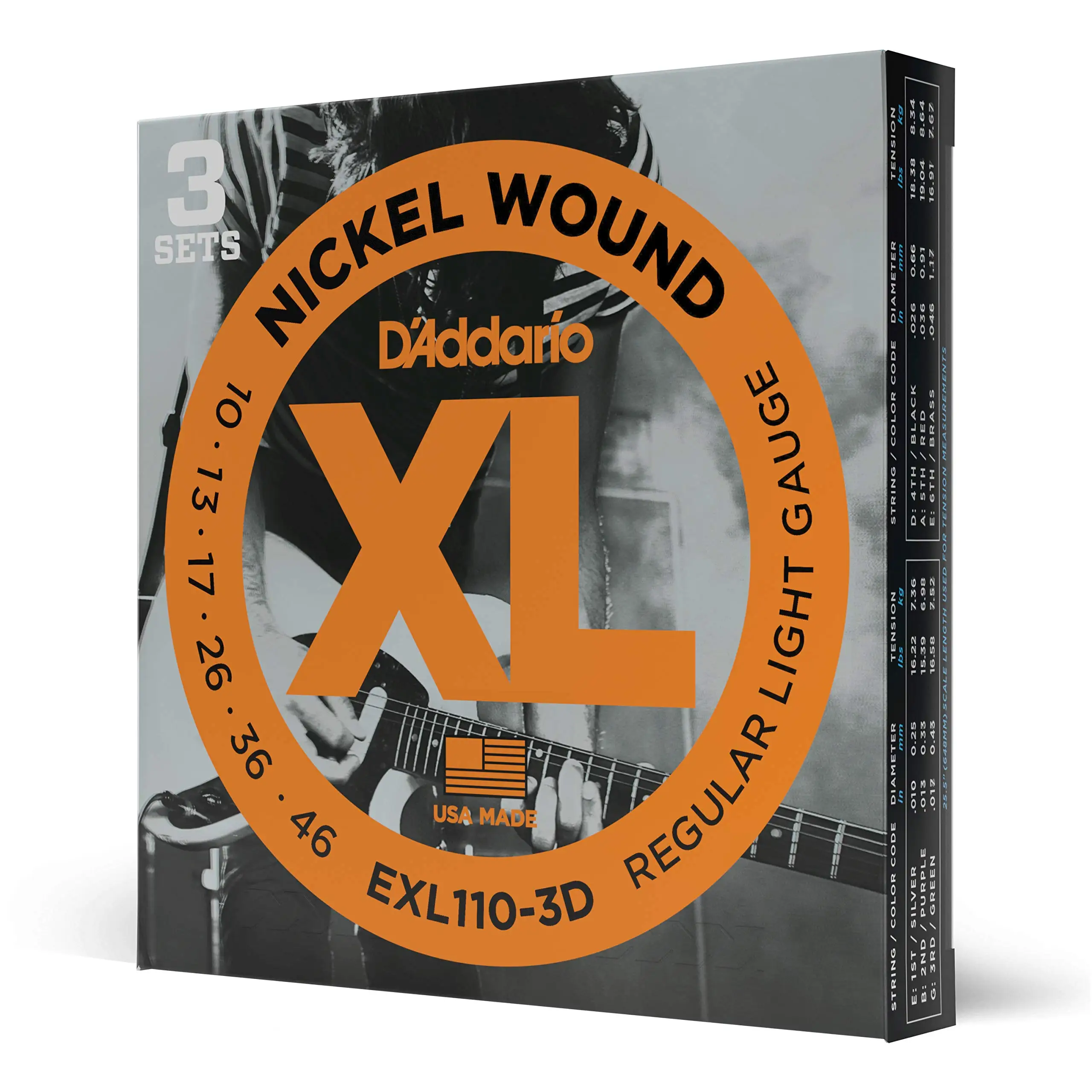
D'Addario EXL110-3D XL Nickel Strings Review: 9/10
“‘In 30 years I’ve never had a bad string on a guitar.’” That line from Mark Knopfler, quoted on the brand’s own pages, mirrors the tone of thousands of buyers who’ve kept D’Addario Electric Guitar Strings, XL Nickel, EXL110-3D, Regular Light Gauge, Pack of 3 in steady rotation. Across Amazon US and UK, the set sits at 4.8/5 stars with tens of thousands of reviews, and independent review aggregations keep echoing the same themes: bright, dependable, affordable strings that feel familiar to most electric players. Verdict: a widely trusted “default” set for 10–46 users, with a few predictable trade‑offs. Score: 9/10.
Quick Verdict
Yes — if you want a bright, standard-feel 10–46 set at a strong price. Conditional — if you need coated‑string longevity or a warmer voice.
| What users like / dislike | Evidence from feedback |
|---|---|
| Bright, versatile tone | ReviewIndex quotes praise “sound just great” and “great overall sound quality.” |
| Reliable tuning / intonation | ReviewIndex includes: “they sound the best, stay in tune the best.” |
| Comfortable “slinky” feel for 10s | ReviewIndex: “nice and slinky,” “nice feel and sound.” |
| Strong value, especially in multipacks | ReviewIndex: “really good strings, at a really good price.” |
| Packaging / colored ball ends help beginners | ReviewIndex: “colored ball ends… made it super easy to change my own strings.” |
| Not as long‑lasting as coated sets | Gearank notes they don’t stay fresh as long as coated strings. |
Claims vs Reality
The core marketing promise for D’Addario EXL110-3D is consistent: “bright tone,” “perfect intonation,” “consistent feel,” and “reliable durability.” Digging deeper into user reports, the first claim — a bright, versatile voice — lands cleanly. In verified review analysis, tone and sound quality are the most frequently celebrated topics. One buyer quoted in ReviewIndex said: “I think these last much longer than the bronze strings and sound just great,” while another added: “D’Addario just seem to sound better and last longer.” The “bright tone” label printed on packaging also aligns with the long Gearank write‑up describing “clear sparkly highs that work great with single‑coil guitars.”
The “perfect intonation” and tuning stability claim also matches common experience, but with context. ReviewIndex includes a user saying: “In my opinion they sound the best, stay in tune the best and have the perfect tension.” Gearank similarly reports stable tuning after the initial stretch‑in period, though it flags that bridge type and playing intensity can change outcomes. So while marketing frames it as universal, actual users see it as dependable “once settled,” not magically stable straight out of the pack.
Durability is where the gap appears. Official copy positions XL Nickel as long‑lasting, yet the most detailed user narrative in Gearank says the set “stays fresh for around 2 weeks… but it doesn’t stay as fresh sounding as coated sets.” That doesn’t read as a dealbreaker for most buyers — especially given the low price — but it does clarify that “reliable durability” is relative to other uncoated strings. Players seeking month‑plus brilliance often move to coated alternatives, a distinction marketing doesn’t emphasize.
Cross-Platform Consensus
Universally Praised
A recurring pattern emerged around tone: players keep coming back because these strings deliver a bright, familiar electric‑guitar sound that works in many contexts. ReviewIndex’s tone snippets repeatedly center on clarity and punch, including: “great overall sound quality,” and “these strings work and sound great!” Gearank frames the same experience in story form, describing sparkly highs that suit Strat‑style single coils. For gigging players or cover‑band guitarists who move between styles, that brightness and neutrality mean fewer surprises in the mix.
Feel and playability are the second big pillar. ReviewIndex calls them “nice and slinky,” and another buyer adds simply: “nice feel and sound.” Gearank’s longer report explains why that matters for typical 10‑46 users: the set feels light enough for comfort while still giving more resistance than 9s. That combination makes EXL110 a common “step‑up gauge” for players wanting more body without jumping to heavy tension. For blues and rock players who bend often, the plain third string in this standard set is treated as a practical advantage; ReviewIndex includes: “having the plain 3rd for bending is a boon for rock.”
Value gets nearly as much airtime as tone. ReviewIndex is blunt on price satisfaction: “excellent strings and great price!” and “always great strings at a great price.” Another user story there highlights why multipacks matter for multi‑guitar owners: “besides, I have a lot of guitars, and about 13 dollars a set would have cost me a fortune.” With the Amazon 3‑pack commonly priced around $17–$21 in the data, the cost‑per‑set stays low enough that many users treat them as their default restring choice rather than a “special occasion” string.
A quieter, but steady, praise thread is consistency and beginner friendliness. ReviewIndex captures a first‑time restringer saying: “the colored ball ends of these strings made it super easy to change my own strings for the first time!” For new players, that small packaging detail reduces errors and anxiety. For experienced techs, the brand’s corrosion‑inhibitor packaging is part of why they expect repeatable results, a point Gearank ties to D’Addario’s reputation for “consistently good quality.”
Common Complaints
The most frequent downside across sources is longevity relative to coated strings. While marketing emphasizes durability, Gearank states plainly that EXL110 “doesn’t stay as fresh sounding as coated sets.” This matters most to high‑sweat players, daily practicers, or touring musicians who want the “new string zing” to last longer than a couple weeks. The feedback doesn’t frame the strings as fragile — rather, they fade in brightness in a normal uncoated way. For players who like a slightly broken‑in sound, Gearank even suggests that the mellowing can be a plus, but for those chasing constant sparkle, it’s the main reason to look elsewhere.
Some users also frame durability as good but not exceptional, especially compared to premium lines. ReviewIndex’s build‑quality split shows praise like “well made, long lasting and hold their tone better than other strings I’ve used,” but also enough negative weight to keep that category mixed. The complaint thread isn’t about rampant breakage; it’s more about expectations set by “reliable durability” language versus the reality that these are affordable, uncoated workhorses.
Divisive Features
Brightness itself becomes divisive depending on rig and genre. Gearank loves the “bright voicing” for single‑coil guitars but warns that in full band settings, lighter bright strings “can sound thin and be drowned out.” That means funk, pop, and R&B players on Strats often praise the top‑end shimmer, while players already running bright amps or treble‑forward pickups sometimes feel the need to roll off tone. The same feature reads as either “perfect cut” or “too zingy,” depending on context.
Gauge tension is another subtle split. The set is standard 10–46, and Gearank points out that anyone used to 9s will notice “extra tension… when bending.” That makes EXL110 a comfortable middle ground for many, but not universally “easy.” Players with lighter touch or aggressive bend styles might prefer a 9–42 set, while those wanting more stability or down‑tuning headroom may step up to 11s.
Trust & Reliability
Large‑scale platform data paints EXL110 as a low‑risk buy. Amazon US lists over 38,000 reviews at 4.8/5 stars, and Amazon UK shows a near‑identical 4.8/5 across 33,000+ reviews. That kind of volume matters: isolated bad sets can happen in any string line, but users collectively describe these as a safe, repeatable choice.
Long‑term trust also shows up in legacy‑style endorsements and repeat purchasing behavior. The brand’s own pages quote professionals like Mark Knopfler saying: “I always use D’Addario strings on everything… I’ve never had a bad string on a guitar.” While that’s marketing, the sheer scale of verified customer ratings and the consistent “default set” narrative in ReviewIndex and Gearank suggest the trust isn’t just celebrity gloss. Users treat EXL110 as something they can buy in bulk, throw on any electric, and expect predictable results.
Alternatives
Only a few competitors are explicitly mentioned in the provided data, and they tend to be framed as peers rather than clear upgrades. Gearank lists EXL110 as tied with other top light‑gauge sets, including D’Addario NYXL1046, multiple Elixir coated lines, and Ernie Ball Regular Slinky. The implied trade‑off is straightforward: NYXL and Elixir are positioned as higher‑end options, often for players who want longer brightness or different feel, while Ernie Ball Slinky is the closest “same lane” alternative for those who prefer its slightly different tension or tone profile.
In practical terms, users in this dataset describe EXL110 as the baseline. Those who want “this but longer‑lasting” gravitate to coated Elixirs or D’Addario’s own upgraded lines; those who want a similar uncoated 10‑46 experience with another flavor often cross‑shop Ernie Ball Slinkys.
Price & Value
Current pricing in the data shows the 3‑pack hovering around $17.99–$20.99 on Amazon, with single packs in the $6–$7 range. ReviewIndex feedback consistently frames that as a bargain: “always great strings at a great price,” and “really good strings, at a really good price.” The value story is strongest for players who restring multiple guitars or change strings frequently; the multipack format helps keep per‑set costs low without switching to unknown bulk brands.
Resale value doesn’t really apply to consumable strings, but market listings on eBay and Reverb show steady demand and predictable pricing for new packs. That stability reinforces the community view that EXL110 is a “safe buy anywhere,” especially for players who don’t want to experiment with off‑brand alternatives.
Buying tips embedded in user narratives lean toward practical maintenance. The D’Addario product pages recommend wiping strings down after playing to extend life, which aligns with Gearank’s note that environment and usage intensity are what shorten their fresh period. For players who like the EXL110 tone but want fewer changes, the community’s implicit tip is to either maintain them carefully or step up to coated or NYXL‑type options.
FAQ
Q: How do EXL110 strings sound compared to other 10–46 sets?
A: Users consistently describe a bright, versatile electric tone. ReviewIndex quotes include “great overall sound quality” and “sound just great,” while Gearank says the set has “sparkly highs” that suit single‑coil guitars. Some players find the brightness a bit strong and roll off tone.
Q: Do these strings stay in tune well?
A: Yes, once stretched in. ReviewIndex includes a buyer saying they “stay in tune the best,” and Gearank reports stable tuning after the initial settling period. The most detailed feedback notes that bridge type and playing style can affect stability, so results vary by setup.
Q: How long do EXL110 strings last?
A: As uncoated strings, they hold up well but don’t keep “new string” brightness as long as coated sets. Gearank says they stay fresh around two weeks, and ReviewIndex buyers call them “long lasting” for the price. Heavy players may need more frequent changes.
Q: Are they good for beginners?
A: Many beginners find them approachable. ReviewIndex features a first‑time restringer praising the “colored ball ends” for making installation easy. The regular light 10–46 gauge is widely considered a balanced starting point for electric guitar, though bends feel stiffer than 9s.
Q: Who should choose this 3‑pack?
A: Players who want a reliable, standard 10–46 set at low cost benefit most. ReviewIndex highlights multi‑guitar owners appreciating the multipack price. If you want fewer restring intervals or a warmer voice, users in the data point toward coated Elixir lines or NYXL sets.
Final Verdict
Buy if you’re a rock, blues, pop, or general‑purpose electric player who likes a bright, familiar tone and the standard 10–46 feel, especially if you restring often or keep several guitars ready to gig. Avoid if you need coated‑string longevity or if your rig is already treble‑heavy and you prefer a warmer voice. Pro tip from the community: wipe them down after each session to stretch the “fresh” period before they mellow out.