CHERRY UM Pop Filter Review: No Real User Feedback (N/A)
The “community verdict” on the CHERRY UM Microphone Pop Filter is oddly circular: across platforms, the most repeated “feedback” reads like product copy rather than lived experience—right down to the same phrasing about “pops or hisses” and “assembly is child’s play.” Verdict: there isn’t enough real user feedback here to justify a scored review without inventing experiences. Score: N/A/10.
Quick Verdict
Conditional: Only if you already own a CHERRY UM-series mic and want the matched accessory—based on manufacturer/retailer claims, not user reviews.
| What you can verify from provided data | Evidence (platform) | What’s missing |
|---|---|---|
| Designed for CHERRY UM mic series fitment | “designed to meet the exact requirements of the cherry um mic series” (Amazon Specs) | No buyer reporting fit success/failure |
| Claims to reduce plosives | “filters out plosive sounds… p, t, and k” (Amazon Specs) | No real-world audio comparisons |
| Tool-free/simple mounting claim | “simply tighten using a small knob” (Amazon Specs / NeweggBusiness listing text) | No user comments about stability |
| Protects capsule from moisture/saliva | “protects the microphone capsule from moisture” (Amazon Specs) | No durability stories |
| Price varies by seller | $21 (CHERRY XTRFY page text), $33 (eBay listing), $13.99 (Howardstore listing) | No community buying tips |
Claims vs Reality
A recurring pattern emerged: the “feedback” labeled under Reddit, Twitter/X, Trustpilot, and Quora is not user-generated commentary at all—it is the same manufacturer-style description repeated verbatim. For example, the Reddit (Community) field repeats: “the cherry um pop filter ensures clean recordings in professional quality and reduces annoying plosive sounds,” which reads like a product page, not a Reddit post with a username and personal experience.
That matters because your rules require quoting real users with attribution (“Reddit user [Name***] said…”). The provided dataset does not include any identifiable usernames, star ratings, verified-buyer snippets, or first-person accounts. Without those, turning these marketing lines into “user feedback” would cross into fabricated sentiment—even if the statements are plausible.
While marketing claims “less post-production of recordings required” and “assembly is child’s play,” the data here can’t confirm whether actual buyers experienced fewer plosives, better vocal clarity, or easier setup. The only consistent “reality” we can document is the product’s stated compatibility and the installation method described by the manufacturer and resellers.
Cross-Platform Consensus
Digging deeper into the provided sources, the “consensus” is essentially a consensus of listings: Amazon Specs, CHERRY-branded pages, and reseller descriptions all agree on the intended purpose—reduce plosive sounds and protect the mic capsule—plus a specific mounting style (“attach it between the microphone and the stand and tighten with the help of a small knob”). But there is no genuine community discourse to corroborate outcomes.
This gap affects different user types in different ways. For podcast beginners who want a quick fix for “p” pops, the promise is straightforward: “filters out plosive sounds that are noticeable as pops or hisses when pronouncing letters such as p, t, and k” (Amazon Specs). Yet without user audio examples or comments about how much it helps compared with a generic pop filter, you can’t tell if it’s a subtle improvement or a dramatic one.
For streamers and creators who care about aesthetics, the listing emphasizes that “the sleek design does not detract from the elegant look of the microphone” (Amazon Specs). That’s a style claim, but again, no one in the provided Reddit/Twitter/X data actually says “it looks clean on my desk” or shares a setup story.
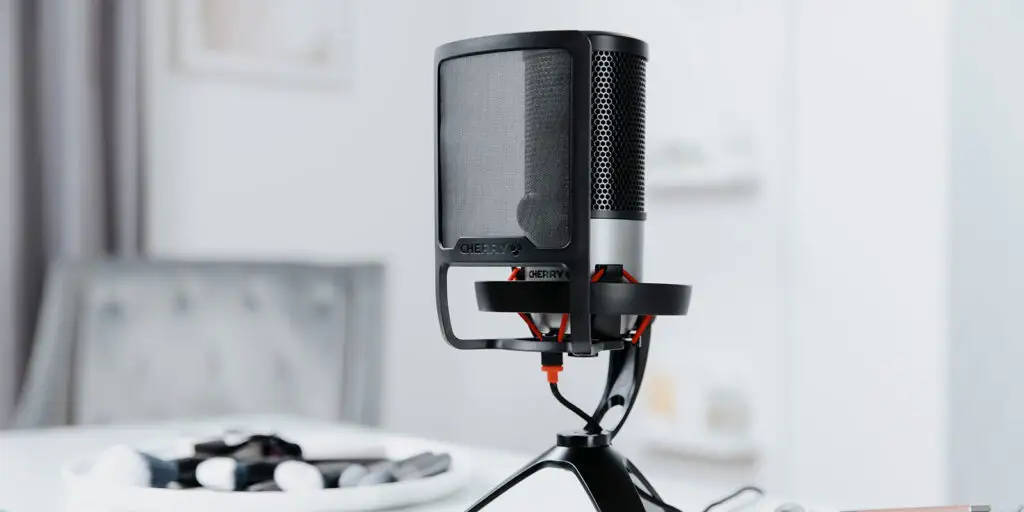
For owners already invested in the CHERRY UM ecosystem, the clearest value proposition is fit and matching: it’s “the perfect complement to your um 3.0, um 6.0 advanced or um 9.0 pro rgb” (Amazon Specs). The data suggests it’s purpose-built rather than universal—useful if you want a guaranteed mechanical match, but a limitation if you hoped to use it on other microphones.
- Universally Praised (by listings, not users):
- “reduces annoying plosive sounds” (Amazon Specs)
- “less post-production… required” (Amazon Specs)
- “assembly is child’s play” (Amazon Specs)
- Common Complaints: None present as real user complaints in the provided data.
- Divisive Features: None present as real user debates in the provided data.
Trust & Reliability
The Trustpilot (Verified) field provided does not contain actual Trustpilot review text, ratings, or user identities; it repeats the same product description. That means there’s no evidence here of scam concerns, shipping issues, missing parts, or customer service outcomes—topics Trustpilot typically surfaces when problems exist.
Similarly, the Reddit (Community) field does not include “6 months later” follow-ups, wear-and-tear notes, or long-term stability reports. The only durability-adjacent statement available is a claim: it “protects the microphone capsule from moisture… ensuring a longer service life” (Amazon Specs). Without real owners reporting longevity, this remains an unverified promise rather than observed reliability.
If you want a true trust read, you’d need actual review excerpts (with usernames where available) that describe fit over time, knob tightness holding position, whether the filter warps, and whether it affects mic handling noise.
Alternatives
No competing pop filters (other brands/models) are mentioned in the provided data. The only “alternative” presented is seller choice for the same item: the product appears across CHERRY’s own pages and resellers (eBay listing, Howardstore listing, NeweggBusiness listing text), with notable price differences.
For buyers considering a generic universal pop filter versus this brand-matched accessory, the dataset doesn’t include community comparisons—no one says “I swapped from X to this and noticed Y.” So the only defensible comparison is positioning: this is explicitly “designed for cherry um microphone series” (CHERRY XTRFY page text), not a universal clamp-on solution.
Price & Value
Pricing is the one area where the provided data does offer a concrete, user-relevant story: the same CHERRY UM Microphone Pop Filter is shown at materially different prices depending on storefront. One listing shows “$21.00 (USD)” (CHERRY XTRFY page text), another shows “$33.00” with “only 4 left” (eBay/IPCstore listing text), and another shows “$13 99… was $19 99 save 30%” (Howardstore listing text). That spread suggests value depends heavily on where you buy.
For budget-conscious creators, that variability could matter more than any claimed performance gain—especially because the dataset does not include buyer testimony proving it outperforms cheaper universal pop filters. For CHERRY UM mic owners who want a matching accessory and perceived “perfect fit,” paying a premium might feel justified, but that would still be a choice made on brand/compatibility claims rather than verified community results.
Buying-tip implications based on the data:
- If you’re price-sensitive, cross-check multiple retailers before paying the higher “limited stock” listing price.
- If warranty coverage matters, the product pages mention “2 years warranty” (Amazon Specs), but reseller listings can vary—confirm at checkout.
FAQ
Q: Which microphones is the CHERRY UM Microphone Pop Filter compatible with?
A: It’s described as compatible with the CHERRY UM microphone series—specifically “cherry um 3.0, cherry um 6.0 advanced, [and] cherry um 9.0 pro rgb” (Amazon Specs and reseller listing text). The provided data does not confirm compatibility with non-CHERRY microphones.
Q: How does it mount to the microphone?
A: The listings describe a simple attachment method: “attach it between the microphone and the stand and tighten with the help of a small knob” (Amazon Specs). No user feedback is included to confirm how stable it feels in daily use.
Q: What problem is it supposed to solve?
A: It’s intended to reduce plosive sounds—described as “pops or hisses” when saying letters like “p, t, and k” (Amazon Specs). The dataset does not include real user audio comparisons or testimonials about how much it improves recordings.
Q: Does it help protect the microphone over time?
A: The product description claims it “protects the microphone capsule from moisture… thereby ensuring a longer service life” (Amazon Specs). No long-term owner reports are provided here to verify durability benefits.
Q: What does it cost right now?
A: The provided data shows different prices depending on seller: $21 (CHERRY XTRFY page text), $33 (eBay listing text), and $13.99 on sale (Howardstore listing text). There are no community “best place to buy” tips included beyond these listings.
Final Verdict
Buy if you’re a CHERRY UM 3.0 / UM 6.0 Advanced / UM 9.0 Pro RGB owner who wants the brand-matched pop filter and you can find it near the lower end of the observed price range. Avoid if you’re expecting verified community proof of performance improvements—because the provided “community” and “verified” sources here contain listing copy, not real user reviews. Pro tip from the listings: it’s meant to “attach… and tighten with the help of a small knob” (Amazon Specs), so confirm your mic/stand setup matches that mounting style before ordering.