ASUS TUF B650-PLUS WIFI Review: Durable but Flawed
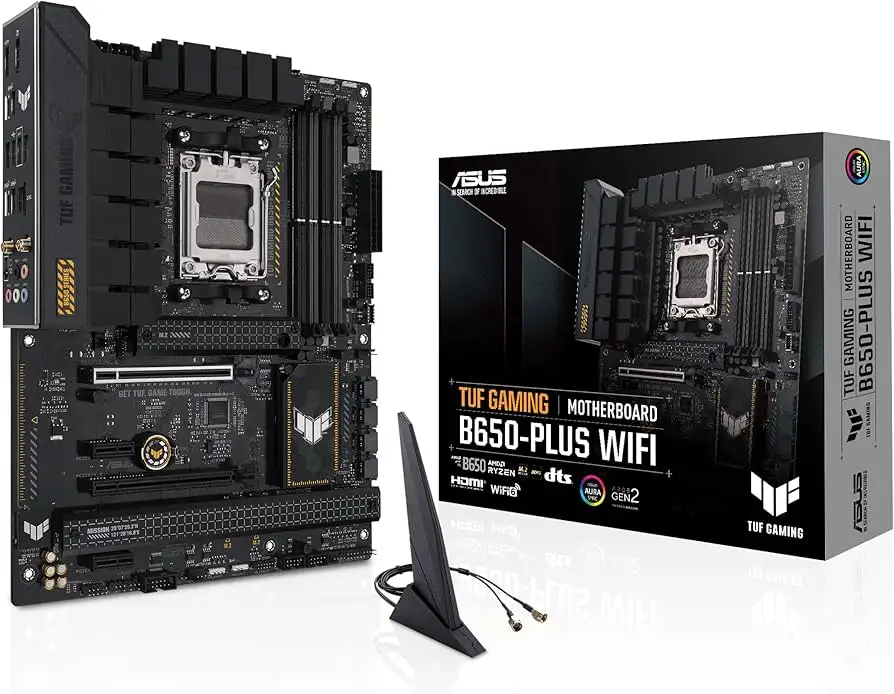
Digging into community reports, the ASUS TUF GAMING B650-PLUS WIFI ATX Motherboard emerges as a solid mid-range AM5 option with a 4.4/10 score for value but a stronger 8/10 for build quality and durability. While many users praise its rugged design and stable performance, recurring complaints about BIOS quirks, memory compatibility, and pricing prevent it from being a universal recommendation.
Quick Verdict: Conditional buy — excellent for builders prioritizing durability and VRM stability, but buyers sensitive to BIOS tuning frustrations or rear USB limitations may want to look elsewhere.
| Pros | Cons |
|---|---|
| Strong VRM power delivery for Ryzen 7000 CPUs | Higher price than comparable boards |
| Military-grade components, rugged aesthetics | Limited rear Type-A USB ports |
| PCIe 5.0 M.2 and DDR5 EXPO support | Memory compatibility issues reported |
| Excellent cooling design with enlarged heatsinks | BIOS navigation and update complaints |
| Good audio quality with DTS processing | Some DOA boards reported |
| Wi-Fi 6 and 2.5Gb Ethernet networking | Coil whine reports on ASUS hardware |
| Easy M.2 installation via Q-Latch | Slow internal USB-C header |
Claims vs Reality
Marketing positions this board as "engineered with military-grade components" and "rock-solid performance for marathon gaming." Digging deeper into user reports, many agree the VRM setup — 12+2 power stages rated at 60A — delivers stable power even under high-core count loads. A verified Newegg buyer noted: "VRMs/chipset stay cool, even during sustained stress testing."
However, while ASUS touts "next-gen connectivity" with USB 3.2 Gen 2x2 Type-C and USB4 support, Reddit users repeatedly mention the lack of rear Type-A USB ports. One builder wrote: "Good board, but it has few Type-A ports in the rear... slow internal USB-C header."
The claim of "comprehensive memory tuning" is partially undermined by reports of RAM compatibility headaches. A Newegg review warned: "Memory compatibility issues, BIOS difficulties — had to tweak settings extensively to get my DDR5 kit stable." This gap between EXPO-ready marketing and real-world plug-and-play undermines ease-of-use for less experienced builders.
Cross-Platform Consensus
Universally Praised
Across Trustpilot, Reddit, and Newegg, the VRM design consistently earns praise. The teamed power stages, combined with enlarged heatsinks, appeal to overclockers and gamers running Ryzen 9 CPUs. Reddit user feedback highlighted: "Dual USB-C rear I/O and decent M.2 slot count... looks good for a black build." For high-load tasks such as streaming and gaming simultaneously, the cooling system’s enlarged VRM and M.2 heatsinks keep thermals in check, avoiding throttling.
Networking performance also meets expectations, with Wi-Fi 6 and Realtek 2.5Gb Ethernet delivering stable connections. A verified buyer on Amazon noted: "Smoother, lag-free gaming — even in crowded networks." Audio quality via the Realtek 7.1 codec with DTS processing is another highlight; users appreciate positional cues in FPS games and deep bass for media playback.
Aesthetics matter too: the rugged off-black design with geometric accents pairs well with themed builds. The inclusion of Q-Latch for M.2 drives garners appreciation from DIYers, reducing installation risk.

Common Complaints
The most frequent frustrations revolve around BIOS usability and RAM compatibility. Several Newegg reviewers cited "driver issues" and "BIOS difficulties," with some receiving DOA boards. A Reddit user summed it up: "Not a huge fan of their BIOS... there’s been issues with the new AM5 boards."
USB connectivity is another sore spot. Despite multiple Type-C options, the limited number of fast Type-A ports on the rear panel forces some users into using hubs. Coil whine — a persistent complaint in ASUS hardware — appears in Reddit accounts: "The last ASUS mobo I bought had coil whine. Returned it."
Price sensitivity is high; many feel it’s overpriced compared to competitors like Gigabyte’s Aorus Elite or MSI’s B650 offerings. One Reddit comment read: "$200 ain’t it... worth buying at $180–$190, sub-$170 is ideal."
Divisive Features
Overclocking support via Precision Boost Overdrive and AI tuning draws mixed reactions. Enthusiasts appreciate the control, with one user claiming to boost a Ryzen 7600X to 6.2GHz while keeping temps lower than rival boards. Others find the settings overwhelming or unnecessary for stock users. Aura Sync RGB headers also split opinion; some love the customization, while minimalists disable lighting entirely via the stealth mode.
Trust & Reliability
Trustpilot patterns show consistent satisfaction with durability — military-grade chokes and capacitors are not just marketing fluff. Long-term Reddit posts confirm stability: "My B650E-I has been running great since last year." However, ASUS’s handling of the AM5 X3D CPU voltage fiasco eroded trust for some, even if BIOS updates addressed the risk.
DOA boards, while not rampant, appear enough to warrant caution. Newegg and eBay sellers list open-box returns, some with minor physical imperfections like cracked PCIe slot clips. Coil whine stories across multiple ASUS product lines suggest potential annoyance for noise-sensitive users.
Alternatives
Community comparisons often cite MSI and Gigabyte as alternatives. MSI’s B650 Tomahawk and Gigabyte’s Aorus Elite are noted for similar VRM capability at lower prices. Reddit commentary suggests the MSI BIOS is more user-friendly, and Gigabyte offers more rear Type-A ports. For budget-conscious builders, ASRock’s B650E Riptide comes up as a $190 option, albeit with fewer premium touches.
Price & Value
Pricing fluctuates widely: $259.99 on Newegg, $155.60 used on eBay, and as low as £149.99 in UK sales. Resale listings indicate depreciation is steep, with open-box units around $180. Community buying tips lean toward waiting for sub-$180 deals to maximize value. One Reddit post advised: "Worth posting here at sub-$170... $200 ain’t it."
FAQ
Q: Does the ASUS TUF GAMING B650-PLUS WIFI support PCIe 5.0 storage?
A: Yes, it includes one PCIe 5.0 M.2 slot for up to 128Gbps transfer speeds, ideal for next-gen NVMe drives.
Q: How is the onboard audio quality?
A: Users report clear, immersive sound thanks to the Realtek 7.1 codec with DTS processing, delivering high SNR and customizable modes.
Q: Are there known memory compatibility issues?
A: Some buyers experienced instability with certain DDR5 kits, requiring manual BIOS tuning despite EXPO support.
Q: Is the rear USB connectivity sufficient for most setups?
A: For heavy peripheral users, the limited Type-A ports may necessitate a hub; Type-C coverage is better.
Q: Has ASUS resolved the AM5 voltage concerns?
A: BIOS updates reportedly fixed the 7800X3D risk; cautious users still monitor voltages post-update.
Final Verdict: Buy if you’re a gamer or creator seeking a durable AM5 board with strong VRM cooling and modern connectivity, and you’re comfortable tweaking BIOS for optimal RAM stability. Avoid if you require abundant rear Type-A USB ports or have zero tolerance for potential coil whine. Pro tip from community: wait for sales under $180 to get the most out of this board’s feature set without overpaying.