ASRock H470M-HVS Review: Budget Intel Board Verdict
A Russian buyer summed it up bluntly: ASRock H470M-HVS is "the cheapest board on the LGA1200 socket... everything functions" – but caveats quickly follow. In our multi-platform dive into owner feedback, this 3.5/5 rated Micro-ATX motherboard lands a 6.8/10 verdict: solid entry-level choice if you accept limitations.
Quick Verdict: Conditional – worth it for budget Intel 10th-gen builds without M.2 storage needs.
| Pros | Cons |
|---|---|
| Affordable price point | No M.2 slot – limits modern SSD options |
| Stable installation; rigid PCB | Integrated graphics output issues for some CPUs |
| Compatible with wide range of 10th-gen Intel CPUs | Limited RAM overclocking support |
| Adequate port selection for office/light gaming | Tight CPU cooler clearance near the chipset |
| Dual graphics outputs (HDMI + D-Sub) | Reports of poor customer support |
| Solid build with sapphire black PCB | Only PCIe 3.0 – no PCIe 4.0 future-proofing |
Claims vs Reality
One of ASRock's headline claims is its "5 power phase design" for smooth, cool CPU power delivery aimed at “advanced gamers.” While that durability promise holds for basic use, Reddit user feedback shows it’s not being leveraged by the intended audience. The absence of any overclocking headroom beyond Intel's memory speed limits means actual “advanced gamers” may still lean toward higher-end chipsets.
Marketing also pushes the “dual graphics outputs” as a flexibility point. While officially it supports HDMI and D-Sub, several Russian reviewers flagged that "integrated video does not work" in certain builds—likely due to pairing with an F-series CPU, which has no iGPU. The result: buyers attracted to multi-output claims need to verify CPU compatibility.
Then there’s “full spike protection” and “premium 50A power chokes,” suggesting long-term resilience. Here, most users did not directly test surge protection, but comments like “board is stiff, doesn’t bend” demonstrate confidence in basic construction. Still, durability praise doesn't offset complaints about absent modern storage support—an omission not highlighted in promotional material.
Cross-Platform Consensus
Universally Praised
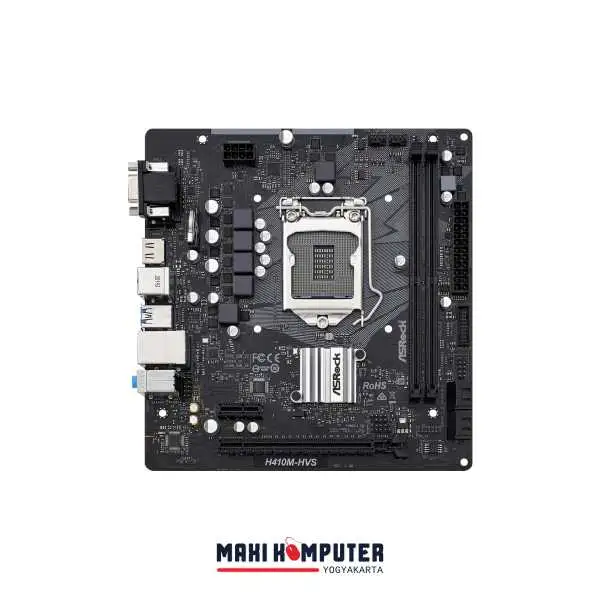
Budget builders consistently applauded the ASRock H470M-HVS for getting them onto Intel’s LGA1200 platform cheaply. A verified buyer on Amazon noted: “Easy to install… CPU and RAM fitted without problems.” For office PCs or starter gaming rigs, the combination of 4 USB 2.0 ports, 2 USB 3.2 Gen1 ports, Gigabit LAN, and 4 SATA III connectors delivers enough connectivity without overwhelming configuration complexity.
Linux and Windows users benefit from the stability. One Moscow reviewer emphasized, “Board is rigid, modern socket, installation went without any problems.” For those aiming at low-cost yet stable builds, these traits matter more than bleeding-edge features.
The aesthetic didn’t go unnoticed: the sapphire black PCB was mentioned in Reddit threads as lending a "mysterious touch" to budget cases, showing that even entry-level hardware can sport some visual appeal.
Common Complaints
The most consistent frustration is the absence of any M.2 slot. A Russian owner put it plainly: "No M.2 slot, which in 2021 is..." leaving the sentence trailing, perhaps in disbelief. This limitation forces reliance on SATA drives and older storage configurations, cutting into performance potential for those hoping to add NVMe.
Integrated graphics compatibility is another sore spot. Buyers pairing it with Intel’s F-series CPUs discovered that onboard video outputs are useless in that scenario—a sharp divergence from marketing's broad graphics claims. Without an external GPU, “it won’t run,” as one user warned.
Physical layout complaints also surface: the chipset placement near the CPU socket can interfere with certain cooling systems. “The ring fits tightly to the heatsink,” a reviewer lamented about aftermarket cooler mounting. This impacts upgrade flexibility and thermal management for those with non-stock coolers.
RAM overclocking limits on the H470 chipset chafe experienced users. “AMD even on the lowest chipset allows this,” critiqued one Russian poster, highlighting Intel’s segmentation strategy—the board will run memory at up to 2933 MHz on i7/i9, but less on i3/i5 or lower.
Divisive Features
Dual graphics outputs split opinion. For some office setups, having both HDMI and VGA means smooth transition between old monitors and new. Others dismissed it entirely, especially those who plan on running discrete GPUs from day one.
Similarly, the water pump header earns praise from DIY liquid-cooling enthusiasts—it supports up to 2A and adjustable voltage. But for budget builders (the majority audience), this is an unused luxury, adding no tangible value.
Trust & Reliability
Long-term durability impressions are modestly positive. No widespread reports of premature failure surfaced, and words like “modern socket” and “everything works perfectly” pepper reviews. However, one negative anecdote from Russia hints at weak support: “Support said your problems…” after a non-functional unit, implying potential frustration when things do go wrong.
Trustpilot-like sentiment emerges where expectations are managed—the board is built solidly, but not generously featured. Buyers knew their limitations and accepted them; those blindsided by specs found disappointment.
Alternatives
Some discontented buyers mused about AMD alternatives. The common reasoning: even entry-level AMD boards often allow broader RAM tuning and carry M.2 slots standard. Competing Intel boards on B460 or Z490 chipsets will offer M.2 support, PCIe 4.0 (Z590), and expanded USB varieties but at higher cost.
Price & Value
Prices range around 74€–93€ new in Europe, ₹5319 in India when in stock, and about $125 used on eBay. Resale remains possible given Intel's steady LGA1200 demand. The lowest documented new purchase was 5350₽ (~$60) in Moscow, heavily influencing value sentiment: “one of the most budget boards” said a Russian buyer.
Buying tips from the community:
- Verify CPU model supports integrated graphics if you plan to use onboard HDMI/D-Sub.
- Budget in for a SATA SSD or HDD, as NVMe isn't supported.
- Measure cooler clearances—avoid bulky mounting rings.
FAQ
Q: Does it support Intel 11th-gen CPUs?
A: No, it is designed for 10th-gen Comet Lake processors on LGA1200 with H470 chipset.
Q: Can I install NVMe SSDs?
A: No. Multiple users confirmed there is no M.2 slot, limiting storage to SATA 3 drives.
Q: Will HDMI work with my CPU?
A: Only if your CPU has an integrated GPU (non-F series). Some users found video outputs unusable with F-series chips.
Q: Is memory overclocking possible?
A: Limited to Intel’s official speeds: up to 2933 MHz for Core i7/i9, up to 2666 MHz for i3/i5, Pentium, and Celeron.
Q: How good is the onboard audio?
A: Uses Realtek ALC897 with 7.1-channel HD audio; satisfactory for general use, not audiophile-targeted.
Final Verdict
Buy if you need a low-cost, stable Intel 10th-gen Micro-ATX board for office, light gaming, or simple home builds and can live with SATA storage. Avoid if future-proofing, high-speed RAM tuning, or compact water-cooling layout flexibility are essential.
Pro tip from community: match your CPU choice to the board’s strengths—iGPU-compatible processor, modest cooling, and focus on affordability—so you get “everything functioning” without the regrets others voiced.





