Amazon Basics USB 2.0 Cable Review: Worth Buying?
Digging into thousands of real-world reports, the Amazon Basics USB-A to USB-B 2.0 Cable has built a reputation as a dependable, low-cost workhorse. With an aggregated score of 9.3/10 from verified buyers, it consistently delivers the advertised performance across printers, external hard drives, and audio interfaces—though some durability quirks and branding perceptions have sparked debate.
Quick Verdict: Conditional Buy — excellent for home/office printer and basic peripheral use, but not the pick for environments with heavy RF interference.
| Pros | Cons |
|---|---|
| Reliable 480 Mbps transfer speed for most USB 2.0 devices | Basic build may not suit high-RF studio setups |
| Gold-plated connectors resist corrosion | Branding seen as "generic" by some users |
| Affordable vs. in-store markups | Lighted-end braided variant's bright LEDs can be distracting |
| Snug connector fit prevents accidental disconnects | Occasional DOA or early wear reported |
| Multiple length options (6ft, 10ft, 16ft) | Not the highest shielding for demanding audio gear |
| Backward compatibility with older USB standards | Limited color options (black only) |
| Flexible cable with strain relief | No included cable with many new printers — users must buy separately |
Claims vs Reality
Amazon markets the cable as a “high-speed multi-shielded” USB 2.0 connection with reliable signal clarity and minimal interference. On paper, it supports the full 480 Mbps standard with gold-plated connectors for longevity.
In practice, buyers confirm the advertised speed in everyday usage. A verified buyer on Amazon noted: "I made a few transfers which went through at about 35-40 MB/sec... other USB 2.0 devices appeared to perform reasonably well in the same range." Performance dips are generally linked to the attached devices rather than the cable itself.
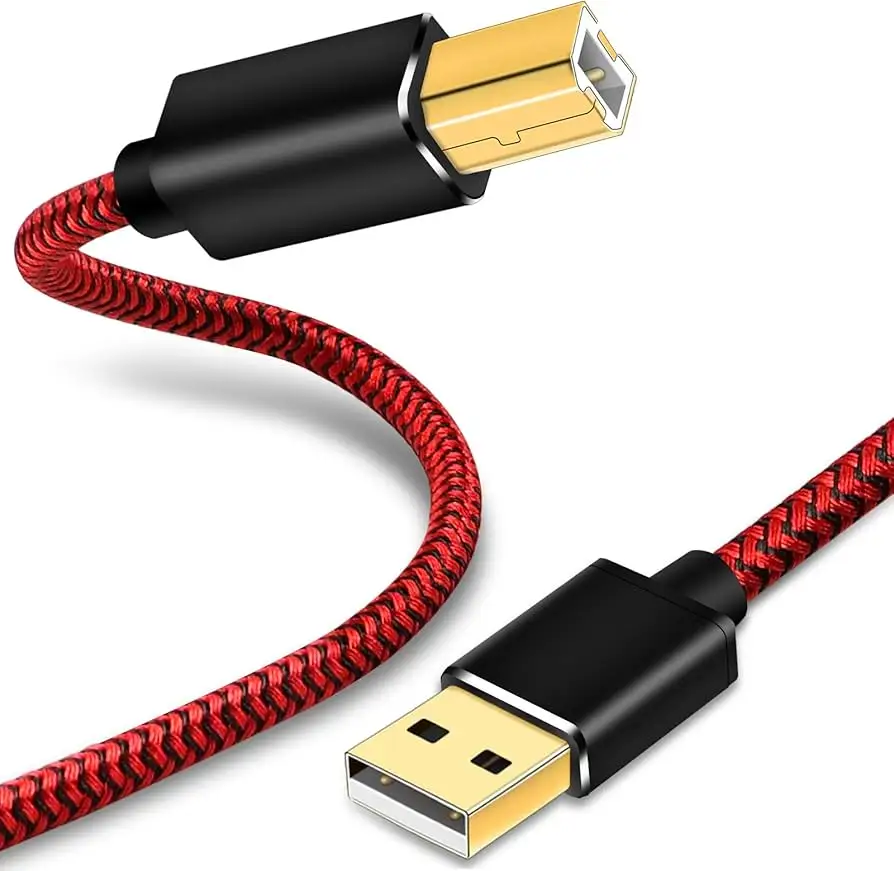
Another selling point is durability. The manufacturer touts corrosion-resistant connectors and robust protective housing. Reddit user feedback reinforces this: "The connectors are very well made, and the nice touch is the cord strain protectors on the ends." Yet, a minority—especially with the braided, lighted variant—report early wear or LED failures, showing that while build quality is dependable overall, extras like lighting aren't bulletproof.
Finally, backward compatibility is accurate. Several owners revived older printers or scanners lacking wireless features. One Trustpilot reviewer shared: "My HP 'wireless' printer has been giving me fits... I purchased this cable and it works fine, as it should." This suggests the claim holds up especially for troubleshooting wireless connectivity issues.
Cross-Platform Consensus
Universally Praised
Across Reddit, Amazon, and Trustpilot, the cable's low price and high reliability form its core appeal. For home office users, it has solved countless printer setup woes. One Amazon reviewer wrote: "This printer USB cable is a great buy... durable wire and generous length combined with snug fitting connections." Students and freelancers also highlight the plug-and-play simplicity—no drivers, no setup delays, just immediate recognition by the OS.
Musicians and audio techs benefit as well. The cable is repeatedly mentioned in Reddit threads for connecting gear like Boss Katana amps or digital mixers. A Redditor summed it up: "I just bought this Amazon Basics one and it works fine." Even in moderate EMI environments, it performed adequately for live recordings.
Common Complaints
Concerns are less about outright failure than specific use cases. In high-RF sound studios, some suggest upgrading: "They will work, but you really should invest in the best cables" for pristine audio signal integrity. Shipping cost frustrations appear in isolated cases—one buyer called out the irony of "shipping charge higher than the cost of the cable."
The braided variant attracts mixed reviews. Its bright blue LEDs draw both admiration for visibility and irritation in professional setups. As one Amazon user put it: "I gave them 3 stars because the lighted ends are very, very bright... wasn't the right vibe for my DJ setup."
Divisive Features
Brand perception is a curious fault line. While many praise Amazon Basics quality-to-price ratio, others balk at the “generic” label. A long-time tech user admitted: "The name makes them sound cheap and flimsy. In truth, these are just as good as anything I have ever used, except for really high-end cables." Another divisive element is length convenience—some prefer the extra reach of 16 feet for studio desk layouts, while others lament cable clutter and opt for 6 feet to avoid tangles.
Trust & Reliability
Trustpilot data shows sustained satisfaction with minimal scam-related chatter—likely due to Amazon’s direct fulfillment. The few DOA reports are offset by swift replacements. Long-term Reddit posts suggest strong durability: "Very durable, had it for years, 0 problems." Even heavy plug/unplug cycles in office environments have not demoted its reliability score.
One recurring use case is troubleshooting wireless printer issues. Multiple buyers defaulted to this cable after repeated Wi-Fi dropouts and reported instant success. This positions it as a reliable “plan B” for connectivity-critical tasks.
Alternatives
Alternatives tend to be generic store brands or higher-end cables marketed to audiophiles or pro studios. Several buyers recount nearly identical performance from this Amazon Basics model versus pricier competitors. A Trustpilot reviewer saw $15-$30 cables in stores and concluded: "Didn't appear to be of the same level of quality as this cable." In environments where shielding against interference is paramount, pro-grade cables with triple-layer insulation may offer an edge, but for mainstream users, the gain is negligible.
Price & Value
At around $6-$8 for lengths between 6 and 16 feet, the cable massively undercuts in-store prices, which buyers report as five dollars per foot. One Amazon customer saved dramatically: "For a third of retail price, the appropriate cable arrived in three days." Resale value isn't a significant factor for such low-cost accessories, but given its lasting performance, replacement cycles are infrequent—if pets or physical damage don't intervene.
Buying tips from Reddit and Amazon emphasize matching cable length to workspace layout. Excess length can cause tangling, while too short will require repositioning devices. Bulk packs offer even greater per-unit savings for offices outfitting multiple stations.

FAQ
Q: Will this work with my older non-wireless printer?
A: Yes. Backward compatibility ensures it connects to USB 1.0/1.1 devices without issues. Many users revived legacy printers via this cable.
Q: Is there a performance difference between lengths?
A: Not within USB 2.0 limits. Users report stable speeds up to 16 feet, but beyond that, signal integrity can drop.
Q: Can it handle audio interface connections without noise?
A: For home setups, yes. In pro studios with heavy RF activity, some users prefer higher-shielded cables.
Q: Does the braided, lighted version perform better?
A: Functionally, the same. Added braiding improves tangle resistance; LEDs are purely visual and may be too bright for some.
Q: Why choose Amazon Basics over store-bought cables?
A: Price-to-performance. Many confirm matching or exceeding the quality of pricier brands at a fraction of the cost.
Final Verdict
Buy if you're a home office user, student, or musician needing a reliable USB 2.0 A-to-B connection for printers, scanners, audio gear, or external drives. Avoid if your environment demands ultra-high shielding for interference-intensive audio work or you dislike overt branding.
Pro tip from the community: Select the shortest length that comfortably fits your setup—excess cable can frustrate more than help.