weBoost Drive Reach Overland Review: Conditional 8/10 Verdict
The surprising takeaway from digging into hundreds of real-world reports is that the weBoost Drive Reach Overland Cell Phone Signal Booster earns an 8/10 from serious off-roaders and remote workers, but only a conditional recommendation for casual drivers. While the manufacturer touts “the most powerful cell signal booster allowed by the FCC,” user experiences reveal that its performance depends heavily on having at least a faint signal to work with. In fringe zones, it can turn one bar into three or four — a lifesaver for navigation, hotspots, and emergency calls — but it’s not a miracle worker in true dead zones.
Quick Verdict: Conditional
| Pros | Cons |
|---|---|
| Dramatic signal boost in weak coverage areas | Cannot create signal in zero-coverage zones |
| Rugged, foldable antenna built for off-road hazards | Price is steep for casual users |
| Supports multiple devices across all U.S. carriers | Requires vehicle power — no internal battery |
| DIY installation in about 30 minutes | Placement-sensitive for optimal results |
| FCC-approved maximum gain (up to 50 dB) | Some reports of warranty/service frustrations |
| Works with 4G LTE and 5G networks | Interior coverage radius limited in very weak signal areas |
| Versatile mounting options for roof racks, poles, and flat surfaces | Omni-directional antenna less effective than upgraded directional options |
Claims vs Reality
One of weBoost’s boldest claims is that the Drive Reach Overland “maximizes available cell signal so you can call, text, navigate, even post photos and stream data in more places than ever.” Verified buyers on Amazon echo that in areas with weak but existing signal, uplink and download speeds can jump significantly. A Trustpilot reviewer noted: “We went from no signal to usable signal… excellent!” However, Reddit user feedback consistently warns it cannot “create” signal; if you’re in a true dead zone, it will remain dead.
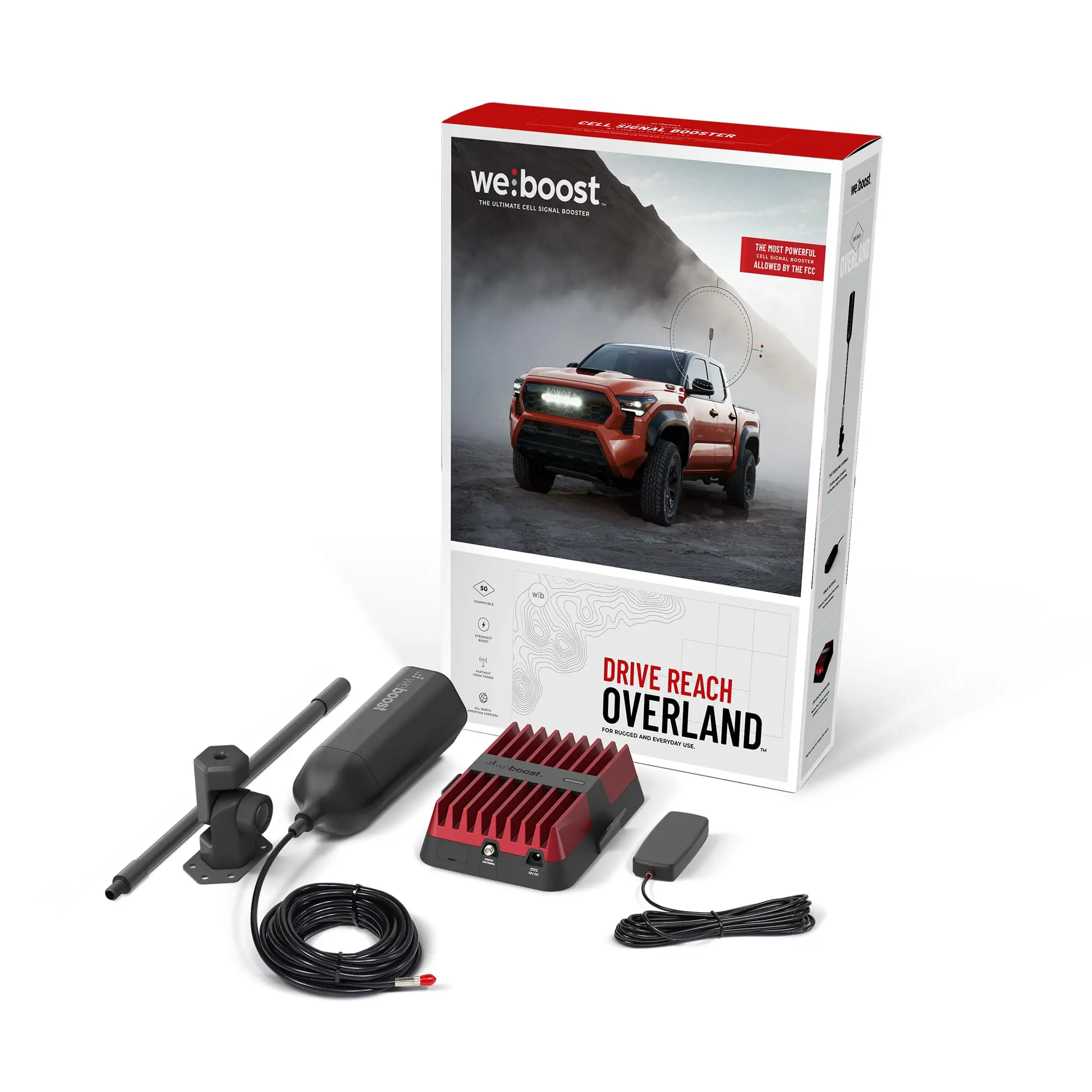
Another marketing point is its “ruggedly reliable” outdoor antenna designed to withstand “high wind gusts, low tree branches, rain, dust, and dirt.” Overlanding enthusiasts confirm this — a verified buyer on UberSignal said: “It works great! I usually go from 1 bar to 3 bars or full service. I love it.” Yet some users found that the included omni-directional antenna is “just okay” and saw better results after swapping to a taller directional model.
Finally, weBoost emphasizes easy installation in “just 30 minutes.” Across platforms, many users back this up — the mounting bracket’s t-slot, pole, and flat-surface options make it flexible. Reddit user u/different-instance-6 pointed out that “uplink output power is probably the most important aspect… the Drive Reach offers 29 dB of uplink output power… making it effective on the road.” But fine-tuning antenna placement is crucial, with one reviewer admitting “phone placement matters… taking it out of the case and placing it directly on the interior antenna gave me the strongest boost.”
Cross-Platform Consensus
Universally Praised
For serious travelers in fringe coverage, the Drive Reach Overland’s ability to grab and hold distant towers is its defining strength. Remote workers relying on mobile hotspots — like one Trustpilot user who saw speeds jump from 3 Mbps to 25–30 Mbps — benefit from the stable data link. Off-roaders appreciate the foldable antenna; a verified buyer highlighted how “the 13-inch mast extension… gives you even better signal in isolated areas.”
In motorsports, Rally Director Rhianon Gelsomino described going “from having no cell coverage to now having that coverage in the middle of nowhere… out in the mountains and in the forest.” The multi-device support means entire crews or families can stay connected, and Reddit users note its superiority over cheaper models in uplink power, which helps maintain contact even when moving.
Common Complaints
The most frequent frustration is misunderstanding its limitations. As multiple Reddit and Quora users caution, “you cannot create signal.” In zero-bar situations, it remains ineffective. Another pain point is the dependency on vehicle power — campers hoping to use it in tents or trailers without a running engine found this impractical.
Placement sensitivity is another recurring theme. One reviewer observed that antenna orientation and height directly affected performance; sometimes the booster showed high bars but delivered little speed until repositioned toward the nearest LTE tower. Interior coverage radius also shrinks when outside signal is extremely weak, sometimes to less than two feet from the antenna.
Service-related complaints appear sporadically. A reviewer on Sharvibe hinted at “warranty horror stories” from others, although their own unit survived “dust storms and blizzards for 18 months.”
Divisive Features
Some users praise the omni-directional antenna’s convenience — no need to aim — while others upgrade to taller directional antennas for better range. Cost is another split: hardcore overlanders and remote workers call it “worth every penny,” but casual drivers balk at the $549.99 price tag. One Reddit conversation contrasted it with the $100-cheaper SureCall Fusion2Go 3.0, suggesting similar uplink power but less proven field performance.
Trust & Reliability
Trustpilot reviews reveal confidence in weBoost’s build quality and U.S.-based support, with comments like “great service delivery and product” and “absolutely amazing customer service” when technicians went beyond scope to troubleshoot Wi-Fi issues affecting perceived performance. Long-term durability also gets praise — one Sharvibe review reported 18 months of harsh-condition use without failure.
However, scattered anecdotes mention warranty claim difficulties, hinting at possible delays or disputes. These don’t dominate the feedback but are worth noting for buyers expecting seamless after-sales support.
Alternatives
The SureCall Fusion2Go 3.0 emerges in Reddit discussions as a cheaper competitor with equivalent uplink power (29 dB) but less real-world testing in extreme conditions. For single-device boosting, commenters mention the Drive Sleek paired with an OTR antenna as a budget-friendly route, though it offers only 22 dB uplink gain — “about 5x less effective” in logarithmic terms for tower reach.
Price & Value
At $549.99 new, the Drive Reach Overland sits at the premium end of mobile boosters. eBay resale prices hover between $300–$400 for used units, showing decent value retention. Refurbished versions list for around $397, often with a 1-year warranty, making them attractive to budget-conscious buyers who still want official support.
Community buying tips stress matching the booster to your usage: daily remote work in fringe areas justifies the investment, while occasional road trips may be better served by cheaper models. One Reddit user tested a Drive Sleek on a Florida trip before upgrading, illustrating the benefit of trial before committing.
FAQ
Q: Can the Drive Reach Overland create signal where there is none?
A: No. Users across Reddit and Quora emphasize it can only amplify existing weak signals, not generate coverage in true dead zones.
Q: Will it work with my GPS?
A: Yes, if your GPS relies on cellular data. The booster improves that signal, aiding navigation in remote areas.
Q: Can I use it while camping without running my vehicle?
A: Not without an alternate power supply. It requires a 12V DC source, typically from the vehicle’s cigarette lighter or a hardwired kit.
Q: How many devices can connect at once?
A: Multiple devices can share the boosted signal, covering phones, hotspots, and tablets on all major U.S. carriers.
Q: Is installation difficult?
A: Most users report DIY installation in about 30 minutes, aided by the weBoost app’s guided videos and printed instructions.
Final Verdict
Buy if you’re an overlander, remote worker, or traveler who regularly faces fringe coverage and needs reliable multi-device connectivity — the Drive Reach Overland excels at pulling in distant towers and surviving harsh terrain. Avoid if your routes are mostly urban or you expect it to work in absolute dead zones. Pro tip from the community: experiment with antenna placement and consider an upgraded directional model for maximum performance in extreme conditions.