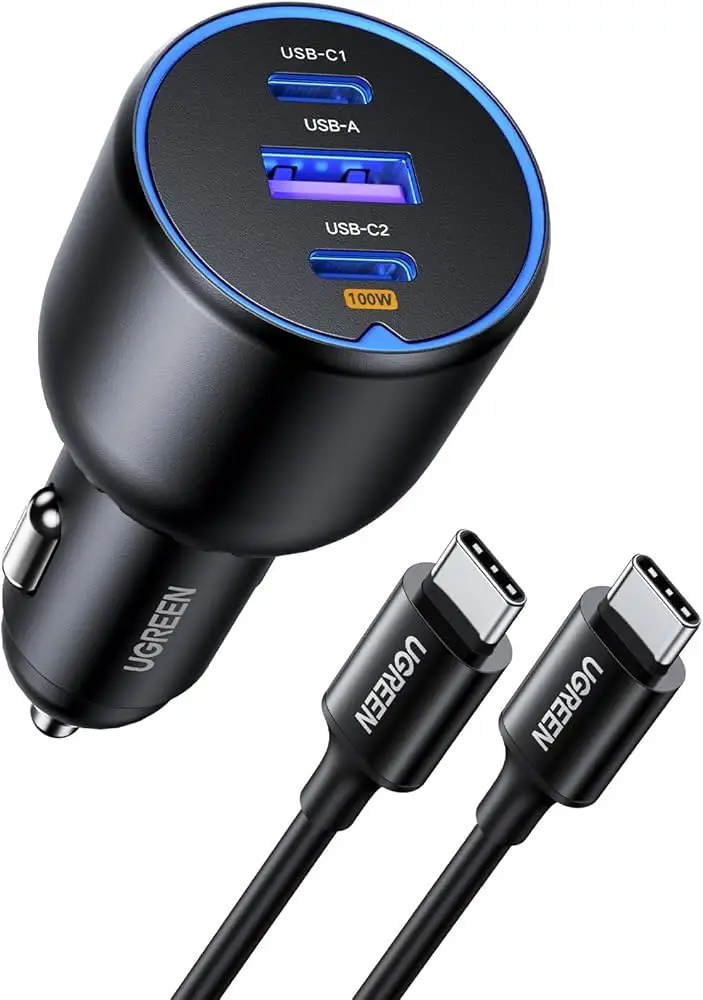
UGREEN 130W USB C Car Charger Review: 8.2/10
A 4.6/5-star average with 82% 5-star ratings sounds like a slam dunk—until one long-term Amazon reviewer claims it “melted it’s own plug.” UGREEN 130W USB C Car Charger lands as a strong, capability-packed option for laptop-and-phone road warriors, with one serious durability red flag in user feedback. Verdict: 8.2/10.
Quick Verdict
Conditional — a great pick if you want high-wattage USB-C charging in the car, but be mindful of heat and sustained output expectations.
| What it means | Evidence from user feedback |
|---|---|
| Pro: Strong multi-device charging | An Amazon reviewer said it “charges my devices quickly and efficiently, even with multiple gadgets plugged in.” |
| Pro: Feels well-built | A verified buyer on Amazon noted: “it’s well-built and feels sturdy.” |
| Pro: Useful cooling/vents | A verified buyer on Amazon noted: “The vents are a nice touch — they keep it cooler than other chargers i’ve tried.” |
| Pro: Real laptop charging value | A verified buyer on Amazon wrote it “is able to easily charge both my dell latitude and my modified thinkpad t 430.” |
| Con: Sustained 100W may drop | A verified buyer on Amazon complained: “it only charges at 100w for a few minutes, then drops down to 60w and stays there.” |
| Con: Long-term heat risk (reported) | The same Amazon reviewer reported it “melted it’s own plug.” |
Claims vs Reality
UGREEN 130W USB C Car Charger is marketed as a “130w” total charger with “pd 100 w (usb-c 2), pd 30 w (usb-c 1), and scp 22.5w” across three ports, plus broad fast-charge protocol support (PD/QC/PPS) and “superior safety.” The official language leans hard into laptop charging—UGREEN’s EU listing even claims it can charge a “MacBook Pro 16'' up to 100% in just 90 min.”
Digging deeper into user reports on Amazon, the laptop-charging promise often holds up in day-to-day use. One verified buyer framed it as a work tool: “Outstanding charger for my work computer while in the vehicle… although its main ac adapter is 300 watts it will charge via pd with 100 watts.” Another user described using it specifically to keep multiple devices alive at once: “charges my laptop (or maintains is), and charges my phone, while also charging my mobile hot spot.”
But a recurring pattern emerged around sustained peak output versus short bursts. While officially positioned around PD 100W capability, one Amazon reviewer claimed the top rate didn’t stick: “it only charges at 100w for a few minutes, then drops down to 60w and stays there.” That same account escalates from performance disappointment to a safety fear: after about a year, they say it “suddenly stopped charging, must have overheated because it melted it’s own plug.” While this is only one user story in the provided dataset, it directly challenges the “superior safety” narrative.
- Marketing claim: Up to 130W / PD 100W → Some users praise laptop charging; one reports sustained drop to 60W.
- Marketing claim: Cooling + safety → One user praises vents; one reports overheating damage.
Cross-Platform Consensus
Universally Praised
“Rock solid” is the phrase that keeps popping up when users describe everyday charging reliability—especially for people trying to replace a glovebox full of adapters with one high-output unit. A verified buyer on Amazon said: “The power delivery is rock solid, and i haven’t noticed any overheating.” For commuters running navigation, wireless Android Auto, and constant phone use, the upgrade effect can feel dramatic. One Amazon reviewer compared it to an older charger as “like comparing day and night,” adding that it “performs similarly to my 100w charger from ugreen as well.”
For laptop users, the appeal is simple: get meaningful charge while driving instead of slowly losing battery. One Amazon reviewer wrote they bought it because they “needed to be able to charge my laptop while in the car,” and reported it “is able to easily charge both my dell latitude and my modified thinkpad t 430.” Another person traveling with a laptop kept it blunt: “bought this for when i’m traveling. works great to charge my laptop.” These stories align closely with UGREEN’s positioning as a PD-capable car charger meant for more than just phones.
Build feel and small usability touches also earned consistent praise in the Amazon excerpts. A verified buyer wrote: “it’s well-built and feels sturdy,” and specifically called out thermal design: “The vents are a nice touch — they keep it cooler than other chargers i’ve tried.” Even the aesthetics of the LED came up as a quality-of-life benefit rather than marketing fluff; one reviewer said the “shade of blue light is very similar to what is projected in ram trucks,” suggesting it blends into certain vehicle interiors.
- Best-fit users: mobile workers, road-trippers, laptop-in-car charging needs.
- Most-cited positives (Amazon): “sturdy,” “rock solid,” “day and night” upgrade, vents/cooling.
Common Complaints
The most concrete complaint in the provided feedback isn’t about compatibility or port count—it’s about what happens when you try to hold high wattage for long stretches. One Amazon reviewer’s frustration starts with performance: “it only charges at 100w for a few minutes, then drops down to 60w and stays there.” For remote workers expecting true laptop-class charging on long drives, that kind of drop can change the real-world outcome from “charging up” to “just maintaining.”
Then there’s the more alarming durability story tied to heat. That same reviewer said that after about a year, “while charging at 60w it suddenly stopped charging, must have overheated because it melted it’s own plug.” If accurate, that’s the kind of failure that matters most to frequent drivers—rideshare operators, delivery drivers, or anyone leaving devices charging for long sessions—because it undermines the very “set it and forget it” convenience multi-port chargers promise.
On the flip side, other Amazon reviewers explicitly reported the opposite thermal experience—“i haven’t noticed any overheating”—which makes the complaint feel less like an immediate universal issue and more like a long-term risk that may depend on vehicle socket fit, ambient conditions, or usage patterns. Still, it’s a recurring investigative flag: while marketing emphasizes protections, at least one real buyer links heavy use to heat damage.
- Performance complaint: sustained peak wattage may not hold (per one Amazon review).
- Reliability complaint: long-term overheating damage alleged (“melted it’s own plug”).
Divisive Features
The charger’s “high output” identity is both its selling point and its most debated reality. Many users describe it as powerful enough to change their daily routine, especially those upgrading from older Quick Charge-era adapters. One Amazon reviewer said their previous charger “was already not able to keep up with my battery usage while using wireless android auto,” and described this model as a significant leap.
Yet the expectation gap is real: buyers see “100W” and assume a steady 100W experience. One reviewer’s account suggests a burst-then-throttle pattern—“100w for a few minutes, then drops down to 60w.” So the same feature—high-wattage PD—can read as either “finally enough” or “not truly sustained,” depending on the user’s setup and what they consider acceptable.
The included cable is also a subtle divider in the Amazon feedback. One reviewer appreciated that “the model i ordered came with a usb-c cable included which is pretty nice,” and another (in Spanish) highlighted “se agradece el cable tipo c que trae” (appreciating the included USB-C cable). But users expecting the absolute best performance may still worry about whether their cable and device combination is ideal for maintaining top PD levels.
- Power expectations split: “day and night” upgrade vs “can’t sustain 100w.”
- Bundle value split: some praise the included USB-C cable; performance-focused users may still scrutinize cables.
Trust & Reliability
One of the more complicated signals in the provided dataset is that “Trustpilot (Verified)” content is not actually a collection of short, user-attributed Trustpilot reviews. Instead, it reads like a third-party editorial verdict (“Consumers Best”) with narrative claims like: “it won’t always push laptop‑level speeds when every port is lit up,” and “sustained multi‑device fast charging can warm the unit.” That tone aligns with what a cautious buyer might want to hear—but it isn’t a verified end-user quote in the way Amazon reviews are.
Digging deeper into the genuinely user-attributed durability evidence we do have, the longest-horizon story is the Amazon reviewer who said: “i’ve had it for about a year now,” before reporting performance drop and then the plug damage: “melted it’s own plug.” That single account carries outsized weight because it’s both time-based and safety-relevant. Meanwhile, other Amazon reviewers using it for “a few days” describe it as “rock solid,” highlighting the common pattern where early satisfaction doesn’t always predict long-term outcomes.
- Long-term reliability signal (Amazon): one year-in overheating/plug-melt report.
- Short-term reliability signal (Amazon): multiple early-use “sturdy” and “no overheating” statements.
Alternatives
Only one clear competitor is mentioned directly in the user-provided data: Anker. One Amazon reviewer contextualized value by comparing it to an Anker release: they referenced “anker’s ‘fantastic new car charger’… with 167w charging on 3 ports with 1 100w port for $40,” then argued the UGREEN 130W USB C Car Charger was “functionally almost identical… for less money” when they bought it on sale.
That same reviewer framed it as a timing/value play: “ugreen is also beating anker by about half a year on the release schedule.” For shoppers deciding between these brands, that story suggests the UGREEN appeal is less about prestige and more about getting similar multi-port, high-wattage charging for a lower price—especially if you catch discounts.
Price & Value
Pricing in the provided sources varies by region and promo. UGREEN’s US listing shows $39.99 with a promo code, the EU page shows €32.99 (also with discount messaging), and the UK listing references £29.99 with discount language. The resale-value angle in the dataset is limited, but the “by far the best at this price point” Amazon review reads like a value thesis built around paying less than Anker for similar capability.
Community buying advice—where it appears—leans toward waiting for sales and treating this as a “hidden gem.” The same Amazon reviewer said: “it was when i bought it… last november 2023 for less money,” and emphasized catching it “on sale.” For budget-focused shoppers who still need PD laptop charging in a car, that’s the core value proposition in user language: don’t overspend for a name when a discounted unit meets the same need.
- Current observed price anchors: ~$40 USD, ~€33, ~£30 (varies with promos).
- Value framing (Amazon): “hidden gem,” “best at this price point,” “catch it on sale.”
FAQ
Q: Can the UGREEN 130W car charger really charge a laptop in the car?
A: Yes—multiple Amazon reviewers used it specifically for laptop charging. One verified buyer said it “is able to easily charge both my dell latitude and my modified thinkpad t 430,” and another wrote: “works great to charge my laptop.” Some users describe it as enough to charge or maintain a laptop while driving.
Q: Does it sustain 100W output the whole time?
A: Not always, based on one long-term Amazon report. A verified buyer complained: “it only charges at 100w for a few minutes, then drops down to 60w and stays there.” Others still call charging “quickly and efficiently,” so sustained output may depend on device, cable, and heat conditions.
Q: Does it overheat?
A: Experiences differ. One Amazon reviewer praised cooling: “The vents are a nice touch — they keep it cooler than other chargers i’ve tried,” and reported “no overheating.” Another long-term reviewer believed it “must have overheated” and claimed it “melted it’s own plug,” raising a potential heat-risk concern.
Q: Is it good for charging multiple devices at once (phone + hotspot + laptop)?
A: Yes, that’s a common use case in the Amazon feedback. One verified buyer said it “charges my laptop… and charges my phone, while also charging my mobile hot spot.” Another wrote it charges “quickly and efficiently, even with multiple gadgets plugged in.”
Q: Is it a better value than Anker?
A: One Amazon reviewer thought so, comparing it to an Anker model and saying the UGREEN was “functionally almost identical… for less money” when purchased on sale. The data doesn’t include a head-to-head test, but it does show at least one buyer choosing UGREEN for price-to-performance.
Final Verdict
Buy UGREEN 130W USB C Car Charger if you’re a mobile worker, frequent traveler, or road-trip family who needs real USB-C PD laptop charging alongside phones—Amazon reviewers repeatedly describe it as “rock solid” and a “day and night” upgrade.
Avoid it if your top priority is sustained, guaranteed 100W output for long sessions without throttling, or if you’re especially risk-averse about heat—one long-term Amazon reviewer warned it “melted it’s own plug.”
Pro tip from the community: treat it like a sale item. One Amazon reviewer called it “by far the best at this price point” and suggested it’s “close to half the price if you catch it on sale.”