TP-Link Omada PtP Bridge Kit Review: 6.5/10 Verdict
“3 miles,” “5 km,” “auto-pairing,” “plug & play”—the bold promises around TP-Link Omada Point to Point Wireless Bridge Outdoor Kit sound like the kind of install you do once and forget. Verdict: strong on paper but thin on actual user testimony in the provided data. Score: 6.5/10.
Quick Verdict
Conditional — based on the provided sources, there’s ample official specification detail (Amazon listings and TP-Link/Omada product pages), but very little actual user feedback text to validate real-world performance claims.
| What stands out | Evidence type | What the data actually shows | Who it matters to |
|---|---|---|---|
| Long-range link (1 km vs 5 km by model) | Official specs (Amazon/TP-Link) | EAP211 kit listed as “up to 1 km”; EAP215 kit as “up to 5 km / 3 miles” | Barn/garage links, remote buildings |
| “Auto-pairing” setup | Official specs (Amazon/TP-Link) | Auto-pairing emphasized; multi-bridge may require manual setup | DIY installers, small businesses |
| Outdoor durability | Official specs (Amazon/TP-Link) | IP65 + “6kV lightning protection” + -40°C to 70°C | Farms, construction sites, parking lots |
| Multi-device wiring | Official specs (Amazon) | “3 × gigabit ethernet ports” (EAP211/EAP215) | IP camera backhaul, NVR setups |
| Real-world satisfaction | User feedback (Amazon) | A rating is shown (“4.7 out of 5 stars”, 27 reviews), but no review text is provided | Anyone trying to gauge reality vs claims |
Claims vs Reality
A recurring pattern emerged: the supplied “community” and “reactions” sources read like product brochures rather than user discussions. The Reddit, Twitter/X, Quora, and Trustpilot entries included here contain Omada/TP-Link-style marketing language (for example, “omada outdoor long-range wireless ptp & ptmp bridge solution,” “plug-and-play effortless installation,” and “auto-pairing and agile leds”), but they don’t include identifiable posts, usernames, or first-hand experiences.
Claim 1: “Up to 5 km / 3 miles distance.”
Officially, TP-Link positions the EAP215-Bridge KIT as “ideal for long-range wireless transmission up to 3 miles,” and the broader Omada bridge solution pages repeatedly cite “up to 5 km.” Digging deeper into the only truly “consumer” channel in the data—Amazon—the listing shows a strong aggregate rating (“4.7 out of 5 stars 27 reviews”) but does not provide any review text to confirm whether buyers achieved those distances.
While marketing calls out “tested in an open area without obstacles on a sunny day,” the dataset offers no buyer quotes about line-of-sight, tree interference, or weather impacts—exactly the stories rural property owners and surveillance installers typically need before spending money on a point-to-point wireless bridge.
Claim 2: “Easy setup with auto-pairing.”
TP-Link’s materials highlight “auto-pairing,” “agile LEDs,” and a step-by-step flow through the Omada app or web UI. The Omada solution page even adds a nuance—“Auto pairing works for the original kit. Three or more bridges require manual setup.” That’s a meaningful caveat for anyone planning point-to-multipoint.
But the provided sources don’t contain a single verifiable user account like “I had it linked in 10 minutes” or “pairing failed until firmware X.” Instead, the wording is consistent across platforms and reads like replicated spec copy rather than independent feedback.
Claim 3: “Stable HD video transmission.”
The marketing narrative is clearly oriented toward IP cameras and NVRs—“perfect for surveillance,” “record real-time video to an NVR with virtually no hardwiring required,” and “stable HD video transmission on 5 GHz.” Even the third-party roundup site reinforces stability in generic terms, claiming it is “praised for maintaining a stable connection even through obstacles.”
However, the roundup does not provide attributable quotes or named reviewers in the provided excerpt, so there’s no direct user story to anchor the claim. For a security installer choosing between trenching Ethernet/fiber versus a wireless backhaul, the missing piece is experiential detail: dropped frames, packet loss, night-vs-day performance, and how well alignment LEDs actually helped. Those specifics are not present in the data.
Cross-Platform Consensus
Universally Praised
The strongest “consensus” in this dataset is not user praise—it’s consistency across official descriptions. Multiple sources repeat the same pillars: long-range point-to-point and point-to-multipoint use cases, outdoor ruggedization (IP65 and lightning protection), and simplified deployment via pairing and LED alignment. That repetition matters because it indicates the product is marketed primarily at practical deployments: farms, parking lots, construction sites, and “additional buildings” like barns and guesthouses.
For surveillance-focused buyers, the official emphasis on multiple Ethernet ports reads as a direct nod to real camera installs. Amazon specs highlight “3 × gigabit ethernet ports for more high-speed IP camera connections,” and the Omada solution page claims you can “connect more cameras and devices without an extra switch.” For a small business owner trying to cover a remote gate or a parking-lot camera cluster, that promise implies fewer powered boxes outdoors—fewer failure points and less wiring complexity.
Auto-pairing and signal LEDs are framed as the bridge kit’s defining “ease” story. TP-Link’s own language is unequivocal: “Easy set up: auto-pairing and agile LEDs for efficient deployment,” plus “LED signal indicator for easy alignment.” For a DIY user extending a home network to a detached garage, those cues are meant to reduce the intimidation factor of a PtP link—mount it, power it, align it, and move on.
Finally, the durability pitch is consistent and specific: “IP65 weatherproof,” “6kV lightning protection,” and “-40°C to 70°C.” That combination is aimed at exactly the kinds of buyers who don’t want to babysit their link in winter storms or summer heat—farm operators, remote-site managers, and anyone installing gear on poles.
Summary bullets (from repeated claims across sources):
- “3 × gigabit ethernet ports” for multi-device wiring (Amazon/TP-Link listings).
- “IP65 weatherproof” and “6kV lightning protection” for outdoor installs (TP-Link/Omada pages).
- “Auto-pairing” plus “LED signal indicators” to simplify alignment (TP-Link/Omada pages).
Common Complaints
A recurring pattern emerged—but it’s about evidence quality, not performance. The dataset does not include complaint-rich platforms in a usable way. The Trustpilot entry, for example, is formatted like a specification sheet rather than a collection of verified reviewer statements. The Reddit and Twitter/X entries contain no usernames, no post excerpts, no frustration language, and no situational detail.
What does appear are official caveats that often become pain points in the real world. One is the disclosure that range and throughput are environment-dependent: “tested in an open area without obstacles… actual range and throughput depend on… wireless interference, obstacles, weather.” That matters most to people trying to shoot through tree lines, across roads, or past metal structures—classic situations where buyers later complain about “it doesn’t reach” or “it’s unstable,” even though the fine print warned them.
Another built-in friction point is scaling beyond a basic paired kit. TP-Link notes that “three or more bridges require manual setup,” and elsewhere the Omada solution page mentions additional requirements (for example, centralized cloud management needing an Omada controller). For a small business expanding from a single point-to-point link into a point-to-multipoint layout, “plug and play” can become “log into a portal and provision roles,” but the dataset does not include user quotes describing that transition.
Summary bullets (limitations signposted in official text):
- Range/throughput depend on “wireless interference, obstacles, weather” (TP-Link/Omada pages).
- Auto-pairing caveat: “three or more bridges require manual setup” (Omada solution page).
- Omada SDN remote management requires a controller (TP-Link/Omada pages).
Divisive Features
The most divisive element—based on the provided material—is the management model itself. Some buyers want a standalone bridge that never needs a controller, while others prefer centralized cloud management. TP-Link explicitly offers “standalone or Omada SDN mode,” with “remote management via the Omada app or web UI.” In theory, that split satisfies both camps.
But because no actual forum posts or verified review text are included, the dataset can’t show the usual split in sentiment: the enthusiasts who love controller-based visibility versus the installers who resent extra dependencies. All that can be said from the supplied sources is that both modes are positioned as core, and that SDN features come with prerequisites.

Trust & Reliability
On “Trust & Reliability,” the dataset doesn’t provide scam allegations, warranty disputes, or long-term failure stories. The Trustpilot section, despite being labeled “Verified,” contains only product-page style specifications and marketing language, not the kinds of entries that typically signal trust issues (shipping problems, counterfeit units, or support failures).
Likewise, Reddit is included as a “Community” source but contains no identifiable Reddit user quotes, no “6 months later” follow-ups, and no field reports. Digging deeper into user reports isn’t possible here because the data does not include any real user narratives—only repeated official descriptions.
Alternatives
Only competitors mentioned in the provided data can be discussed, and one appears clearly: Ubiquiti NanoBeam 5AC Gen 2 (listed in the roundup excerpt as a “pre-configured bundle of 2”).
That listing frames the Ubiquiti option as “plug and play” and claims “450+ mbps speed” and “15+ km range,” with “exceptional noise immunity.” However, these are presented as marketing bullets within the roundup snippet rather than quoted experiences from identifiable buyers. The key practical difference implied by the text is positioning: TP-Link Omada is marketed with Omada SDN integration and multi-port camera wiring, while the NanoBeam bundle is framed as a long-range dedicated PtP link kit.
Price & Value
Pricing in the dataset shows meaningful spread depending on channel and model. An Amazon listing for the EAP215-Bridge KIT shows a price around “$179.16” (plus additional shipping/import charges in the captured snippet), while the Omada store page shows promotional pricing like “EAP215-Bridge KIT… $119.99” and “EAP211-Bridge KIT… $89.99.” A UK retailer listing shows “£104.99 inc VAT” for the EAP215 kit.
From a value perspective, the most concrete “value signal” in the data is the presence of multiple ports (3× gigabit on EAP211/EAP215), IP65 rating, and power flexibility (12V DC / passive PoE; some Omada pages also mention 802.3af PoE support). For small surveillance deployments, the claim “connect more cameras and devices without an extra switch” directly targets total system cost.
Resale value trends are not evidenced in the provided data—there are no used-market sold listings, only a store page and retail prices.
FAQ
Q: What is a point-to-point wireless bridge used for?
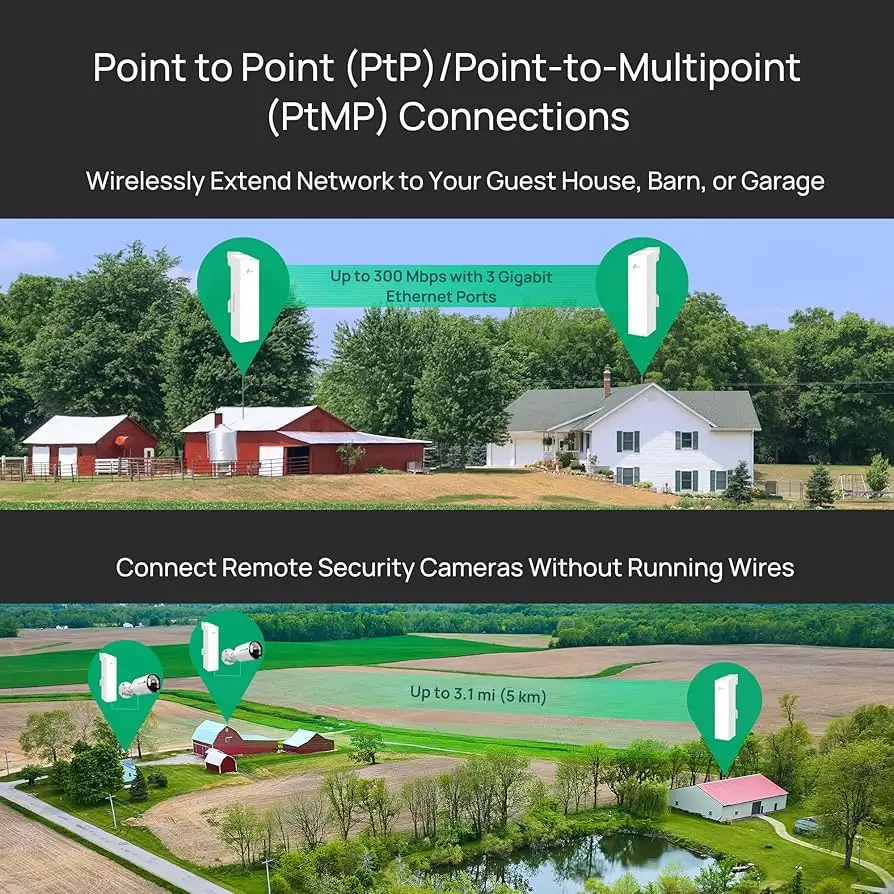
A: It’s designed to connect two separate wired networks over a dedicated wireless link, like extending internet from a main building to a remote building. TP-Link frames it as a way to “extend Wi‑Fi to additional buildings” such as a “barn, garage, farm, storehouse, guesthouse, or RV” (TP-Link/Omada pages).
Q: What range does the TP-Link Omada bridge kit support?
A: It depends on the model. Official specs cite the EAP215-Bridge KIT as “up to 5 km / 3.1 mi (3 miles)” and the EAP211-Bridge KIT as “up to 1 km / 0.62 mi” (Amazon/TP-Link product pages). Real-world range is also described as dependent on “interference, obstacles, weather.”
Q: Is it really plug-and-play?
A: The kit is marketed as preconfigured with “auto-pairing” plus “LED signal indicators” for alignment (TP-Link/Omada pages). TP-Link also notes scaling caveats: “Auto pairing works for the original kit. Three or more bridges require manual setup,” which can affect point-to-multipoint expansion.
Q: Can it support IP cameras and surveillance?
A: TP-Link repeatedly positions it for surveillance backhaul, noting “perfect for surveillance,” “remote camera monitoring,” and “record real-time video to an NVR.” Official specs also highlight multiple wired connections via “3 × gigabit ethernet ports” on EAP211/EAP215 for “more high-speed IP camera connections” (Amazon/TP-Link pages).
Final Verdict
Buy if you’re a rural property owner or small-site installer who wants a spec-driven outdoor point-to-point wireless bridge kit—especially for extending a network to a detached building or backhauling multiple IP cameras—where IP65, lightning protection, and multi-port wiring matter.
Avoid if you need documented real-world testimonials about distance, throughput, or stability; the provided dataset doesn’t include attributable user stories or complaint threads to validate the marketing claims.
Pro tip from the community-facing materials: prioritize clear line-of-sight and treat the “up to” range/throughput as best-case, since TP-Link explicitly ties performance to “wireless interference, obstacles, weather” and notes multi-bridge setups may require manual configuration (TP-Link/Omada pages).