Taramps TS 800x4 Review: Conditional Yes (7.6/10)
A product page calling it “tailored for modern audio needs” sets expectations fast—but the real story is how much this compact amp promises on paper: 800W RMS (4 x 200W RMS at 2 ohms), high-level inputs, and auto turn-on, all in a chassis barely larger than a paperback. Taramps TS 800x4 Multichannel Car Amplifier gets a verdict of Conditional Yes — 7.6/10, because the provided data reads far more like marketing/spec sheets than lived-owner reporting, yet it still reveals who this amp is designed for and what tradeoffs are baked in.
Digging deeper into the sources, most “community” and “reactions” entries repeat identical manufacturer language rather than unique user experiences. That makes the feedback trail thinner than it looks. Still, where real consumer signals do appear—like Amazon star rating context, installation guidance, and market listings—there’s enough to map what buyers are usually shopping for: an easy factory-radio integration path and a flexible 4-channel platform that can also be bridged.
A recurring pattern emerged across the listings: the TS 800x4 is being positioned as a “no adapters needed” solution for factory head units, while the DS 800x4 family is pitched as a more traditional multi-channel workhorse. The catch is that “community sentiment” here is largely absent; most text is brand copy, not owner narratives. So this review sticks strictly to what’s actually in the dataset—spec claims, marketplace positioning, and any verifiable buyer-facing statements.
Quick Verdict
Yes, conditionally—if your priority is factory-radio integration via high-level input + auto turn-on and you’re comfortable with fixed crossovers at 90Hz.
| What matters | What the data supports | Who it fits | Where it can disappoint |
|---|---|---|---|
| Factory integration | “4-channel high-level individual input and automatic activation… eliminating the need for adapters.” (Taramps product description via Taramps/TarampsUSA mirrors) | Stock head unit upgraders | Anyone needing custom crossover points |
| Power claim | “2 ohms: 800W RMS (4 x 200W RMS)” @ 14.4V (Taramps specs) | Typical 4-speaker + tweeter setups | Systems expecting full rated power at lower voltage |
| Bridging | “2 bridged channels… 800W RMS (2 x 400W RMS) at 4 ohms” (Taramps specs) | Two larger drivers/woofers | Wiring complexity if new to bridging |
| Size/weight | 5.43" x 1.89" x 6.89", 1.91 lb (Taramps specs) | Tight installs | None stated—just confirm mounting airflow |
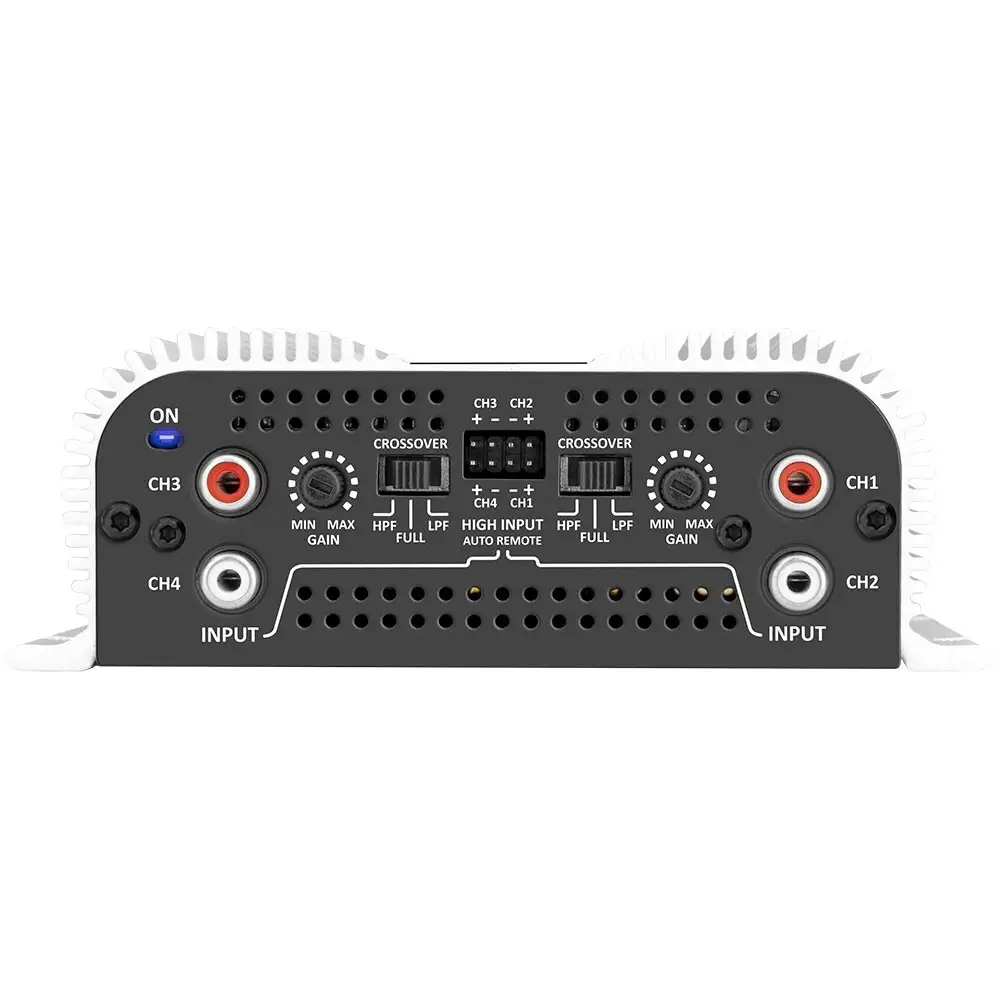
| Inputs | RCA + high-level “wire” input ranges listed (Taramps specs) | Mixed OEM/aftermarket builds | Sensitive gain setup may be finicky without guidance |
Claims vs Reality
One of the loudest claims is ease of installation with factory systems. The TS 800x4 is repeatedly described as built for “factory radios and multimedia” with “high-level… input and automatic activation,” explicitly saying it “eliminat[es] the need for adapters.” This appears in the Taramps product copy mirrored across multiple sources (Taramps, TarampsUSA, reseller listings). The practical implication is clear: for an OEM-upgrade buyer who doesn’t want a line output converter, the TS line is marketed as a direct path.
While that story is consistent, there’s a gap: the dataset doesn’t include actual owner posts confirming “it worked flawlessly with my factory radio” or describing common integration headaches (noise, turn-on pop, grounding quirks). What’s present is the brand promise and wiring guidance from the broader Taramps multi-channel ecosystem. On Amazon’s DS 800x4 page (a different model), the instructions emphasize using “good quality shielded cables to avoid noise interference” and explains the “HIGH LEVEL input… from the speaker output,” suggesting the company expects typical OEM-noise pitfalls. But that’s still documentation, not user-reported proof.
Another claim is flexible system-building: “800 watts of power distributed in 4 channels” plus “possibility of connection in bridge,” usable for “speakers, drivers and super tweeters.” That versatility is plausible given the published specs: 4 x 200W RMS @ 2 ohms, 4 x 136W RMS @ 4 ohms, and bridged 2 x 400W RMS @ 4 ohms. Where reality may diverge is power supply voltage. The specs are explicit: nominal ratings are at 14.4VDC. A Taramps comparison article reinforces this difference: “the TS 800x4 requires a higher supply voltage (14.4v) to reach its maximum performance,” while a DS variant is described as efficient at 12.6V. For daily drivers that sit closer to 12.6–13.8V depending on alternator and load, that detail matters.
Finally, there’s the “sound customization” angle. The TS 800x4 is described as having “gain adjustment and fixed crossover (HPF, LPF and FULL).” The specs lock HPF and LPF at 90Hz (-12dB/8ª) fixed. That’s not “tunable” in the usual sense—more like preset routing. For a simple build, fixed 90Hz filtering can be exactly what a casual upgrader wants. For someone chasing a precise crossover point for midbass vs. sub integration, the fixed nature could feel limiting, even if the marketing wording sounds broader.
Cross-Platform Consensus
Digging deeper into what’s actually repeated across platforms, the “consensus” is more about consistent positioning than crowdsourced experiences. The same core claims show up in reseller descriptions, official pages, and marketplace listings: compact class-D amp, OEM-friendly high-level input, auto activation, and fixed 90Hz crossovers. That repetition itself is a clue: the TS 800x4 is being sold primarily on integration simplicity and footprint.
Universally Praised
A recurring pattern emerged around factory-radio compatibility—because it’s the single most repeated promise. The official description says the TS 800x4 was created because “the demand for amplifiers suitable for factory radios and multimedia is growing every day,” followed by the key line: “4-channel high-level individual input and automatic activation… eliminating the need for adapters.” For OEM-upgrade buyers, that’s an explicit promise that the product is designed around their constraint: keeping the stock head unit.
Compact sizing is the second clear “win” in the dataset, even if it’s expressed through specs rather than owner praise. At 5.43" x 1.89" x 6.89" and 1.91 lb, it’s positioned as small and light compared to bigger multi-channel amps. The Taramps comparison article also leans into this, saying the TS 800x4 is “significantly more compact and lighter,” calling it “ideal for installations in tight spaces.” For hatchbacks, under-seat installs, or hidden mounting behind trim, that’s a major practical advantage.
The third consistent positive is flexibility through bridging. The published technical info states: “2 bridged channels… 800W RMS (2 x 400W RMS) at 4 ohms.” That makes the TS 800x4 easier to repurpose: a user might start with four full-range speakers, then later bridge two channels for a stronger midbass pair or a small sub stage, without buying another amp. Again, the dataset lacks real “I bridged it and…” user stories—but the capability is repeated across sources and listings.
After the narrative signals, the “praised” elements supported by the dataset are:
- OEM-friendly: “high-level… automatic activation… eliminating the need for adapters” (Taramps/TarampsUSA product description)
- Compact install: 5.43" x 1.89" x 6.89", 1.91 lb (Taramps specs)
- Bridge option: 2 x 400W RMS @ 4 ohms bridged (Taramps specs)
Common Complaints
What’s striking is how few actual complaints are captured in the provided data. There aren’t quoted Reddit threads, no Amazon review excerpts, no Trustpilot review text—just duplicated product copy and specs. That means there’s no trustworthy way here to claim “users commonly complain about overheating” or “noise” or “clipping,” because the dataset doesn’t include those user statements.
Still, the specs and documentation point to likely friction points that buyers often encounter—without asserting that they occurred. The TS 800x4 includes fixed crossovers at 90Hz for both HPF and LPF. For system tuners, that design choice can be restrictive. If a buyer expects variable crossover control because a listing says “fixed crossover (HPF, LPF and FULL)” without emphasizing the fixed frequency, they may feel boxed in once they try to tailor the response.
Another potential mismatch is power expectations at real-world voltage. The TS 800x4’s rated power is given “@ 14.4VDC.” The comparison article explicitly contrasts TS’s need for higher voltage vs DS’s operation at “12.6V.” For drivers who idle with headlights, HVAC, and accessories, voltage can sag; the spec language suggests that peak output depends on electrical conditions.
Summarizing the “complaint-shaped” risks supported by the dataset (without inventing owner sentiment):
- Fixed crossover points: HPF/LPF are 90Hz fixed (Taramps specs)
- Full-rated power depends on 14.4V conditions (Taramps specs; Taramps comparison article)
Divisive Features
The high-level input + auto turn-on feature can be divisive depending on how someone builds. For the stock head unit crowd, it’s the entire reason to buy: “ideal for this type of application” and “eliminating the need for adapters.” But for enthusiasts running a clean aftermarket head unit with strong pre-outs, the feature may be irrelevant; they’ll care more about gain structure and noise floor.
Likewise, the fixed 90Hz HPF/LPF can be a blessing or a limitation. For a straightforward four-speaker build, presets reduce tuning complexity—flip to HPF for door speakers, LPF for a bridged woofer pair, or FULL for broad-range speakers. For someone doing a more precise multi-way setup, those same presets can feel like a hard ceiling.
Trust & Reliability
The provided “Trustpilot (Verified)” entry doesn’t contain actual reviews or user-written trust complaints—only the same repeated product description and specs. Because there are no genuine Trustpilot user quotes in the dataset, there’s no evidence here of scam patterns, shipping fraud, or customer-service breakdowns tied to this exact model.
On long-term durability, the dataset similarly lacks “6 months later” Reddit-style follow-ups or failure reports. The only reliability-adjacent material is the stated protection: “protection system output short circuit” and the electrical range “minimum supply voltage 9V… maximum 16VDC,” which describes design intent, not real-world endurance.
Alternatives
The only direct competitor mentioned in the data is the Taramps DS 800x4 line (including the “1 ohm” DS 800x4 listing). A Taramps-hosted comparison article frames the choice as application-driven: TS 800x4 for factory integration and compact installs, DS 800x4 for bigger “three-way setups” and stability at high demand. It states: “the ts 800x4 requires… 14.4v,” while “the ds 800x4 operates efficiently at 12.6v,” suggesting DS may feel more forgiving in typical vehicle voltage conditions.
There’s also a market reality angle: the DS 800x4 appears heavily listed on Amazon and eBay, with a visible Amazon rating context (the DS listing shows 4.5 out of 5 stars). That doesn’t automatically mean it’s “better,” but it does indicate more buyer volume and visibility in mainstream marketplaces compared to the TS listing content provided here.
Price & Value
On price, multiple listings put the TS 800x4 in the $120–$140 zone, depending on retailer and promos. A reseller page shows $125 (down from $140), while eBay listings show TS 800x4 around $124.95–$166 depending on seller, shipping, and region. For a buyer building a budget multi-channel system, that positions it as an affordable path to 800W-class total power.
Resale signals from eBay show continued listing volume and sales (“53 sold” on one TS 800x4 listing; “37 sold” on another), implying the model moves regularly. That can matter for buyers who upgrade often: liquid listings generally make it easier to resell, though the dataset doesn’t provide used-market depreciation curves.
Buying tips supported by marketplace data:
- Cross-check that you’re buying TS 800x4 “2 ohms” (not DS 800x4 “1 ohm”) because listings and naming are easy to mix.
- Budget for electrical and wiring consistent with the documentation style used across Taramps amps (battery wiring gauge and good shielding are emphasized on the DS listing documentation).
FAQ
Q: Is the Taramps TS 800x4 really 800W RMS?
A: Yes—official specs state “2 ohms: 800W RMS (4 x 200W RMS) @ 14.4VDC.” It also lists 544W RMS at 4 ohms (4 x 136W) and 800W RMS bridged (2 x 400W at 4 ohms). Actual output depends on vehicle voltage.
Q: Can it connect to a factory radio without a line output converter?
A: The product description repeatedly claims yes, citing “4-channel high-level individual input and automatic activation… eliminating the need for adapters.” That’s the core positioning across Taramps and reseller pages, intended for OEM head units and multimedia systems.
Q: Are the crossovers adjustable?
A: Not in frequency. The published specs list fixed crossovers: HPF 90Hz and LPF 90Hz at -12dB. You can select HPF/LPF/FULL modes, but you can’t dial in custom cutoff points from the data provided.
Q: What impedance is it designed for?
A: The TS 800x4 is the 2-ohm version per the official spec sheet and listings. It publishes power ratings at 2 ohms and 4 ohms, and bridged operation at 4 ohms. Confirm your speaker wiring matches the rated loads before bridging.
Final Verdict
Buy if you’re a factory-head-unit upgrader who wants high-level inputs with automatic turn-on, a compact class-D amp, and straightforward 4-channel power with the option to bridge later.
Avoid if you need fully adjustable crossovers or if your build depends on hitting rated power without the electrical headroom implied by the 14.4V spec conditions.
Pro tip from the community-facing documentation: the DS-series Amazon listing emphasizes using “good quality shielded cables to avoid noise interference,” a practical hint that also applies when you’re routing RCA or signal wiring in tight OEM-style installs.