Taramps TS 800x4 Review: Compact Power, Mixed Clarity 7.8/10
“Amp is small but does punch a nice loud highs,” one Amazon reviewer wrote—then another cut straight through the hype: “It’s loud just loud… no clarity… keeps cutting off on me.” That tension defines the Taramps TS 800x4 Car Audio Amplifier: big output from a tiny chassis, but not everyone agrees on refinement. Verdict: Conditional buy — 7.8/10.
Quick Verdict
The Taramps TS 800x4 Car Audio Amplifier is a strong yes for people chasing compact power for mids/highs (and tight installs), but conditional if you’re picky about filtering behavior and clarity at aggressive gain settings.
| Decision | Best for | Evidence from users | Watch-outs |
|---|---|---|---|
| Yes | Tight-space installs | “Great item & quality. fits in small areas.” (Amazon customer review) | Fixed crossover constraints |
| Yes | Loud mids/highs setups | “tiny but loud” (Amazon customer review) | Some report “no clarity” |
| Conditional | Factory radio integrations | Official messaging emphasizes high-level input + auto activation (Taramps product pages) | User data here doesn’t include install troubleshooting stories |
| Conditional | Bikes/powersports | “Installed on my bike.” (Amazon customer review) | Heat/limits depend on tuning and mounting |
| No (if picky) | Audiophile clarity-first builds | “it’s just loud no clarity” (Amazon customer review) | Reports of cutting off when adjusting gains |
Claims vs Reality
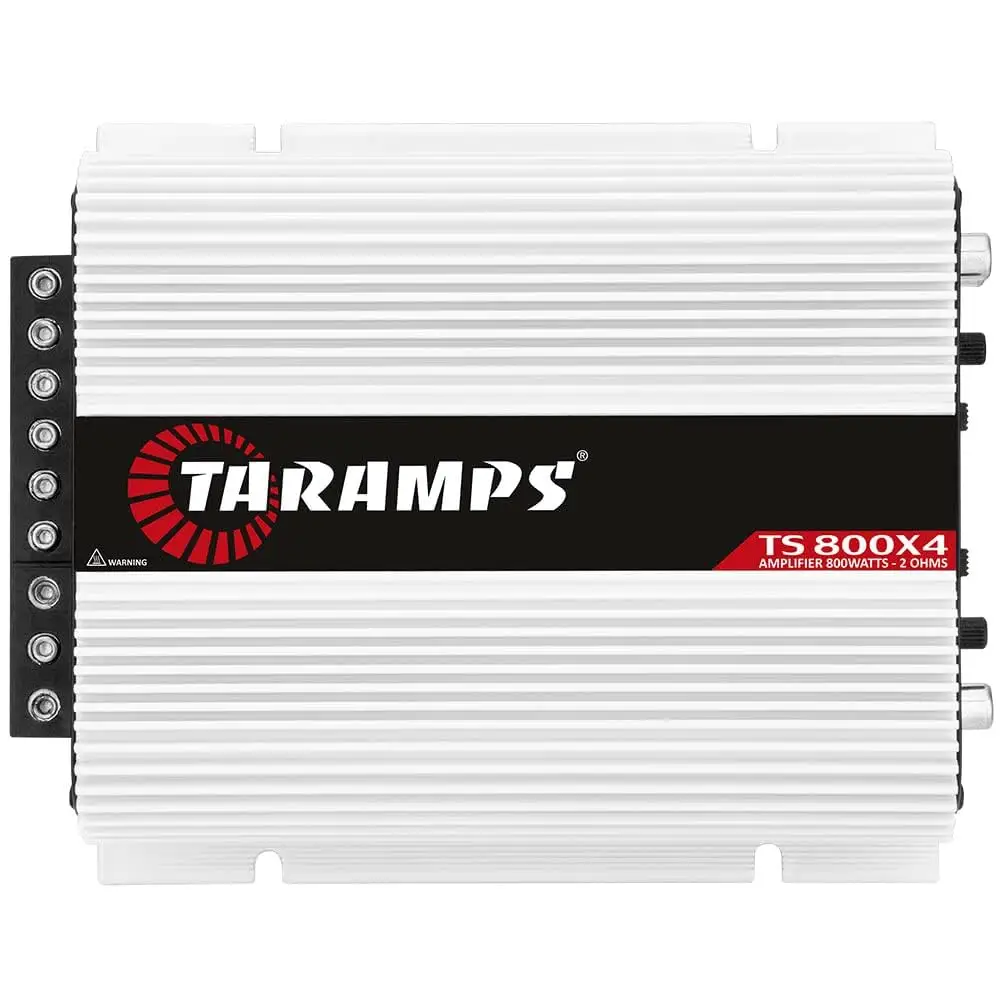
One core marketing claim is that the Taramps TS 800x4 Car Audio Amplifier is built for easy integration—especially “suitable for factory radios and multimedia” with “4-channel high-level individual input and automatic activation,” meant to “eliminate the need for adapters” (Taramps product description mirrored across listed sources). Digging deeper into the provided user reviews, the feedback that surfaces isn’t about wiring headaches or adapter drama; instead, it’s mostly about what happens after it’s installed: loudness, footprint, and sound character.
Another prominent claim is raw output: “800w rms (4 x 200w rms) at 2 ohms,” plus bridge options (Taramps product listings/spec tables). In the Amazon review set, multiple buyers echo that power-per-size story in plain language. One reviewer summed up the appeal: “small amp that packs a punch!… pushing my rockford speakers with no problem. very clear and no noise.” Another kept it even shorter: “tiny but loud.” For buyers building a budget-friendly multi-channel setup, those comments read like confirmation that the “800 watts” headline is at least emotionally believable in real-world listening.
But the biggest gap appears around control and filtering. Official specs repeatedly mention fixed crossovers (HPF/LPF at 90 Hz) and “full range crossover” language depending on listing (Amazon product page text and Taramps pages). One dissatisfied Amazon reviewer described a specific mismatch with expectations: “i hate the way hpf still gets bass through it ruins my setup.” The same person also reported instability during tuning: “keeps cutting off on me when adjusting gains.” While the marketing emphasizes convenience and broad compatibility, at least one user story suggests that crossover behavior and gain adjustment can be the difference between “loud” and “livable.”
Cross-Platform Consensus
Universally Praised
The most consistent theme in the available user feedback is the compact footprint of the Taramps TS 800x4 Car Audio Amplifier—not as a spec-sheet brag, but as a practical installation win. A recurring pattern emerged in Amazon reviews: people love fitting meaningful output into small spaces. One Amazon customer review said: “Great item & quality. fits in small areas.” Another framed it almost comically: “my speaker is bigger than the amplifier.” For builders working with tight trunks, under-seat mounting, or custom panels, that size advantage isn’t cosmetic—it can determine whether the upgrade happens at all.
Power density is the other repeated applause line. Amazon reviewers repeatedly describe the amp as surprisingly forceful for its dimensions. One wrote: “this little amp got all the power you need for midrange speaker trust me.” Another praised the outcome more than the engineering: “my car speakers are alive again!! will buy again!!” That kind of feedback tends to come from users upgrading older systems or reviving factory speakers with aftermarket amplification—where the immediate jump in volume and punch feels dramatic.
Clarity also shows up in positive reports—though not universally. One Amazon reviewer described performance in clean, system-level terms: “very clear and no noise.” Another called it “crystal clear sound and great amp size . internal fan to keep it cool . installed on my bike.” For motorcycle and powersports users, the implied benefit is straightforward: a small footprint plus audible output in a loud environment. When a rider says it’s “crystal clear,” they’re effectively saying it cuts through wind and road noise without turning into hash.
After these repeated themes, the simplest consensus statement from user stories is: small, loud, and often satisfying—especially for mids and highs. “tiny but loud,” one Amazon customer wrote, and that line pops up as the clearest shorthand for the upside.
- Most repeated praise: compact size (“fits in small areas,” “my speaker is bigger than the amplifier”) from Amazon customer reviews.
- Frequent satisfaction theme: strong output for mids/highs (“power you need for midrange speaker,” “tiny but loud”) from Amazon customer reviews.
- Some users report clean results: “very clear and no noise” and “crystal clear sound” (Amazon customer reviews).
Common Complaints
The most pointed negative feedback centers on sound quality and control—particularly for users who aren’t just chasing volume. Digging deeper into the critical Amazon review, the complaint isn’t vague disappointment; it’s specific and system-damaging in the reviewer’s eyes: “it ’s loud just loud… no clarity.” For someone building a balanced system—especially where vocals and upper mids need precision—“just loud” reads like a warning that the amp can deliver SPL without delivering definition.
Protection behavior or instability during tuning is another recurring pain point—at least in that same detailed critique. The Amazon reviewer reported: “keeps cutting off on me when adjusting gains.” For installers and DIY tuners, that kind of “cutting off” story matters because it suggests the margin for error may feel thin during setup. Even if the cause is system-specific (power wiring, impedance, gain staging), the user experience is still: frustration when trying to dial it in.
The third complaint is crossover behavior—especially if buyers expect a high-pass filter to cleanly remove bass from midrange speakers. The same Amazon reviewer wrote: “i hate the way hpf still gets bass through it ruins my setup.” The official information repeatedly lists fixed HPF/LPF points at 90 Hz (Taramps spec pages and Amazon listing text), and fixed filters can be limiting. If a user’s speakers or enclosure need a different cutoff, a fixed HPF may not align with the build’s needs—leading to exactly the “still gets bass through it” frustration described.
- Reported drawback for clarity-focused listeners: “it’s just loud no clarity” (Amazon customer review).
- Reported setup/tuning frustration: “keeps cutting off on me when adjusting gains” (Amazon customer review).
- Reported crossover dissatisfaction: “hpf still gets bass through it” (Amazon customer review).
Divisive Features
Sound character is clearly divisive. On one side, an Amazon customer wrote: “very clear and no noise,” and another praised “crystal clear sound.” On the other side, a different Amazon reviewer insisted: “no clarity.” That contradiction suggests outcomes may depend heavily on system context—speaker choice, impedance wiring, gain staging, and expectations. For a casual upgrader, “clear enough and loud” might be a win; for an SQ-focused listener, even minor harshness or bass bleed can feel like a deal-breaker.
Crossover design is similarly polarizing because it’s fixed. Official specs cite fixed HPF/LPF at 90 Hz (Taramps product pages). For some users, that simplicity is a benefit—fewer knobs, fewer mistakes, quick installs. For others, it’s exactly the constraint that “ruins my setup,” as one Amazon reviewer put it, if their mids need a higher cutoff or if they want steeper/adjustable filtering.
Trust & Reliability
Trust signals in the provided data are strongest on Amazon via aggregate ratings and buyer language. The listing shows a high overall star rating for the product category pages, and the review breakdown cited for the TS 800x4 shows “4.4 out of 5” with a majority of 5-star ratings (Amazon customer reviews page excerpt). That doesn’t guarantee longevity, but it does suggest many buyers feel they got what they expected—often framed as compact power and noticeable volume gains.
At the same time, the user-provided dataset doesn’t include the kind of long-horizon “6 months later…” Reddit threads or durability diaries that would typically anchor reliability conclusions. What does exist are immediate-use stories like “installed on my bike,” plus comments about an internal fan and staying cool (Amazon customer review: “internal fan to keep it cool”). The most reliability-relevant negative story is functional: “keeps cutting off on me when adjusting gains.” That may be protection behavior or system mismatch, but it’s still a real-world reliability concern from at least one buyer’s perspective.
Alternatives
The only direct alternative repeatedly present in the provided data is the Taramps DS 800x4 (Amazon specs for DS 800x4 1 ohm, plus the Taramps help-center comparison article). The manufacturer-hosted comparison claims both are “800W RMS” 4-channel amps, but positions them differently: the TS model as more compact and oriented toward factory integration, and the DS model as larger and potentially more tolerant in systems with less ideal voltage (the comparison notes TS reaching rated power at 14.4V vs DS at 12.6V, and differing dimensions/weight).
That framing lines up with how the TS is talked about by buyers: small, punchy, easy to tuck away. If you’re a tight-install user (small vehicle, bike, or hidden-mount build), the TS’s small size is repeatedly validated by Amazon reviewers: “fits in small areas,” “my speaker is bigger than the amplifier.” If you’re building something more demanding, the alternative narrative in the manufacturer comparison leans toward DS for heavier, sustained projects—though this dataset doesn’t include DS user reviews to confirm that from community experience.
Price & Value
Price signals vary by platform, but the story is consistent: the Taramps TS 800x4 Car Audio Amplifier sits in an affordable band for a compact 4-channel Class D. The provided pricing snippets show it commonly listed around $119.99–$134.00 on Taramps retail pages, while eBay listings show a range (examples include $120.64, $125.00, $166.00 depending on seller and bundle). For budget-minded upgraders, that price-to-output appeal is exactly what Amazon reviewers describe when they talk about “small amp that packs a punch” and being “blown away.”
Resale and market liquidity also look active in the eBay data: multiple listings, “53 sold” on one TS 800x4 listing, and many related Taramps multi-channel models circulating. That kind of marketplace activity can matter for experimenters—buyers who might try the amp, then resell if it doesn’t match their tuning preferences.
Buying tips implied by user stories are less about coupons and more about fit-for-purpose. If your goal is loud mids/highs in a small footprint, the repeated Amazon praise suggests good value. If you’re sensitive to clarity and need flexible filtering, the one detailed negative review suggests you should be cautious—because “just loud” isn’t a bargain if it “ruins my setup.”
FAQ
Q: Is the Taramps TS 800x4 actually loud for its size?
A: Yes—multiple Amazon reviewers emphasize surprising output from a compact chassis, calling it “tiny but loud” and saying it “packs a punch.” For small cars or hidden installs, that size-to-volume ratio is a major reason people buy it.
Q: Does it sound clear, or is it only about volume?
A: It depends. Some Amazon buyers praised “crystal clear sound” and “very clear and no noise,” while another said “it’s just loud no clarity.” The feedback suggests system setup and expectations strongly affect whether it feels clean or merely loud.
Q: Does the high-pass filter (HPF) fully block bass for mids?
A: Not for everyone. One Amazon reviewer complained that the “hpf still gets bass through it,” saying it “ruins my setup.” Official specs in the provided data list fixed crossovers at 90 Hz, which may not match every speaker’s needs.
Q: Is it a good choice for a motorcycle or powersports install?
A: Some buyers think so. An Amazon reviewer said it was “installed on my bike,” praising “crystal clear sound” and noting an “internal fan to keep it cool.” The compact size is repeatedly highlighted as a practical advantage for tight mounting.
Q: Are there signs of reliability issues like shutting off?
A: There’s at least one negative report: an Amazon reviewer said it “keeps cutting off on me when adjusting gains.” Other reviewers reported “all good” and “great amp,” so the issue isn’t universal in the provided feedback—but it’s a real complaint to weigh.
Final Verdict
Buy the Taramps TS 800x4 Car Audio Amplifier if you’re a space-constrained builder who wants a compact 4-channel amp that users describe as “tiny but loud,” especially for midrange speakers and straightforward installs.
Avoid it if your system depends on precise filtering and you’re chasing clarity-first sound—because one dissatisfied Amazon buyer warned it’s “just loud no clarity,” and complained the HPF “still gets bass through it.”
Pro tip from the community: prioritize fit and realistic goals—several buyers celebrate that “my speaker is bigger than the amplifier,” but the most frustrated user story came from pushing tuning expectations (“keeps cutting off on me when adjusting gains”).