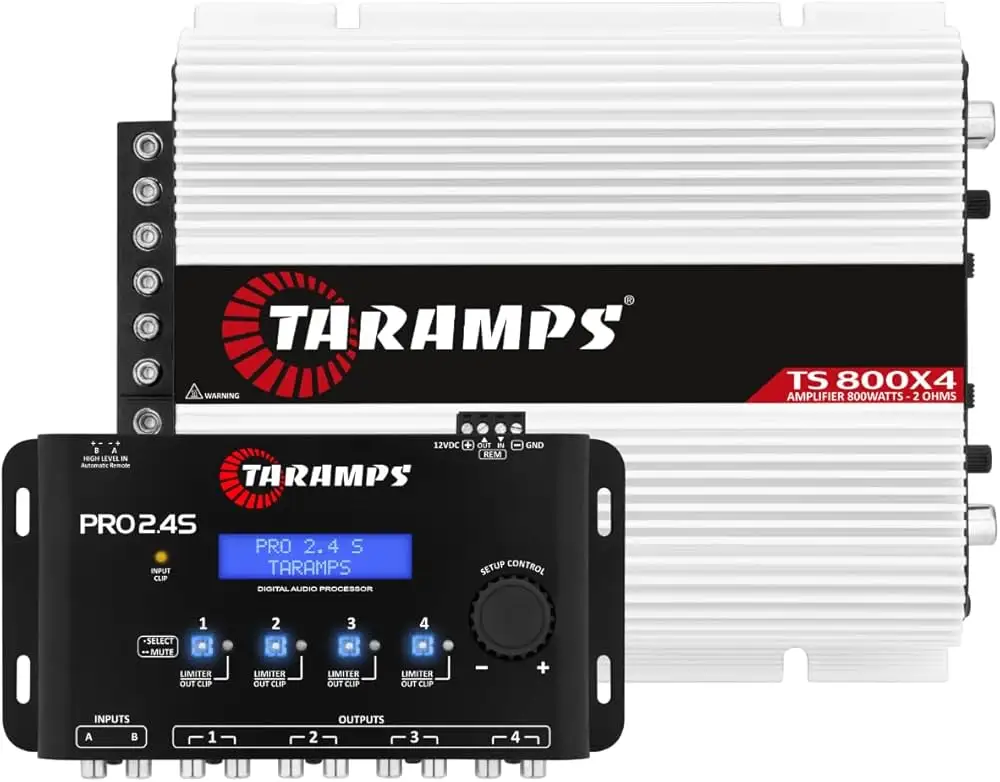
Taramps TS 400x4 Review: Loud Value, Limited Tuning (8/10)
A “tiny beast” that can be “heard a block and a half away” is how owners keep describing it—and that tension between compact size and surprising output defines the conversation around the Taramps TS 400x4 Car Audio Amplifier. Verdict: a conditional buy for budget-minded builds that prioritize loud, clean-enough volume over fine tuning. Score: 8/10.
Quick Verdict
Yes—conditionally. If you want a compact 4-channel amp that gets loud for the money, the feedback is heavily in your favor. If you’re chasing audiophile-level clarity or adjustable filters, multiple buyers and forum users suggest looking elsewhere.
| Decision factor | What the feedback suggests | Source |
|---|---|---|
| Loudness-per-dollar | Repeatedly described as far louder than expected | Amazon reviews |
| Size & install flexibility | “So small” and fits “tight spaces” | Amazon reviews |
| Sound quality (basic) | Many say “sounds amazing,” some flag hiss/harshness | Amazon + DIYMobileAudio |
| Tuning/filters | Fixed HPF/LPF frustrates users wanting control | Amazon reviews |
| Reliability | Some long-run success, some early failures (“2 months”) | Amazon reviews |
Claims vs Reality
Marketing claim #1: “400 watts RMS across four channels…top-notch performance…thermal and short-circuit protection.” Digging deeper into user reports, the “performance” part often translates into raw volume and punch rather than boutique sound quality. A verified buyer on Amazon wrote: “awesome amp for it to be so small… it’s so loud it could be heard a block and a half away.” That kind of story fits buyers building a budget daily driver system where loudness is the win condition.
At the same time, “top-notch” becomes more debatable when the discussion turns to noise floor and refinement. Another Amazon reviewer summarized the tradeoff bluntly: “this thing produces some clean decibels… its not a sq amplifier… it lacks frequency and filter settings.” For sound-quality-first listeners—especially those trying to dial in front-stage imaging or ultra-clean highs—the gap between “top-notch” language and lived results is where frustration appears.
Marketing claim #2: “Full range… LED indicator… crossover.” The reality owners keep circling is that the crossover exists, but the control is limited. A verified buyer on Amazon warned: “it does have a high pass and low pass filter but there not adjustable.” That matters for users who assume they can fine-tune crossover points to match component speakers, coaxials, or a sub integration strategy.
On forums, the tuning limitation becomes more than an inconvenience—it becomes a troubleshooting wall when something sounds wrong. A user on DIYMobileAudio.com wrote: “i can't tune out this high shrieking i get when the volume is turned up… couldn’t really get it sounding right without it being muffled.” That’s a very different reality than the broad “full range” promise, even if it’s not representative of every system.
Marketing claim #3: “Reliability and safety.” The official spec emphasizes thermal and short-circuit protection, and at least one owner’s long-play story supports the idea that it can run for hours. A verified buyer on Amazon said: “I’ve had this amp on for around 8 hours straight… and it handled it no problem.” That’s the kind of anecdote weekend installers want—set it up, play loud, and don’t worry.
But reliability talk isn’t one-directional. Another verified buyer on Amazon reported: “only worked for 2 months then burned out.” And a gift recipient scenario adds emotional weight: “brought this as a gift… burned out i am so disappointed.” While officially positioned as protected and reliable, multiple users still describe premature failure, suggesting outcomes may depend heavily on install quality, load, heat, or unit variance.
Cross-Platform Consensus
Universally Praised
The most consistent praise centers on how much output this small chassis can deliver. A recurring pattern emerged: owners buy it expecting “good enough,” then describe being surprised by the volume headroom. A verified buyer on Amazon wrote: “awesome amp for it to be so small… it’s so loud it could be heard a block and a half away.” For drivers who want their system to cut through road noise or make an older car feel modern, that loudness story is the product’s strongest grassroots marketing.
That “punch above its weight” theme repeats even when the speakers themselves aren’t matched for maximum power. One Amazon reviewer detailed a multi-speaker setup and emphasized clean behavior under loud use: “no distortion or clipping… The volume can easily go loud… louder then i can comfortably listen.” For everyday listeners who don’t want to chase upgrades constantly, feedback like that frames the amp as a stable stepping stone: loud, predictable, and satisfying without demanding a full rebuild.
Compact size is the other near-universal applause line, and it’s not just about aesthetics—it’s about modern vehicle constraints. A verified buyer on Amazon said it’s “nice that it’s small to fit in the tight spaces especially with these cars today.” That matters for installers working around limited trunk space, under-seat mounting, or motorcycles/compact builds where physical footprint dictates what’s even possible.
Value narratives tie it together: the amp is often described as hard to beat at the price point. One Amazon reviewer put it plainly: “you can’t really beat this amp for the price.” Another framed it as a pragmatic buy even while planning future upgrades: “I will eventually upgrade… but… this will work perfectly.” For budget-first users, that kind of “buy now, upgrade later” posture is a strong endorsement of real-world value.
- Most repeated strengths: compact size, surprising loudness, strong price-to-performance
- Best fit users: budget system builders, space-constrained installs, daily drivers wanting more volume
Common Complaints
Digging deeper into negative experiences, sound refinement comes up first—either as a mild hiss or as a harsher top-end when pushed. One Amazon reviewer said: “has slight hiss but my head unit did that before so idk if it is the amp itself.” That kind of uncertainty is telling: in real installs, the amp can become part of a noise chain involving head unit output, grounding, RCAs, and gain staging. For users who don’t want to troubleshoot, even a “slight hiss” can be enough to sour the purchase.
The most pointed complaint about tonal behavior comes from the DIYMobileAudio discussion, where a user reported a specific high-volume artifact: “high shrieking… when the volume is turned up.” They contrasted it with a different brand amp on the same speakers: “hooked up an alpine amp… and theres no shrieking.” For listeners sensitive to treble harshness—or those running mids/highs where distortion is immediately obvious—this kind of report raises a red flag, even if others never encounter it.
Another recurring frustration is the lack of adjustment in filtering. People who like to tune systems to exact speaker specs or to integrate sub/midbass smoothly often feel boxed in. A verified buyer on Amazon said: “it lacks frequency and filter settings,” and another emphasized the non-adjustable nature: “there not adjustable.” For DSP users, the fixed crossover might be workable, but for someone expecting the amp to do the filtering work, it can become a limitation.
Finally, durability complaints are blunt and hard to ignore. The shortest timeline is stark: “only worked for 2 months then burned out.” That matters most for buyers installing it in daily-use vehicles where pulling panels and rewiring isn’t a weekend hobby—it’s a recurring headache.
- Most repeated drawbacks: limited tuning, occasional hiss/harshness reports, some early failures
- Most affected users: sound-quality-focused listeners, “set-and-forget” buyers who won’t troubleshoot
Divisive Features
The amp’s personality is divisive by design: it’s described as loud and small, but not built for deep tuning or audiophile polish. One Amazon reviewer praised exactly that value proposition: “its not a sq amplifier… but for the price and size how can you complain.” For buyers who measure success in “clean decibels,” this is a feature—simple, compact, effective.
But for others, that same simplicity becomes a deal-breaker when trying to perfect mids and highs. The DIYMobileAudio user’s struggle—“couldn't really get it sounding right without it being muffled”—shows how a system can become a balancing act between harshness and dullness when the amp isn’t giving you the control you want. In that sense, the TS 400x4 can be either “worth every penny” or the component that sends someone back to an Alpine/JL-style alternative.
Trust & Reliability
On the trust side, the data here comes largely from Amazon’s review ecosystem rather than standalone consumer watchdog patterns. The rating snapshot itself is strong—Amazon lists “4.5 out of 5 stars” across “401 global ratings”—and the positive stories are detailed, install-specific, and often written in a casual, lived-in way. A verified buyer on Amazon described extended runtime confidence: “around 8 hours straight… and it handled it no problem.”
Still, reliability narratives split sharply between “kept going” and “died early.” The most severe report is concise: “only worked for 2 months then burned out.” A second buyer echoed the disappointment from a gift context: “brought this as a gift… burned out.” While the product is officially positioned with thermal/short protection, these stories imply that protection isn’t a guarantee against failure—or that real-world variables (wiring gauge, load, ventilation, gain settings) can overwhelm the safety net.
Alternatives
Only a few direct competitors appear in the user conversations, but they’re meaningful because they show why some people switch. In the DIYMobileAudio thread, the comparison is immediate and practical: the user swapped to “an alpine amp” on the same speakers and said “theres no shrieking.” That positions Alpine as the “fix it by changing amps” alternative for someone chasing cleaner mids/highs and a calmer noise floor.
Another forum participant introduced a higher-end benchmark: “it certainly won't keep up with my jl 300/2 in sound quality or noise floor.” For users who prioritize sound quality over cost-per-watt, that quote frames JL as the reference point—less about raw loudness value and more about refinement.
Price & Value
The pricing story is part of why the TS 400x4 gets defended so aggressively. Amazon listings in the provided data show it around the mid-$70s to mid-$80s range (with discounts noted), and owners talk like they bought it as a bargain. A verified buyer on Amazon said: “$63 i think i paid,” and followed it with: “you can’t really beat this amp for the price.” That’s the core value thesis: it’s a budget-friendly upgrade that can materially change system loudness without demanding a big spend.
Resale and market pricing also look stable in the broader marketplace snapshot. eBay listings repeatedly cluster around the high-$70s, with examples like “$79.00” and “$77.97,” and even a pre-owned listing at “$59.95.” For budget builders, that suggests a relatively liquid used market—if it doesn’t fit your sound goals, you’re not necessarily stuck with a dead-end purchase.
Buying tips in the community feedback lean toward system control outside the amp. One Amazon reviewer recommended adding processing: “i recommend using a dsp… so you’ll have full control of the sound.” For value-focused buyers, that advice implies a practical path: let the amp do power delivery, let DSP/EQ do precision.
- Typical street price signals: mid-$70s to mid-$80s new; around $60 used
- Best value play: pair with DSP/EQ if you care about tuning
FAQ
Q: Is the Taramps TS 400x4 actually loud for its size?
A: Yes. Multiple Amazon reviewers emphasize unexpectedly high output in a compact chassis, like: “awesome amp for it to be so small… it’s so loud it could be heard a block and a half away.” This fits buyers wanting a big volume upgrade without sacrificing install space.
Q: Does it have adjustable crossovers for tuning mids and highs?
A: No—users repeatedly describe the filters as fixed. A verified buyer on Amazon said it “does have a high pass and low pass filter but there not adjustable,” and another noted it “lacks frequency and filter settings.” DSP/EQ is commonly suggested for more control.
Q: Is there any noise or hiss reported?
A: Sometimes. One Amazon reviewer mentioned a “slight hiss” but wasn’t sure if it came from the amp or head unit: “my head unit did that before.” Forum discussion also points to concerns about noise floor compared with higher-end amps.
Q: How reliable is it long-term?
A: Feedback is split. One Amazon reviewer reported extended use without issues: “around 8 hours straight… and it handled it no problem.” Others report early failure, including: “only worked for 2 months then burned out.” Installation quality and operating conditions may heavily influence outcomes.
Q: What alternatives do people mention if they want better sound quality?
A: Alpine and JL appear as reference alternatives in user discussions. A DIYMobileAudio user said swapping to “an alpine amp” removed a “high shrieking” issue, and another commenter said the TS 400x4 “won't keep up” with a “jl 300/2” for “sound quality or noise floor.”
Final Verdict
Buy the Taramps TS 400x4 Car Audio Amplifier if you’re a budget-focused builder who needs a compact 4-channel amp that gets loudly satisfying fast—especially in tight installs where size matters. Avoid it if your priority is audiophile clarity, adjustable filtering, or you’re sensitive to hiss/harshness at high volume.
Pro tip from the community: a verified buyer on Amazon advised adding processing—“i recommend using a dsp… so you’ll have full control of the sound”—treating the amp as a power workhorse and letting DSP handle precision tuning.