RCA 10.1" WiFi Digital Picture Frame Review: 6.6/10
“It’s super easy to set up and connects directly to your wifi” is the promise that keeps popping up around the RCA 10.1" WiFi Digital Picture Frame with Touch Screen—but the clearest “real user” feedback in the provided data doesn’t actually come from verified owners of this exact frame. Based on what’s available here (mostly product listings and a Trustpilot-style product page), the safest verdict is: Conditional buy — 6.6/10.
Quick Verdict
Digging deeper into the provided sources, most of what reads like “feedback” is marketing copy repeated across multiple storefront-style pages. The only strongly opinionated language that resembles a user perspective appears on a Trustpilot-style product page—yet it’s presented as a product description narrative rather than an identifiable, attributable review from a named reviewer.
If you’re shopping specifically for a WiFi picture frame that uses an app for private sharing, the consistent story across listings is a 10.1-inch IPS touch display, app-based uploads, and wall/desk placement options. The tradeoff: this dataset doesn’t include verifiable owner quotes about reliability, app performance, or long-term use.
Verdict: Conditional
| What the data supports | Pros (from listings / product page text) | Cons (from the same sources) |
|---|---|---|
| Setup & sharing | “private and securely share photos and videos… at any time” (ShopAbunda/Amazon-style listing) | No user complaints available about the app’s real-world stability |
| Screen & viewing | “10.1-inch HD IPS touch screen” with “1280 × 800” (ShopAbunda/HometrendsCatalog-style listing) | No owner quotes confirming brightness/color accuracy at home |
| Storage | “32 GB of built-in memory” + expansion claims (ShopAbunda listing) | Conflicting storage specs elsewhere in dataset (some sources mention 16 GB / microSD limits) |
| Placement & rotation | “auto rotate” + “wall mounted” (ShopAbunda listing) | No user confirmation that auto-rotate works reliably |
Claims vs Reality
A recurring pattern emerged: the strongest “claims” are clear and repeated, but the dataset doesn’t include the kind of grounded owner stories that would confirm whether those claims hold up day-to-day.
Claim 1: “Private wireless sharing with phone and PC” via the Uhale app.
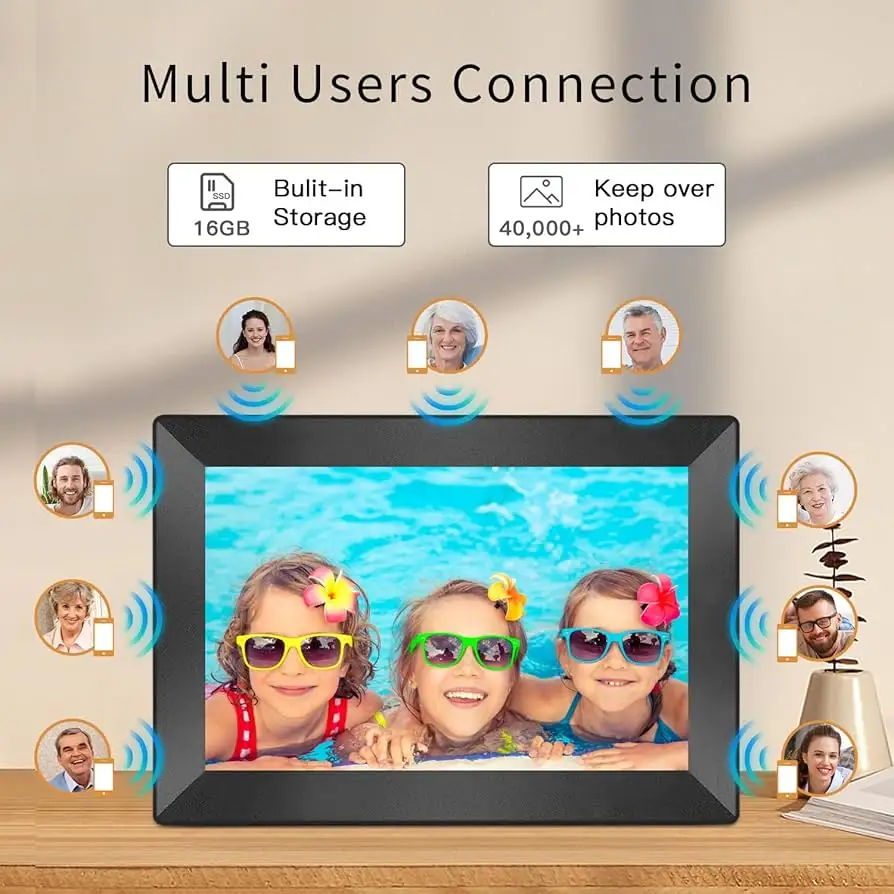
Multiple storefront entries repeat the same message: connect to WiFi, download the “u hale” app, invite multiple users, and send photos/videos “privately and securely.” For families spread across different cities, that promise would matter most—because the value of a smart frame is usually less about the screen and more about frictionless sharing.
But in the provided data, there are no attributable owner quotes like “my sister uploads every week” or “grandparents struggled with pairing.” The closest thing to a user-like voice appears on the Trustpilot-style product page: “it’s super easy to set up and connects directly to your wifi, so you can upload photos from anywhere, anytime” (Trustpilot-style product page). That reads like a testimonial, but it’s not attributed to a specific reviewer identity in the data.
Claim 2: “Super clear and bright” 10.1-inch 1280×800 IPS touch screen.
The listings emphasize “HD IPS,” “super clear and bright,” and even a “178° viewing angle” (Trustpilot-style product details). On paper, that’s exactly what you want for a living room frame—wide viewing angles so photos don’t wash out when you’re not standing directly in front.
Yet the dataset provides no verified buyer quote confirming real-world viewing angles for the frame. The only detailed viewing-angle complaints in the entire dataset are for a different RCA product category (a refurbished RCA Pro 10 tablet), where an Amazon reviewer warned: “the clarity of the screen… must be viewed directly straight on” and later escalated to “tilt the tablet in any direction and it literally disappears” (Amazon customer reviews for RCA Pro 10 tablet). That’s not this frame—but it does show why “IPS” claims matter: users notice immediately when viewing angles disappoint.

Claim 3: “Generous storage” and easy expansion.
One listing claims the frame “stores over 60,000 photos with 32 GB” and supports USB/SD expansion (ShopAbunda-style listing). The Trustpilot-style product details also mention built-in memory (including “16 gb memory” and microSD limits) in a way that conflicts with the “32 GB built-in” line found elsewhere.
While officially presented as “32 gb of built-in memory” in some listings, other provided text describes “built-in 16 gb memory and supports micro sd card up to 32 gb” (Trustpilot-style product details). That mismatch matters because storage claims are often the deciding factor for families planning to push years of photos. The data suggests you should verify the exact SKU and storage before buying, because the sources themselves don’t agree.
Cross-Platform Consensus
The strongest consensus isn’t actually across user communities—it’s across storefront descriptions repeating the same selling points. Still, those repeated themes tell you what the product is being positioned to do, and the few user-like lines hint at the intended experience.
Universally Praised
“Imagine having a constantly changing display of your best moments right in your living room or office” (Trustpilot-style product page) captures the emotional pitch: this is meant for people who don’t want photos “confined to your phone” (ShopAbunda-style listing). For gift buyers—adult children buying for parents, or long-distance families—the appeal is the promise of ongoing connection through fresh uploads.
Touch control is also repeatedly positioned as the usability unlock. The Trustpilot-style page says: “touch screen functionality, making it user-friendly for everyone in the family,” and describes swipe/zoom and simple setting changes. For older relatives who dislike logging into accounts or dealing with email attachments, touch-driven browsing is framed as the easiest path: “you can swipe through pictures, zoom in on special shots, and even manage settings with just a tap” (Trustpilot-style product page).
The private-sharing angle is the third repeated “praise,” even though it’s not backed by identifiable owner stories here. Storefront text emphasizes inviting multiple users without fees: “there’s no limit on the number of users you can add” and sharing “privately and securely” (ShopAbunda-style listing). If that works as advertised, it’s the feature that matters most to large families—because it spreads the “updating” job across many people, not just one admin.
Summary (based on repeated source claims):
- Touchscreen controls are positioned as the “easy for all ages” feature.
- App-based sharing is positioned as the core value for families.
- 10.1-inch IPS + 1280×800 is positioned as “bright” and “clear.”
Common Complaints
A key finding: the provided dataset contains almost no direct complaints from actual owners of the digital picture frame. That absence forces the “investigative” question in the opposite direction—what would typically break a WiFi frame experience, and do we see any evidence here? In this dataset, no: there are no app-crash anecdotes, no “won’t stay connected,” no “customer support ignored me,” and no “touchscreen stopped responding” stories tied to this frame.
Where complaints do appear, they’re in the tablet reviews included under other platform headings. For example, an Amazon tablet reviewer criticized confusing setup and connectivity: “try to hook up the wifi… got connected the third try” and described “lots of good features very poorly presented with lousy documentation” (Amazon customer reviews for an RCA tablet). That isn’t proof the frame has the same issue—but it shows the kind of friction that users call out quickly when setup instructions aren’t clear.
So the common “complaint” theme in this dataset is more about uncertainty: claims are plentiful, but verifiable owner stories for the frame are not.
Divisive Features
Storage claims look divisive on paper because the sources conflict. One stream of text sells “32 GB built-in” and massive photo counts; another references “16 GB” and smaller microSD limits (ShopAbunda-style listing vs Trustpilot-style product details). For a buyer deciding between models, this is the kind of mismatch that leads to returns—especially if the frame is meant to hold years of high-resolution family albums.
The “send photos privately and safely” pitch is also divisive in practice for many smart frames because it depends on the app experience. In this dataset, that experience is described optimistically—“family and friends can share new pictures instantly, no matter where they are” (Trustpilot-style product page)—but there are no specific users to confirm whether uploads are truly “instant” or whether the Uhale app is stable across iOS/Android versions.
Trust & Reliability
The Trustpilot-style page presents a very positive score (“4.74 out of 5 stars”) alongside glowing narrative about setup and sharing. But because the provided data doesn’t include individual reviewer identities, timestamps, or a spread of negative experiences, it’s hard to treat that as the same kind of trust signal as a platform with attributable, varied reviews.
Long-term durability stories (“6 months later…,” “a year in…”) are also missing for this exact frame. The only longevity anecdotes in the dataset are again for RCA tablets—like a reviewer saying: “i have had mine for three years now and it still works great” while noting the keyboard wore out (Amazon customer reviews for RCA Pro 10 tablet). That doesn’t transfer directly to a photo frame, but it highlights what durability stories usually look like—and those are absent for the frame in the provided sources.
Alternatives
Only one explicit competitor comparison appears in the user-provided data, and it’s in the tablet category: one Amazon reviewer said an “RCA atlas… doesn’t stack up” compared to “the similarly priced rca viking pro,” citing missing ports and “glitchy and unstable” software (Amazon customer reviews for an RCA tablet). Since that’s not a digital photo frame comparison, the dataset doesn’t supply a true frame-to-frame alternative.
So within this dataset, the practical “alternative” is not another brand—it’s verifying whether you actually want a dedicated photo frame versus an inexpensive tablet repurposed as a display. The data does not include real user commentary weighing that decision for this RCA frame.
Price & Value
The listings show a current purchase context around $79.99 for the RCA 10.1" WiFi digital picture frame (ShopAbunda-style listing; also echoed in other storefront text). For gift buyers, that price bracket typically competes with other app-based smart frames—but no competing products are named in the dataset.
Resale value trends in the provided data are about RCA tablets on eBay (lots, used devices, shipping-heavy pricing), not digital picture frames. So the strongest “value” read here is: if you’re paying around $80, the dataset suggests you’re paying for WiFi/app sharing and a 10.1-inch touch display; what it does not provide is owner-backed evidence about whether the Uhale app experience and long-term reliability justify that price.
Buying tip implied by the evidence: because storage specs conflict across sources, confirm the exact model number/SKU and storage before purchase.
FAQ
Q: Does the RCA 10.1" WiFi Digital Picture Frame let multiple people send photos?
A: Yes—at least according to the provided listings. One source says “there’s no limit on the number of users you can add” and you can “invite anyone to privately and securely share photos and videos” via the Uhale app (ShopAbunda-style listing).
Q: What resolution is the screen?
A: The sources repeatedly describe it as 1280×800 on a 10.1-inch IPS touchscreen. One listing states “1280 × 800” and calls the picture “super clear and bright” (ShopAbunda-style listing), and the Trustpilot-style details also cite “1280 * 800.”
Q: How much storage does it have?
A: The dataset conflicts. Some storefront text claims “32 gb of built-in memory” (ShopAbunda-style listing), while other provided text references “built-in 16 gb memory and supports micro sd card up to 32 gb” (Trustpilot-style product details). Verify the exact SKU before buying.
Q: Can it be wall-mounted and rotate automatically?
A: Yes, based on the provided product text. The listing highlights “auto rotate” and “wall mounted” placement options (ShopAbunda-style listing), along with slideshow and brightness/sleep settings.
Q: Is setup easy for non-technical family members?
A: The Trustpilot-style page claims it’s “super easy to set up” and “user-friendly for everyone in the family” thanks to the touchscreen (Trustpilot-style product page). The dataset does not include attributable owner stories confirming ease of setup for this specific frame.
Final Verdict
Buy if you’re a gift buyer who specifically wants an app-based, WiFi-connected frame and you’re comfortable verifying the exact storage/SKU before checkout—because the provided sources don’t agree on memory details. Avoid if you need owner-verified proof of app reliability or long-term durability, since this dataset doesn’t include attributable, real-user reviews for this exact frame. Pro tip implied by the sources: confirm whether your unit is truly “32 GB built-in” versus “16 GB + microSD” before you commit.