Pyle Bluetooth Marine Amplifier Review: Mixed Value 6.6/10
A “waterproof” amp that some owners describe as “raindrops only, no submersion” is the story that keeps resurfacing around the Pyle Bluetooth Marine Amplifier Receiver—alongside praise for easy installs and the appeal of skipping a head unit entirely. Verdict: solid concept with uneven execution depending on model and expectations. Score: 6.6/10
Quick Verdict
Conditional. It can be a convenient, compact Bluetooth-first solution for boats/UTVs/golf carts—especially when you want to hide the amp and run music from a phone. But multiple buyers flag quality-control issues (DOA units, stripped screws, weird Bluetooth behavior) and “waterproof” expectations that don’t match real-world exposure.
| What buyers focus on | What they say | Best for | Risk for |
|---|---|---|---|
| Bluetooth-first setup | “you dont even need a stereo in the boat” (Amazon reviewer, PLMRA410BT page) | Simple installs, phone-as-head-unit | Users who need reliable pairing/controls |
| Installation size | “relatively small… plenty of mounting options” (Amazon reviewer, PLMRA410BT page) | Tight compartments | People expecting full-size terminals/features |
| Sound output | “sound output is sufficient… plenty loud” (Amazon reviewer, PLMRA410BT page) | Casual listening, outdoor noise | Bass/adjustment tweakers |
| Waterproof expectations | “raindrops only, no submersion” (Verified Purchase on Amazon, PLMRA430BT page) | Covered mounting | Exposed installs and splashes |
| Build/QC | “remote terminal was shorted internally… dead on arrival” (Amazon reviewer, PLMRA410BT page) | Buyers who can test immediately | Anyone installing after return window |
| LEDs/ergonomics | “no way to turn off the very bright flashing leds” (Verified Purchase on Amazon, PLMRA430BT page) | Daytime installs | Cabins/bedrooms/night use |
Claims vs Reality
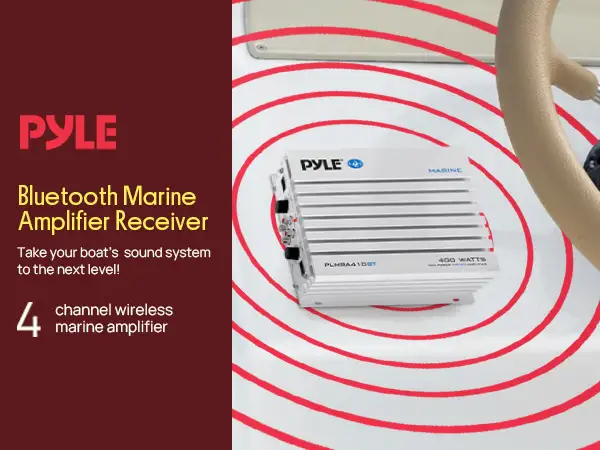
Pyle’s marketing language leans hard into “marine,” “waterproof,” and easy Bluetooth streaming. Digging deeper into user feedback, the gap is less about whether the amp can play music—and more about what “waterproof” and “Bluetooth convenience” mean once it’s mounted in a real boat, ATV, or outdoor wall.
Claim 1: “Waterproof / IP-rated marine protection.”
Official specs for the PLMRMBT7B list “marine grade IP-65 rating,” and the product pitch emphasizes “waterproof & weather-resistant connectors.” Yet real-world interpretations diverge fast. A verified buyer on Amazon (PLMRA430BT listing) wrote that the “so called waterproof” level was actually “raindrops only, no submersion,” describing how they “disassembled… cleaned, dried and then… epoxied all boards” to survive harsher exposure. That same reviewer claimed success after hard use—“drove it through streams and creeks”—but the story itself underscores the mismatch between a consumer’s idea of “waterproof” and what they felt the product shipped as.
Another Amazon reviewer on the PLMRA410BT page took a more cautious stance: “idk about being ‘waterproof’ but i have it tucked up under the dash of my rzr so we’ll see in time.” That’s the recurring pattern: users often treat “waterproof” as “better-than-average resistance if mounted smart,” not a license for direct water contact.
Claim 2: “Simple Bluetooth streaming with 30+ ft range.”
On paper, Bluetooth setup reads “simple & hassle-free,” and one Amazon reviewer (PLMRA410BT page) loved the flexibility: “i can connect my iphone via bluetooth directly to the amp… so technically, you dont even need a stereo in the boat.” For boat owners who want friends to DJ without touching the head unit, that’s a real win.
But range and behavior can be inconsistent depending on mounting and casing. An Amazon reviewer on the PLMRA410BT page reported: “bluetooth works great, but only to about 3 to 4 feet away” unless the amp’s orientation favored signal escape, blaming the metal case blocking it. On the PLMRA430BT page, a verified buyer complained of a “very short bluetooth trigger delay” that “miss[es] the first second or two of each song,” plus a faint “high pitch hum” whenever Bluetooth connected. For users streaming playlists in a cabin or at low volume between tracks, that’s the kind of annoyance that becomes the whole experience.
Claim 3: “Bridgeable / flexible channel configurations.”
Some buyers purchase specifically to bridge channels for a sub while running speakers off the remaining channels. A verified buyer on Amazon (PLMRA430BT listing) celebrated that approach, describing a hidden classic-car build: “no head unit!… run this amp totally via bluetooth… and it sounds great,” and noting that each pair is “bridgable.” Another Amazon reviewer framed a similar “head unit delete” vibe: “delete the head unit… run exclusively off bt.”
However, contradictions appear across models and listings. An Amazon reviewer on the PLMRA410BT page warned bluntly: “this amp is not bridgeable!!!!” despite “the description states it bridgeable.” That kind of mismatch matters most to buyers planning a 2.1 setup; if you’re building around bridging, user reports suggest verifying the exact model behavior before committing.
Cross-Platform Consensus
A recurring pattern emerged across Amazon reviews and community discussion: people love the idea of a compact, Bluetooth-enabled marine amp that can hide away and just play. When it works, the setup feels almost too easy—especially for boats and off-road vehicles where a traditional head unit is one more failure point.
Universally Praised
Bluetooth as a “head unit replacement” is the biggest selling point in real use.
Boat owners repeatedly describe the convenience of running music straight from a phone. One Amazon reviewer on the PLMRA410BT listing spelled out the appeal: “if i turn the stereo off, i can connect my iphone via bluetooth directly to the amp… so technically, you dont even need a stereo in the boat.” For families sharing a boat, that translates to fewer arguments and fewer cables—guests can play a playlist without touching the dash wiring.
That same simplicity shows up in other installs. A verified buyer on Amazon (PLMRA430BT page) described a teen’s jon boat setup: “easy to install, and with bluetooth built-in you don't need a head unit!… wow it rocks!” For small boats and open-air riding, being able to hide the amp and keep controls on the phone is a practical benefit, not a gimmick.
Install size and straightforward wiring get consistent applause.
Multiple owners mention compactness and easy mounting. An Amazon reviewer on the PLMRA410BT page noted the amp was “relatively small… plenty of mounting options,” and another called it a “great little unit,” adding the install was simple—“remote wire, ground, and 12v power”—with the caveat: “be sure to buy your own wiring cause this doesn’t come with any.” For DIYers upgrading an existing 12V setup, that’s a “drop-in and go” vibe.
Perceived loudness is often “enough,” especially for casual outdoor listening.
Rather than obsessing over RMS figures, buyers talk about practical volume. A PLMRA410BT reviewer described running multiple speaker zones in a boat and said, “with the amp dials on max… it is plenty loud for us,” keeping the stereo volume around half. For UTV and boat users fighting wind and engine noise, “sufficient loudness” is the success metric.
Common Complaints
“Waterproof” expectations collide with real exposure.
Digging deeper into user reports, the harshest stories aren’t always about sound—they’re about what happens when water enters the picture. The PLMRA430BT verified buyer who called it “raindrops only, no submersion” went as far as sealing boards with epoxy. Another Amazon reviewer (PLMRA410BT page) essentially hedged their bet: “idk about being ‘waterproof’… time will tell.” For buyers mounting in exposed areas, the feedback suggests treating “marine” as “resistant” rather than “submersible.”
Quality-control and durability concerns show up repeatedly.
Some buyers report units that fail immediately or soon after. On the PLMRA410BT page, one reviewer wrote: “the unit never powered on… remote terminal was shorted internally,” warning others to “test it right away… many of these amps are dead on arrival.” Another review mentioned a hardware issue: an “output screw stripped the first time i tightened it,” raising concerns about physical build quality. For installs that happen weeks after delivery, these stories are especially painful because they often land outside return windows.
Bluetooth quirks: range, hum, and “first seconds missing.”
Bluetooth performance isn’t uniformly “set it and forget it.” One Amazon reviewer (PLMRA410BT page) said range was “only… 3 to 4 feet away” in their mounting orientation. A verified PLMRA430BT buyer reported a faint “high pitch hum” whenever Bluetooth connected and complained the amp “miss[es] the first second or two of each song.” For cabin installs or anyone listening at low volume between tracks, these annoyances become glaring.
Bright LEDs and limited control options frustrate some owners.
A verified buyer on the PLMRA430BT page said there was “no way to turn off the very bright flashing leds,” resorting to “tape over them” because the amp lit up a stateroom at night. That’s a specific but meaningful complaint for boat cabins and enclosed spaces.
Divisive Features
The “no head unit” lifestyle is either liberating or limiting.
Some owners love the simplicity: “no head unit!… run… totally via bluetooth” (Verified Purchase, PLMRA430BT page). Others run into control oddities depending on phone/device behavior; one PLMRA430BT reviewer said volume control stopped working properly after switching phones, and the amp “defaults to what ever the master volume is… blasting,” concluding: “i do not recommend!” For users who frequently switch devices or want consistent physical knobs, the Bluetooth-first approach can feel fragile.
Perceived power vs skepticism.
While many buyers say it’s loud enough, community chatter can be skeptical about wattage claims. In a Reddit thread about a different Pyle receiver (PDA6BU.6), commenters joked: “i’m also curious what they think 200w is” and “it’s probably 2 watts.” Even though that thread isn’t the same marine amp model, it reflects a broader consumer attitude: Pyle’s big watt numbers are often treated with suspicion, while real satisfaction is tied to “does it get loud enough for my use?”
Trust & Reliability
A reliability theme emerges most strongly in the Amazon review excerpts that mention early failures and warranty friction. One PLMRA410BT buyer warned that their unit “never powered up,” urging others to “test it right away” because “many of these amps are dead on arrival.” Another reviewer described hardware that felt fragile, like an “output screw stripped” on first tightening—small, but it raises questions about long-term survivability in vibration-heavy environments like boats and off-road vehicles.
Long-term stories in the provided community data skew more toward Pyle’s broader audio gear than a single marine amp model, but the durability anxiety is consistent: devices that work fine initially, then “randomly die” months later, and customer support that feels slow or inconvenient. For buyers, the practical takeaway from these accounts is to test immediately, mount conservatively (especially regarding water exposure), and keep expectations aligned with budget-grade marine audio.
Alternatives
Only a few explicit competitors appear in the provided data, and they mostly show up through user comparisons rather than formal head-to-head testing.
A verified buyer on Amazon (PLMRA430BT page) compared their experience against a Jensen unit: “my convertible took in rain and fried my jensen… sound is a little louder and more clear than the jensen,” but they still disliked the screw-terminal wiring. This frames Jensen as an alternative some shoppers come from—often because of weather-related failure.
On the PLMRA410BT page, one reviewer mentioned running “x2 boss audio marine” tower speakers and another said the amp “fixed my boss problem,” suggesting Boss Audio is in the same ecosystem of budget marine gear people mix-and-match. These mentions don’t establish Boss as definitively better—just commonly adjacent in real installs.
Price & Value
On Amazon, the PLMRMBT7B listing shows “currently unavailable” in the provided snapshot, but the ecosystem pricing signal is clear: Pyle marine amps frequently live in the budget-to-midrange bracket, with heavy emphasis on “a lot of features for the money.” That value argument is echoed directly by owners: “for the price, i think it’s a win on all levels” (PLMRA410BT review), and “you just can’t beat the price, for the sound that you’re getting” (PLMRA430BT review excerpt).
Resale/market context from eBay listings suggests steady churn and strong availability of used/new units (numerous Pyle marine amp listings across wattage bands). That can be a pro for bargain hunters, but it can also signal a category where people frequently upgrade, swap, or replace.
Buying tips surfaced in user stories are pragmatic: test immediately (“make sure to test it right away”), plan to supply your own wiring (“doesn’t come with any”), and mount in a location that doesn’t block Bluetooth if you need range (“casing… blocks the signal”).
FAQ
Q: Can you run it without a head unit (stereo)?
A: Yes—several Amazon buyers describe using Bluetooth directly. One Amazon reviewer on the PLMRA410BT page said, “you dont even need a stereo in the boat,” because they “connect [an] iphone via bluetooth directly to the amp.” Others still prefer a stereo for radio or consistent controls.
Q: How “waterproof” is it in real use?
A: User expectations vary. A verified buyer on Amazon (PLMRA430BT listing) called it “raindrops only, no submersion,” and said they sealed the boards with epoxy themselves. Other buyers mount it under dashes or covered areas and wait to see “in time.”
Q: Is Bluetooth range actually 30+ feet?
A: Sometimes, but placement matters. One PLMRA410BT reviewer reported only “3 to 4 feet” unless the amp’s orientation helped, blaming the metal case. Another product review (PFMRA340BB.5) reported about “50 feet” on an iPhone 8, showing range can vary by model and install.
Q: Is it really bridgeable?
A: It depends on the exact model. A verified buyer on Amazon (PLMRA430BT page) praised its bridged channel setup, but an Amazon reviewer on the PLMRA410BT page warned, “this amp is not bridgeable!!!!” despite the listing description. Buyers building a 2.1 system should verify model-specific bridging.
Q: What are the most common setup gotchas?
A: Owners repeatedly mention supply and fit details. One PLMRA410BT reviewer warned to “buy your own wiring cause this doesn’t come with any,” and another noted Bluetooth performance can depend on mounting direction because the case “blocks the signal.” Testing immediately after delivery is a recurring piece of advice.
Final Verdict
Buy if you’re the kind of boat/UTV owner who wants a compact amp you can hide, stream from a phone, and keep wiring simple—like the Amazon reviewer who said, “you dont even need a stereo in the boat” (PLMRA410BT page). Avoid if your install is truly exposed to water or you need guaranteed bridgeability and flawless Bluetooth behavior across devices.
Pro tip from the community: test it immediately after delivery—one buyer warned that “many of these amps are dead on arrival” (PLMRA410BT page)—and mount it where the metal case won’t choke Bluetooth range.