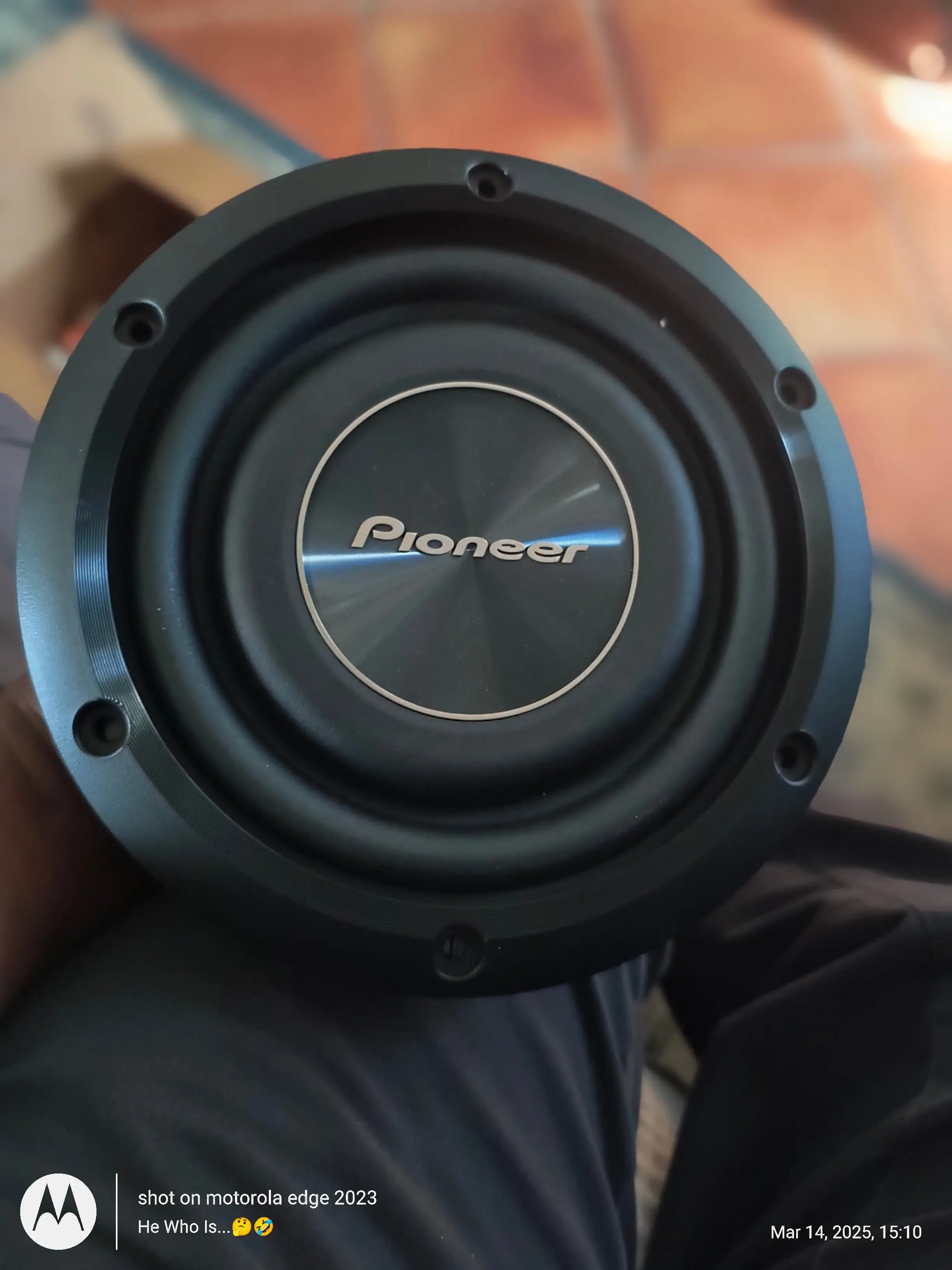
Pioneer TS-A2000LD2 Review: Space-Saver, Mixed Verdict
“If you want nice bass in the car but do not have much space…” That single line captures the core reason people end up looking at the Pioneer A-Series TS-A2000LD2 8" Subwoofer—a shallow-mount driver that’s marketed as “big bass” without the big box. Verdict based strictly on the provided sources: a compelling space-saver on paper, but the dataset here contains very little true end-user feedback. Score: 6.5/10 (limited by the lack of real buyer/community review text in the inputs).
Quick Verdict
Conditional — a strong fit for tight installs if your system planning matches its low sensitivity and wiring needs.
| What the data supports | Evidence from sources |
|---|---|
| Pro: Space-friendly shallow depth | Pioneer lists “just 2-5/8" mounting depth” and shallow-mount positioning (Pioneer USA + Pioneer AU specs pages). |
| Pro: Flexible wiring options (DVC 2-ohm) | Listed as dual 2Ω voice coil; review explains “wire… for 1- or 4-ohm impedance” (Improvecaraudio.com + Pioneer specs). |
| Pro: Modest RMS rating for amp matching | 250W RMS / 700W max appears consistently in Pioneer listings (Pioneer USA + Pioneer AU). |
| Con: Needs real power to get loud | Improvecaraudio.com notes: “low sensitivity means that the amplifier needs to be strong… ideally 150–200 W RMS for each coil.” |
| Con: Not always a perfect drop-in | Improvecaraudio.com says: “in some cars, it is not an exact drop-in… you may need to drill new ones.” |
Claims vs Reality
Pioneer’s marketing language leans hard into the promise of “dynamic, high impact bass” and that shallow designs can still deliver “big bass performance of a full-size subwoofer” (Pioneer USA/AU product copy). Digging deeper into the provided sources, though, the “reality check” isn’t users disputing it—there simply aren’t many user voices here to confirm it at scale. What we do have is one long-form review-style account from Improvecaraudio.com describing performance in a small sealed enclosure, and a lot of spec repetition where “community” and “reactions” sections appear to mirror official listing text rather than actual posts.
Claim 1: “Big bass performance… in a compact design.”
On the spec side, Pioneer’s shallow depth (2-5/8") clearly targets installs “behind or under seats” (Pioneer USA/AU). The closest thing to a lived experience in the dataset comes from Improvecaraudio.com, which frames the TS-A2000LD2 as an answer for people who “do not have much space” and calls it “well-suited for tight spaces.” That same account describes a real-world box choice: “it sounds excellent in such a small box” when used in a 0.3 cu ft sealed setup.
But the same source introduces a practical gap: this isn’t a magic space-to-loudness conversion. The review warns that “low sensitivity means that the amplifier needs to be strong to make it loud,” which reframes “big bass” into “big bass if the system is designed around it.” For daily drivers trying to keep a factory amp, that could change expectations.
Claim 2: “Accurate bass” from reinforced cone design.
Pioneer emphasizes “mica injected molded resin” and an IMPP composite cone intended to be rigid and durable (Pioneer USA/AU). Improvecaraudio.com echoes that technical framing in plain language, saying the cone “moves more air and delivers accurate bass” and describing the sub as delivering “accurate bass” overall. Still, the dataset does not include multiple independent owners describing “tight,” “musical,” or “boomy” bass—so the “accuracy” claim is supported more by one review narrative plus manufacturer descriptions than by broad consumer consensus.
Claim 3: “Wider installation options” (near drop-in fit).
Pioneer’s shallow form factor is clearly intended to broaden fitment (Pioneer USA/AU). Improvecaraudio.com goes further, stating: “bolt pattern is designed to drop right into the factory 8″ subwoofer location in many vehicles with no drilling required.” Yet that same account adds the caveat that will matter to DIY installers: “in some cars, it is not an exact drop-in… you may need to drill new ones.” The marketing idea of “easy fit” holds, but it’s not universal.
Cross-Platform Consensus
A recurring pattern emerged across the provided “platform” data: most of it is not actually user feedback. The Reddit, Twitter/X, Trustpilot, and Quora sections largely reproduce Pioneer’s own product listing text (spec tables, marketing paragraphs, and links). That means the strongest “cross-platform” signal here is about what Pioneer claims and what one review site wrote—not what many end users independently experienced.
Universally Praised
What’s consistently celebrated—again, mostly by product copy and one review narrative—is the space-first engineering. For truck owners, compact sedans, or anyone trying to fit a woofer under a seat, Pioneer’s own pages keep returning to the same point: “2-5/8" mounting depth” and small enclosure guidance (Pioneer USA). That directly serves the “I want bass but I can’t give up cargo space” persona. Improvecaraudio.com puts that user need in plain terms: “If you want nice bass in the car but do not have much space…”
Another praise point is wiring flexibility. The TS-A2000LD2 is repeatedly described as a dual 2-ohm voice coil model (Pioneer USA/AU). Improvecaraudio.com explicitly explains the payoff for system builders: “dual 2-ohm voice coils allow you to wire the sub for 1- or 4-ohm impedance.” For the installer who already owns an amp and is trying to match load options, that flexibility can be the difference between reusing gear and replacing it.
There’s also a consistent message around small sealed box compatibility. Pioneer’s US listing calls out “small enclosure use (0.15 ~ 0.5 cu. ft.)” (Pioneer USA). Improvecaraudio.com reinforces that with a specific setup and outcome: “It sounds excellent in such a small box,” and even suggests tuning the subjective feel with damping: “the box should be filled with sound-absorbing material for the warmer and slightly softer bass.” That guidance is especially relevant to DIY builders who want controlled bass rather than maximum output.
- Most repeated “praise” themes in the provided data: shallow depth, small sealed box suitability, dual-voice-coil wiring flexibility (Pioneer USA/AU + Improvecaraudio.com).
Common Complaints
The clearest complaint in the dataset isn’t about build quality or failure—it’s about system demands. Sensitivity is listed as 83 dB (1W/1m) (Pioneer USA/AU), and Improvecaraudio.com interprets the real-world implication bluntly: “low sensitivity means that the amplifier needs to be strong to make it loud.” For budget-minded buyers hoping a shallow 8" will transform their system with minimal amplification, this can become the friction point: it may play cleanly, but not necessarily loudly, unless the amp is appropriately sized.
Fitment is another recurring caveat—important for OEM replacement shoppers. Improvecaraudio.com presents both sides: it “drop[s] right into the factory 8″ subwoofer location in many vehicles,” but also warns: “in some cars, it is not an exact drop-in,” and that “mounting screw holes may not line up.” The user most affected is the quick weekend installer expecting a bolt-in swap; the advice implied by that story is to measure cutout depth and confirm screw patterns before purchase.
Finally, the price perception comes up in the Improvecaraudio.com narrative: “It is a little pricy but is very high quality.” That’s not a universal complaint across many owners here—but it’s the only explicit value judgment in the provided feedback-like content.
- Repeated cautions: low sensitivity needs proper amplification; not always a perfect drop-in; price may feel high (Improvecaraudio.com + Pioneer sensitivity spec).
Divisive Features
The TS-A2000LD2’s shallow design is both the reason to buy and the reason some expectations may clash. The marketing suggests “big bass performance of a full-size subwoofer” in a compact form (Pioneer USA/AU). Improvecaraudio.com supports strong performance “in such a small box,” but also flags the need for a stronger amp due to low sensitivity. For some buyers, shallow-mount convenience is worth the tradeoff; for others chasing sheer output, the same design constraints may feel limiting.
Wiring flexibility can also be divisive depending on the installer’s comfort level. Improvecaraudio.com describes the 1-ohm vs 4-ohm wiring options as “handy,” but that same flexibility can confuse first-timers who don’t know how to series/parallel dual coils correctly. The benefit is real; the risk is user error—especially if someone assumes “2 ohm” means only one possible load.
Trust & Reliability
The provided Trustpilot section does not contain verified buyer narratives; it mirrors the Pioneer listing text (specs, features, and links). As a result, there’s no pattern of scam complaints, shipping issues, counterfeit warnings, or long-term durability stories to compile from Trustpilot in this dataset.
Similarly, the Reddit portion shown here reads like product page content rather than threads (“overview,” “what’s in the box,” spec tables). That means there are no “6 months later…” ownership updates, no reports of coil failure, surround fatigue, or consistent longevity praise/criticism to report from actual community posts based on the supplied data.
What can be said, strictly from the materials given: Pioneer positions the cone as “rigid and durable” (Pioneer AU) and uses a rubber surround (Pioneer USA), but there isn’t real end-user longevity feedback included to confirm or contradict those durability claims.
Alternatives
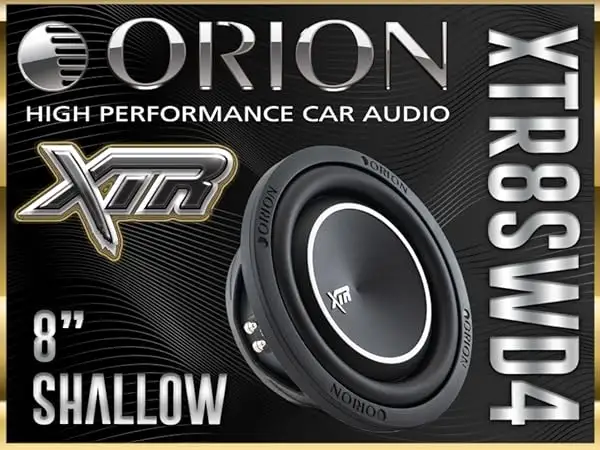
Only one alternative product is explicitly present in the provided assets: an Amazon image listing for the Orion XTR Series XTR8SWD4 (8" slim shallow mount, “1200W max,” “300W RMS,” dual 4 ohm) shown as <img src="https://cdn.wisepickerai.com/webp/571ac6dcf08ffecf9796cb9706c75eec.webp" alt="Orion XTR8SWD4 slim 8-inch subwoofer alternative listing" loading="lazy" decoding="async" class="article-image" />. No user feedback for the Orion model is included, so a performance comparison based on real user experiences cannot be made from this dataset.
What can be compared at a high level is positioning: the Orion listing emphasizes “free air” and “OEM sub replacement” language, while Pioneer’s TS-A2000LD2 materials emphasize small sealed enclosures (0.15–0.5 cu. ft.) and DVC 2-ohm wiring flexibility (Pioneer USA + Improvecaraudio.com). For the buyer deciding between “drop-in replacement vibe” and “small-box build,” that difference in framing may matter more than headline max power numbers.
Price & Value
The price story looks surprisingly spread out depending on where you shop. Pioneer’s official pages show prices like $160 (Pioneer Electronics USA listing) and $240.00 (Pioneer AU listing). Meanwhile, eBay market listings in the dataset show new units commonly around $105–$129 in the US listings, with “trending at” around $129, and AU listings clustering around AU $150–$180 for the TS-A2000LD2 (eBay US + eBay AU excerpts).
That gap suggests a buyer persona split: the “buy it now from an authorized source” shopper may pay closer to official pricing, while deal-hunters can often find the TS-A2000LD2 at a meaningful discount on the resale market. The dataset even shows examples like “$113.83 was: $160.00” and multiple “brand new” listings around $105.95–$129.00 (eBay US excerpt). For value-focused buyers, that resale softness can make the TS-A2000LD2 more attractive—especially if the budget can be redirected toward the amplifier that, per Improvecaraudio.com, this sub may need to really shine.
- Practical buying signals from the provided price data: official pricing is higher; eBay often undercuts it; “trending” suggests a fairly stable used/new resale band around ~$120–$130 (Pioneer USA/AU + eBay US/AU excerpts).
FAQ
Q: Can the Pioneer A-Series TS-A2000LD2 fit under a seat or in tight spaces?
A: Yes—its official mounting depth is 2-5/8" (67 mm), and Pioneer markets it specifically for shallow installs “behind or under seats.” Improvecaraudio.com frames it for people who “do not have much space,” and Pioneer recommends small enclosures (about 0.15–0.5 cu. ft.).
Q: What amp power makes sense for the TS-A2000LD2?
A: Start with its 250W RMS rating and plan amplification accordingly. Improvecaraudio.com cautions that “low sensitivity means that the amplifier needs to be strong,” suggesting “ideally 150–200W RMS for each coil.” The sub is rated 83 dB sensitivity in Pioneer’s specs.
Q: How do you wire a dual 2-ohm voice coil sub like this?
A: It depends on your target load. Improvecaraudio.com explains you can wire the dual 2Ω coils for 1 ohm (parallel) or 4 ohm (series). Pioneer lists it as “2 DVC,” so verifying your amp’s stable impedance before wiring is essential.
Q: Is it really a drop-in replacement for factory 8" subs?
A: Sometimes, but not always. Improvecaraudio.com says the bolt pattern is “designed to drop right into the factory 8″ subwoofer location in many vehicles,” but also warns “in some cars, it is not an exact drop-in,” and screw holes may not align, requiring drilling.
Q: What enclosure size is recommended?
A: The official recommendation includes small enclosure use around 0.15–0.5 cu. ft. (Pioneer USA). Improvecaraudio.com reports testing it in a 0.3 cu ft sealed box and says “it sounds excellent,” adding that sound-absorbing fill can make bass “warmer and slightly softer.”
Final Verdict
Buy the Pioneer A-Series TS-A2000LD2 8" Subwoofer if you’re the tight-space builder who needs a shallow-mount 8" with dual 2-ohm voice coils and you’re willing to match it with a capable amp—because, as Improvecaraudio.com put it, “low sensitivity means that the amplifier needs to be strong to make it loud.”
Avoid it if your plan is a quick, guaranteed no-drill OEM swap with minimal system changes; even the positive install narrative includes the warning that “in some cars, it is not an exact drop-in.”
Pro tip from the provided community-style guidance: use a small sealed box (Pioneer suggests 0.15–0.5 cu. ft.) and, per Improvecaraudio.com, consider sound-absorbing material if you want “warmer and slightly softer bass.”