Melissa & Doug USA Map Floor Puzzle Review: Worth It?
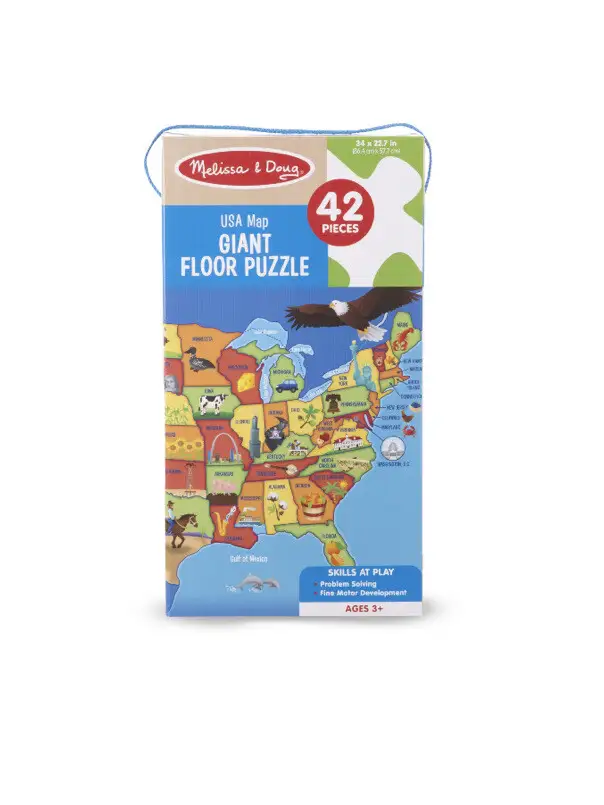
A parent trying to keep a 4-year-old engaged without a screen summed up the appeal bluntly: “we absolutely love this puzzle.” That kind of hands-on attention—kids returning to it day after day—shows up across platforms for the Melissa & Doug USA Map Floor Puzzle. Verdict: a strong pick for geography play with caveats around fit/handling and age expectations. Score: 8.4/10
Quick Verdict
Yes (conditional) — Great for kids who like puzzles and visual learning; less ideal if you expect “snapping” interlock or want a smaller tabletop format.
| What it’s about | What users liked | What users didn’t | Best for |
|---|---|---|---|
| Big USA map floor puzzle | “pieces are big and very strong” (Hip2Save reader) | “doesn’t ‘snap together’ like other puzzles” (Hip2Save reader) | Visual learners, homeschool use |
| Geography + state shapes | “can correctly place all of states in correct location” (Fat Brain Toys review) | Some want clearer differentiation: “vary the colors of the states” (Fat Brain Toys review) | Kids learning state orientation |
| Durable, kid-handling friendly | “nice sturdy pieces” (Fat Brain Toys review) | Handling can be finicky: needs careful placement (Hip2Save reader) | Families doing repeat play |
| Educational details | “helps kids learn the state names and capitals” (Fat Brain Toys review) | Some adults want more labeling on the base (Fat Brain Toys review) | Early elementary learning |
Claims vs Reality
Marketing for the Melissa & Doug USA Map Floor Puzzle leans heavily on “easy to assemble,” “extra-thick pieces,” and a “wipe-clean surface.” Digging deeper into user reports, the core of that promise holds—but it’s not the “click-and-go” experience some caregivers expect from traditional interlocking puzzles.
One recurring gap is what “easy to assemble” means in real living rooms. A Hip2Save reader described a learning benefit that came from the puzzle being less rigidly interlocking: “the puzzle doesn’t ‘snap together’ like other puzzles… it made the puzzle more challenging as my daughter had to meticulously place the pieces together.” For parents aiming for independent play, that’s a double-edged sword: it can build patience and spatial reasoning, but it may frustrate kids who want instant, stable connections.
The “educational” claim is also real, but it’s delivered differently depending on the child’s age and learning style. Several stories focus on kids learning by shape and repetition. A reviewer on Fat Brain Toys wrote: “both my 3 and 5 year old granddaughters love this puzzle… three year old can correctly place all of states in correct location on map.” That said, age guidance can get confusing across listings: Amazon US calls out a recommended age range of 6–10 years, while Amazon Canada shows “3 years and up.” While officially positioned as older-kid appropriate, multiple caregivers describe successful play with preschoolers—usually with adult help at first.
Finally, durability is praised in user anecdotes, though it’s often about “holding up” in typical family use rather than laboratory toughness. A Hip2Save reader noted: “The pieces are big and very strong… it’s so nice that i will be saving it.” That “save it for the next kid” sentiment is exactly what brands mean by long-lasting—but it’s rooted in repeated home use stories rather than formal wear testing.
Cross-Platform Consensus
Universally Praised
The loudest praise for the Melissa & Doug USA Map Floor Puzzle is how it turns geography into an activity kids actually request. Instead of being a one-and-done educational purchase, multiple caregivers describe children returning to it like a favorite game. On Fat Brain Toys, one gift-giver wrote: “the 4 year old girl i gave this gift to really liked it. she played w/ it all afternoon… woke up the next morning and first thing she said is could she play w- her new map before going to school.” For parents trying to build early familiarity with U.S. states, that “first thing in the morning” pull matters more than any printed claim.
A second pattern is how well it supports visual learners and Montessori-style routines. A Hip2Save commenter described using it explicitly in a learning method context: “i homeschool my 4 year old daughter using the montessori method… my daughter loved the large-scale imagery and vibrant pictures and colors.” For homeschool families, the value isn’t just entertainment—it’s repetition without resistance, where the child “just referred to the picture on the box and completed it herself… on her own.”
The third praise is the physical design: big pieces and a large footprint that makes it feel like an event on the floor rather than a small tabletop toy. For little hands, that scale can make the difference between “too fiddly” and doable. Hip2Save reader Jackie framed it as a keep-forever item: “The pieces are big and very strong. Great way to learn states, capitals, and their locations.” For families with multiple kids, that strength and reusability becomes part of the purchase logic.
- Strong engagement: kids “played… all afternoon” and asked for it again (Fat Brain Toys)
- Visual learning fit: “large-scale imagery and vibrant pictures” (Hip2Save)
- Family longevity: “saving it” after multiple kids used it (Hip2Save)
Common Complaints
The most consistent complaint isn’t about printing or education—it’s about expectations for how the puzzle fits together. A Hip2Save reviewer was candid: “the puzzle doesn’t ‘snap together’ like other puzzles and at first i wasn’t too fond of that.” For caregivers expecting pieces to lock firmly, the experience can feel unstable, especially on carpet or in high-traffic spaces where kids bump the edges.
Another recurring critique is about clarity and differentiation between states—particularly for kids learning shapes for the first time. One Fat Brain Toys reviewer suggested: “my only suggestion would be that you vary the colors of the states so their shapes are more apparent.” For teachers or parents guiding multiple children at once, clearer color contrast can reduce confusion and speed up independent placement.
Some feedback also shows how parents want extra labeling support. In a classroom/gift context, one Fat Brain Toys reviewer said the puzzle was fun, but added that “we grownups… thought it would be more beneficial if the names of the states were printed on the base… her dad is going to use a marker to add the name of the state.” That’s not a dealbreaker for puzzle-loving kids, but for adults using it as a structured geography lesson, it’s a reminder that the learning scaffolding may need supplementation.
- Fit stability: “doesn’t ‘snap together’ like other puzzles” (Hip2Save)
- Visual differentiation: “vary the colors of the states” (Fat Brain Toys)
- More labeling desired: parent planned to “use a marker” to add names (Fat Brain Toys)
Divisive Features
The “doesn’t snap together” trait splits opinion because it changes what the puzzle is good at. For some families, that friction becomes a learning advantage. The Hip2Save homeschool parent initially disliked it, then reframed it: “it made the puzzle more challenging… [my daughter] had to meticulously place the pieces together.” For kids who enjoy careful problem-solving, that can build persistence and spatial accuracy.
For others—especially households hoping for quick setup and stable display—it’s a negative. If a child wants to finish and admire the map without it shifting, the same characteristic can feel like a design flaw rather than a feature. In other words, the puzzle’s challenge level depends as much on the home setup and the child’s temperament as it does on piece count.
Trust & Reliability
A recurring trust signal comes from repeat-purchase and “keep it” language rather than formal reliability claims. The Hip2Save reader who wrote “i have this and all of my kids have used it… i will be saving it” is essentially offering a long-term durability anecdote in plain language: it survived multiple children and remained good enough to store for the future.
At the same time, the dataset includes reviews for a related Melissa & Doug USA Map Sound Puzzle (a different product category with electronics). Those comments introduce a cautionary note about reliability for sound-feature versions: one Fat Brain Toys reviewer described a failure: “voice was barely audible… and now there is no voice at all… i would like a refund.” That isn’t about the floor puzzle itself, but it’s relevant for shoppers cross-shopping Melissa & Doug map puzzles: if you’re picking between a simple cardboard floor puzzle and an electronic sound puzzle, the non-electronic option avoids battery/speaker failure modes entirely.
On “scam concerns,” the available Trustpilot-labeled content is actually a mirrored set of product reviews rather than complaints about fraud or non-delivery. What emerges is less about scams and more about product performance and customer expectations.
Alternatives
Only a few clear alternatives are mentioned directly in the provided data. The most explicit is the brand’s own adjacent map puzzle: the Melissa & Doug National Parks U.S.A. Map Floor Puzzle – 45 Pieces. It targets a younger age band (“3+ years”) and emphasizes search-and-find elements, animal-shaped pieces, and a guide with bilingual (English/Spanish) content. For families whose kids are more motivated by animals and scavenger-hunt tasks than state names, that theme could be a better hook than pure state geography.
Within Melissa & Doug’s ecosystem, another alternative referenced is “add the Melissa & Doug dinosaur floor puzzle,” which suggests a non-geography option for kids who want large-piece floor puzzles but aren’t ready for state shapes. The user story implication: if your child likes puzzles but isn’t interested in maps yet, a theme-based floor puzzle may keep engagement high while still building fine motor and problem-solving skills.
Price & Value
Pricing swings widely depending on retailer and region. The U.S. Amazon listing frames it as a mainstream toy with a large review base (4.7/5 with 10,678 reviews), while Amazon Canada shows a much higher sticker price (listed at $43.61). Deal-focused communities track steep discounts: Hip2Save reported “just $5… the lowest price we’ve seen,” reinforcing that timing and retailer matter a lot.
Resale and secondhand pricing on eBay suggests the puzzle often circulates cheaply used—listings show prices like $4.99 pre-owned (plus shipping), and multiple “new sealed” listings at varying levels. For budget-minded families, that resale market supports the idea that it’s easy to replace if pieces go missing. For gift buyers, the spread means it’s worth checking multiple stores before paying full price.
Buying tips from the community lean toward durability and reusability. The best “value” story isn’t about MSRP—it’s about longevity: “all of my kids have used it… i will be saving it.” That implies the cost per hour drops quickly if it becomes a regular floor activity rather than a one-week novelty.
- Watch deal cycles: Hip2Save tracked drops to “just $5”
- Consider used listings: eBay commonly shows low pre-owned pricing
- Value increases with repetition: “saving it” after multiple kids (Hip2Save)
FAQ
Q: Does the Melissa & Doug USA Map Floor Puzzle “snap together” like a standard jigsaw?
A: No—at least one buyer explicitly said it “doesn’t ‘snap together’ like other puzzles.” They added that it made the puzzle “more challenging” because their child had to “meticulously place the pieces together,” which some families liked for building problem-solving skills. (Hip2Save)
Q: Is it actually good for preschoolers, or is it too advanced?
A: It depends on the child. Although Amazon US lists a recommended age range of 6–10 years, multiple caregivers describe 3–5-year-olds enjoying and completing state placement with help. One review said a “three year old can correctly place all of states” when paired with a learning routine. (Amazon; Fat Brain Toys)
Q: What makes it educational beyond just being a puzzle?
A: Families cite geography learning through repetition, visual cues, and state-shape recognition. A homeschool parent said their child learned “the orientation of different states and their location in relation to one another,” and another user framed it as a “great way to learn states, capitals, and their locations.” (Hip2Save)
Q: Do the pieces hold up to repeated kid use?
A: Several users describe the pieces as durable over time. One Hip2Save reader wrote: “The pieces are big and very strong,” and another said “all of my kids have used it… i will be saving it.” These are anecdotal but consistently point to good everyday durability. (Hip2Save)
Q: Any common frustrations parents mention?
A: Two themes come up: stability and clarity. Some disliked that it doesn’t lock tightly (“doesn’t ‘snap together’”), and others wanted clearer visual separation, suggesting the brand “vary the colors of the states so their shapes are more apparent.” A different reviewer even planned to add labels with a marker. (Hip2Save; Fat Brain Toys)
Final Verdict
Buy the Melissa & Doug USA Map Floor Puzzle if you’re teaching geography through hands-on play—especially for visual learners, homeschool routines, or kids who love big floor puzzles and will repeat them daily. Avoid it if you need a tightly interlocking puzzle that “snaps” firmly together or if your child gets frustrated by careful placement.
Pro tip from the community: pair it with a routine and repetition—one caregiver said they “pair it with the montessori states song,” and another found the challenge helped their child build independence. (Fat Brain Toys; Hip2Save)