Melissa & Doug Solar System Floor Puzzle Review: Worth It?
A 48-piece “toddler” puzzle that some kids finish in 15–20 minutes—and others find so oversized it’s hard to manage: Melissa & Doug Solar System Floor Puzzle lands as a strong family favorite with a few real caveats. Verdict: recommended for most preschool space-fans, with size/fit quirks that matter. Score: 8.6/10.
Quick Verdict
For many families, this is a “pull it out again and again” floor puzzle that blends space learning with an approachable challenge. A reviewer on STEM Spark framed the sweet spot clearly: it has “the right amount of pieces (48) for a four year old,” and their child “didn't really need my help to solve it!” Meanwhile, a smaller subset warns about practical downsides—mostly around how big it is on the floor and how it stores.
A verified purchaser on Amazon wrote it’s “very sturdy; not as bendy as most puzzles,” and described using it to “quiz your child on solar system facts.” Across reviews (notably Fat Brain Toys’ 120 reviews averaging 4.74, and Amazon’s 4.8/5 across 30k+ ratings), enthusiasm clusters around sturdiness, bright artwork, and educational labeling.
| Call | Evidence-backed summary |
|---|---|
| Buy? | Conditional “Yes” for ages ~3–6 who like floor puzzles |
| Biggest pro | Sturdy, thick pieces: “big and thick!” (Fat Brain Toys reviewer “stacy davies”) |
| Biggest con | It’s huge: “a little too big for my 3 year old daughter” (Fat Brain Toys reviewer “fiel cheever - educator”) |
| Best for | Space-obsessed kids learning planet names: “can name all the planets so this was a hit!” (Fat Brain Toys reviewer “hailey steele”) |
| Watch-outs | Storage box fit: “box just barely fits all the puzzle pieces” (Fat Brain Toys reviewer “michael”) |
Claims vs Reality
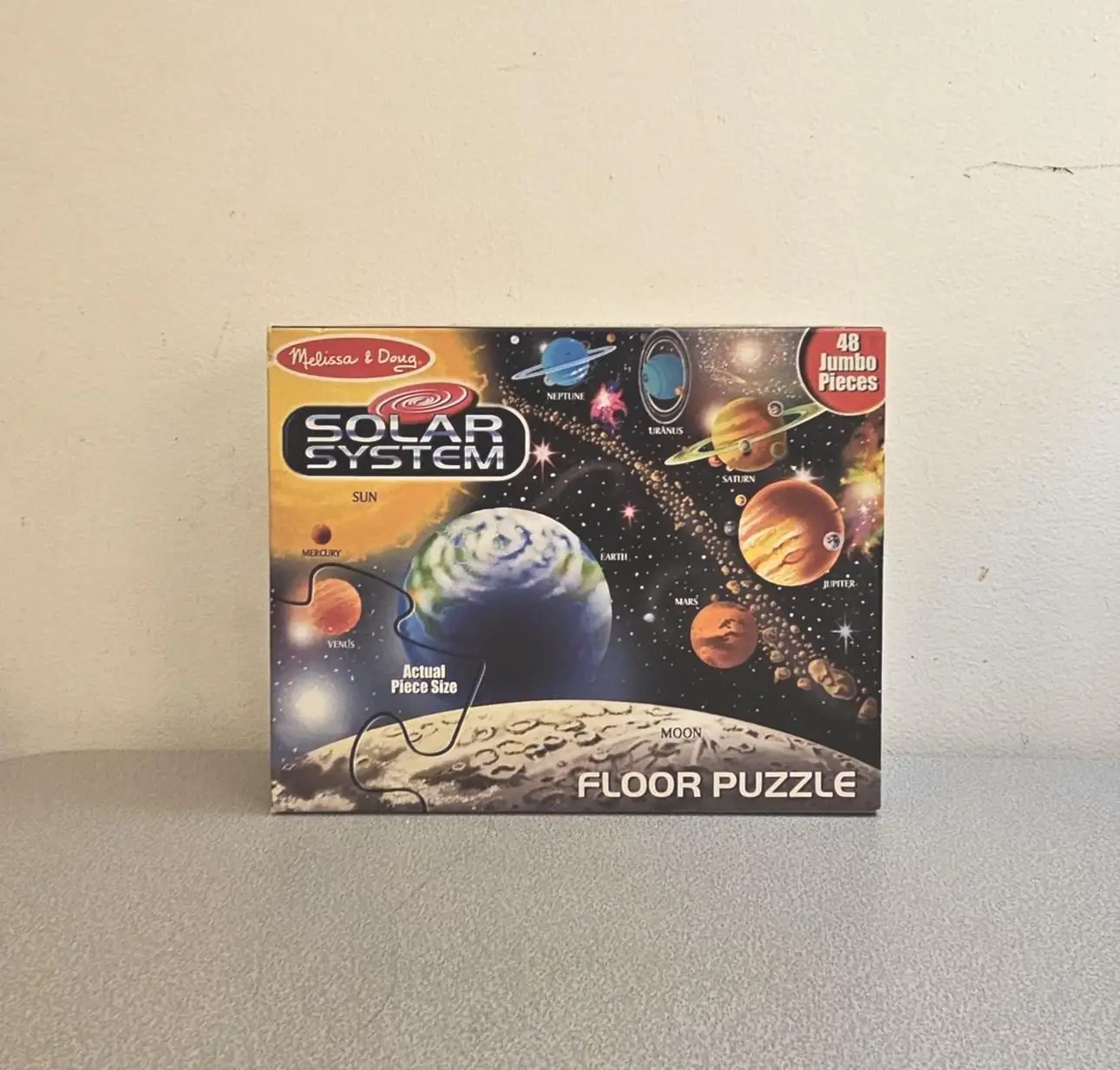
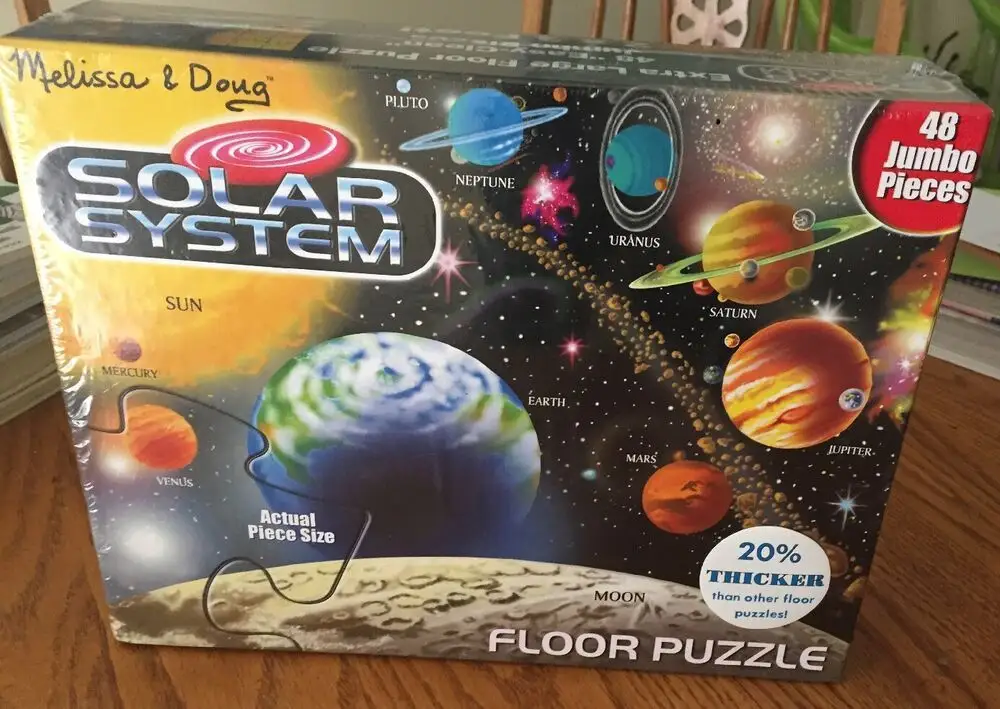
Melissa & Doug markets this as a “2 feet by 3 feet” floor puzzle with “48 extra-thick cardboard pieces,” “easy-clean surface,” and planet labels designed to build problem-solving and hand-eye coordination (Amazon product listing and brand site). Digging into user reports, those claims largely hold up—but the lived experience adds nuance about age readiness, floor space, and piece fit.
Claim 1: “48 pieces” is age-appropriate for preschoolers.
In real homes, that depends on the child’s puzzle confidence. On STEM Spark, the reviewer said it was “the right amount of pieces (48) for a four year old,” adding that sorting was “straight forward” and their child “didn't really need my help to solve it!” That same review clocked completion at “15–20 minutes,” but emphasized repeat play: “he'll rebuild again and again for the next couple of years.”
On the other hand, some families find the same 48-piece count doesn’t guarantee ease—because the floor format changes the difficulty. Fat Brain Toys reviewer “sandra sarka” called it “challenging enought for a 5 year old with help,” and “beth rich” described a 3-year-old who “can complete it with moderate assistance.” The reality: 48 pieces can be solo-friendly for many 4–6 year olds, but younger kids often want a grown-up nearby.
Claim 2: The large format is a feature, not a hassle.
Marketing celebrates the jumbo size; user feedback agrees it’s visually impactful—yet it can overwhelm smaller kids or smaller living spaces. Fat Brain Toys reviewer “terri bensinger” loved the scale but warned: “The puzzle itself is humongous,” adding “don't be surprised if your kid crawls all over the rest of the puzzle to figure out where pieces go.” Meanwhile, “fiel cheever - educator” offered a more hesitant take: “it's a little too big for my 3 year old daughter,” even though the child “loves doing puzzles.”
So while officially a floor puzzle “2 feet by 3 feet,” multiple users report that the same size can be a joy (room to spread out, easy-to-grab pieces) or a drawback (needs floor space, physically big for a small child).
Claim 3: Durability and build quality are standout.
This is one of the most consistent realities across sources. A verified purchaser on Amazon wrote: “this puzzle is very sturdy; not as bendy as most puzzles.” Fat Brain Toys reviewer “rosey garcia” echoed that it’s “big and sturdy,” and “alena eckert” said “it is not easily destroyed.” Still, at least one report flags wear risk: Fat Brain Toys reviewer “rupali” said their child “tore off the cover of puzzles” and they had to “stick it back,” adding uncertainty about longevity.
Cross-Platform Consensus
Universally Praised
The loudest through-line is how well the puzzle hits kids who are already “into planets,” turning curiosity into hands-on repetition. Fat Brain Toys reviewer “hailey steele” described a grandson with a “fascination with the solar system” who “can name all the planets so this was a hit!” That theme repeats in multiple household stories: the puzzle becomes both an activity and a prompt for talking about space.
The second near-universal praise is piece feel and manageability for little hands. People repeatedly point out thickness and chunkiness as the difference-maker. Fat Brain Toys reviewer “stacy davies” said “the pieces are big and thick!” and called it a “solid challenge” that still felt achievable. Another parent, “kimberly schell,” highlighted “big chunky pieces for little hands,” describing a kid who stayed engaged without giving up.
A third praised element is educational labeling and the way it supports casual teaching. A verified purchaser on Amazon described quizzing their child after assembly: “you can quiz your child on solar system facts.” Fat Brain Toys reviewer “cecilia tessitore” wrote, “Works well. We have been teaching kids about the planets & solar system. This helps with the visuals.” The picture that emerges is less about perfectionist astronomy and more about a playful learning aid families actually use.
- Common praise themes: thick pieces, bright/vibrant artwork, planet labels that prompt learning conversations, replay value for space-obsessed kids.
Common Complaints
The most frequent complaint isn’t about missing pieces or unclear printing—it’s about the practical reality of a jumbo floor puzzle. Digging deeper into user reports, “big” can become “too big,” especially for younger kids or tight living rooms. Fat Brain Toys reviewer “fiel cheever - educator” summed it up: “it's a little too big for my 3 year old daughter… she’s used to smaller puzzles.” STEM Spark’s reviewer also noted the footprint: “it is a floor puzzle, so it's rather larger when out on the floor,” even though they found storage manageable.
Storage itself shows up as a real-world annoyance. Fat Brain Toys reviewer “michael” praised the puzzle but criticized the packaging: “the box just barely fits all the puzzle pieces when a kid puts them away… I have to assist him in putting the pieces away.” For families trying to encourage independent cleanup, that box-fit detail can matter more than any “easy-clean surface” claim.
Finally, a smaller set of durability notes suggests that while many call it sturdy, some kids can still damage the top layer. “rupali” reported their child “tore off the cover of puzzles,” raising a durability question in rougher play environments.
- Common pain points: takes up floor space, can feel oversized for some 3-year-olds, box can be tight for cleanup, occasional reports of surface wear.
Divisive Features
The size is also the most divisive feature, because it’s both the product’s identity and its biggest constraint. Some families treat the giant format as part of the fun—“my child has even walked across it and it stayed together!” (Fat Brain Toys reviewer “atlanta mom”). Others see the same size as a barrier to independent play, especially at the youngest recommended ages.
Challenge level splits similarly: for puzzle-loving kids, it can be quick. STEM Spark’s reviewer reported “15–20 minutes” for a 4-year-old. But for other households, it’s a longer, shared activity. Fat Brain Toys reviewer “sarah rogowski” described a 3-year-old who “still needs some occasional help,” calling it “good for a mama / son activity.”
Trust & Reliability
On trust signals, the broad base of feedback is overwhelmingly positive across high-volume platforms (Amazon’s 4.8/5 with 30k+ reviews; Fat Brain Toys’ 4.74 average across 120 reviews). Still, digging into reliability narratives, two specific concerns appear: long-term wear on the puzzle surface and practical ownership friction like storage.
For durability over time, many stories imply repeated use: “he wants to use it over and over” (Fat Brain Toys reviewer “debra fitch”), and another grandparent said their grandson takes it out “2 to3 times a week” (Fat Brain Toys reviewer “amy wahl”). Yet not every home has the same outcome—“rupali” cautioned that after damage they weren’t “sure how long it will last.” The most consistent reliability “risk” is less about pieces falling apart and more about how the puzzle is treated (kids crawling, stepping, sliding pieces).
Alternatives
Only a few specific alternatives are explicitly mentioned in the provided data. On Amazon’s listing, the brand suggests adding the “Melissa & Doug farm cube puzzle set” to “round out the puzzle play experience.” That’s not a direct space competitor, but it’s positioned as another screen-free puzzle option for similar ages.
Within the broader Melissa & Doug space category, eBay listings show other space-themed puzzles (including a “glow-in-the-dark outer space” 48-piece floor puzzle) and a separate “exploring space 200 piece floor puzzle” aimed at older kids. The practical implication from user stories: if a child completes this 48-piece version too quickly—like the STEM Spark 4-year-old finishing in “15–20 minutes”—families looking for a bigger challenge may prefer a higher piece count, while families struggling with the “humongous” size may want a smaller tabletop format rather than another floor puzzle.
Price & Value
Pricing varies by retailer in the provided data: brand site lists $18.99, Amazon shows around $18.99, and community commentary suggests it can dip lower during promotions. STEM Spark’s reviewer said they bought it on Prime Day and noted it could be found “for under $13,” calling that “a good price for a floor puzzle… from a quality company.”
Resale data from eBay suggests steady demand, with listings for new sealed and preowned copies across a wide range (often influenced by shipping costs). The presence of many “preowned excellent” listings implies these puzzles can survive multiple households, aligning with Fat Brain Toys reviews describing them as “very durable” and “high quality.”
Buying tips that emerge from real feedback are practical: consider floor space first, and consider the child’s puzzle maturity. If your child already “mastered a 24-piece puzzle,” one parent said this “48-pieces… is providing him with a new challenge” (Fat Brain Toys reviewer “beth rich”). If your child is used to smaller formats, the “little too big” complaint suggests sizing up may need adult support at first.
FAQ
Q: How long does it take kids to finish this 48-piece floor puzzle?
A: It varies by age and puzzle skill. On STEM Spark, the reviewer said it took “about 15–20 minutes” for a 4-year-old, while Fat Brain Toys reviewers describe younger kids needing “moderate assistance” and occasional help, making it more of a parent-child activity.
Q: Is the puzzle too big for a 3-year-old?
A: Sometimes. Fat Brain Toys reviewer “fiel cheever - educator” said it was “a little too big for my 3 year old daughter,” even though she likes puzzles. Other families report 3-year-olds loving it with help, and the jumbo pieces can be easier to grip.
Q: Are the pieces sturdy or flimsy?
A: Most feedback calls them sturdy and thick. A verified purchaser on Amazon wrote it’s “very sturdy; not as bendy as most puzzles,” and Fat Brain Toys reviewers repeatedly mention “big and thick” pieces. One reviewer (“rupali”) did report the surface layer tearing, suggesting rough play can cause wear.
Q: Does it help kids learn the planets?
A: Many families use it that way. Fat Brain Toys reviewer “cecilia tessitore” said, “We have been teaching kids about the planets & solar system. This helps with the visuals,” and an Amazon verified purchaser described quizzing kids on “which planet is the largest… closest to the sun.”
Q: Is cleanup/storage easy?
A: Mixed. STEM Spark’s reviewer said it “breaks down into a reasonable sized box for storage,” but Fat Brain Toys reviewer “michael” warned the “box just barely fits all the puzzle pieces,” so younger kids may need help putting it away neatly.
Final Verdict
Buy if your child is a preschool space fan who likes hands-on learning and jumbo floor puzzles—and you have the floor space for a 2' x 3' layout. Avoid if you need a compact puzzle or your 3-year-old strongly prefers smaller, tabletop puzzles.
Pro tip from the community: turn it into a learning game after assembly—an Amazon verified purchaser suggested using it to “quiz your child on solar system facts,” and multiple families described kids proudly naming planets as they finish.