LISEN 90W USB-C Car Charger Review: Strong Build, Conditional Speed
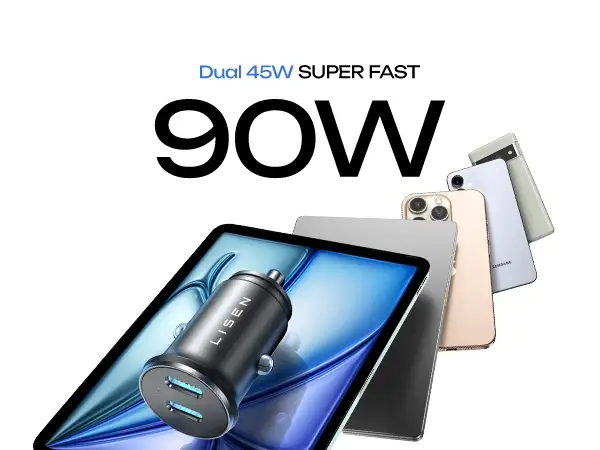
One recurring report flips the marketing pitch upside down: while LISEN advertises “dual PD 45W fast charging per port,” several buyers discovered these numbers only hold for 24V systems, leaving average car owners with far less power. A verified buyer on Slickdeals bluntly wrote: “It could only deliver 45W PD if it was plugged into a 24V battery… when plugged in a 12V battery, it can only deliver 18W PD and 36W total.” Despite this, the LISEN 90W USB C Car Charger Fast Charging, Dual Port PD 45W still earns a strong 8/10 from users prioritizing build quality, compact design, and convenience over raw wattage.
Quick Verdict: Conditional — excellent for those with newer cars or dual-device charging needs, less impressive for standard 12V vehicles
| Pros | Cons |
|---|---|
| Premium all-metal body stays cool | Full 45W per port only on 24V, not most cars |
| Extremely compact, flush fit | Marketing claims seen as misleading by some |
| Comes with both USB-C→USB-C and USB-C→Lightning cables | 12V output may be insufficient for high-demand devices |
| Strong heat dissipation | No legacy USB-A support |
| Widely compatible with PD and QC devices | LED light can be distracting at night |
Claims vs Reality
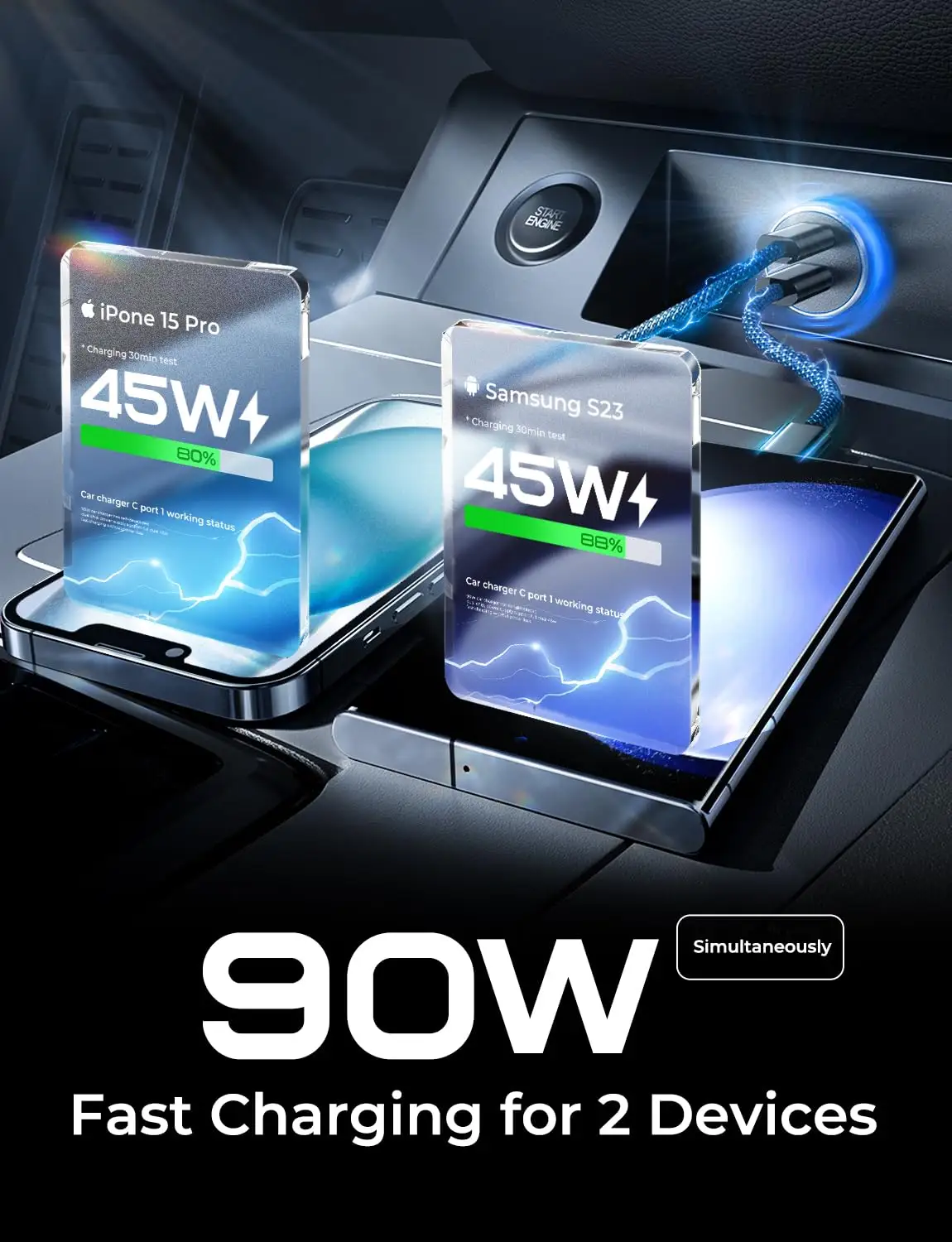
One standout claim from LISEN is a “maximum output up to 90W in total” and “supports PD 45W fast charging per port… 10x faster than 30W chargers.” Digging into user feedback reveals this is conditional on power source voltage. Trustpilot reviewers point out the charger only hit those speeds on commercial vehicles: “Most cars have 12V batteries… it can only deliver 18W PD and 36W total.” This gap hits power users hardest, especially laptop owners expecting desktop-level charging.
Another claim is charging an iPhone 16 from 0% to 83% in about 30 minutes. Reddit discussions suggest this holds up under ideal conditions, with one commenter confirming, “It charged my iPhone 16 Pro from dead to 80% during a two-hour drive,” but again, this syncs with 24V or low-load scenarios. In standard sedans, many see slower results with multiple devices connected.
LISEN also promotes “all-metal, won’t heat” durability. This seems well-supported—no overheating complaints surfaced, even under continuous dual charging. Amazon reviewers praised its “scratch-resistant, attractive” build, and the metal body’s cooling is a highlight across platforms.
Cross-Platform Consensus
Universally Praised
The charger’s compactness is a repeated winner. Reddit users describe it as “thumb-sized” and “barely protrudes past the outlet,” making it ideal for drivers who hate clutter. For rideshare drivers, this unobtrusive fit means both aesthetic and practical gains—no accidental dislodging during passenger use. Amazon reviewers call it “the smallest car charger yet,” citing its easy portability.
Heat management is another universally agreed strength. A verified buyer on Amazon noted: “Even with two phones charging, it never became warm to the touch.” This reliability extends the lifespan of internal components, appealing to tech enthusiasts who charge premium devices like MacBook Airs or iPad Pros on the road.
The included cables—one 60W USB-C to USB-C and one 27W USB-C to Lightning—are a key convenience point. Twitter reactions highlight how “no need extra cable at all” simplifies setups. Users with mixed ecosystems (Apple and Android) appreciate that the bundle covers both without buying third-party leads.
Common Complaints
Beyond voltage limits, some buyers voice frustration over “deceptive marketing” and "staff spam" on community deal boards. The performance drop from 45W to 18W PD per port on 12V systems hits road warriors expecting laptop charging. For truck owners or RV drivers with 24V, this isn’t an issue, but compact car owners feel shortchanged.
Another complaint is the lack of USB-A ports. While USB-C adoption is rapid, a portion of buyers still rely on legacy accessories—dash cams, GPS units—that need USB-A. For them, replacing the old A+C charger with this all-C model disrupts usage patterns.
Though rarely mentioned, the blue LED locator light draws mixed reactions. For some, it’s a lifesaver for night driving; for others, it’s “too bright and distracting,” especially in darker cabins.
Divisive Features
The premium metal shell splits opinion on weight. Reddit threads mention it’s “heavy & solid… once use, love forever,” yet some ultra-minimalists find heft unnecessary for a portable charger. The fixed compact form also means no swivel head, which can be limiting in recessed cigarette lighters.
Fast-charging consistency divides users. The charger supports multiple protocols—PPS, PD 3.0, QC 3.0—but benefits are clearer on newer devices. Owners of older phones see less dramatic gains, prompting questions about whether the upgrade is worth it.
Trust & Reliability
Trustpilot and Quora posts raise red flags about LISEN’s advertising precision, calling performance stats “deceptive” and accusing forums of being flooded with staff-promoted messages. While limited to a subset of buyers, these concerns temper enthusiasm for the brand’s promotional material.
On durability, reports remain consistently positive. No corrosion, rust, or oxidation issues appear thanks to the zinc alloy or aluminum body. Amazon feedback confirms “long-term use as new,” with some users noting six months of continuous use without decline in performance or finish.
Alternatives
While no direct competitor names surface often, many community members compare it to older A+C chargers. They highlight that A+C models, even at lower wattage, sometimes fit legacy setups better. For drivers prioritizing universal compatibility over maximum PD rates, sticking to hybrid port chargers may avoid frustration.
Price & Value
At launch, prices hover around $15.99 but dip as low as $10.77 for Prime members with codes, as seen in Slickdeals records. eBay auctions show resale as low as $5.20, suggesting fast depreciation—likely linked to the niche appeal for 24V owners.
Buyers recommend grabbing it on sale if you need both cables included, as purchasing equivalent high-quality cables separately often costs more than the charger itself.
FAQ
Q: Does it really deliver 45W per port?
A: Only with a 24V vehicle system. In 12V cars, expect about 18W PD per port and 36W total, which is fine for phones but underwhelming for laptops.
Q: Will it charge my older iPhone quickly?
A: Yes, but gains are more modest. PD 27W Lightning output charges an iPhone 12 or 13 to around 80% in 30–35 minutes under ideal conditions.
Q: Can I use it in trucks or RVs?
A: Absolutely. In fact, 24V systems unlock the full advertised 45W per port, making it perfect for larger vehicles and travel setups.
Q: Is overheating an issue?
A: No. The all-metal build has strong heat dissipation, and across reviews, no overheating problems are reported even under load.
Q: Are the included cables durable?
A: Yes. They’re nylon braided with anti-break SR and tested for over 40,000 bends, rated for high-wattage PD protocols.
Final Verdict: Buy if you have a 24V system, need dual fast charging on USB-C devices, and value a cool-running, compact metal charger. Avoid if you're expecting laptop-level power from a 12V sedan setup. Pro tip from community: wait for sub-$12 deals to maximize value without feeling shortchanged on power output.