LISEN 57W Retractable USB-C Car Charger Review: 7.8/10
“Solves my problem with cords!” is the kind of line that keeps surfacing around the LISEN iPhone Car Charger USB C Fast Charging Retractable, 57W Mini—a product that’s clearly trying to win on tidiness as much as speed. Verdict: Conditional buy, 7.8/10, because the convenience story is strong, but the real-world experience hinges on how you use the retracting cable and whether you expect perfect durability.
A reviewer quoted in Kimola’s Amazon review analysis framed the appeal bluntly: “it’s much nicer to store in the car with out the cord getting everywhere. and is fast charging.” That same preview suggests the charger’s “retractable cord feature… helps keep the charging area tidy,” while also acknowledging “some users experienced issues with the retraction mechanism.”
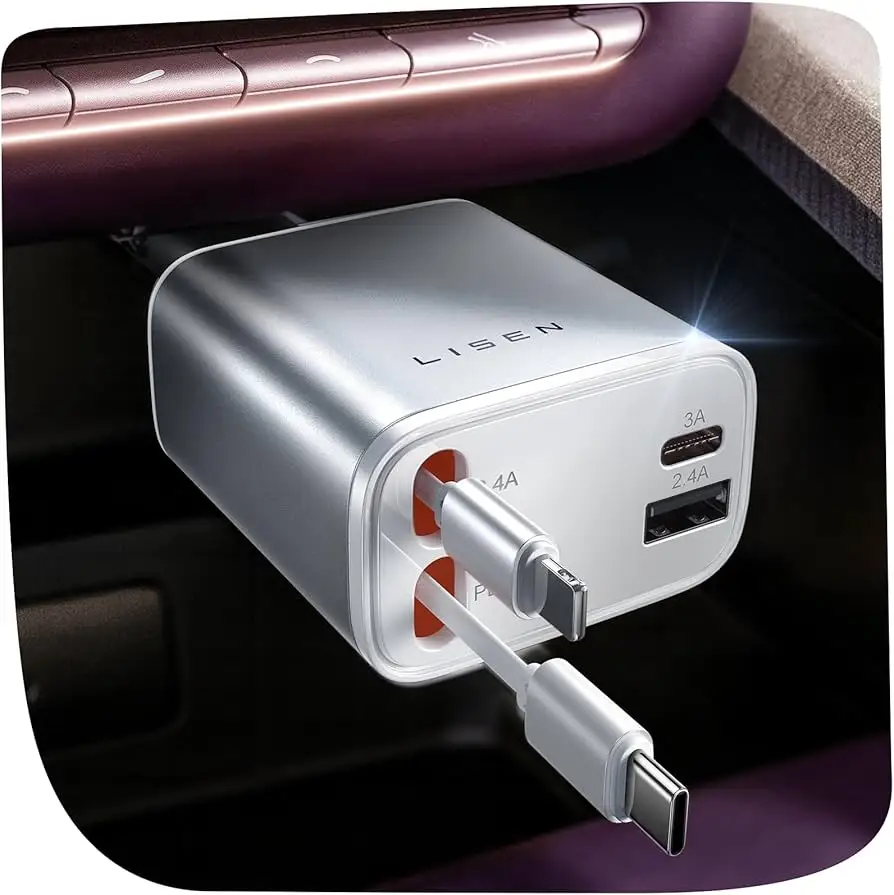
On the marketing side, the product pitch is confident: “57W USB C car charger” with a “fast 30W PD USB C retractable cable,” plus extra ports to “enable charging of three devices.” The feedback that’s available supports the broad direction—fast charging and less clutter—while also hinting at the one thing retractables always risk: the mechanism.
Quick Verdict
Yes/Conditional — Yes if you want a neat, built-in retractable USB‑C cable and typically charge one primary device; conditional if you need flawless retraction long-term or expect every device/phone combination to “just work” without compatibility caveats.
| What buyers highlight | Evidence (source) | Why it matters |
|---|---|---|
| Cord clutter relief | “Solves my problem with cords!” (Kimola/Amazon review preview) | For commuters and rideshare drivers, a retractable cable keeps the console area clear. |
| Fast charging feel | “very fast charging” (Kimola/Amazon review preview) | Helps navigation-heavy users keep battery from dropping mid-drive. |
| Android compatibility reports | “works great for my android. love the retractable cord.” (Kimola/Amazon review preview) | Suggests it’s not iPhone-only in practice (within USB‑C ecosystem). |
| Value perception | “great price for a multi function car tool.” (Kimola/Amazon review preview) | Buyers frame it as a practical all-in-one solution. |
| Retraction reliability concerns | Kimola notes “some users experienced issues with the retraction mechanism.” | The one failure mode that can undermine the whole “tidy” promise. |
Claims vs Reality
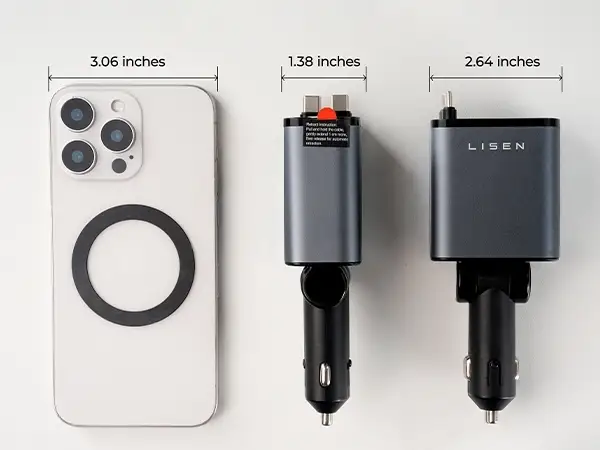
The first big promise is compactness and fit. The official copy pushes “60% less space, ultra mini,” arguing the redesign avoids interfering with gear shifts and fits “all vehicle models currently on the market.” While the provided user quotes don’t directly mention gear-shift clearance, the broader “less clutter” theme appears repeatedly—buyers describe it as a fix for messy cables rather than a bulky accessory. The lived experience, in other words, matches the intent of the mini redesign, even if specific fitment anecdotes aren’t present in the snippets.
The second headline claim is speed: “charging… from 0% to 80% in 30 minutes” (for certain phones) with a “30W PD” retractable USB‑C cable. The user feedback excerpts align with that perception, even if they don’t quantify percentages. One reviewer previewed by Kimola said: “very fast charger. keeps phone fully charged while using it all day for navigation. love the retractable function.” That’s a real-world scenario—screen on, GPS running—where “fast charging” isn’t just a benchmark; it’s the difference between arriving with battery left or limping to the destination.
The third claim is reliability on rough roads: a “double locking” mounting structure “to ensure that the charging will not be cut off… even on bumpy roads.” The available feedback doesn’t confirm or refute that specific “bumpy roads” promise for this charger. But across Lisen’s broader ecosystem on Trustpilot, stability language is common—“holds my phone steady even on bumpy roads” and “very stable stand”—though those comments appear tied to mounts/stands rather than the retractable charger itself. The gap here is evidence: the marketing makes a bold continuity claim, but the most direct user narrative in the dataset focuses more on cable management and speed than on “no cut-off” performance.
Cross-Platform Consensus
Universally Praised
Digging deeper into the available feedback, the clearest consensus isn’t about watts—it’s about order. The retractable cord is described as a practical fix for everyday annoyance, especially for people who hate loose cables in the cabin. A reviewer in the Kimola/Amazon preview put it plainly: “Solves my problem with cords!” For commuters who toss a phone into the cupholder between stops, that kind of “always there, never tangled” setup is the actual feature.
For navigation-heavy drivers, the charger’s perceived speed shows up as a quality-of-life win. One Kimola/Amazon excerpt reads: “very fast charger. keeps phone fully charged while using it all day for navigation.” That’s an important distinction: it’s not just “charges quickly when idle,” but “keeps up while the phone is working,” which matters for delivery drivers, road-trippers, and anyone running brightness high with maps streaming.
There’s also a theme of “works well across devices,” at least within the USB‑C world. One previewed review says: “works great for my android. love the retractable cord.” That kind of comment matters for mixed-device households (iPhone 15/16 users plus Android users) where the car becomes a shared charging station.
Finally, value-for-money appears as a repeated framing. A Kimola/Amazon preview quote: “great price for a multi function car tool.” That’s not just about price—it’s about the psychological relief of consolidating: one accessory that reduces clutter and handles the daily charge routine.
After those narratives, the core praised themes can be summarized as:
- Retractable cable reduces cabin clutter (Kimola/Amazon)
- Fast charging perception during real use (Kimola/Amazon)
- Works for USB‑C Android users too (Kimola/Amazon)
- Good value as an all-in-one car accessory (Kimola/Amazon)
Common Complaints
The biggest recurring risk signal is exactly what you’d expect from a retractable: the mechanism. Kimola’s summary notes that “some users experienced issues with the retraction mechanism.” Even without detailed “what failed and when” anecdotes in the provided text, that single line matters because it speaks to long-term satisfaction: if the retraction starts sticking, the product stops being “tidy” and becomes yet another cable problem.
Another complaint category is baked into the official compatibility note: “the built-in USB C cable can only be used to charge iPhone 15/16 series… and other Android products” and “not compatible with iPhone models below 15.” That’s not a user gripe in the excerpts, but it’s an obvious mismatch risk for families still running iPhone 14/13/12 devices. In practice, people may still use the extra USB‑C/USB‑A ports for older iPhones with their own cables, but the “built-in cable” convenience is restricted.
A third friction point is behavioral: the product instructions say you must “pull the cable, extend 1 cm, then release for automatic retraction.” That implies a learning curve. For users who expect “pull and it snaps back” without thinking, misuse can feel like a defect. The dataset doesn’t contain a direct quote about learning the pull/release step, but the presence of the instruction suggests real support burden.
Summarized complaint themes from what’s provided:
- Retraction mechanism reliability issues appear in user sentiment (Kimola/Amazon)
- Compatibility caveats can surprise older iPhone owners (Official specs)
- Retracting requires a specific pull/release behavior (Official specs)
Divisive Features
The multi-device story is a bit split—mostly because of how brands describe power sharing versus how people interpret it. The product positions itself as able to “enable charging of three devices,” and the broader LISEN car charger lineup includes notes like “cannot fast charging 2 devices simultaneously” on a different LISEN model page. Without direct user quotes about multi-device performance on this 57W retractable model, the “divisive” angle is expectation-setting: some drivers buy it for a solo daily commute, others want a true family road-trip hub.
There’s also a subtle spec inconsistency across sources: official marketing text says “60% less space,” while a retail-deal writeup describes “75% less space.” While that’s not user feedback, it’s a reminder that the messaging varies depending on where you read it—meaning buyers may walk in with inflated expectations about just how “ultra mini” it feels.
Trust & Reliability
On Trustpilot, the visible quotes skew positive and emphasize “premium” feel and stability—but they also appear to cover a wide range of Lisen products, not specifically this retractable 57W charger. Customers there say things like “feels premium” and “solid value,” which supports the brand’s general perception as competent and not flimsy.
For long-term durability, the most relevant reliability signal in the provided dataset is the Kimola/Amazon note: “some users experienced issues with the retraction mechanism.” What’s missing from the supplied excerpts are true “6 months later” Reddit-style follow-ups for this exact product; the dataset’s “Reddit” section appears to contain product copy and a deal article rather than community posts. The net result: the best available “trust” narrative is that many buyers love the concept, but the retracting mechanism is the known point of fragility.
Alternatives
Only one clear competitor-like reference appears in the data: other LISEN car charger models, particularly a non-retractable “54W” dual-port adapter and another LISEN “USB C & L” charger.
If the retractable mechanism worries you, the simpler LISEN car charger 54W dual-port listing emphasizes a “tiny thumb-sized body” and all-metal shell, and it explicitly notes a limitation: “cannot fast charging 2 devices simultaneously.” That alternative is less about cable management and more about a compact plug plus your own cables—better for people who already have a favorite cord and just want a small, heat-resistant adapter.
For users who need both USB‑C and Lightning built in, the LISEN USB C & L car charger product page leans into “2-in-1” compatibility and higher total wattage claims (like “96W”), plus a coiled design rather than fully retractable. That may suit mixed iPhone generations (Lightning + USB‑C) more cleanly, at the cost of bulk and a different kind of cable management.
Price & Value
Pricing signals vary by channel. The retractable 57W model is shown at $19.99 with a crossed-out $29.99 in the provided product text. A deal writeup highlights it as low as “$11” with a promo code, calling out the appeal of “gets rid of messy and tangled wires.”
On resale and market pricing, the provided eBay data focuses on listings for other LISEN chargers (including a “60W dual USB C” item and a separate LISEN car charger listing at higher prices). That suggests a general aftermarket presence for the brand, but it doesn’t provide a clear resale trend line for this exact retractable 57W mini model.
Community-style buying advice in the dataset is mostly deal-driven: if you see a legitimate promo, it can shift the value proposition from “nice convenience” to “impulse upgrade.” The user-story angle remains consistent: people aren’t paying for raw wattage alone—they’re paying to eliminate cable mess.
FAQ
Q: Does the built-in retractable cable work with older iPhones (iPhone 14/13/12)?
A: No—official specs say the built-in USB‑C cable is “not compatible with iPhone models below 15.” You can still use the extra ports with your own cable for older iPhones, but the built-in retractable convenience is aimed at USB‑C iPhones and Android devices.
Q: Is it actually fast enough to charge while using GPS navigation?
A: Feedback excerpts suggest yes. One reviewer in the Kimola/Amazon preview said: “very fast charger. keeps phone fully charged while using it all day for navigation.” That scenario implies it can keep up with heavy screen-on use, not just slow trickle charging.
Q: What do buyers like most about it?
A: The retractable cord and reduced clutter dominate the praise. A Kimola/Amazon preview quote says: “Solves my problem with cords!” Another says: “works great for my android. love the retractable cord.” The common theme is a tidier car setup.
Q: Are there known reliability issues?
A: Some reports point to the retracting mechanism. Kimola’s summary of Amazon reviews states that “some users experienced issues with the retraction mechanism.” If long-term mechanical reliability is your top priority, a non-retractable compact adapter may feel safer.
Final Verdict
Buy if you’re a daily commuter, road-tripper, or rideshare driver who hates console clutter and wants a built-in retractable USB‑C cable—especially if you’ve got an iPhone 15/16 or a USB‑C Android. Avoid if you need guaranteed long-term retraction durability or your household mainly uses older Lightning iPhones and you were counting on the built-in cable.
Pro tip from the specs: follow the retraction instruction—“pull the cable, extend 1 cm, then release”—because the mechanism is part of the product’s core promise, and the user feedback shows it’s also where problems can surface.