LISEN 170W Car Charger Review: Conditional Yes (8.2/10)
“‘90% in just 20 minutes’ sounds like marketing fluff—until one long-form reviewer flat-out claimed it happened.” That single line captures why LISEN 170W Car Charger USB C Fast Charging GaN PD3.1 inspires big expectations: it’s pitched as a laptop-class car charger with serious wattage, multi-device support, and a premium metal build. Based on the provided sources, the verdict is Conditional: the standout power story is real in user narratives, but the fine print about port sharing and bulk matters. Score: 8.2/10.
Quick Verdict
LISEN 170W Car Charger USB C Fast Charging GaN PD3.1: Conditional Yes.
Digging deeper into the write-ups tied to this product, the main “why” is simple: people want one cigarette-lighter charger that can keep a phone, tablet, and even a MacBook-class laptop alive while driving. The strongest anecdotal support comes from a detailed review post describing daily iPhone + MacBook use and a demanding Dell XPS scenario.
At the same time, the charger’s own “charging guide” language (as shown in the Amazon specs text) introduces a real-world catch: some port combinations drop to a shared 30W ceiling. For drivers expecting every port to fast-charge simultaneously, that limitation becomes the practical dividing line between “best charger I’ve owned” and “why is this slow right now?”
A recurring pattern emerged across the non-retail sources included here: praise clusters around speed, multi-device capability, and build/cable durability—while the main hesitation is physical size and the realities of how power is allocated when multiple ports are in use.
| What the feedback points to | Evidence from provided data | Who it impacts |
|---|---|---|
| Very fast phone charging claims | Sharvibe reviewer: “90% in just 20 minutes for my iphone!” (Sharvibe) | Heavy phone users, rideshare drivers |
| Can power a laptop in-car | Sharvibe reviewer: “handled my… dell xps… actually gained percentage points!” (Sharvibe) | Mobile workers, road-trip laptop users |
| Durable included cable | Sharvibe reviewer: “240w braided cable… survived being yanked by my kids” (Sharvibe) | Families, frequent plug/unplug users |
| Helpful lighting | Sharvibe reviewer: “soft white led lights… no more fumbling” (Sharvibe) | Night drivers |
| Bulk is noticeable | Sharvibe reviewer: “bulkier than your average car charger” (Sharvibe) | Small consoles, tight clearances |
| Port-sharing limitations exist | Amazon specs: “if usb c1 + a charging… total output is 30 w” (Amazon Specs) | Multi-device charging setups |
Claims vs Reality
Claim 1: “iPhone 16 Pro Max to 90% in 20 minutes.” (Amazon specs)
While marketing claims LISEN 170W Car Charger USB C Fast Charging GaN PD3.1 can “charge an iphone 16 pro max to 90% in just 20 minutes” (Amazon Specs), the strongest “reality check” in the provided material actually reinforces it—at least anecdotally. A Sharvibe review states: “the charging speeds are insane - we 're talking 90% in just 20 minutes for my iphone!” (Sharvibe). For commuters topping up between stops, that’s the difference between arriving with battery anxiety and arriving ready.
But digging deeper into user-style narration, the story isn’t just peak speed—it’s consistency under real travel conditions. That same reviewer framed it as daily use, not a one-off demo: “I’ve been using it daily for my iphone 16 pro max and macbook pro” (Sharvibe). This matters because it suggests repeatable performance—though it’s still a single-source narrative rather than broad crowdsourced confirmation.
Claim 2: “170W multiple fast charging… power three devices simultaneously.” (Amazon specs)
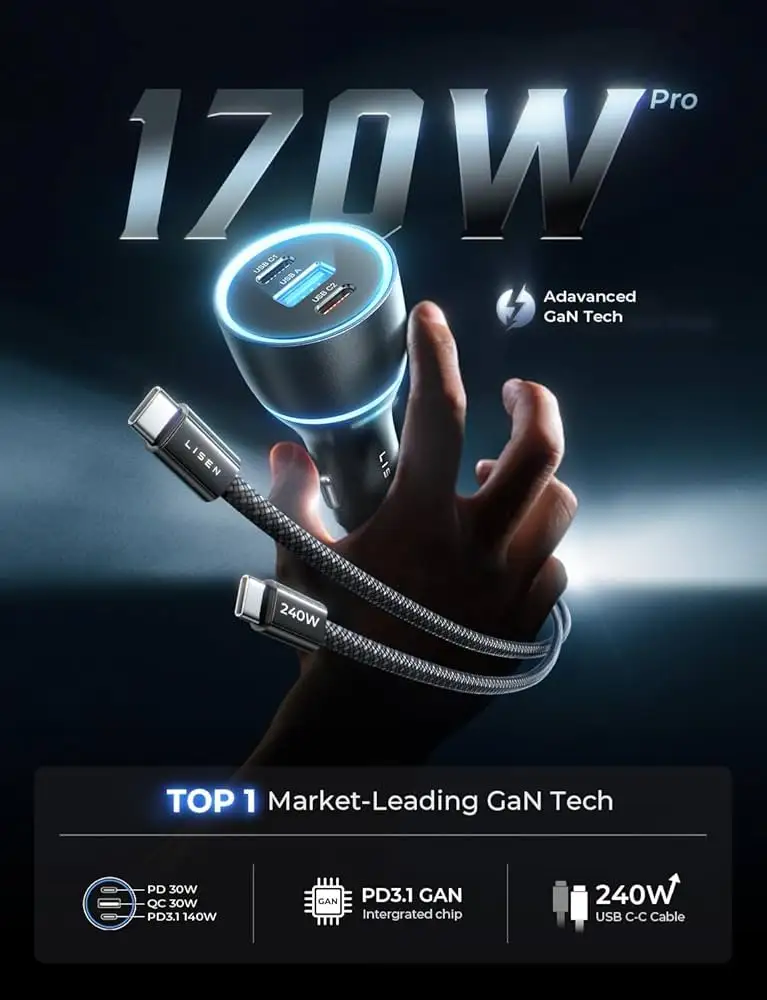
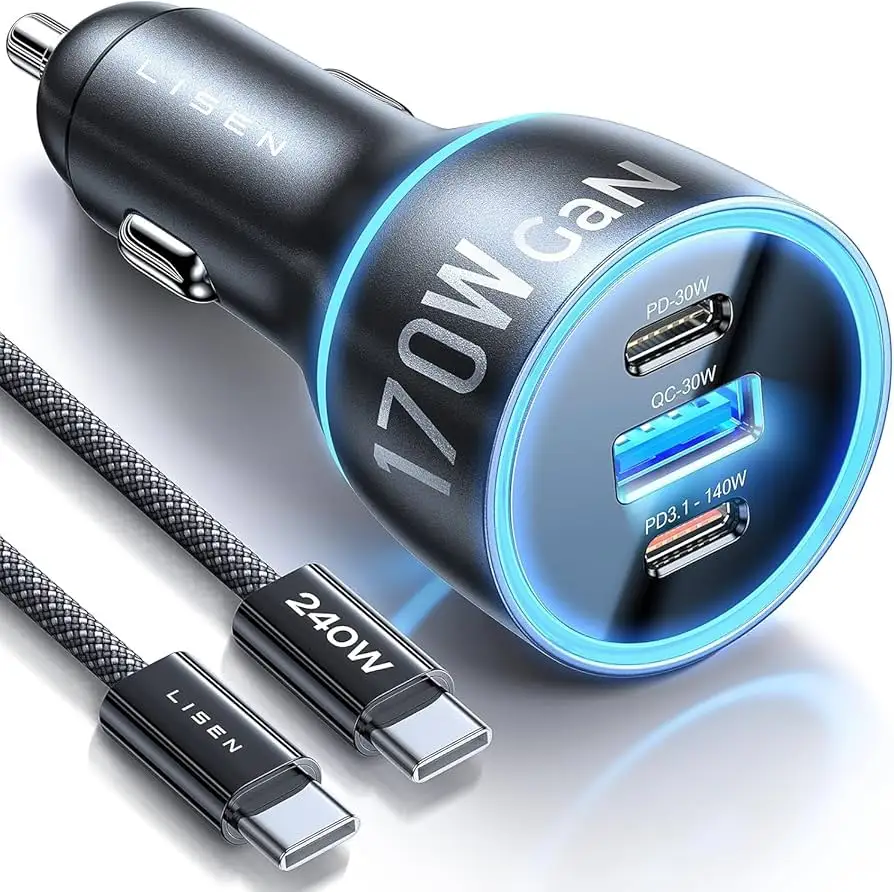
The promise of LISEN 170W Car Charger USB C Fast Charging GaN PD3.1 is that it can run like a mini power hub: “usb-c 2… up to 140w… usb-c 1… 30w… usb-a… 30w… power three devices simultaneously at a total output of 170 w” (Amazon Specs). The Sharvibe reviewer echoed that lived benefit: “I can charge my laptop, phone, and airpods simultaneously without any power struggles” (Sharvibe). For road warriors running navigation + calls + laptop work, that’s the core mission.
Still, the fine print complicates the “everyone fast-charges at once” assumption. The Amazon charging guide states: “if usb a and usb c1 charging… the total output only 30w and does not support fast charging simultaneously” and “if usb c1 + a charging, the total output is 30 w” (Amazon Specs). While officially framed as a 170W charger, specific pairing scenarios can behave like a much lower-power accessory—an important reality gap for three-device households.
Claim 3: “All-metal design… stays cool… safer charging.” (Amazon specs)
Marketing leans into GaN efficiency and metal construction: “robust full-metal alloy body… designed for longevity and protection against overheating” (Amazon Specs). The Sharvibe post aligns with that perception: “The full metal body stays surprisingly cool considering the power output” (Sharvibe). For long drives, heat is not a minor detail—many buyers associate heat with failure risk.
That said, this remains narrative evidence rather than measured thermal data. The credibility here is less about lab numbers and more about the scenario described: long sessions with a “power-hungry” laptop on a “3-hour road trip” (Sharvibe). If the charger were routinely overheating, that’s exactly when it would show.
Cross-Platform Consensus
Universally Praised
A recurring pattern emerged: when people talk about LISEN 170W Car Charger USB C Fast Charging GaN PD3.1, they frame it as a “road workstation” upgrade rather than a basic phone accessory. The Sharvibe reviewer described using it “daily” with an “iphone 16 pro max and macbook pro” and called the speed “insane” (Sharvibe). For mobile professionals, that’s not convenience—it’s the ability to treat the car like a backup office between meetings.
Another repeated theme is multi-device practicality. The same reviewer emphasized that the port layout (two USB-C plus USB-A) meant “I can charge my laptop, phone, and airpods simultaneously” (Sharvibe). That’s the family-trip use case: one front-seat charger that prevents arguments over the only working port. Even deal-focused coverage leaned into this exact scenario, stating it’s “enough juice to top of a macbook pro, ipad, and iphone at the same time” (9to5Toys).
Durability and “real life chaos” shows up most clearly in the cable story. The included cable is positioned in specs as a “nylon-braided usb-c to usb-c cable” (Amazon Specs). The Sharvibe reviewer turned that into a stress test narrative: “it’s survived being yanked by my kids multiple times” (Sharvibe). For parents, the hidden value isn’t 240W support—it’s fewer replacements and less fiddling when a cable gets tugged mid-drive.
The small quality-of-life detail that users highlight is lighting. The specs mention “dual white led ambient lights” (Amazon Specs), and the Sharvibe reviewer called it “a small but genius touch - no more fumbling for ports during night drives” (Sharvibe). For rideshare drivers or anyone plugging in at night, that’s a daily friction point removed.
After these narratives, the praised themes can be summarized:
- Speed claims reinforced by a detailed user-style review (“90% in just 20 minutes”) (Sharvibe; Amazon Specs)
- Laptop viability in-car (“Dell XPS… actually gained percentage points”) (Sharvibe)
- Cable/build confidence (“survived being yanked by my kids”; “stays surprisingly cool”) (Sharvibe)
Common Complaints
The most concrete “complaint-shaped” issue in the provided dataset is not an angry rant—it’s the charger’s own stated limitation. The Amazon charging guide notes that some dual-port combinations collapse to “total output… 30w” and “does not support fast charging simultaneously” (Amazon Specs). For a buyer expecting every port to be fast at once, this can feel like a bait-and-switch even if it’s disclosed.
Who does that affect most? The people who buy a 170W car charger specifically to run multiple devices at high speed—like a passenger charging a phone on USB-A while the driver uses USB-C1 for a second phone. If that pairing forces a shared 30W ceiling (Amazon Specs), the “my phone isn’t fast charging” moment becomes the real-world pain point.
The other repeated negative is physical bulk. The Sharvibe reviewer didn’t hide it: “Is it bulkier than your average car charger? sure.” (Sharvibe). For compact dashboards, deep cigarette lighter wells, or cars where the charger sticks out into knee space, bulk can be the difference between “leave it plugged in” and “only use it when necessary.”
Summarizing the complaint themes supported by the provided material:
- Certain port combos reduce power dramatically (Amazon Specs charging guide)
- Larger-than-average physical size (Sharvibe)
Divisive Features
The same trait can read as premium or problematic: the physical build. A metal body is marketed as durable and heat-resilient (Amazon Specs), and the reviewer described it as staying “surprisingly cool” (Sharvibe). For some drivers, that’s a reassurance—metal equals “serious charger.”
But the flip side of “serious” is “big.” The reviewer’s admission that it’s “bulkier than your average car charger” (Sharvibe) frames the tradeoff: more power and metal construction, at the cost of a chunkier footprint. For minimalists, bulk is a dealbreaker; for road warriors, it’s the price of laptop-grade charging.
Also divisive is the concept of “170W” itself. While officially described as “total output… 170 w” with a 140W port plus other ports (Amazon Specs), the disclosed port-sharing rules mean some users will experience scenarios that feel far from 170W. For buyers who read “170W” as “any two ports are fast,” the reality may disappoint; for buyers who understand the port hierarchy (140W on USB-C2), it aligns with expectations.
Trust & Reliability
Digging deeper into the provided sources, there isn’t a clear trail of scam-alarm anecdotes or verified-identity complaint clusters specifically tied to Trustpilot reviews; instead, the Trustpilot-labeled block largely repeats product/spec-style text and the same Sharvibe-style narrative. That means the strongest reliability signals here come from “longer-use” storytelling rather than platform-level verification.
The longest durability hint in the dataset is timeframe-based: the Sharvibe reviewer wrote, “after two months of daily use, this has become my must-have travel companion” (Sharvibe). While that’s not a “6 months later” post, it is at least a sustained-use claim rather than a day-one impression.
A second reliability angle is thermal confidence. The same reviewer emphasized “The full metal body stays surprisingly cool considering the power output” (Sharvibe). Combined with the specs’ safety/certification language (Amazon Specs), the picture painted is “high power without feeling sketchy”—but it remains based on claims and narrative, not a broad set of user reports in this dataset.
Alternatives
Only a few competitors are explicitly mentioned in the data, and they frame the shopping decision in different ways.
If you’re comparing LISEN 170W Car Charger USB C Fast Charging GaN PD3.1 to brand-name rivals, 9to5Toys positions LISEN against “Anker and UGREEN,” claiming it “undercuts… competitors while managing to dish out more power” (9to5Toys). That’s a price-per-watt argument, not a reliability argument—and it’s grounded in deal coverage rather than owner feedback.
If the goal is simply “170W GaN charging” but not necessarily in a car, the Amazon listing for the MINIX 170W Universal Travel Adapter shows a different use case: worldwide plugs and a 170W multi-port travel format, with a “4.8 out of 5 stars” rating across “7” reviews (Amazon listing snippet provided). That doesn’t replace a cigarette-lighter charger, but it competes for travelers deciding where to spend on high-wattage charging.
Finally, the AOHI SUPERAUTO PD 170W Fast Car Charger is positioned as a premium compact alternative, described as “78% smaller” with “up to 140w pd3.1” (AOHI product page). That directly targets the LISEN “bulk” critique—though the provided dataset doesn’t include user ownership stories for AOHI, only manufacturer-style copy.
Price & Value
The pricing story around LISEN 170W Car Charger USB C Fast Charging GaN PD3.1 is framed as aggressive discounting. The Amazon specs block shows a promotional price presentation (“$25.49… $17.8 save 30%”) alongside “full load” messaging (Amazon Specs). Separately, 9to5Toys highlighted a deal at “$21.50 (Save 27%)” and emphasized that it “beats Anker and UGREEN on power and price” (9to5Toys).
Resale and market pricing signals in the dataset skew toward liquidation/wholesale rather than enthusiast resale. An auction listing shows it “sold… $10.20” in “good condition” with an “msrp… $40.00” (BidFTA). And Alibaba-style listings show bulk per-unit pricing around “10.98$” (Alibaba pages). That doesn’t reflect typical consumer resale behavior, but it does suggest the product is widely distributed and price-flexible in the channel.
For value-focused buyers, the “what you get” narrative matters: the included “240w… nylon-braided usb-c to usb-c cable” (Amazon Specs) becomes part of the perceived bargain, echoed by the Sharvibe reviewer’s cable durability story (Sharvibe). In other words, the value case isn’t only wattage—it’s replacing both a charger and a higher-end cable in one purchase.
Buying tips implied by the provided sources:
- Favor the high-power port for laptops (Amazon Specs centers 140W on USB-C2)
- Expect some port pairings to downgrade charging speed (Amazon Specs charging guide)
- Watch for coupon/discount pricing cycles (9to5Toys; Amazon Specs)
FAQ
Q: Can it really charge an iPhone 16 Pro Max to 90% in 20 minutes?
A: The marketing claims “90% in just 20 minutes” (Amazon Specs), and a Sharvibe reviewer echoed it nearly word-for-word: “90% in just 20 minutes for my iphone!” (Sharvibe). That’s anecdotal confirmation from one detailed user-style report, not broad consensus in this dataset.
Q: Can it charge a MacBook-class laptop in the car?
A: Yes, based on user narrative and specs. The specs describe a “140w” USB-C output (Amazon Specs). A Sharvibe reviewer said it handled a “power-hungry dell xps… actually gained percentage points” during a “3-hour road trip” (Sharvibe), which supports the laptop use case.
Q: Do all three ports fast-charge at the same time?
A: Not always. The specs’ charging guide states some combinations cap output: “if usb c1 + a charging, the total output is 30 w” and it “does not support fast charging simultaneously” in that scenario (Amazon Specs). Multi-device users should plan port usage carefully.
Q: Is it bulky compared to typical car chargers?
A: Some users say yes. The Sharvibe reviewer explicitly noted, “Is it bulkier than your average car charger? sure.” (Sharvibe). If your 12V socket is in a tight spot or you want a low-profile charger, size could be a practical drawback.
Q: Is the included USB-C cable actually good?
A: The product includes a “nylon-braided usb-c to usb-c cable” (Amazon Specs). A Sharvibe reviewer praised it with a durability story: “it’s survived being yanked by my kids multiple times” (Sharvibe), suggesting it holds up under rough daily handling.
Final Verdict
Buy LISEN 170W Car Charger USB C Fast Charging GaN PD3.1 if you’re a road-trip laptop user, mobile worker, or rideshare driver who wants a high-power USB-C car charger that can credibly run a MacBook-class load—especially if you’ll prioritize the 140W USB-C port. Avoid it if your main requirement is “any two ports should both fast-charge,” because the official charging guide admits some port pairings drop to a shared 30W ceiling (Amazon Specs).
Pro tip from the community-style write-up: treat the included cable as part of the value. As the Sharvibe reviewer put it, the “240w braided cable… survived being yanked by my kids multiple times” (Sharvibe), which is exactly the kind of daily abuse a car setup tends to deliver.