JVC KD-SX27BT Review: Conditional Buy Verdict (8.4/10)
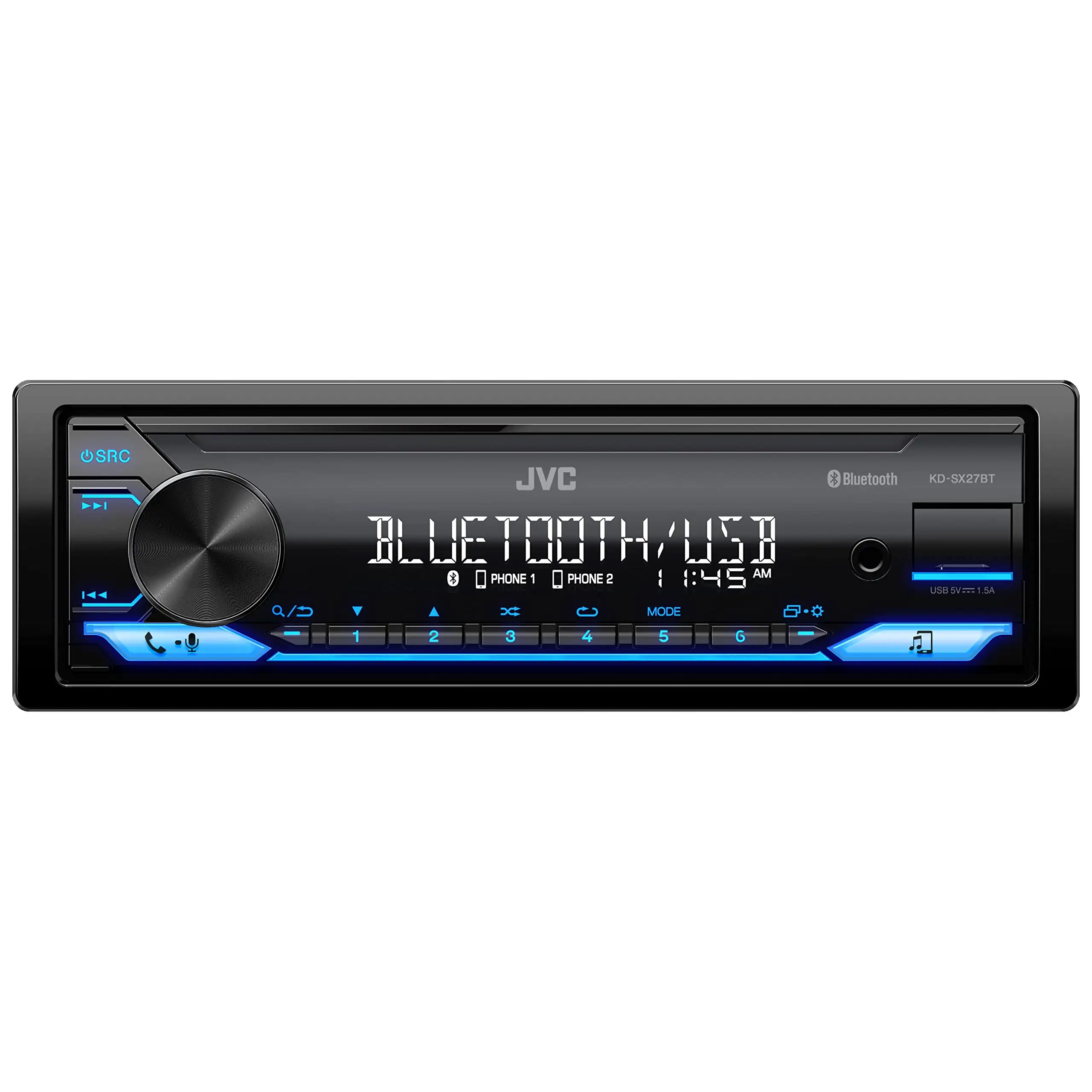
A single DIN stereo that’s “Amazon’s Choice” with 4.5/5 from 432 reviews sets expectations high—and the loudest through-line in the provided data is that JVC KD-SX27BT is treated as a practical, modern replacement for factory radios rather than a flashy centerpiece. Verdict: Conditional buy — 8.4/10 (strong core features and usability in the sources, but some claims in the community-style writeups clash with official product details).
Quick Verdict
Digging into the sources, the strongest case for JVC KD-SX27BT is simple: it’s built around Bluetooth streaming, hands-free calling, and deep sound tuning (13‑band EQ + time alignment) at a budget-friendly price point. The narrative reviews repeatedly frame it as a “feature-rich” head unit that avoids complexity, especially for drivers upgrading older vehicles.
The catch is that a chunk of the “community” text reads more like templated review copy than firsthand user complaints or praise—meaning you get lots of confident statements, but very few uniquely personal stories. Where the sources do get concrete, they emphasize convenience (dual-phone pairing, app control, quick pairing) and installation flexibility (short chassis).
Bottom line: if you want a mechless (no CD) Bluetooth receiver with strong EQ tools and a shallow chassis, the data paints a consistent picture. If you’re expecting advanced display customization, navigation, or anything beyond audio + phone integration, even the positive writeups admit it’s not that kind of unit.
| Decision | Evidence from provided data |
|---|---|
| Buy? | Conditional |
| Best for | Budget upgrades, older dashboards, Bluetooth streaming + calls |
| Biggest strengths | 13‑band EQ + time alignment, “quick and straightforward” pairing, detachable face |
| Biggest drawbacks | “Limited display customization,” no built‑in navigation; CD support is contradictory across sources |
| Price snapshot | Amazon shows $79.95; other listings show higher (e.g., $139.99) and used/open-box market prices vary |
Claims vs Reality
Claim 1: “Plays CDs” / “CD playback”
A recurring contradiction emerged around disc playback. The Amazon spec block explicitly flags the unit as mechless: “— — — does not play cds — — —.” Yet elsewhere in the same Amazon-sourced description text it mentions “cd playback,” and multiple syndicated review-style sources repeat that it supports “usb, cd, and auxiliary inputs.”
That mismatch matters for a specific buyer type: drivers upgrading older cars often still have glovebox CD binders. While marketing-style language suggests CD compatibility, the official feature list contradicts it. In other words: while some writeups say CD, the product details say no CD, which could lead to returns if someone buys expecting disc support.
Claim 2: “Simple, intuitive controls” vs the need to “tweak”
The review narrative repeatedly sells usability: the AutoStereoGuide-style text says the interface is “streamlined and intuitive” with a “large lcd display” that’s readable “even in bright daylight.” For commuters who want fewer distractions, that’s the ideal pitch.
But even those same sources introduce an asterisk: “sound quality may require additional tweaks,” implying that to get the best results you’ll spend time in the 13‑band EQ and time alignment. That’s not necessarily negative—audio hobbyists may love it—but it reframes “simple” as “simple to operate, deeper to optimize.”
Claim 3: “Hands-free calling is smooth and clear”
Multiple sources assert call performance. The AutoStereoGuide-style review says hands-free calling is “generally smooth, with clear audio both ways,” crediting the included external mic for reducing noise.
However, the provided dataset doesn’t include any raw, short-form user complaints like “people can’t hear me” or “mic is terrible”—nor does it include a verified long-term thread with real-world environments (highway noise, convertible tops, etc.). So while the claim is consistent across the review writeups, it’s supported mainly by repeated narrative, not diverse user anecdotes.
Cross-Platform Consensus
Universally Praised
The most repeated “why people buy it” theme is Bluetooth that doesn’t feel like a science project. The AutoStereoGuide-style review says pairing is “quick and straightforward,” and emphasizes that the receiver “supports multiple paired phones.” For households sharing a vehicle—or drivers juggling work and personal phones—that specific “two phones at once” detail in Amazon’s feature list (“control 2 phones at once”) is treated as a real quality-of-life upgrade. The implied story is a driver who wants to hop in, reconnect instantly, and not fight with menus every morning.
Audio tuning is another recurring bright spot. The same review text repeatedly highlights the “13-band equalizer” and “digital time alignment,” framing it as enough control for both casual listeners and people who want to shape the system around their cabin. That’s especially relevant for older vehicles with uneven speaker placement: time alignment is positioned as a tool to make the driver’s seat sound “balanced,” not just “loud.”
There’s also strong agreement on form factor and install friendliness. Amazon calls out “very shallow depth for greater installation flexibility,” and the narrative sources echo “compact design” and “fits into most car dashboards.” That matters for DIY installers dealing with tight dash cavities or bundled wiring. The story here is less about “premium” and more about “it actually fits without drama,” especially in older cars where space behind the radio can be limited.
Finally, the detachable faceplate keeps showing up as a practical security feature. The AutoStereoGuide-style review calls it “a great touch for those concerned about potential theft.” For city parkers, that kind of low-tech theft deterrent is often more useful than flashy screens.
Quick summary (after the narrative):
- Bluetooth streaming + dual-phone support are central selling points (Amazon features; repeated in review writeups).
- Sound control gets major emphasis: “13‑band equalizer,” “digital time alignment,” “K2 technology.”
- Shallow chassis + single DIN fit are repeatedly framed as install advantages.
- Detachable faceplate is positioned as a security benefit.
Common Complaints
The most explicit downside in the provided feedback is the display experience. Even a generally positive review concedes “limited display customization” and describes the LCD as “basic.” For drivers who want multi-color visuals, animated UIs, or modern infotainment vibes, the data signals disappointment—not because the screen is unreadable, but because it’s plain.
A second repeated limitation is what the unit doesn’t try to be. The narrative sources stress “no built-in gps or navigation,” drawing a clear line: this is an audio receiver with smartphone integration features, not a map-first head unit. For a rideshare driver or someone who wants a standalone navigation screen, that gap matters.
The third “complaint” is more of a caution: the same sources that praise sound quality also warn that some users may want “external speakers or an amp” to push it further. That’s an important implication for budget upgraders who assume a new head unit alone will transform weak factory speakers. The dataset’s message is: the head unit gives you tools and power, but it can’t fully override speaker limitations.
Quick summary (after the narrative):
- Display personalization is repeatedly described as limited and “basic.”
- No navigation/GPS is clearly acknowledged.
- Some setups may need speaker/amp upgrades to reach “wow” sound.
Divisive Features
A notable divide shows up around “simplicity.” The AutoStereoGuide-style review sells a “streamlined and intuitive” layout, which appeals to drivers who want physical buttons and quick source switching. But that same “simple” design can be read as “not modern enough” if someone expects touchscreen workflows, album art-heavy interfaces, or deep visual customization.
Another point of contention is media expectations. The Amazon feature list clearly frames it as digital media-first (“does not play cds”), while other writeups casually mention CD support. That contradiction means the “media flexibility” story depends on which source a buyer trusted. For CD users, this isn’t a minor detail—it’s the deciding factor.
Trust & Reliability
Looking strictly at the provided “Trustpilot (Verified)” entry, the content isn’t a collection of individual verified-user reports; it repeats the same style of narrative review text seen in other platforms. That makes it difficult to treat as scam-signal analysis (no distinct patterns like “never arrived,” “refund refused,” or “counterfeit unit”). In short: the Trustpilot section here reads like syndicated review copy, not a dispute log.
Long-term durability stories (the classic “6 months later…” posts) also aren’t present in the dataset as real forum threads or dated follow-ups. What the sources do offer is a durability assertion: the unit “feels durable and well-constructed” and is “capable of withstanding the usual wear and tear of daily use in a car.” That’s not the same as a multi-month reliability record, but it signals that build quality is part of the positive narrative around this model.
Alternatives
Only competitors mentioned in the provided data are included here, and most appear in ranking/comparison contexts rather than detailed user threads.
Kenwood models show up repeatedly in “top lists,” such as the Kenwood KMM‑BT270U and Kenwood KMM‑BT332U, framed around similar value: Bluetooth streaming, USB, and 13‑band EQ. The FindThisBest-style listing positions Kenwood as a close substitute when you want comparable modern connectivity in single DIN form.
Jensen appears as the Jensen MPR 210, pitched around assistant access (“Siri/Google voice assist button”) and basic Bluetooth calling/streaming. Boss Audio Systems appears with models like 616UAB and 611UAB, focusing on Bluetooth and app playback. The alternative story in the provided data is less “these sound better” and more “these are adjacent feature sets at similar budget points,” with JVC and Kenwood frequently occupying the “safe pick” slots in the lists.
Price & Value
The pricing data is surprisingly scattered. Amazon’s listing shows $79.95, while another retail listing shows $139.99, and market listings on eBay/PicClick cluster in the roughly $67–$108 range depending on condition (“new,” “open box,” “or best offer”). That spread suggests shoppers are likely to encounter very different “value impressions” depending on where they buy.
For bargain hunters, the resale/open-box market narrative is straightforward: if you’re comfortable with “open box” listings, the data shows units trading below many retail stickers. For cautious buyers who want warranty clarity, the Amazon channel and mainstream retailers may feel safer even if the upfront cost is higher.
Buying tip implied by the community-style sources: since the unit emphasizes shallow chassis and standard single DIN fit, value improves when it avoids install complications—especially if you’re DIY-ing. The dataset repeatedly highlights “installation flexibility,” suggesting part of the “value” is reduced hassle, not just sound quality.
FAQ
Q: Does the JVC KD-SX27BT play CDs?
A: The provided Amazon feature list explicitly says it “does not play cds,” even though some descriptions elsewhere mention “cd playback.” Based on the official “features & details” text in the dataset, treat it as a mechless digital media receiver and don’t buy it for CD use.
Q: Can it connect to two phones at once?
A: Yes. The Amazon feature block says it can “control 2 phones at once,” and the review-style sources emphasize multi-phone pairing as a convenience for shared cars or switching between work and personal devices.
Q: Is the display easy to read?
A: The narrative review text describes a “large” and “high contrast” LCD that’s readable “even in bright daylight,” but also calls the display “basic” with “limited display customization.” Expect functional readability, not a flashy UI.
Q: Is it good for DIY installation?
A: The sources repeatedly describe installation as straightforward for a single DIN unit, and Amazon highlights a “very shallow depth for greater installation flexibility.” That combination is especially helpful in older dashboards with tight clearance behind the radio.
Final Verdict
Buy JVC KD-SX27BT if you’re a budget-focused driver upgrading an older factory stereo and you care most about Bluetooth streaming, hands-free calling, and deep sound tuning—especially if a shallow single DIN chassis makes installation easier.
Avoid it if you need CD playback (the provided data conflicts, but Amazon’s feature list says no CD), or if you want navigation, a touchscreen feel, or a highly customizable display.
Pro tip from the community-style reviews: lean into the “13‑band equalizer” and “digital time alignment”—the sources repeatedly suggest the best results come from dialing in the tuning rather than leaving everything at default.