iOttie Velox Qi2 Mini Review: Fast Charge, Shaky Hold
“It’s been a roller coaster of love and frustration.” That one line captures the most consistent emotional arc around the iOttie Velox Qi2 Mini Wireless Charger Car Mount with MagSafe. Verdict: a genuinely fast-charging, satisfying-to-use mount that some people still don’t fully trust once roads (or long-term durability) get involved. Score: 7.4/10.
Quick Verdict
Conditional — worth it if you prioritize Qi2 charging speed and a clean, compact vent setup; questionable if you need pothole-proof phone retention or hate built-in cables.
| What real buyers/users focused on | Pros (what went right) | Cons (what went wrong) |
|---|---|---|
| Charging speed | “15w qi2 charging is legit fast” (Trustpilot) | Speed depends on alignment + compatible device/case (The Geek Church) |
| Magnetic hold | “That magnetic snap… super satisfying” (Trustpilot) | “Magnet strength seems inconsistent” on bumps (Trustpilot) |
| Vent attachment security | “This thing isn’t going anywhere” once installed (Trustpilot) | “Installation a workout” due to “thick silicone prongs” (Trustpilot) |
| Cable management | Built-in power approach can mean “consistent charging speeds” (MacSources) | “Permanently attached cable is annoying” (Trustpilot); “route and hide the cable” (MacSources) |
| Overall rating signal | Amazon listing shows 4.1/5 average (Amazon) | Some users expect more durability “for $50” (Trustpilot) |
Claims vs Reality
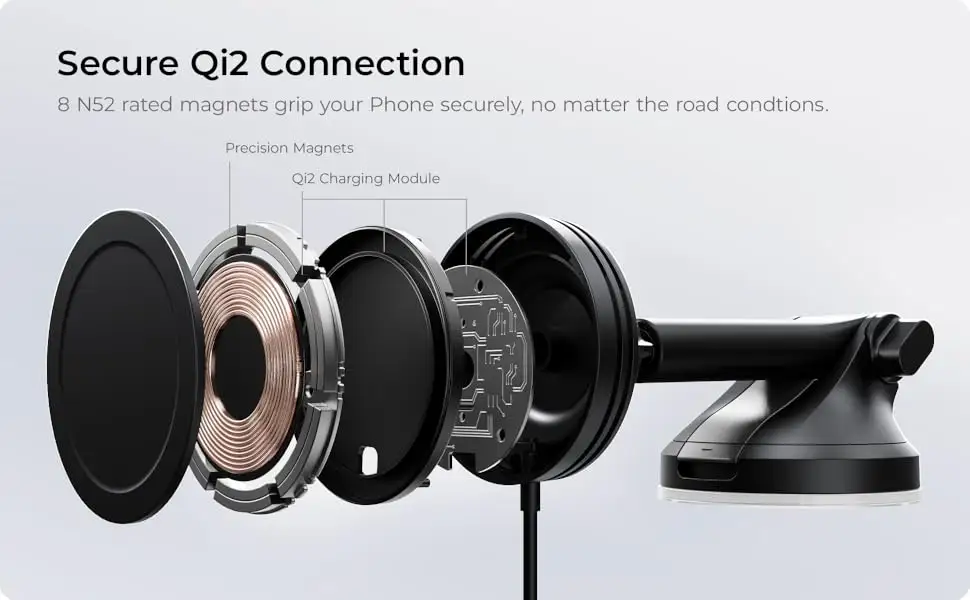
iOttie’s positioning leans hard on three promises: fast Qi2 charging “up to 15W,” a “powerful magnetic hold,” and “easy & secure installation” (iOttie product page; Amazon listing). Digging deeper into user reports, the charging promise is the one most cleanly validated—but the “secure hold” story gets more complicated once you bring in case choice, road conditions, and placement.
Claim #1: “Up to 15W” fast Qi2 charging.
A recurring pattern emerged: when the phone/case combo is right, people describe charging as not just adequate but meaningfully useful during navigation-heavy drives. Trustpilot reviewer Sarah Miller wrote: “The 15w qi2 charging is legit fast—my iPhone 15 Pro goes from 20% to 80% during my drive while running GPS.” For commuters and road-trippers, that’s not a lab-stat; it’s the difference between arriving with battery anxiety versus arriving with headroom.
At the same time, compatibility boundaries show up quickly in real-world anecdotes. The Geek Church’s reviewer (Techno_Mark) described a scenario where magnetic sticking didn’t work because “I have an older model of the Samsung,” adding that “it does work well with MagSafe compatible iPhones.” While the product is officially described as for “Qi2-enabled devices” and “MagSafe series iPhones” (iOttie; Amazon), the lived experience reinforces that this isn’t a universal charger/mount for any phone that can do wireless charging.
Claim #2: “Powerful magnetic hold… even on rough roads.”
The marketing is confident—“strong magnets hold your phone… even on rough roads” (iOttie product page; Amazon). But one of the most specific user stories pushes back on that blanket statement. Trustpilot reviewer Sarah Miller said: “With my slim MagSafe case, it holds fine on smooth roads, but add some bumps and suddenly I’m playing ‘catch the falling phone’.” That’s the sort of scenario that matters most to drivers: the moment you hit a pothole is exactly when you need the mount to be most reliable.
Even within that same experience, there’s nuance: she reported improved performance after changing placement—“better performance after repositioning the mount away from dashboard curves (pro tip!)” That suggests the “secure hold” isn’t only about magnet strength; it can be affected by geometry, mounting angle, and how perfectly the phone sits flush.
Claim #3: “Easy & secure installation.”
Here, the “secure” half gets more support than the “easy” half. Sarah Miller called the vent attachment “too secure,” explaining “those thick silicone prongs make installation a workout, but once it’s on? This thing isn’t going anywhere.” For drivers who don’t want mid-drive adjustments, that’s reassuring. For people who swap cars, move mounts frequently, or have delicate vent slats, “workout” installation reads like friction.
MacSources similarly framed installation as simple—“just slide the prongs onto your vehicle’s air vent blade”—but still flagged a different practical pain point: living with the cable afterward.
Cross-Platform Consensus
Universally Praised
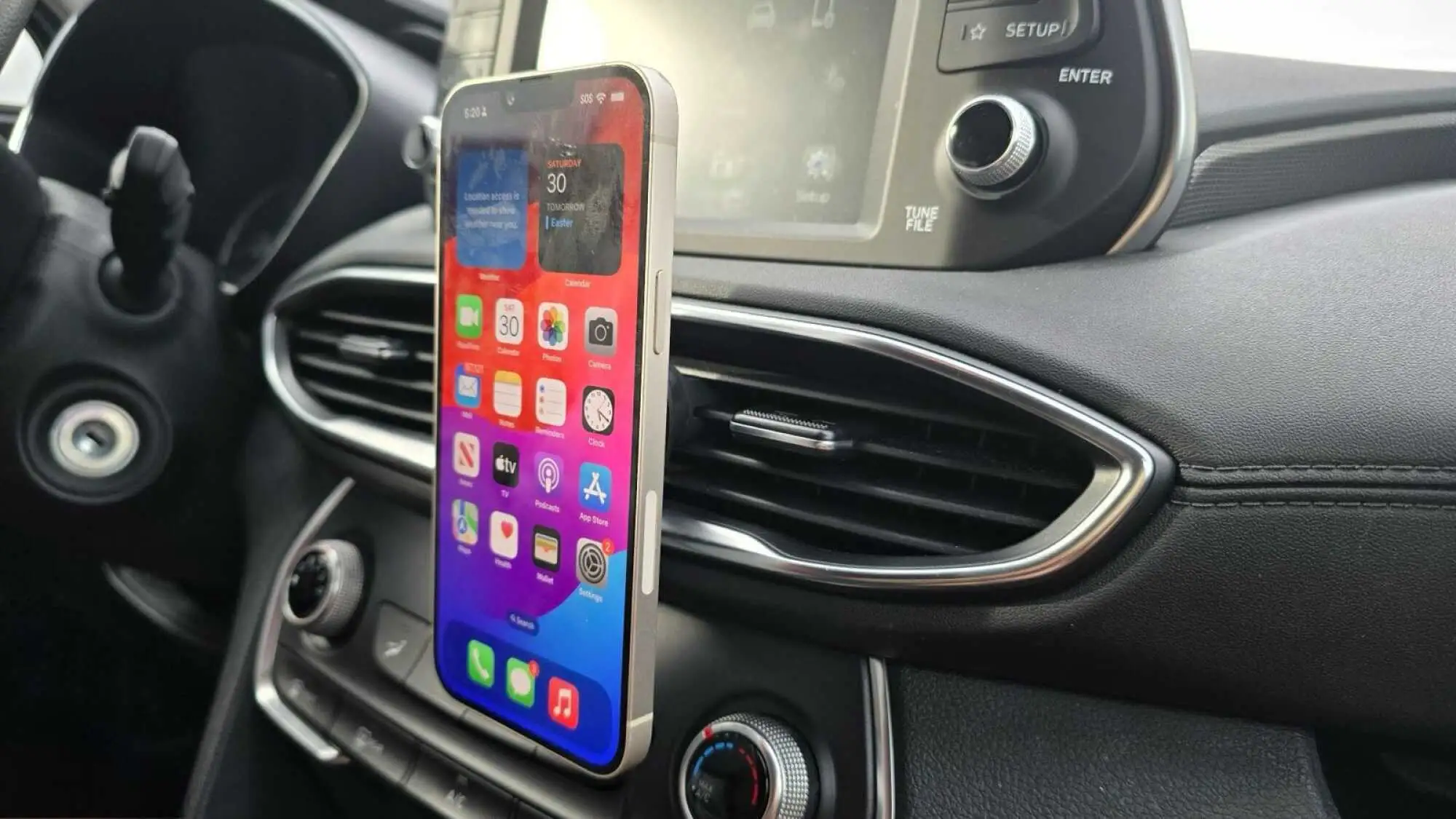
“That magnetic snap… super satisfying every single time.” Trustpilot reviewer Sarah Miller’s description is echoed more broadly in the tone of other writeups: when the system works, it feels frictionless—tap the phone on, it aligns, and charging happens without fiddling. For drivers who do multiple short trips, that one-hand “tap-and-go” flow is the real convenience, not the spec sheet.
Speed and “actually useful charging while driving” is the other consistent high point. Sarah Miller’s commute story—“20% to 80% during my drive while running GPS” (Trustpilot)—frames the mount as more than a holder. For heavy navigation users, rideshare drivers, and commuters running CarPlay/airplay-style setups, the difference between slow trickle-charging and meaningful battery recovery is the difference between carrying backup cables versus leaving them in the glovebox.
Several reviewers also gravitated toward the compactness and unobtrusiveness. MacSources described liking “the small form factor” and noted that “when your phone is on it, the charger is essentially invisible” (MacSources). For drivers who hate bulky windshield arms or anything blocking sightlines, “discrete” becomes a comfort/safety preference, not aesthetics alone.
Finally, once installed, the vent grip earns praise for staying put. Sarah Miller’s take—“once it’s on… isn’t going anywhere” (Trustpilot)—pairs with MacSources’ “easy installation” and steady use during a road trip: “I didn’t have any issues with the phone slipping off the mount or not gaining a charge” (MacSources). For road-trippers, that reliability over hours matters more than how it behaves in a 30-second demo.
Quick highlights people repeatedly tied to specific benefits:
- For commuters: “15w qi2 charging is legit fast” while running GPS (Trustpilot)
- For minimalists: “small form factor” and “essentially invisible” mount feel (MacSources)
- For set-it-and-forget-it drivers: vent grip that “isn’t going anywhere” once installed (Trustpilot)
Common Complaints
The most consequential complaint is trust in retention on rough roads. Despite marketing language about stability “even on rough roads” (iOttie; Amazon), Sarah Miller described the opposite experience during potholes: “magnet strength seems inconsistent” and “I’m playing ‘catch the falling phone’” (Trustpilot). For anyone in cities with bad pavement—or drivers of heavier phones—this is not a minor annoyance. It’s a safety distraction risk.
The second common frustration is cable management, specifically because the cable is not removable. Sarah Miller called it out plainly: “The permanently attached cable is annoying… awkward coil of excess cord stuffed in my console” (Trustpilot). MacSources reached a similar conclusion from a different angle: “The only downside… having to route and hide the cable,” adding that the built-in cable can help consistent charging but “you can’t detach the cable if you just want to use the mount as a mount and not a charger” (MacSources). For drivers who obsess over clean interiors, this becomes a daily irritation.
Durability anxiety shows up as a shadow over otherwise positive experiences. Sarah Miller said that after three months, hers hadn’t broken, but she’s “babying it after seeing those plastic pin complaints,” and concluded: “For $50, I expected more durable construction” (Trustpilot). Even without a detailed failure log in the provided dataset, the fact that she adjusted her behavior based on what she “saw” others report is a signal: long-term confidence isn’t universal.
Most repeated pain points, in users’ own words:
- “Magnet strength seems inconsistent” on bumps (Trustpilot)
- “Permanently attached cable is annoying” (Trustpilot)
- “For $50, I expected more durable construction” (Trustpilot)
Divisive Features
The vent mount design is polarizing because “secure” and “easy” can conflict. Sarah Miller framed it as “too secure” with installation that’s “a workout” (Trustpilot), while MacSources called installation “a breeze” and emphasized the lack of “complicated latches” (MacSources). For some cars and vent styles, the same tight prongs feel like reassurance; for others, they feel like a hassle.
Even the magnet experience splits depending on conditions. The same Trustpilot review that loved the tactile experience—“super satisfying”—also warned that the hold can fail under impacts. That divide suggests the “perfect conditions” comment is central: “It works great when everything aligns perfectly… it shouldn’t require perfect conditions at this price point” (Trustpilot). Drivers on smooth highways may never notice; drivers on rough city streets might notice immediately.
Trust & Reliability
Digging deeper into reliability perceptions, the strongest theme isn’t widespread reported breakage in the provided data—it’s worry about it. Trustpilot reviewer Sarah Miller wrote: “After three months, mine hasn’t broken like some reported, but I’m babying it after seeing those plastic pin complaints.” That reads like a product that can perform well day-to-day but still triggers caution about long-term durability.
At the same time, there are positive “no issues” durability-adjacent stories, at least over trips and repeated use. MacSources reported using it on a “short road trip” and later with multiple phone models—“I didn’t have any issues with the phone slipping off the mount or not gaining a charge” (MacSources). The dataset here doesn’t include the kind of “6 months later…” Reddit follow-ups the prompt asks for, so the reliability narrative is dominated by these shorter windows plus the fear of failure.
Alternatives
Only one direct alternative was explicitly mentioned in the provided sources: Scosche. The Geek Church’s reviewer wrote, “the only mount that I found that I had reviewed also belonged to Scosche, and it was pretty good” (The Geek Church). That comparison isn’t a spec-by-spec shootout; it’s a breadcrumb that some shoppers cross-shop prior-reviewed brands when they want a lower-risk, familiar option.
For buyers who resonate with Sarah Miller’s “keep looking” warning for “absolute reliability” or heavier phones (Trustpilot), that Scosche mention may be where they start—especially if their priority is holding power over charging speed.
Price & Value
The price picture is messy across listings, which affects perceived value. iOttie’s dash/windshield version is shown at $59.95 on iOttie’s product page (iOttie). The Amazon listing for the Velox Qi2 Mini air vent variant shows 4.1/5 stars and promotional pricing down to $34.95 in the captured snapshot (Amazon). MacSources cited a list price of $54.95 on iOttie and availability on Amazon at $49.95 (MacSources). When users argue “For $50, I expected more durable construction” (Trustpilot), they’re implicitly anchoring to that higher end—not the sale price.
Resale/market pricing signals appear in e-commerce listings rather than community stories. An eBay-like marketplace listing (PeachImports) shows a price in INR (Rs. 9,290 sale) for the dash/windshield model (PeachImports), and another retailer listing shows $69.07 sold out (Electroeshop). These aren’t user opinions, but they illustrate that “what you pay” varies significantly depending on region and channel—making the value debate highly dependent on timing.
Buying tips grounded in the dataset’s lived experience:
- If you’re paying closer to “$50” territory, Sarah Miller’s durability expectations become more relevant: “it shouldn’t require perfect conditions at this price point” (Trustpilot).
- If you catch a steep discount (as shown on Amazon snapshot), the “design quirks” may feel easier to forgive.
FAQ
Q: Does the iOttie Velox Qi2 Mini actually charge fast at 15W?
A: For some users with compatible iPhones, yes. Trustpilot reviewer Sarah Miller said, “The 15w qi2 charging is legit fast—my iPhone 15 Pro goes from 20% to 80% during my drive while running GPS.” Compatibility matters; The Geek Church noted older Samsung models may not “stick.”
Q: Will it hold my phone securely on rough roads?
A: Not consistently for everyone. While iOttie claims strong hold “even on rough roads,” Trustpilot reviewer Sarah Miller reported pothole issues: “magnet strength seems inconsistent” and “I’m playing ‘catch the falling phone’.” She did say repositioning the mount improved performance.
Q: Is the air vent installation easy?
A: It depends on your tolerance and vent type. Trustpilot reviewer Sarah Miller said “those thick silicone prongs make installation a workout,” but also added, “once it’s on… this thing isn’t going anywhere.” MacSources called installation straightforward: “just slide it into place… plug it in.”
Q: Is the cable removable or easy to manage?
A: The built-in cable is a common annoyance. Sarah Miller wrote: “The permanently attached cable is annoying… awkward coil of excess cord” (Trustpilot). MacSources agreed that “route and hide the cable” is the main downside and noted you “can’t detach the cable” if you want mount-only use.
Q: Is it compatible with Android phones?
A: The provided user stories suggest compatibility is limited by Qi2/MagSafe behavior. The Geek Church reviewer couldn’t get their older Samsung to stick and said that “makes… sense,” while praising MagSafe iPhone/case sticking (The Geek Church). Official listings emphasize Qi2-enabled devices and MagSafe iPhones (iOttie; Amazon).
Final Verdict
Buy the iOttie Velox Qi2 Mini Wireless Charger Car Mount with MagSafe if you’re a daily commuter with a compatible iPhone who wants genuinely fast Qi2 charging and loves a “tap-and-go” mount feel—Trustpilot reviewer Sarah Miller’s “20% to 80%” commute story is the clearest win.
Avoid it if you drive rough roads, run a heavier phone, or need absolute retention reliability—Sarah Miller’s “catch the falling phone” pothole moment is exactly the kind of failure that breaks trust.
Pro tip from the community: Sarah Miller reported “better performance after repositioning the mount away from dashboard curves” (Trustpilot), suggesting placement can make the difference between “great” and “frustrating.”