iOttie Velox Qi2 Mini Review: Fast Charge, Risky Hold
The “magnetic snap” is the moment that keeps coming up—because when it works, it feels effortless. iOttie Velox Qi2 Mini Wireless Charger Car Mount with MagSafe lands as a strong charger-first mount with a reliability caveat: fast Qi2 charging and a satisfying attachment experience, but some buyers and reviewers describe inconsistent hold and durability worries. Verdict: Conditional buy — 7.4/10.
Quick Verdict
For drivers on smoother roads who want fast Qi2 charging and don’t mind a few design quirks, iOttie Velox Qi2 Mini Wireless Charger Car Mount with MagSafe gets a cautious yes. For anyone who drives rough routes, runs a heavier phone, or needs “set it and forget it” stability, the feedback suggests you may end up frustrated.
A reviewer on Trustpilot (also syndicated elsewhere) summed up the emotional arc: “it’s been a roller coaster of love and frustration.” Sarah Miller wrote: “the 15w qi2 charging is legit fast… my iPhone 15 Pro goes from 20% to 80% during my drive while running GPS,” but added that after potholes, “the magnet strength seems inconsistent.”
| What matters | What feedback suggests | Source |
|---|---|---|
| Charging speed | “20% to 80%” on a commute while using GPS | Trustpilot / Sharvibe (Sarah Miller) |
| Magnetic “snap” feel | “super satisfying every single time” | Trustpilot / Sharvibe (Sarah Miller) |
| Bumpy-road stability | “playing ‘catch the falling phone’” | Trustpilot / Sharvibe (Sarah Miller) |
| Installation grip | “installation a workout… isn’t going anywhere” | Trustpilot / Sharvibe (Sarah Miller) |
| Cable design | “permanently attached cable is annoying” | Trustpilot / Sharvibe (Sarah Miller) |
| Overall ratings signal | 4.1/5 from 59 reviews (listing data) | Amazon listing info |
Claims vs Reality
The marketing story is straightforward: strong magnets, 15W Qi2 charging, and airflow/ventilation to reduce heat. Digging deeper into user reports, the “fast charge” claim holds up more consistently than the “even on rough roads” stability promise—at least in the limited firsthand accounts provided here.
Claim 1: “Up to 15W” Qi2 charging and fast power on the go.
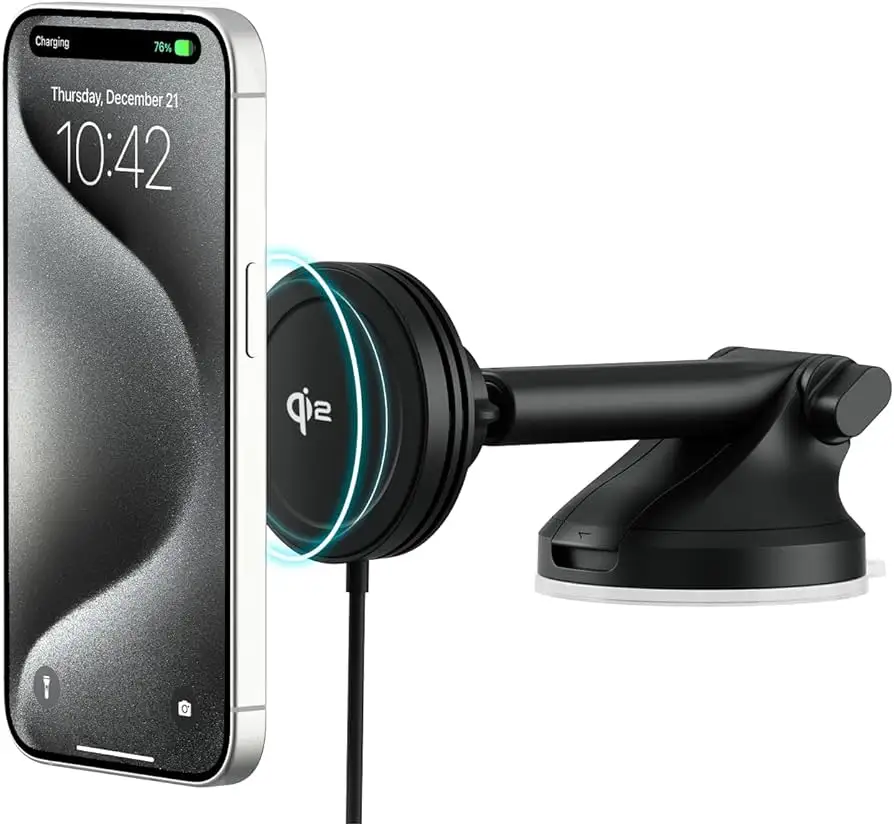
The product pages emphasize “wireless charging up to 15W” and position Qi2 as the big upgrade. In user-like review content, the strongest corroboration comes from Sarah Miller, who said: “the 15w qi2 charging is legit fast” and described a real-world scenario with navigation running: “my iPhone 15 Pro goes from 20% to 80% during my drive while running GPS.” For commuters who depend on CarPlay-like navigation or constant screen-on maps, that kind of charging story is the difference between arriving with battery anxiety versus arriving topped up.
At the same time, “up to” is doing work here. The data provided doesn’t include multiple independent users measuring wattage, so the clearest reality check is experiential rather than instrumented. Still, the narrative supports that the charging can feel meaningfully fast under typical driving use.
Claim 2: “Powerful magnetic hold… even on rough roads.”
Official copy repeatedly frames the magnets as secure “even on rough roads.” But that’s where the most direct contradiction appears. Sarah Miller wrote that the honeymoon ended with road shock: “when I hit my first pothole… with my slim MagSafe case, it holds fine on smooth roads, but add some bumps and suddenly I’m playing ‘catch the falling phone’.” In other words, the marketing claim is universal; the lived experience is conditional.
She also offered a situational workaround: “better performance after repositioning the mount away from dashboard curves.” That kind of “tuning” may be acceptable to tinkerers, but it’s a red flag for drivers who just want a stable magnetic car mount that doesn’t demand perfect alignment.
Claim 3: Cooling/ventilation reduces heat during charging.
The product descriptions call out “ventilation holes… help to dissipate heat.” There’s less user-supplied evidence evaluating temperature in practice. The Geek Church review echoes the claim in passing, stating “there is a built-in ventilation system to dissipate heat,” but doesn’t pair it with a temperature complaint or success story. So the “reality” here is mostly that reviewers repeat the design intent, without enough additional feedback in the provided data to confirm whether it materially changes heat behavior for long GPS sessions.
Cross-Platform Consensus
A recurring pattern emerged: people praise what happens when the phone is perfectly aligned—charging speed and that magnetic “snap.” But complaints cluster around what happens when conditions aren’t ideal: potholes, heavier phones, and long-term durability fears.
Universally Praised
Charging performance is the headline benefit in the most detailed firsthand account. For commuters, that matters because navigation, streaming audio, and high screen brightness can drain a battery faster than older car chargers can replace it. Sarah Miller’s story is framed around exactly that use case: a “daily 45-minute commute,” GPS running, and the phone climbing from “20% to 80%.” If you’re the kind of driver who starts the day with a half-charged phone and relies on maps for the entire trip, that’s a compelling real-world promise.
The “tap-and-go” attachment experience is also described as emotionally satisfying—an underrated detail for frequent drivers. Sarah Miller called it out directly: “That magnetic snap when you attach your phone? super satisfying every single time.” For rideshare drivers or delivery drivers who mount and unmount dozens of times a day, that frictionless connection can be a genuine quality-of-life upgrade—when it holds.
Setup and overall usefulness are praised in more general review content. The Geek Church described it as “very, very useful” and emphasized how simple the concept is: “you have a great place to stick your phone up, and it will charge as you can view the map functions.” That’s the core job of a magnetic wireless car charger, and this reviewer’s tone suggests the product meets that baseline expectation—especially for MagSafe-compatible iPhones.
Praises summarized
- Fast, practical charging for GPS-heavy commutes (“20% to 80%” during a drive)
- Satisfying magnetic alignment and attachment feel (“super satisfying every single time”)
- Straightforward use-case fit for map viewing and charging (“a great place to stick your phone up”)
Common Complaints
The most repeated and specific complaint is stability on imperfect roads. While marketing says “even on rough roads,” the detailed user-like review describes the opposite: “magnet strength seems inconsistent.” The scenario is familiar: a slim MagSafe case holds on smooth pavement, but “add some bumps” and the phone becomes a falling object you have to catch. This affects drivers in cities with potholes, rural drivers on uneven surfaces, and anyone with stiffer suspension or frequent stop-and-go road jolts.
Cable management and design choices also show up as pain points. Sarah Miller said: “The permanently attached cable is annoying… I’ve got this awkward coil of excess cord stuffed in my console.” For minimalist interiors or drivers who already route cables cleanly through trim, a fixed cable can turn a premium accessory into a messy-looking setup—especially if the included cable length doesn’t match your car’s port placement.
Durability anxiety is the shadow hanging over the product’s value proposition. Sarah Miller wrote: “for $50, I expected more durable construction” and mentioned “plastic pin complaints” from other reviewers she’d seen, even though her unit “hasn’t broken” in three months. The story here isn’t just breakage—it’s the feeling that you may need to baby a car mount that’s supposed to thrive in a harsh environment.
Complaints summarized
- Rough-road reliability concerns (“catch the falling phone”)
- Fixed cable frustration (“awkward coil of excess cord”)
- Durability doubts at the price (“expected more durable construction”)
Divisive Features
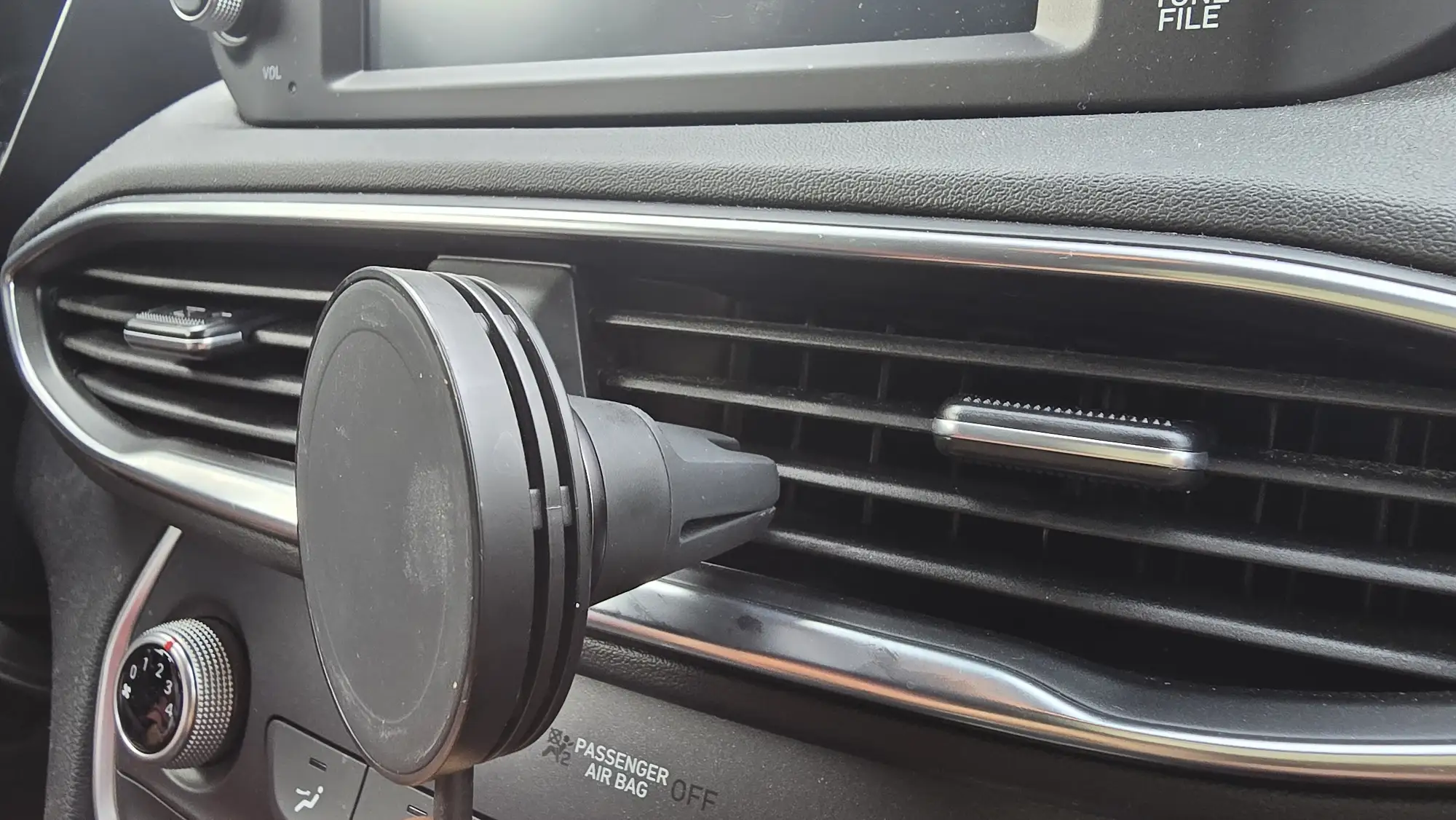
The same design element can be praised and criticized depending on the user. The vent attachment is described as almost too secure. Sarah Miller called the silicone prongs “installation a workout,” but immediately followed with the upside: “once it’s on? this thing isn’t going anywhere.” For someone who installs once and never moves it, that vise-like grip can be ideal. For drivers who switch vehicles, share a car, or frequently reposition their mount, the “workout” factor becomes a daily annoyance.
Compatibility expectations also split experiences. The Geek Church noted a sticking issue in a video and explained it as device mismatch: “I couldn’t get my phone to stick, but I have an older model of the Samsung… it does work well with MagSafe compatible iPhones.” That’s consistent with the official positioning—Qi2-enabled devices and MagSafe iPhones—but in practice it can still create confusion for buyers who assume “magnetic wireless charging” is universal.
Trust & Reliability
The most concrete reliability narrative is short-term confidence paired with long-term worry. Sarah Miller said: “after three months, mine hasn’t broken like some reported, but I’m babying it after seeing those plastic pin complaints.” That’s not a failure report, but it’s a trust signal problem: the product works, yet the owner feels they need to handle it carefully.
On “scam concerns,” the provided Trustpilot content is essentially a single detailed review (duplicated across multiple platforms in the dataset). That makes it hard to infer broader fraud patterns or systemic issues. What is evident is that the credibility of user feedback here hinges heavily on one named reviewer’s account rather than a wide pool of “6 months later” community check-ins.
Alternatives
Only one alternative is explicitly mentioned in the provided data: Scosche. The Geek Church reviewer said they had reviewed a Scosche mount and “it was pretty good.” That’s not a direct head-to-head comparison, but it does suggest that if the Velox Qi2 Mini’s durability doubts or magnet consistency worry you, some buyers might look to brands like Scosche for a different tradeoff profile.
Sarah Miller’s own “keep looking” guidance is more conditional than brand-specific: “if you want absolute reliability or have a heavy Pro Max model, keep looking.” For bigger phones and rough-road drivers, the alternative might simply be a mount with a more mechanically secure cradle or a stronger magnetic system—though no specific model names are provided in the dataset.
Price & Value
Pricing in the dataset varies by retailer and mount style, which changes the perceived value sharply. Official-style listings show the dash/windshield version around $59.95, while an Amazon listing for the air-vent model shows $39.95 (with discount shown) and a 4.1/5 rating from 59 reviews. That gap matters because the harshest critique in the detailed review is explicitly tied to price expectations: “For $50, I expected more durable construction.”
Resale value and market price signals appear indirectly through third-party listings (including higher-priced listings and “sold out” notes), but there aren’t actual user resale stories in the provided data. The more actionable “value” takeaway is this: at a discounted price, the charging performance and convenience may feel like a good deal; at full price, the design quirks and reliability anxieties loom larger.
Buying tips emerge from lived setup experience. Sarah Miller suggested a placement tweak: “better performance after repositioning the mount away from dashboard curves.” If you’re buying primarily for magnetic stability, that’s the kind of practical community guidance that can make the difference between “fine” and “phone on the floor.”
FAQ
Q: Does the iOttie Velox Qi2 Mini actually fast-charge an iPhone at 15W?
A: The official specs claim “wireless charging up to 15W,” and one detailed reviewer supported the real-world speed, saying: “the 15w qi2 charging is legit fast… my iPhone 15 Pro goes from 20% to 80% during my drive while running GPS” (Trustpilot / Sharvibe, Sarah Miller).
Q: Is the magnetic hold reliable on bumpy roads?
A: It depends on road conditions and setup. While marketing claims strong magnets “even on rough roads,” Sarah Miller reported the opposite after potholes: “magnet strength seems inconsistent… add some bumps and suddenly I’m playing ‘catch the falling phone’” (Trustpilot / Sharvibe). She said repositioning helped.
Q: Is it easy to install on an air vent?
A: Reports suggest it’s secure but can be tough to mount. Sarah Miller said “those thick silicone prongs make installation a workout,” but also noted the payoff: “once it’s on? this thing isn’t going anywhere” (Trustpilot / Sharvibe). This suits drivers who install once and leave it.
Q: Will it work with Android phones?
A: Compatibility appears conditional. The product is positioned for Qi2-enabled devices and MagSafe iPhones, and The Geek Church noted a sticking issue with an older Samsung: “I couldn’t get my phone to stick… I have an older model of the Samsung,” while saying it “does work well with MagSafe compatible iPhones” (The Geek Church).
Q: What’s the biggest design annoyance mentioned by users?
A: Cable management. Sarah Miller complained: “The permanently attached cable is annoying… I’ve got this awkward coil of excess cord stuffed in my console” (Trustpilot / Sharvibe). For drivers who care about a clean dashboard setup, this can be a daily irritation.
Final Verdict
Buy iOttie Velox Qi2 Mini Wireless Charger Car Mount with MagSafe if you’re an iPhone commuter who prioritizes fast Qi2 charging and loves the “tap-and-go” MagSafe feel—Sarah Miller’s “20% to 80%” GPS commute story is the clearest win.
Avoid it if you drive rough roads daily, need absolute stability, or run a heavier phone and can’t tolerate occasional drops—because “catch the falling phone” is the kind of problem that ruins trust fast.
Pro tip from the community: Sarah Miller reported “better performance after repositioning the mount away from dashboard curves,” suggesting placement and alignment can meaningfully change how reliable the magnetic hold feels.