iOttie Velox Qi2 Mini Review: Conditional Buy (7.6/10)
“Super satisfying every single time” is how one reviewer described the magnetic snap—right before admitting they ended up “playing ‘catch the falling phone’” after a pothole. iOttie Velox Qi2 Mini Wireless Charger Car Mount with MagSafe lands as a strong idea with real-world caveats: fast charging and slick alignment, but questions around consistency and durability. Verdict: Conditional buy — 7.6/10.
Quick Verdict
Yes/No/Conditional: Conditional — great if you prioritize Qi2 charging speed and easy alignment, less ideal if you drive rough roads or want a purely “set-and-forget” mount.
| What people focus on | What they liked | What they didn’t | Best for |
|---|---|---|---|
| Charging speed | “the 15w qi2 charging is legit fast” (Sharvibe/Trustpilot repost) | Needs the “right” alignment/conditions to feel perfect | Daily commuters running GPS |
| Magnetic hold | “super satisfying every single time” snap (Sharvibe/Trustpilot repost) | “magnet strength seems inconsistent” on bumps (Sharvibe/Trustpilot repost) | Light-to-average phones, smoother roads |
| Installation (vent) | “installation is a breeze” (MacSources) | “installation a workout” (Sharvibe/Trustpilot repost) | People okay with tight vent grips |
| Cable design | “built-in design ensures consistent charging speeds” (MacSources) | “permanently attached cable is annoying” (Sharvibe/Trustpilot repost) | Drivers who can route cables cleanly |
| Build confidence | Some report no breakage at 3 months (Sharvibe/Trustpilot repost) | “plastic pin complaints” + durability doubts (Sharvibe/Trustpilot repost) | Buyers who don’t mind babying gear |
Claims vs Reality
One of the loudest marketing promises is a “powerful magnetic hold… even on rough roads.” Digging deeper into user reports, that claim holds up for some drivers—but not consistently across conditions. Sarah Miller (as published on Sharvibe and reposted under Trustpilot data here) described the initial experience as excellent: Reddit-style enthusiasm without the hype, saying the magnetic snap is “super satisfying every single time.” Then the story shifts when road quality changes: after a pothole, she wrote that the magnet can feel “inconsistent,” especially with a slim MagSafe case, to the point where she’s “playing ‘catch the falling phone’.”
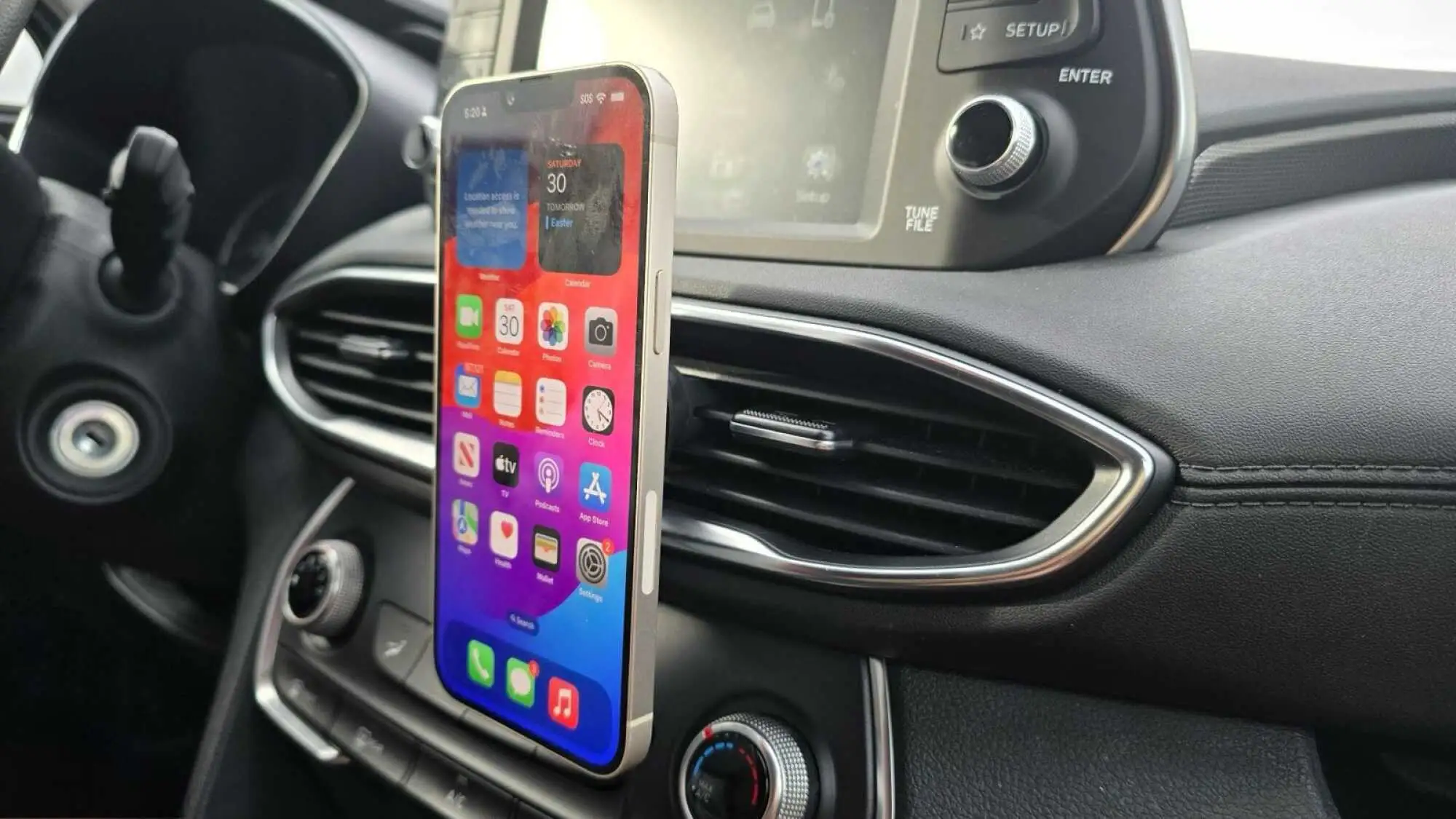
That same account adds an important nuance that complicates simple “good vs bad” takes: placement mattered. Sarah noted, “better performance after repositioning the mount away from dashboard curves,” implying that alignment and mounting geometry can make the difference between rock-solid and risky. While the product is officially framed around perfect magnetic alignment, the lived reality (at least in this account) is that you may have to experiment to get there.
Another marketing promise centers on fast charging—up to 15W Qi2. Here, the feedback is more straightforward: when it works, it works. Sarah Miller said, “the 15w qi2 charging is legit fast,” claiming her “iPhone 15 Pro goes from 20% to 80% during my drive while running GPS.” That’s a commuter’s dream scenario: navigation on, screen bright, and the battery still climbs quickly. MacSources echoes the reliability angle from a different perspective, calling out “consistent charging speeds” and describing the charger as a “reliable choice for on-the-go phone charging needs.”
Finally, the product positioning implies a clean, premium daily-driver setup—yet cable design and long-term durability pop up as reality checks. Sarah complained the “permanently attached cable is annoying” and described “an awkward coil of excess cord stuffed in my console.” For drivers with minimalist interiors, that’s not a small nit; it’s a constant visual and functional annoyance. And while she says “after three months, mine hasn’t broken,” she also admits she’s “babying it” after seeing “plastic pin complaints,” undercutting the expectation of a carefree $50–$60 accessory.
Cross-Platform Consensus
Universally Praised
A recurring pattern emerged around the core promise: magnetic alignment plus genuinely fast wireless charging can make commuting feel effortless—when your phone and case fit the intended ecosystem. Sarah Miller’s commute story is the clearest example of the benefit for navigation-heavy drivers: “my iPhone 15 Pro goes from 20% to 80% during my drive while running GPS.” For people who depend on maps, music streaming, and constant screen-on time, that kind of real-world charging headroom matters more than spec-sheet wattage.
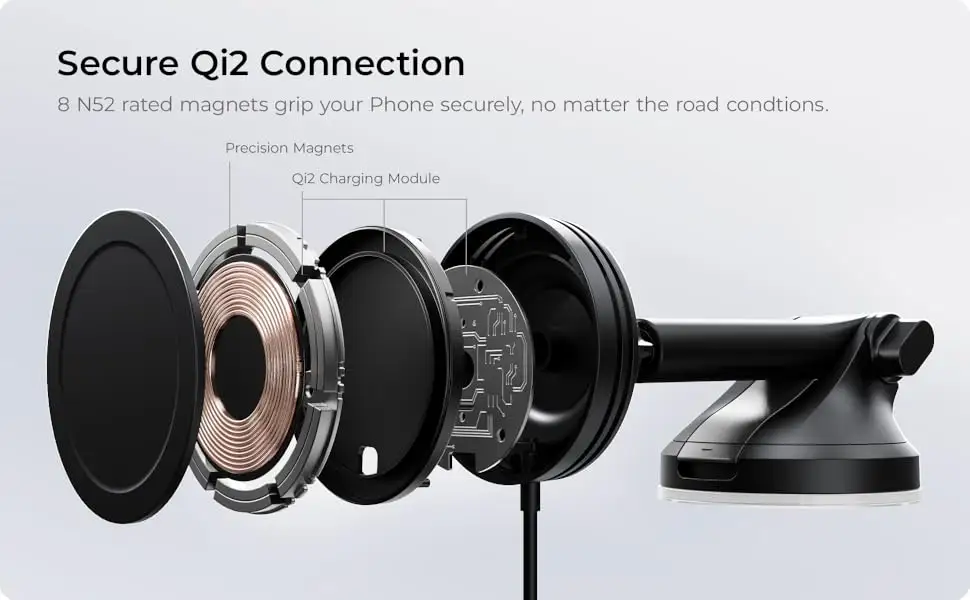
MacSources reinforces that “it didn’t have any issues with the phone slipping off the mount or not gaining a charge” during a road trip, and specifically calls out use with “an iPhone 14 Pro and an iPhone 15 Pro Max.” For road trippers, that’s the scenario where overheating, vibration, and long sessions usually expose weaknesses. Their experience frames the mount as the kind of compact charger you can “install… and start using… immediately,” especially appealing to drivers who don’t want suction cups, dashboards pads, and multiple adjustment points.
The second widely praised theme is ease of getting the phone on and positioned. This mount is meant to be “tap your phone against the mount face” simple, and that convenience shows up in how people describe the feel. Sarah’s “super satisfying” snap is essentially a user-level description of frictionless alignment—something that matters when you’re hopping in and out of the car repeatedly. MacSources also highlights the “small form factor” and the ball joint flexibility, emphasizing that with the mount in place “the charger is essentially invisible,” a win for drivers who hate bulky rigs blocking vents or sightlines.
Common Complaints
Where the praise converges on the charging experience, the complaints cluster around consistency—especially when real roads get involved. Sarah Miller’s account is blunt: the “honeymoon phase ended” after hitting rough patches, because “the magnet strength seems inconsistent.” For urban drivers dealing with potholes, speed bumps, or uneven pavement, this becomes less about convenience and more about safety and distraction: a mount that sometimes turns into a falling-phone problem isn’t just annoying, it’s a hazard.
Cable management is the other repeated friction point, and it’s not framed as a one-time setup headache—it’s a daily reminder. Sarah called the “permanently attached cable… annoying,” describing excess cord that ends up stuffed away awkwardly. MacSources takes a softer tone but lands on the same issue: “the only downside… is having to route and hide the cable,” and while they appreciate the cable being long enough, they also stress the trade-off: “you can’t detach the cable if you just want to use the mount as a mount and not a charger.” For drivers who sometimes want a clean, non-charging mount (or who already have a built-in USB-C setup they prefer), the fixed cable reduces flexibility.
Durability anxiety also bubbles up in a way that suggests more than isolated paranoia. Sarah says she hasn’t experienced failure yet, but she’s “babying it” because of “plastic pin complaints” she’s seen from others. That’s not the same as a confirmed widespread defect in this dataset, but it does show how buyer confidence can erode: even satisfied users can become cautious when community chatter suggests weak points.
Divisive Features
Installation is one of the most polarizing elements—particularly for vent mounting. MacSources frames vent install as effortless: “just slide the prongs onto your vehicle’s air vent blade… plug it in, and you are good to go.” That’s the ideal audience: someone with compatible vent slats who values speed and minimal setup.
Sarah Miller describes the opposite feeling: “the vent attachment is too secure if that makes sense,” and says “those thick silicone prongs make installation a workout.” Yet even she acknowledges the benefit once it’s on: “this thing isn’t going anywhere.” Digging deeper into that contradiction, it suggests a trade-off some drivers will love (vise-like grip, less wobble) and others will hate (hard install, potential vent stress). Your tolerance depends on whether you prioritize quick removal or maximum hold.
Trust & Reliability
The dataset’s “Trustpilot (Verified)” entry repeats the same Sarah Miller narrative found elsewhere here, so it reads less like a broad pattern and more like a single, detailed user story being circulated. Still, the reliability concerns inside that story are specific enough to matter: “magnet strength seems inconsistent,” and she references “plastic pin complaints” as a reason she’s “babying it.” That kind of secondhand durability worry can shape buyer behavior even when the unit is currently working.
On the longevity front, the clearest time horizon is “after three months,” where Sarah reports, “mine hasn’t broken.” That’s reassuring for new buyers, but it’s also paired with disappointment: “for $50, I expected more durable construction.” In other words, even without a failure, perceived build quality can feel behind the price tag—especially for drivers who want a mount they can forget about for years, not months.
Alternatives
Only one alternative brand is explicitly mentioned in the provided data: Scosche. The Geek Church author, Techno_Mark, points to Scosche as “pretty good,” framing it as a comparable option they’ve reviewed before when discussing whether there’s “anything else like it… for a lower price.” They don’t provide a direct head-to-head on charging speed or magnet performance in this dataset, but the mention signals that shoppers cross-shop Scosche when they want similar functionality without iOttie’s specific design quirks.
Within iOttie’s own lineup (as listed in the provided materials), the Velox Pro is presented as having “CryoFlow cooling technology,” and other mounts exist like iTap 3 variants. However, the user feedback here centers on the Velox Mini Qi2 experience rather than detailed comparisons. The practical takeaway from the stories: if you’re buying primarily for “15W Qi2” and MagSafe-style alignment, this model is the one users are describing as fast; if you want fewer cable compromises or different mounting styles, iOttie’s other models are in the ecosystem but not directly validated by the included user narratives.
Price & Value
Pricing in the provided sources floats around the mid-premium range: iOttie’s official listing shows $59.95 for the dash/windshield version, while MacSources cites list pricing around $54.95 and Amazon availability around $49.95 at the time of their write-up. That spread matters because the strongest negative reactions are tied to expectations at the $50+ tier. Sarah Miller’s value judgment is pointed: “for $50, I expected more durable construction,” and she argues it “shouldn’t require perfect conditions at this price point.”
Resale/market price indicators in the dataset are messy but telling: an eBay-market listing shows $69.07 (sold out), while an open-box listing shows a steep discount ($40 from $66). That divergence suggests buyers may find better value through open-box if they’re comfortable with the risk, especially given the durability anxieties mentioned in user commentary. For bargain hunters, that open-box pricing aligns with Sarah’s sense that full price can feel too high for something that may need “babying.”
FAQ
Q: Does the iOttie Velox Qi2 Mini actually charge fast in real driving?
A: Yes—at least for some users it’s notably quick. Sarah Miller (Sharvibe/also reposted in Trustpilot data) said “the 15w qi2 charging is legit fast,” claiming her iPhone 15 Pro went “from 20% to 80% during my drive while running GPS.”
Q: Will the magnet hold on rough roads and potholes?
A: It depends on conditions and setup. While marketing emphasizes a strong hold, Sarah Miller wrote the “magnet strength seems inconsistent” once she hit potholes, especially with a slim MagSafe case—though she reported “better performance after repositioning the mount away from dashboard curves.”
Q: Is the built-in cable a good thing or a hassle?
A: Both, depending on your setup. MacSources liked that the “built-in design ensures consistent charging speeds,” but also said hiding the cable is the “only downside.” Sarah Miller called the “permanently attached cable… annoying,” describing excess cord clutter.
Q: Is vent installation easy?
A: Opinions split sharply. MacSources said “installing… is a breeze” and praised the simple slide-on vent prongs. Sarah Miller said the “thick silicone prongs make installation a workout,” even though she admitted that once installed “this thing isn’t going anywhere.”
Q: Should Pro Max owners worry?
A: Some caution shows up in user commentary. Sarah Miller warned that if you “have a heavy pro max model, keep looking,” tying that concern to her experience with bumps and inconsistent hold. MacSources, however, reported no slipping with an “iPhone 15 Pro Max” on a trip.
Final Verdict
iOttie Velox Qi2 Mini Wireless Charger Car Mount with MagSafe is a conditional pick: buy it if you want Qi2-speed wireless charging with a satisfying magnetic “snap” and you mostly drive smooth roads. Sarah Miller summed up the best-case scenario as “legit fast” charging and a “super satisfying” attachment feel—but also warned about “inconsistent” hold on potholes and a cable that’s “annoying.”
Avoid it if you need absolute reliability over rough pavement, hate fixed cables, or don’t want to think about placement and alignment. Pro tip from the community: Sarah Miller reported “better performance after repositioning the mount away from dashboard curves,” suggesting setup tweaks can make or break the experience.