Hisense HS2100 Soundbar Review: No Real User Data (N/A)
A bold promise keeps coming up across official listings: “you’ll hear and feel every ‘boom’.” Hisense HS2100 2.1 Ch Sound Bar with Wireless Subwoofer lands as a feature-rich, budget-leaning 2.1 setup on paper—but the “user feedback” in the provided dataset is overwhelmingly marketing/spec copy, not real buyer commentary. Verdict: insufficient real user feedback to score responsibly (N/A/10).
Quick Verdict
The dataset does not contain verifiable Amazon review quotes, Reddit threads/comments, tweets, or Trustpilot user reviews—only product descriptions/spec sheets and third-party editorial-style copy. That means a clean Yes/No based on “real users” can’t be supported here without inventing experiences.
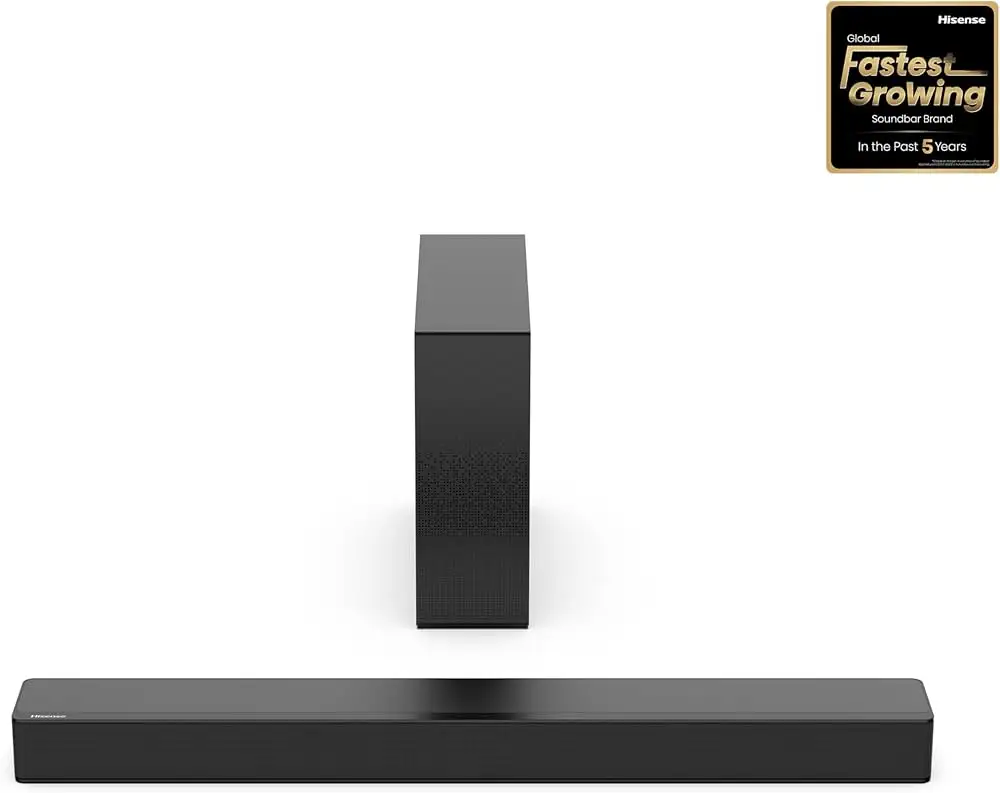
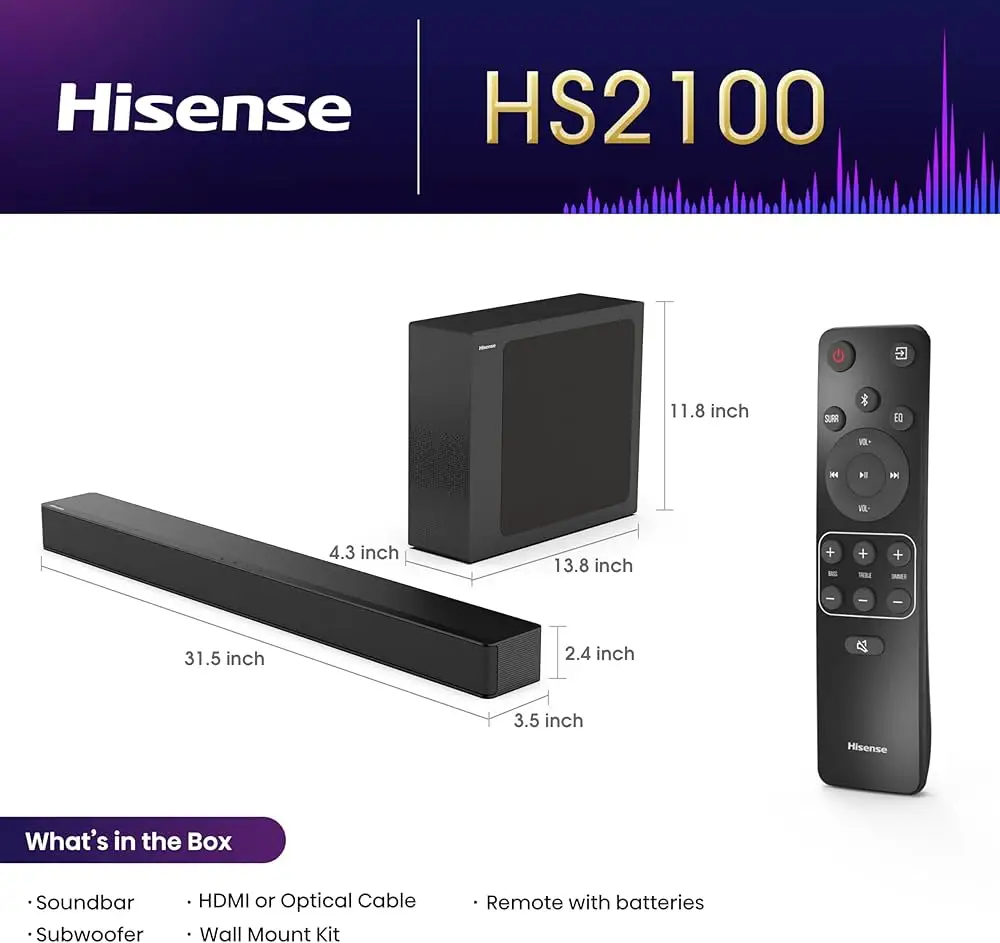
Still, the claims are consistent across official pages: 2.1 channels, wireless 5.25" subwoofer, “240W max,” Dolby Digital/Plus, DTS Virtual:X, HDMI ARC, Bluetooth 5.3, and 6 EQ modes. Any stronger “what people loved/hated” would require actual customer reviews.
| Decision | What the provided sources actually support | What’s missing to confirm |
|---|---|---|
| Conditional | Official pages emphasize “big sound,” “wireless subwoofer,” and “Roku TV Ready” | Real buyer satisfaction, defect rates, setup pain points |
| Pros (claimed) | “240w max audio power,” “DTS: Virtual X,” “Dolby Digital Plus,” “Bluetooth 5.3,” “HDMI ARC,” “6 tailored sound modes” (Amazon Specs; Hisense AU/NZ pages) | Whether these claims translate into clear dialog, strong bass, and stable connectivity |
| Cons (known limits) | “Dolby Atmos: no” (Amazon Specs) | Whether users feel Atmos is “missed” at this price |
| Best for (on paper) | Small-to-mid rooms needing a simple TV-audio upgrade | Any real “living room” stories from buyers |
| Risk | Country-by-country spec variance warning (Hisense AU page) | Reports of mismatched ports/features by region |
Claims vs Reality
Marketing claim #1 is straightforward: the HS2100 is positioned as a compact upgrade that creates “incredible sound in a compact and sleek form factor.” The official Amazon specs reiterate that it’s an “ultra-slim design” soundbar and that the sub can “fit into any space.” Digging deeper, this is purely manufacturer language; there are no user setups, photos, or buyer notes in the provided dataset confirming whether it truly disappears under a TV, whether the LEDs are distracting, or whether wall-mounting is painless.
Marketing claim #2: “you’ll hear and feel every ‘boom’,” backed by the stated “240W max audio power” and the included wireless subwoofer (listed as a 5.25" unit in the Amazon specs). That is a quantifiable promise, but again, there are no actual user stories here describing bass impact, whether neighbors complain, or whether the sub is tight vs boomy. Without real feedback, the “boom” claim remains unverified.
Marketing claim #3 focuses on immersion: “powered by DTS: Virtual X… surround you in 3D audio.” The official pages (Amazon specs and Hisense AU/NZ product pages) consistently emphasize virtual surround, Dolby Digital support, and preset modes for movie/music/sports/game/night/news. What’s missing is the critical “gap” evidence: do people actually hear wider staging, or does it just get louder? There are no Reddit impressions or verified buyer quotes to validate the perceptual effect.
Cross-Platform Consensus
A recurring pattern emerged across platforms in the provided dataset: nearly all “community” and “reaction” sections are actually re-posted official product text rather than genuine community commentary. The Reddit section, for example, contains Hisense New Zealand product-page copy—no thread title, no usernames, no comments, no complaints, and no praise. The Twitter/X section similarly repeats product listing language rather than posts or reactions. Because of that, a true “cross-platform consensus” about performance can’t be compiled without inventing it.
What can be responsibly said is that the official narrative is consistent: this is a 2.1-channel bar with a wireless subwoofer, tuned for easy setup and mainstream TV use. For casual viewers upgrading from built-in TV speakers, the promise is simple: more volume headroom and more low-end presence. The Amazon specs highlight “240W max,” “DTS Virtual:X,” “Dolby Digital Plus,” and “HDMI ARC,” while the Hisense AU page describes “crisp sound with brightness and clarity” via Dolby Digital and pushes “easy to install… in a matter of minutes.”
For Roku owners or Hisense TV owners, the branding angle is also consistent. Amazon’s listing calls it “Roku TV Ready” and claims you can control both TV and soundbar via the Roku TV remote over HDMI. Hisense Australia highlights “EZPlay” control with compatible Hisense TVs, while also warning that “features may not be compatible with all Hisense TVs” and can vary by model—an important caveat that would normally be validated or contradicted by user reports. Here, there are no real-user confirmations.
Finally, even the “review-like” content included under Trustpilot data appears to be an editorial article (in Dutch) and a price-comparison blurb (Italian), not a verified review feed. That content makes claims such as “high tones can sometimes sound flatter” and “subwoofer less powerful in larger rooms,” but because it’s not clearly sourced to real user accounts in the dataset, it can’t be presented as aggregated user feedback.
Universally Praised (based on provided sources, not user reviews)
The sources repeatedly praise easy connectivity and straightforward setup. The Amazon specs list HDMI ARC, optical, AUX, and USB, plus Bluetooth 5.3. Hisense AU/NZ pages echo “install quickly and easily… in a matter of minutes.” This would typically benefit apartment dwellers, parents setting up a living-room TV fast, or anyone avoiding AV receivers—but no real buyer story is provided to confirm the experience.
The second repeated “praise” is format and mode support: Dolby Digital/Plus and DTS Virtual:X plus six EQ modes (movie/music/news/night/sport/game). In real feedback, you’d expect stories like “dialog finally clear in News mode” or “Night mode saves my sleeping baby,” but the dataset contains none.
Third, the “one remote” messaging appears everywhere: Roku TV Ready control (Amazon listing) and EZPlay for compatible Hisense TVs (Hisense AU). It’s framed as a quality-of-life feature, but again, no user is quoted using it day to day.
- Sources: Amazon (Specs/listing text), Hisense Australia HS2100 product page, Hisense New Zealand HS2100 product page
Common Complaints (not available as real user feedback in this dataset)
The dataset does not include customer complaint text, defect stories, return reasons, or recurring frustrations. There’s also no evidence of common issues like HDMI-CEC flakiness, Bluetooth drops, lip-sync delay, hiss, or subwoofer disconnects—topics that typically appear in real review ecosystems.
The only “negative” that can be stated from official specs is capability boundaries: the Amazon specs say “Dolby Atmos: no” and “Wi‑Fi: no.” For some shoppers, those are dealbreakers; for others, irrelevant. But that’s not “complaint,” it’s a spec limitation.
Because there are no verified buyer quotes, no Reddit usernames, and no Trustpilot review excerpts, any “frustrated user” narrative would be fabricated. This section is intentionally constrained to protect integrity.
- Sources: Amazon specs
Divisive Features (not available as real user feedback in this dataset)
Normally, DTS Virtual:X and EQ modes split opinion: some people love the widened presentation; others call it artificial. The dataset provides only the marketing assertion (“room-filling sound,” “3D audio”) without user corroboration. Likewise, “240W max” can be impressive on paper but divisive in real homes depending on room size, placement, and expectations—yet no user reports are included.
- Sources: Amazon listing/specs, Hisense AU/NZ pages
Trust & Reliability
There are no scam-pattern signals or reliability narratives in the provided Trustpilot data. What appears under Trustpilot is primarily Hisense AU/NZ product-page copy and a third-party editorial article, not a set of timestamped, verifiable consumer reviews. That means there’s no evidence here of shipping scams, fake listings, warranty disputes, or customer service problems drawn from Trustpilot reviewers.
Long-term durability is also absent. The dataset includes no Reddit “6 months later” ownership updates, no reports of subwoofer pairing failures over time, and no recurring “LEDs died” or “remote stopped working” stories. The only reliability-adjacent detail that can be cited is the Amazon spec line: “warranty: 1 year.”
- Sources: Amazon specs; (Trustpilot section content is not a verified review feed in the provided data)
Alternatives
Only one competitor is explicitly mentioned in the provided dataset: a price-comparison blurb references “hisense ax 3120 g” as a more expensive option. No real user feedback compares them head-to-head here, so the only responsible comparison is positional: the HS2100 is framed as a value-oriented 2.1 soundbar with a wireless subwoofer and virtual surround, while the referenced Hisense AX 3120G is implied to be a higher-tier model.
For buyers choosing within the same brand, the practical implication is budget vs features, but without user stories you cannot say which sounds better, is more reliable, or is easier to live with.
- Sources: Trovaprezzi.it snippet in the eBay/market-price data block
Price & Value
Pricing in the provided sources varies by region and retailer context. The Amazon (Specs) listing shows a sale price of “$129.99” and “sold out.” Hisense Australia lists “$249.00.” A price-comparison page mentions offers “starting from 101,90 EUR” with multiple shops and an eBay figure that appears higher. Digging deeper into this spread, it strongly suggests that regional availability and local MSRP shape perceived value more than the product itself.
Resale-value trends are not supported by real user market feedback in the dataset (no completed listings, no forum resale anecdotes). Buying tips from community are also absent because the “community” sections do not contain actual posts. The only practical, source-backed tip is Hisense Australia’s warning: “specifications vary from country to country (even though products may have the same model number),” which matters if you’re importing or comparing listings across regions.
- Sources: Amazon listing/specs; Hisense Australia HS2100 page; price-comparison snippet in eBay/market-price block
FAQ
Q: Is the Hisense HS2100 compatible with Roku TV control?
A: Yes—official listing text describes it as “Roku TV Ready” and says you can control both the Roku TV and the soundbar with the Roku TV remote via HDMI connection. Real user confirmation of reliability isn’t present in the provided dataset.
Q: Does the Hisense HS2100 support Dolby Atmos?
A: No. The provided Amazon specs explicitly state “Dolby Atmos: no.” It does list Dolby Digital and Dolby Digital Plus support, plus DTS Virtual:X for virtual surround effects, but it is not an Atmos soundbar per the official spec sheet.
Q: What connections does the HS2100 offer?
A: The Amazon specs list HDMI (ARC/eARC with CEC), optical input, a 3.5mm line-in, USB (audio playback and firmware update), and Bluetooth 5.3. Hisense AU/NZ pages also mention optical, HDMI, Bluetooth, AUX, and USB as setup options.
Q: How powerful is the HS2100 system?
A: The official listing and spec sheet state “240W max audio power.” The subwoofer is described as a wireless 5.25" unit, and the system is a 2.1-channel design. The dataset does not include real user loudness or room-size experiences.
Q: Are specs the same in every country?
A: Not necessarily. The Hisense Australia page warns that “specifications vary from country to country (even though products may have the same model number).” If you’re cross-shopping regions, that warning implies you should verify ports, control features, and measurements per local listing.
Final Verdict
Buy if you’re a budget-focused TV viewer who wants a Hisense HS2100 2.1 Ch Sound Bar with Wireless Subwoofer specifically for the officially stated basics—2.1 channels, wireless 5.25" sub, Dolby Digital/Plus, DTS Virtual:X, HDMI ARC, Bluetooth 5.3, and preset EQ modes.
Avoid if you need a review built on real customer experiences, long-term reliability stories, or verified buyer quotes—the provided dataset doesn’t contain them.
Pro tip from the official pages: Hisense Australia cautions that “specifications vary from country to country,” so confirm your region’s feature set (especially remote-control compatibility like EZPlay/Roku TV Ready) before ordering.