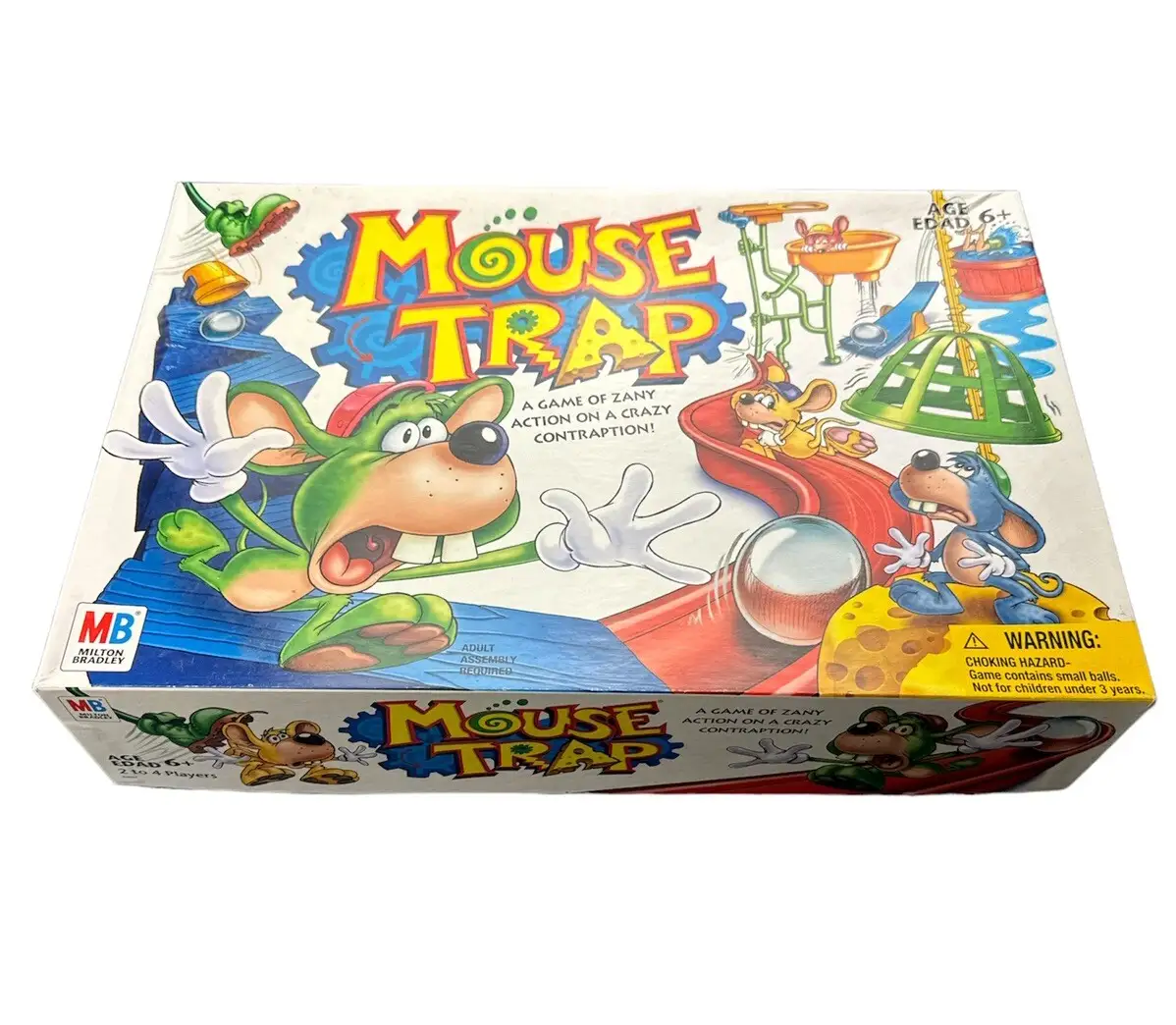
Hasbro Gaming Mouse Trap (Amazon Exclusive) Review: 7.5/10
A soup can showed up as an emergency “repair tool” in one firsthand play session—because the trap “somehow never rolls right.” Hasbro Gaming Mouse Trap Board Game (Amazon Exclusive) lands as conditional fun: chaotic, nostalgic, and kid-pleasing, but often finicky to assemble and keep working. Verdict: Conditional buy — 7.5/10
Quick Verdict
Yes/No/Conditional: Conditional (great when it works; expect fiddling)
| What shoppers mention most | Evidence from user feedback | Who it affects |
|---|---|---|
| Kids love triggering the trap | Reddit community post described kids “obsessed with cranking the trap” | Families with ages ~4–8 |
| Setup can be frustrating | Reddit community post: instructions “drawn by a sleep-deprived engineer” | Adults assembling with kids |
| Mechanism can be unreliable | Verified Amazon review: cage wouldn’t drop until a “folded napkin” fix | Anyone expecting smooth gameplay |
| Small parts / choking concern | Reddit community post warned metal balls are “definitely a choking hazard” | Homes with toddlers |
| Packaging/condition issues happen | Verified Amazon review: box “damaged… pieces were missing” | Gift buyers, online orders |
| Nostalgia factor is real | Verified Amazon review: “great memories playing this with my grandkids!” | Parents/grandparents |
Claims vs Reality
Marketing claim 1: “Easy set up… easier to set up than previous versions.” Digging deeper into user reports, the lived experience often sounds less “easy” and more like a mini engineering project. A Reddit community poster said the “assembly instructions look like they were drawn by a sleep-deprived engineer,” adding it took “20 minutes just to attach the dang diver.” That’s not a dealbreaker for patient families, but it changes the mood: the first session can feel like troubleshooting instead of game night.
Even when assembly is technically possible, some households report needing workarounds to get the chain reaction to run consistently. On Amazon (Classic Mousetrap Game reviews), a verified buyer described how they “could not get the cage to drop until we put a small piece of folded napkin under the washtub,” and noted another spot where “the marble drops into the bucket it doesn't always release the broomstick… a touch of a finger releases it.” For families buying the Amazon Exclusive expecting plug-and-play, these “little fixes” are the gap between the promise and reality.
Marketing claim 2: “Sturdy design” / “functions well.” The data paints a split story: some buyers describe smooth, satisfying operation, while others report fragile parts or inconsistent motion. A verified buyer on Amazon (U-Build Mouse Trap reviews) complained the game was “very flimsy and is a pain,” to the point they planned to “buy the original mousetrap game.” That “flimsy” accusation is echoed in the broader TLDR summary from ShopSavvy, which flags that “plastic components are not very sturdy” and that “several parts require manual adjustment.”
At the same time, there are pockets of strong satisfaction—especially when the goal is simply to build and trigger the contraption with kids. A verified buyer on Amazon (Classic Mousetrap Game reviews) wrote: “this is an awesome game! … it works well,” calling it “the best, most well made version imo.” The reality seems to depend on version, expectations, and tolerance for occasional re-seating parts mid-game.
Marketing claim 3: “Ages 6 and up” (and safe family play). Official listings repeatedly warn about choking hazards and marbles. User narratives reinforce that the hazard feels very real in practice. The Reddit community poster didn’t mince words: the “metal balls? definitely a choking hazard — keep away from toddlers no matter what the box says.” For families with mixed ages, the “ages 6+” label may be accurate for players, but the small parts risk remains a household-management issue.
Cross-Platform Consensus
Universally Praised
The strongest through-line across platforms is that kids enjoy the spectacle—sometimes more than the rules. In the Reddit community post, the moment-to-moment joy was the trap itself: kids (ages 5–8) were “obsessed with cranking the trap,” and the game earned “4/5 stars because i’m still finding tiny plastic parts under my couch.” That quote captures the trade: delight plus mess.
Grandparent-and-grandkid play also shows up as a repeat “why we bought it” story. A verified buyer on Amazon (Classic Mousetrap Game reviews) framed it as memory-making: “great memories playing this with my grandkids!” They admitted their “recollection was that you built the trap as the game was played,” but in practice, everyone “just wanted to build it and keep setting it off!” For multigenerational families, the product functions as an activity toy and a board game second—an important distinction if you’re buying it for structured gameplay.
Even small tactile elements become part of the appeal when kids are involved. The Reddit community poster called the cardboard cheese “weirdly satisfying to punch out.” That kind of sensory “busy hands” fun matters for younger players who might struggle with longer strategy games; it’s also why parents sometimes accept the fiddly setup—because the payoff is a shriek-and-laugh chain reaction when the cage finally drops.
After those stories, patterns become clear:
- The “trap moment” is the star; many families treat gameplay as a vehicle to trigger it.
- Nostalgia drives purchase intent, especially among parents and grandparents.
- The build-and-trigger experience can entertain even when the rules fade into the background.
Common Complaints
A recurring pattern emerged around reliability: the trap can be temperamental, and households develop “hacks” to make it behave. The Reddit community poster described the “tiny metal ball” that “somehow never rolls right,” saying they had to “weigh down the board with a soup can to make it work (shoutout to other reviewers for that hack!).” For families expecting a smooth chain reaction every time, that’s a frustrating mismatch—because the whole point is the satisfying Rube Goldberg payoff.
Instructions and initial assembly are another pain point, especially for adults trying to set it up while kids hover. The same Reddit post complains the instructions felt like they were “drawn by a sleep-deprived engineer.” ShopSavvy’s TLDR echoes the broader sentiment: “assembling the game is more complicated than older versions,” and “pieces can be cumbersome to assemble and disassemble.” The impact is practical: busy parents may find the first play session is mostly setup, not play.
Quality control and packaging condition also surface in verified purchase reviews. A verified buyer on Amazon (U-Build Mouse Trap reviews) wrote: “I… found a broken game piece and a substitution of a glass marble for a steel marble.” Another verified buyer said the box looked “damaged… pieces were missing,” adding they were “very disappointed.” Those aren’t gameplay design critiques—they’re fulfillment/condition issues that matter most when the game is bought as a gift.
After those stories, the complaint cluster looks like this:
- Trap mechanism can require manual nudges, weighting the board, or small shims.
- Setup/instructions can slow down the first session.
- Occasional “arrived damaged/missing/broken” reports create gift risk.
Divisive Features
The biggest divide is whether “fiddling” is part of the charm or a dealbreaker. Some families are happy to tweak and keep going because the laughter payoff is worth it. The Reddit community poster framed failures as part of the entertainment: “hilarious when it fails? absolutely.” For households that treat it like a slapstick contraption toy, imperfect function can still be fun.
Others want the classic “build it as you play” feel—or at least a smoother modern experience—and get annoyed when it feels like a downgrade. A verified buyer on Amazon (U-Build Mouse Trap reviews) disliked the Lego-heavy setup, saying it “took a long time to set up” and “just wasn't any fun,” complaining there was “no real ‘rube goldberg’-ness.” Another verified buyer said they’d rather “buy the original mousetrap game,” calling their version “very flimsy.” The divide isn’t subtle: it’s about what you want Mouse Trap to be—reliable board game, nostalgic replica, or chaotic kid activity.
Trust & Reliability
On scam or seller-trust signals, the most concrete red flags in the provided data come from verified purchase complaints about condition and contents rather than explicit fraud. A verified buyer on Amazon (U-Build Mouse Trap reviews) said they discovered “a broken game piece and a substitution of a glass marble for a steel marble,” suggesting either repackaging, mixed parts, or inconsistent packing. Another verified buyer said their “box was damaged… pieces were missing,” which is the kind of issue that creates distrust even when the retailer makes it right.
Long-term durability stories in the provided Reddit content don’t include “6 months later” style follow-ups; what does appear is the immediate “parts everywhere” reality. The Reddit community poster joked they were “still finding tiny plastic parts under my couch,” which reads less like breakage and more like the everyday risk of small components in a busy home. Across sources, the reliability concern centers on the mechanism needing adjustment, not a clearly documented timeline of parts failing over months.
Alternatives
The only directly referenced alternative in user feedback is “the original mousetrap” / classic versions. The comparison is emotional and practical: some buyers want the older feel and sturdiness. A verified buyer on Amazon (U-Build Mouse Trap reviews) said: “I like the other version better,” even while admitting the one they bought is “a good game for family game night.” Another verified buyer was more decisive, saying they were putting the game in a yard sale and “spending the extra money to buy the original mousetrap game,” citing “flimsy” build and frustration.
On the flip side, classic editions aren’t automatically perfect. A verified buyer on Amazon (Classic Mousetrap Game reviews) described needing a “folded napkin” fix to make the cage drop consistently and noted the marble release sometimes needed “a touch of a finger.” So the “classic” alternative may reduce disappointment for purists, but it doesn’t guarantee a flawless chain reaction every time.

Price & Value
The Amazon listing context shows a high overall star rating (4.6/5 with thousands of reviews), but third-party sentiment analysis paints a shakier picture. BestViewsReviews claims that in its analyzed sample “around 47% reviews were positive while around 49%… had negative sentiment,” and flags “average quality packaging” as a drawback. That tension suggests the game’s perceived value depends heavily on whether your copy arrives complete and whether you’re okay with occasional mechanical tinkering.
Community and market pricing also frames the decision. The Reddit community post referenced paying “$24.49.” ShopSavvy’s pricing snapshot lists “lowest at Amazon $13.94” and “lowest… $10.99 at Kohl’s.” On eBay, listings span roughly the teens to mid-$20s for newer copies, with plenty of replacement parts and used sets floating around—useful if you lose a marble or a critical piece. That resale ecosystem indirectly supports the “small parts go missing” reality.
Buying tips implied by user stories are less about coupons and more about risk management: if it’s a gift, condition matters; if it’s for younger siblings in the house, the choking hazard and tiny pieces matter; and if you want smooth gameplay, be ready to test the trap early. A verified buyer on Amazon (U-Build Mouse Trap reviews) regretted not checking immediately: “I didn't immediately check everything,” then later found broken/substituted parts—an experience that pushes value down fast.
FAQ
Q: Is the Mouse Trap game actually fun for kids ages 6 and up?
A: Yes—especially for younger kids who love the “chain reaction” moment. In a Reddit community post, the kids (ages 5–8) were “obsessed with cranking the trap.” Some adults say the rules matter less than building it and “keep setting it off,” per a verified Amazon buyer.
Q: How hard is it to assemble the trap?
A: Often harder than expected. A Reddit community poster said the instructions looked like they were “drawn by a sleep-deprived engineer” and it took “20 minutes just to attach the dang diver.” A verified Amazon buyer also warned that placing parts wrong can stop it from working.
Q: Does the trap mechanism work reliably?
A: Not always. Multiple buyers describe needing small fixes: a verified Amazon buyer said the cage wouldn’t drop until they used “a small piece of folded napkin under the washtub,” and another moment required “a touch of a finger” to release a mechanism. Reddit also mentions weighing down the board with a “soup can.”
Q: Are the small parts a real safety concern?
A: Yes, based on both warnings and user emphasis. A Reddit community poster called the metal balls “definitely a choking hazard — keep away from toddlers no matter what the box says.” This matches the product’s repeated choking-hazard messaging around marbles and small parts.
Q: Should I buy this version or look for the original/classic?
A: It depends on what you want. Some verified Amazon buyers prefer “the other version” and even plan to “buy the original mousetrap game” due to flimsiness or setup frustration. Others praise classic sets but still report occasional tweaks to make the mechanism drop consistently.
Final Verdict
Buy if you’re a family with kids who mainly want the build-and-trigger spectacle, and you can tolerate a little tinkering—because, as the Reddit community post put it, it’s “total chaos (the good kind).” Avoid if you want a consistently reliable chain reaction with minimal setup or you’re gifting without time to check contents. Pro tip from the community: if the trap “never rolls right,” some players literally “weigh down the board with a soup can” to help it work.